

The first house: where the count starts
Content version · · Sources & references
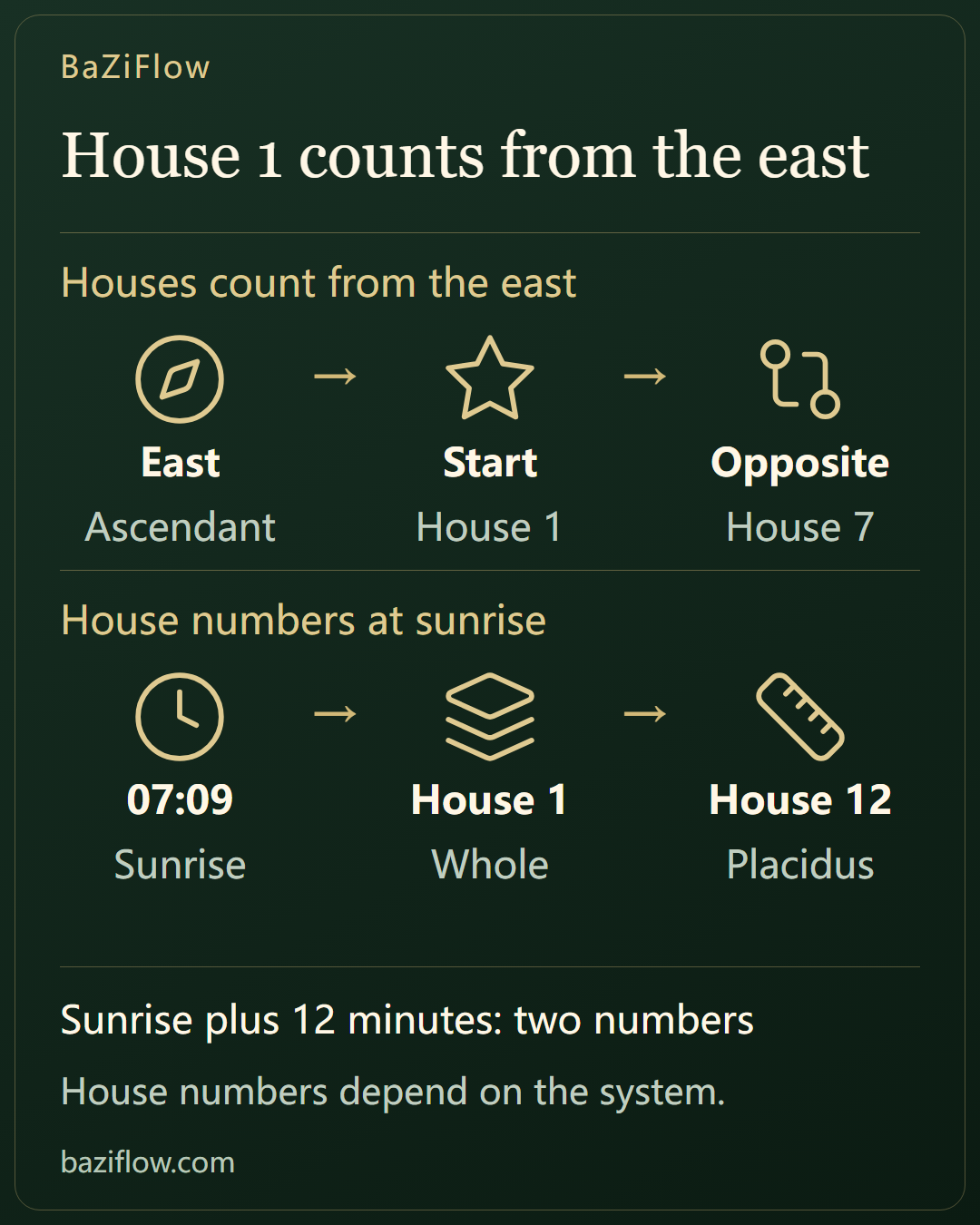
House 1 starts the count of twelve and is an angular house. Engine data for Beijing at sunrise on 20 Nov 2026 compares whole sign with Placidus, with Lilly’s entries and the time each sign takes to rise.
The short version7 min read
The first house is the start of the twelve: the slice lying just beneath the eastern horizon, counted from the point where the ecliptic meets that horizon. It is one of the four angular houses, and Lilly says the name Ascendant comes from the Sun rising at its cusp.
- House numbers begin at the Ascendant, the point where the ecliptic crosses the eastern horizon. House 1 is angular like houses 4, 7 and 10, and house 7 lies straight across from it.
- In Beijing at 07:09:16 on 20 Nov 2026 the Ascendant and the Sun share one longitude; for roughly 12 minutes afterward the same Sun counts as house 1 in whole sign and as house 12 in Placidus.
- The Ascendant circles the zodiac once a sidereal day but spends unequal time in each sign: on that day, 72 minutes in Aries and 150 in Virgo. Whether a few minutes of error moves the first house depends on how far the birth time sits from a sign change.
Read first
Counting the houses starts at the eastern horizon
In plain words first: the twelve houses divide the whole circle of the sky, above and below the horizon, into twelve slices, counted from the eastern horizon, and the slice lying just under that horizon is the first house.
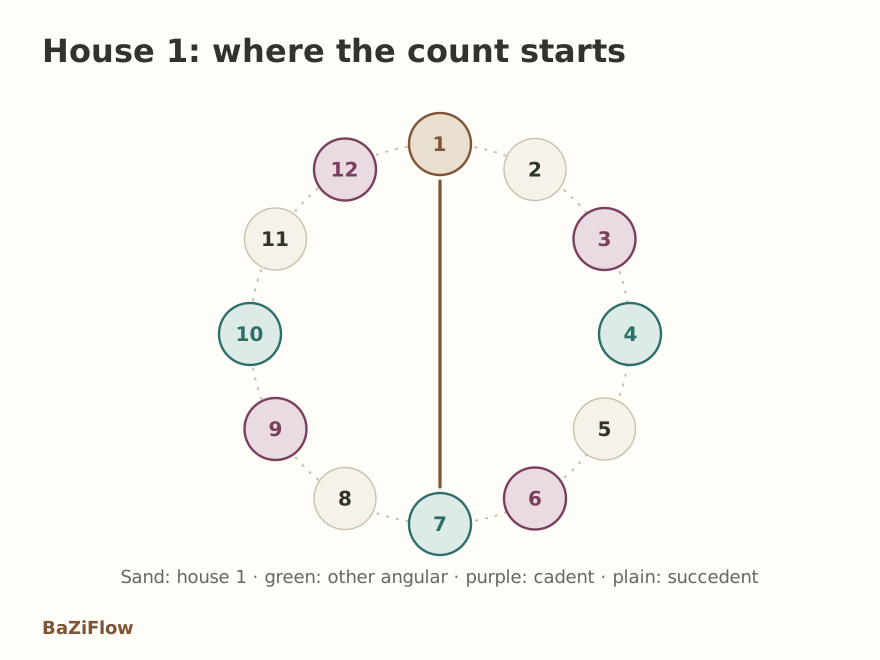
Position sketch: twelve houses around a ring, numbered clockwise from house 1 at the top; colors mark the class of position (angular, succedent, cadent), not the size of a house.
House 1 sits at the top of the picture in sand. Houses 4, 7 and 10 are the other three angular houses, in green. Houses 2, 5, 8 and 11 follow the angles and are called succedent, left plain. Houses 3, 6, 9 and 12 are cadent, in purple, a word that literally means falling away from the angle. An arc joins house 1 to house 7: the two ends of the horizon axis.
William Lilly’s Christian Astrology (1647) also says why the first house is called the Ascendant:
The book says: "when the Sun commeth to the cusp of this house, he ascends", and is then visible on our horizon.
The twelve minutes after sunrise: one Sun, two house numbers
The link between the Ascendant and the Sun can be seen in a moment you can recompute. Take Beijing (39.9 N, 116.4 E) on the morning of 20 November 2026. The engine puts the Ascendant and the Sun at the same longitude, about 27°38′ of Scorpio, at 07:09:16 Beijing time: the center of the Sun sits right on the eastern horizon. This is sunrise in the geometric sense, ignoring refraction and the radius of the solar disk, so it differs from a printed sunrise table by a few minutes.
Before that instant the Sun is below the horizon; after it, above. Here are four moments around it, with the house each system gives the Sun:
Enlarge diagram · scroll sideways to read
Placidus starts house 1 at the Ascendant itself, so as soon as the Sun crosses it the Sun belongs to house 12. Whole sign makes house 1 the entire sign of Scorpio, and the Sun only counts as house 12 once the Ascendant has moved into Sagittarius, at 07:21:06. The gap is 11.8 minutes. Both answers are exact arithmetic under their own rule; write down the system and the time, and anyone can check them.
The first house in the book: first of all, the person
Christian Astrology lists, house by house, what each house "signifies". The first house comes first, and its subject is the person: the one who asks, or who is born. In the section on judgment Lilly adds that in nativities the Ascendant always stands for the person born, whether king or beggar.
Enlarge diagram · scroll sideways to read
In Ptolemy the rising sign has another name, the horoscope. Tetrabiblos I.12 also reports that some people cut the whole zodiac into four quadrants by the horizon and the meridian: the quadrants from the Ascendant to the Midheaven and from the western angle to the lower heaven count as oriental and masculine, the other two as occidental and feminine. Lilly’s quadrant table keeps that idea and puts the first house in the last quadrant, grouped with houses 2 and 3, a quadrant that starts at the lower heaven and ends exactly at the Ascendant.
How long a sign takes to rise
The Ascendant circles the zodiac once per sidereal day, but the twelve signs do not take equal time. For the same Beijing day, the engine gives the minutes each sign spends on the Ascendant:
Enlarge diagram · scroll sideways to read
Aries and Pisces take 72.4 minutes each, Taurus and Aquarius 87.0, Gemini and Capricorn 114.9, Cancer and Sagittarius 141.9, Leo and Scorpio 151.6, Virgo and Libra 150.3. The twelve numbers add up to 1436.1 minutes, 23 hours 56 minutes, one sidereal day. The curve is mirror-symmetric: two signs equally far on either side of an equinox, such as Aries and Pisces or Taurus and Aquarius, take the same time.
The curve explains why two people with the same birthday can have different first houses, and why the birth time matters. With Aries rising the Ascendant covers one degree in about 2.4 minutes; with Virgo, in about 5. The nearer a recorded time falls to a sign change, the likelier a few minutes of error are to land in the next sign and move the start of the first house. The Sun and Moon have their own, different precision needs, see born exactly on a sign boundary.
Putting someone else in the first house: Lilly’s derived houses
After the twelve houses Lilly sets out a rule: whoever the question is about, the house that stands for that person is his Ascendant, that is his first house, the next house is his second, and so on around the circle. For a king the tenth is his first house and the eleventh his second; but in a nativity the Ascendant always means the person born.
This is plain arithmetic: counting from house B, the n-th house is numbered ((B + n − 2) mod 12) + 1.
Enlarge diagram · scroll sideways to read
Two exercises
Counting from house 7, which house is the partner’s second?
7 + 2 − 1 = 8, so house 8.
Counting from house 10, which house is his fourth?
10 + 4 − 1 = 13, and 13 − 12 = 1, so house 1.
The count only works once you have written down whose first house it is. In your own chart the first house is you; for a partner, a parent or a business associate, say first whether you are using a derived house or that person’s own chart. For what the other houses cover, continue with the second house, and find the overall list in what the twelve houses describe.
Questions readers ask next
Is the first house simply the rising sign?
In whole sign, yes: the first house is the whole sign containing the Ascendant, counted from its 0 degrees. In Placidus the house starts at the exact degree of the Ascendant and runs to the cusp of house 2, which is seldom 30 degrees wide. Say which system you use before speaking of "the sign of the first house".
Why is the Sun in the twelfth house just after it rises?
House numbers increase in the direction of the zodiac, and houses 1 to 6 lie beneath the horizon while 7 to 12 lie above it. An Ascendant at a larger longitude than the Sun means the Sun has already risen, so it sits one step before house 1, which is house 12. Before sunrise it is still in house 1.
Could ten minutes in the birth time change the first house?
It can, or it may not. On the Beijing date used here the Ascendant stayed 151.6 minutes in Scorpio and 141.9 in Sagittarius, with the change at 07:21:06. The nearer a recorded time falls to such a change, the more a record check is worth.
Was this article helpful?
Sources & references
Continue reading
The Second House: Succedent, Lilly’s Money and Helpers, and Its Width in Three Cities ↗