

An–Huai: positions and conduct
Content version · · Sources & references
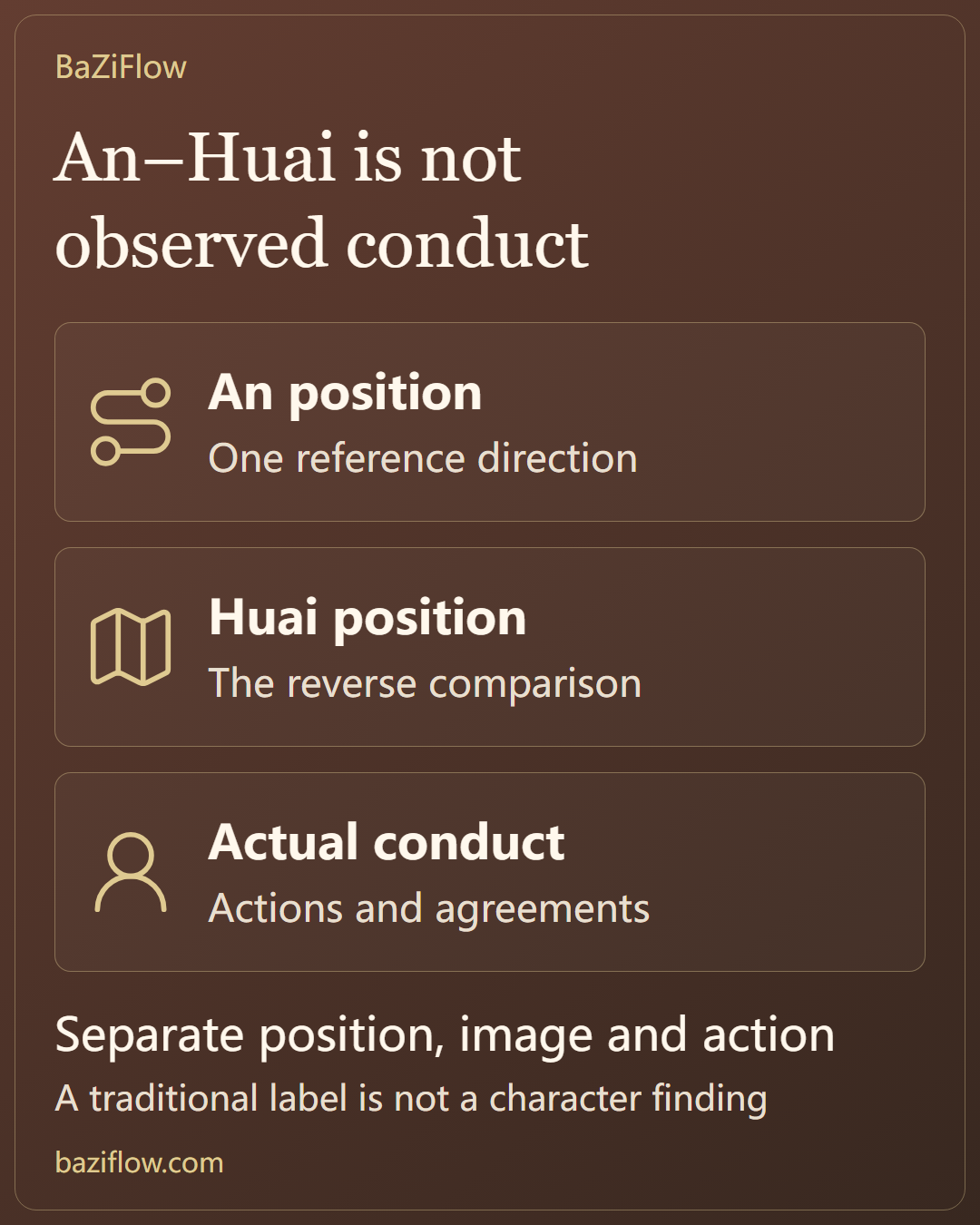
An archive-display disagreement separates a traditional category from observed edits, unknown motives and a practical approval agreement.
The short version6 min read
An–Huai (安壞) starts as a pair of directed position labels; modern readings add images of stability and destruction. With assumed Bi (畢) and Jing (井) references, Jing is An from Bi and Bi is Huai from Jing. That calculation has observed neither person’s conduct. An archive-display example shows what further evidence an actual disagreement requires.
- An–Huai combines opposite reference directions: Bi to Jing has offset three, An; Jing to Bi has offset twenty-four, Huai.
- Stability and destruction are attributed interpretive images, not evidence of an individual’s motive, editing authority or observed conduct.
- A corrected misunderstanding and repeated disregard for an explicit agreement are different outcomes even when the astrological category is unchanged.
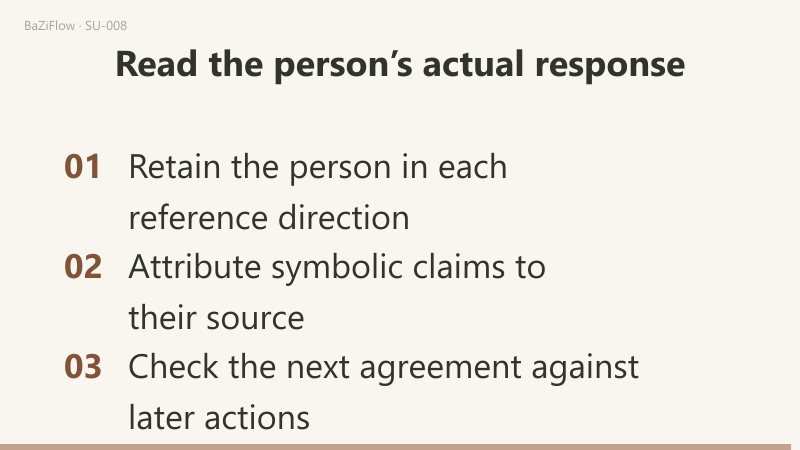
Read first
How An and Huai are formed
Reduce the position calculation to a checkable example. Assume A has Bi and B has Jing in the 27-mansion sequence without Niu. From A, Bi, Zui, Shen and Jing occupy inclusive positions one through four, placing Jing at An. From B, continuing in the same sequence takes twenty-four steps to Bi, placing A at Huai. The reference person changes between the two sentences; dropping the subjects obscures the calculation.
Koseido’s relationship explanation uses stability and destruction as interpretive images and discusses different forms of interaction. Turning an An position into “this person provides stability” therefore adds an interpretive claim. Continuing to “this person deliberately replaced my work” adds a claim about a particular intention. That last step requires evidence about the incident; the position calculation did not supply it.
T1299's three-nine sequence contains An and Huai as relative-position labels and asks for comparison in both directions. Koseido's modern relationship explanation attaches associations of stability and destruction to the paired category. These sources show how the terminology is organized and interpreted within the tradition. They do not establish either volunteer's motives or forecast the outcome of the display project.
When a source uses confident language, attribution still matters. “This author interprets the category in this way” is different from “this person will behave that way.” Quoting a practitioner does not add observations of the individual being discussed. The structure of the reciprocal comparison is covered in six relationship groups; this article concerns the next step, where a reader might overextend it.
Huai should not become a moral accusation, and An should not become an exemption from responsibility. Nor does a difficult label require someone to tolerate a situation they do not want. Decisions about continuing a collaboration belong to the participants and their actual circumstances.
An: B in A’s sequence
Huai: A in B’s sequence
Audit one incident before making a category explain it
Imagine two volunteers preparing an archive display. One replaces captions that the other thought were already agreed. The change creates extra work and a dispute about responsibility. If they have seen an An–Huai reading, it may be tempting to call the incident proof that their partnership was always destructive.
That conclusion skips the evidence needed to understand the incident. Who changed which version? What approval process had they actually agreed? Did a new requirement arrive? A relationship category supplies none of these answers. The example is fictional and has no calculated birth data; it is a way to practice separating an interpretation from an event.
For the archive-display example, make three separate entries before drawing a conclusion.
| Entry | Evidence to seek | What it cannot establish alone |
|---|---|---|
| The captions were replaced | Version history and the changed passages | A permanent destructive personality |
| The change caused rework | The affected layout or review tasks | That all future cooperation will fail |
| Approval expectations differed | Each person's account and prior agreement | That either person's unspoken intention is known |
These distinctions do not minimize the inconvenience. They describe it more accurately. A changed caption and the time needed to repair a layout can be discussed directly, without turning the other volunteer into a symbolic role. Equally, missing evidence should remain missing rather than being filled with a charitable story merely to keep the peace.
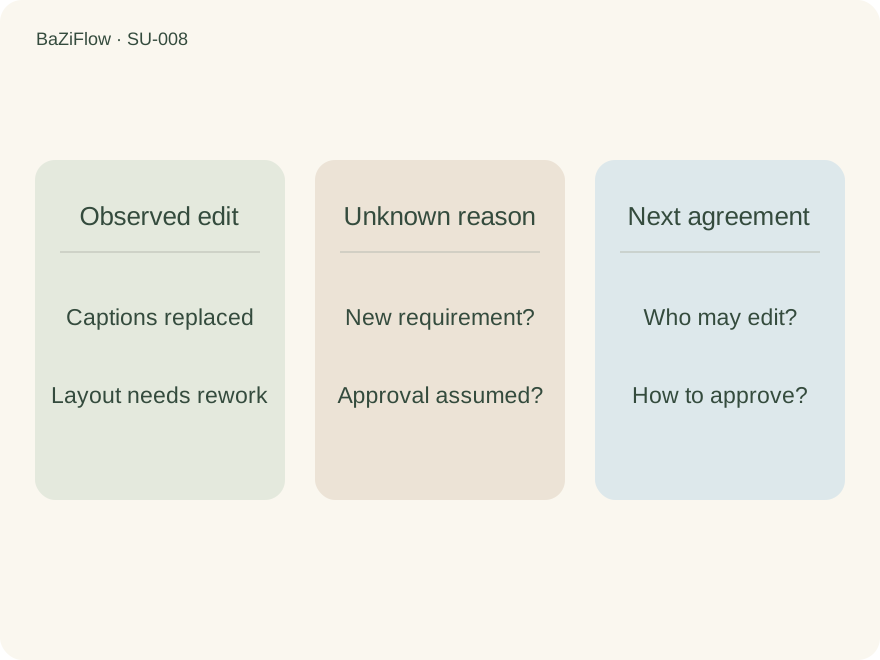
Original archive-project exercise. Separate evidence fields, not a guaranteed repair process.
The diagram separates the observed change, the unknown reason and the next agreement. It does not promise that asking a question will produce cooperation. Its purpose is to make the next exchange specific enough that the response and later actions can be evaluated.
Position: An / Huai
Image: stability / destruction
Conduct: the actual edit
Ask for information without accepting an invented answer
A volunteer might say: “The new caption is longer than the space we reserved, so the lower panel needs another layout pass. When you changed it, did you think the wording was still open, or had a new requirement come in?” The answer can then be checked against the notes and version history. It is not necessary to begin with a claim about An–Huai or an assumed hidden motive.
Eyal and colleagues' research distinguishes imagining another person's perspective from obtaining information from that person. It is not a study of Sukuyō and cannot guarantee that this conversation will resolve the problem. The limited lesson used here is that an answer generated in one's own imagination is not the same evidence as the other person's account.
Even that account is one part of the record. What the person says, what the documents show and what happens after an agreement may differ. Listening does not require treating every explanation as proven. A practical next agreement might specify who can edit captions, which changes need approval and how the final version will be identified.
This is an original collaboration exercise, not a special cure for an astrological pairing. It would also make sense for people with another label or none at all. Its value rests on the concrete problem it addresses, not on a prediction that the category will be transformed.
A correction and a repeated breach are different outcomes
When reviewing an An–Huai reading, preserve outcomes that do not fit its story. An isolated misunderstanding that is corrected is not the same as repeated disregard for an explicit agreement. If a joint project is completed with a shared approval process, record that result. If unauthorized changes continue, record the repeated behavior instead. Do not force both outcomes into the same inevitable story of attraction and destruction.
The participants may continue together, divide the work differently or end the joint project. The label does not decide among those options. Actual consent, available time and the ability to honor agreements are relevant; a claim that discomfort is destined does not replace them.
Misunderstanding corrected
- Check the revised process
Unauthorized edits recur
- Address repeated conduct
Keep outcomes that challenge the reading
Retrospective notes should preserve counterexamples too. Saving every conflict while discarding ordinary cooperation makes the category appear more explanatory than the full record supports. The opposite selection can hide real concerns. Keep the source's interpretation, your initial expectation, the observed actions and the later outcome in distinct entries. Recording Sukuyō cases develops that approach without treating a personal log as proof of predictive validity.
Initial interpretation
- Retain the original expectation
Subsequent actions
- Keep cooperation and conflict
Questions readers ask next
What do An and Huai identify before interpretation is added?
They identify relative positions in the declared three-nine ordering. Bi to Jing is offset three, An; Jing to Bi is offset twenty-four, Huai. A modern author’s images of stability and destruction are an additional interpretation, not another step in that arithmetic.
Does calling someone the Huai person establish their character?
No. A more exact record says that A occupies Huai in B’s sequence, retaining the reference direction. That position contains no observation of A’s conduct and does not establish a motive, moral quality or inevitable outcome.
What changes when unauthorized edits recur after a clear agreement?
The record now contains repeated conduct rather than only an initial misunderstanding. Decisions about responsibilities or continuing the project should respond to the actual explanation, execution and participants’ choices. The category does not excuse ignoring an agreement.
Was this article helpful?
Part of a learning path
Sources & references
Continue reading
Rong–Qin: a favorable label is not a work agreement ↗