

Water: number one, flowing down, Yang and Yin Water
Content version · · Sources & references
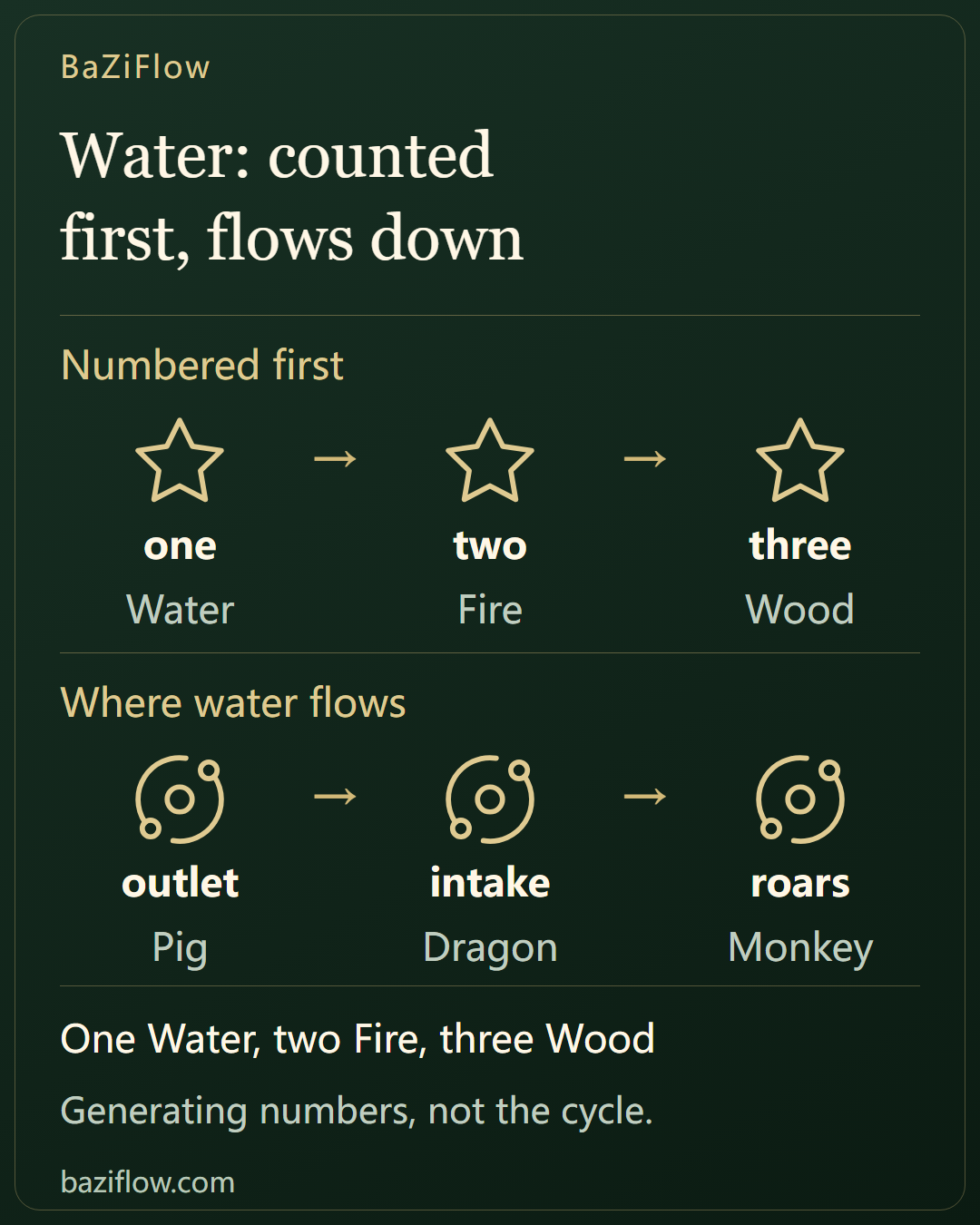
What the Sanming Tonghui says of Water: why it is first in the numbered order, moistening and flowing down, the Pig as outlet and the Dragon as intake, Yang and Yin Water, four lines, and the branches that hide Water.
The short version9 min read
Water is first in the numbered order of the elements: the book says that before heaven and earth parted and before things were formed, Water was seen first. Its nature is to moisten and flow down, from the Pig outlet to the Dragon intake.
- Water takes the stems Yang Water and Yin Water and the branches Rat and Pig; in this site's table it generates Wood and controls Fire, and is generated by Metal and controlled by Earth.
- The numbered order the book quotes is one Water, two Fire, three Wood, four Metal, five Earth: Water sits at the Rat in the north, the Rat is the first of yang, so it is one, and its completed number is six.
- On where Water flows the book says: heaven tilts to the northwest, so the Pig is the place water goes out; earth sinks in the southeast, so the Dragon is the place water is taken in; hence "water does not flow west".
Read first
Five Elements cycles: learn the relationships, not just the order ↗
Why the elements are counted from Water
Most people learn the elements as "Wood Fire Earth Metal Water" or "Metal Wood Water Fire Earth". The order the classic Sanming Tonghui (三命通会) quotes is different: one Water, two Fire, three Wood, four Metal, five Earth, with Water first.
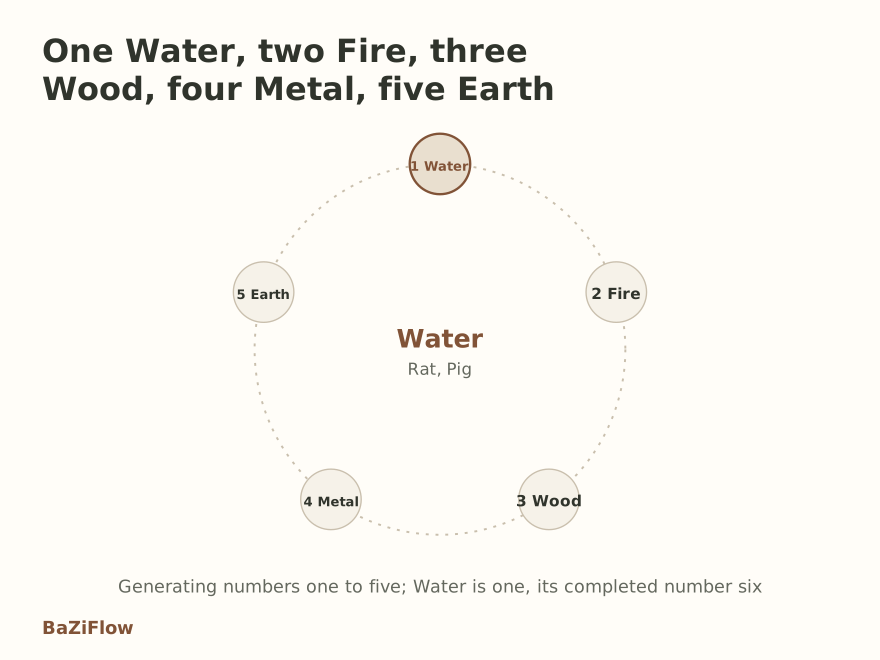
Order sketch: the elements run around the ring by generating number one to five, not in generating order; Water's stems and branches follow this site's usual entry-level tables.
The picture sets the elements on a ring in this numbered order, with Water as one. Water takes the stems Yang Water (壬) and Yin Water (癸) and the branches Rat (子) and Pig (亥). The book first explains the first two numbers from direction and yin and yang: Water is in the north, the place of the Rat, which is the first of yang and counts as one yang number, so Water is one; Fire is in the south, the place of the Horse, which is the first of yin and counts as two yin numbers, so Fire is two. Then comes a more direct reason:
Water is born of one. Before heaven and earth parted and before the ten thousand things were formed, none failed to appear first in Water. … Check it by what we see now: before the fruit and seed of plants are set, and in the womb and egg of people and insects, the embryo is all water. How could it not count as one?
The passage has two layers. First: when heaven and earth had not parted and things were not yet formed, what appeared first was Water. Then a check against what we can see: the fruit of a plant before it sets, and the womb and egg of people and insects, all begin as water, so calling Water "one" is not odd. These numbers are the generating numbers: Water one, Fire two, Wood three, Metal four, Earth five. The completed number of Water is six, written in the book as "Water six, Fire seven, Wood eight, Metal nine", while Earth stays at five throughout.
To moisten, and to flow down
After the numbers the book turns to the word and the nature of Water:
Water rules the north and answers to winter. The word water means to moisten: yin qi soaks and supports the ten thousand things. Water goes from west to east, and it is Metal that generates it; its flow winds and bends, going down by the easy way until it arrives. That is its natural character.
"Moisten" is to soak and to nourish. "Water goes from west to east, and Metal generates it" gives its origin: Metal is in the west, water flows from west to east, and Metal is what generates it. "Winds and bends, goes down until it arrives" is how it travels: no straight lines, just following low ground all the way. The book quotes Master Zhang (Zhang Zai) that Water and Fire are both qi, whose rising and sinking go with yin and yang and cannot be held by Earth, and adds that "the nature of Water is to flow down; going with the flow it can hold much". The flow has a definite start and end in the book:
Enlarge diagram · scroll sideways to read
"Heaven tilts to the northwest, earth sinks in the southeast" speaks of a gap in the sky and a hollow in the earth: water goes out through the northwest gap and runs into the southeast low ground, so "water does not flow west". The book also distinguishes two ways of flowing: along the twelve branches in order, "it has capacity and measure"; against them, "it has a roar", and only a chart that fits a pattern counts as clear and honored. This is what this passage of the Sanming Tonghui says about it, not a general rule of the twelve branches.
Yang Water and Yin Water: the last two stems
Water's stems are the last two of the ten. The book writes of Yin Water: "following Yang Water, completing one round of the stems, the qi of yin and yang accomplished at the end and turning back toward the start", so it closes a cycle and also begins the next.
Enlarge diagram · scroll sideways to read
The book says that Yang Water "is born at the Monkey and dies at the Rabbit" and quotes the classic phrase "dead water runs over its banks"; it says Yin Water "is born at the Rabbit and dies at the Monkey" and quotes "water does not flow west". Those four words appeared once in the chapter on the elements and here are used again to explain why Yin Water dies at the Monkey. Yang Water's Establishment is the Pig and its Peak the Rat; for Yin Water it is the Rat and the Pig, so the two branches swap jobs. For the whole table, see the article on twelve stages and void branches.
Metal feeds it, Earth holds it: Water's four lines
Water's four lines are two coming in, Metal feeding it and Earth restraining it, and two going out, its restraint of Fire and its feeding of Wood. In the part on Water the book gives each line one sentence in its measured form:
Enlarge diagram · scroll sideways to read
Read these and Water always needs a counterpart: Metal for a source, Earth for banks, an even Fire to complete it, Wood for a place to work. The book adds a flip side in the same passage: "when Water and Earth are mixed there is the ill of a muddy source", and Water mixed with Earth has a clouded head.
Rat and Pig: the end and the start of the cycle
The branches of Water are the Rat and the Pig, which are the first and the last of the twelve and stand side by side. The book calls the Rat "the chief of the twelve branches" and the Pig a place of "six yin", whose "image is five lakes gathered together". Add the point above, that the Water stems are the last two of the ten, and Water sits at the seam of both cycles.
Enlarge diagram · scroll sideways to read
Two of the other three branches that hide Water match what came before. The Monkey is where Yang Water has Growth, and the book says as much: "the Monkey is a seat where Water and Earth have their Growth". The Dragon is the book's "intake of water"; in this site's hidden-stem table it hides Yin Water in third place, and it is also the Storage of Yang Water. Main qi, hidden stems and the stage in the twelve-stage table are three separate answers; to see what each is for, turn to how hidden stems unfold.
Strong Water, weak Water, and blazing Fire
The four lines above describe Water in measure; the sayings of Xu Dasheng that the book quotes push it to three extremes:
Enlarge diagram · scroll sideways to read
The subject of all three lines is Water itself: when strong it is drained by the Wood it generates; when weak it fears the Earth that controls it; and when it moves against Fire that is too hot, the Water is heated too. Looking back at "banked by Earth against flooding", the book first asks how much Water there is and only then says what the Earth is.
Look back
Two questions
Does the Dragon hide Water, and why does the book call it the "intake of water"?
The Dragon hides Yang Earth, Yin Wood and Yin Water; Yin Water is third. "Intake of water" is the book's name for it by its southeast position: water leaves the Pig in the northwest and is taken in here.
Where does Water stand in the numbered order, and what is its completed number?
Water is first, with the generating number one and the completed number six; Fire is two and seven, Wood three and eight, Metal four and nine, and Earth stays at five.
The element before Water is Metal and the one after is Wood; if Water is missing from a chart, whether to make it up is the subject of what a missing element means.
Questions readers ask next
Why does the book count one Water, two Fire, three Wood, not the "Wood Fire Earth Metal Water" I memorized?
The two orders do different jobs: Wood Fire Earth Metal Water is the ring in generating order, while one Water, two Fire, three Wood, four Metal, five Earth is the order of the generating numbers. The book explains one and two from direction and yin-yang, and adds that before heaven and earth parted and things were formed, Water appeared first.
Why does Yang Water welcome Earth?
The book says Yang Water "welcomes Yang Earth as the help of an embankment and fears Yin Wood as a drain on its qi". At the Rabbit, Wood is strong and controls Earth; the weakened Earth collapses, the banks give way and the water runs off and scatters, which is why Yang Water "is born at the Monkey and dies at the Rabbit", with the classic's line that dead water runs over its banks. Yet for weak Water the book says meeting Earth means being silted up, so whether Earth is a bank or a blockage depends on how much Water there is.
Why is Water's completed number six?
The book says Metal, Wood, Water and Fire all wait on Earth to be completed, so Earth's number five is added to each generating number: Water one plus five makes six, then Fire seven, Wood eight and Metal nine. Earth itself "is completed without waiting for ten" and always keeps five.
Was this article helpful?
Sources & references
Continue reading
Metal (金): To Hold Back, No Forging No Vessel, Yang and Yin Metal ↗
Missing element in BaZi: does it need a remedy? Four questions after a zero ↗