

Conjunction, opposition and square
Content version · · Sources & references
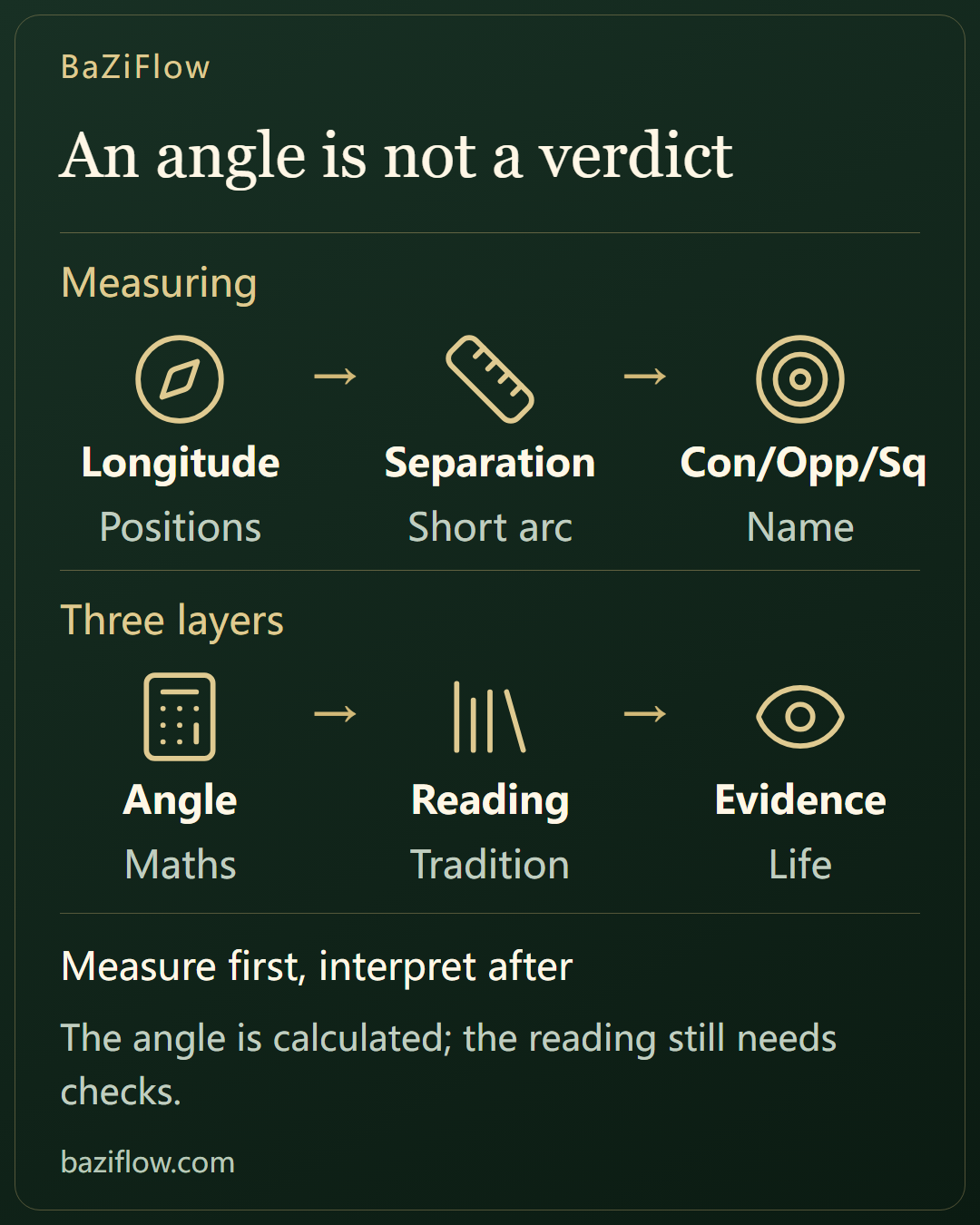
Conjunction, opposition and square are only longitude separations: 0°, 180° and 90°. An angle dial, a swap-the-planets test and a three-layer record separate calculation, tradition and evidence.
The short version5 min read
Conjunction, opposition and square are first of all separations measured along the ecliptic: 0°, 180° and 90°. Whether they are "good" or "bad" belongs to three other layers that must be checked.
- Conjunction, opposition and square are the shorter distance between two positions in longitude: 0°, 180° and 90°. Red and blue lines are software colours, not verdicts.
- The same angle label does not mean the same interpretation: Mercury conjunct Venus and Mars conjunct Saturn call for different accounts.
- The angle is calculated, the tradition's reading is a second layer, and whether it fits one person's life needs separate evidence; the three cannot be merged into one sentence.
Read first
Aspect Angles and Orbs: Calculate One Line from Two Positions ↗
Three angles, measured on a circle first
The relationship between two bodies on a chart is first a geometric quantity: how many degrees apart they are in longitude, taking the shorter way round the circle. A conjunction is 0°, an opposition 180° and a square 90°.
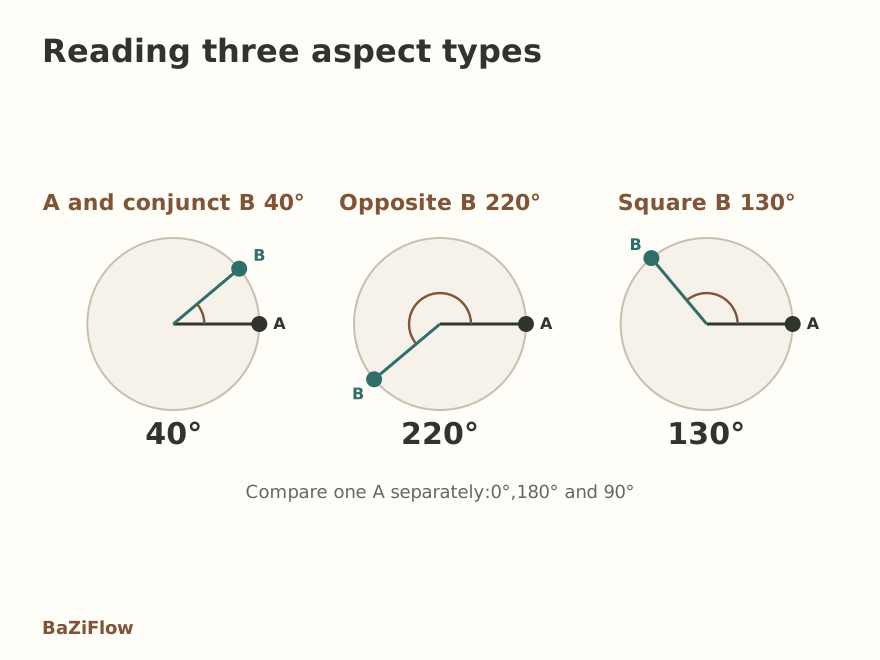
Geometric sketch: A and B are abstract positions, not a measured chart, and carry no good-or-bad score.
A longitude conjunction is not a physical collision: two bodies can share a longitude while differing in latitude and in distance from Earth. Lines on a flat chart are not ropes or orbits; they are a way of displaying a selected coordinate relationship.
Enlarge diagram · scroll sideways to read
"This square means failure": how many claims hide in it
Imagine a chart report that says, "This square means your project will fail." The sentence carries far more than the number 90.
Enlarge diagram · scroll sideways to read
Underline the new claims first. If the report cannot answer them, a more elaborate description of the square will not supply the missing evidence. It only makes the jump harder to see.
Keep the angle, change the participants
Use two invented records. Record A: Mercury 40°, Venus 40°. Record B: Mars 40°, Saturn 40°. Both pairs have a longitude separation of 0°. These are deliberately chosen coordinates, not real birth moments.
Enlarge diagram · scroll sideways to read
The label is unchanged, but the participants are not, so "what is being combined" needs a different account. "A conjunction brings good things" discards exactly the information needed to tell the two records apart; swapping in "intense energy" is still almost empty until the participants, method and chart context are named.
Historical categories and modern cautions: which layer they answer
Enlarge diagram · scroll sideways to read
Two sources, what each says
Separates harmonious from inharmonious relationships
It describes opposition, trine, square and sextile. Saying the ancients never distinguished good from bad is not accurate history, and treating the classification as evidence of what will happen to a reader today is not either.
"Easy" or "tense" is not success or failure
This is a caution inside astrology, not proof of how an angle produces character.
One scene that keeps the three layers apart
Two collaborators are preparing a community exhibition. One has the permission documents for the photographs but no captions; the other has captions but does not know who owns the pictures.
Enlarge diagram · scroll sideways to read
If both sets of records were complete and only the page count were unsettled, the problem would be layout. Searching for hostility between the two would then replace their actual information with an invented difficulty.
What was calculated
State the separation, the orb, and whether it is natal, transit or between two people.
The interpretation adopted
Say which tradition or textbook is used, and cite it.
What the person has confirmed
Write the checked facts; if none, leave it blank rather than letting the first two quietly turn into it.
When several lines form a larger shape, confirm them one by one before reading aspect patterns in the whole chart.
Questions readers ask next
Is a square always "pressure" and an opposition always "conflict"?
No. The traditional classification does separate harmonious from inharmonious relationships, but that is an interpretation inside astrology and not evidence of what will happen to someone. The same angle reads differently with other bodies, orbs and chart context.
What do the red and blue lines in my software mean?
They are display colours the software assigns to different angles so the lines can be told apart. They are not a rating of fortune, and not a computed measure of strength.
Does changing "guaranteed failure" to "guaranteed growth" make a reading more reliable?
No. Both versions make a promise that an angle cannot give. A steadier way to write it is to state the calculation, say which interpretive tradition is used, and then give the facts the reader has actually checked.
Was this article helpful?
Part of a learning path
Astrology: from four components to the whole chart · Step 4 of 4 available