

Pomegranate Wood: Yang Metal Monkey and Yin Metal Rooster
Content version · · Sources & references
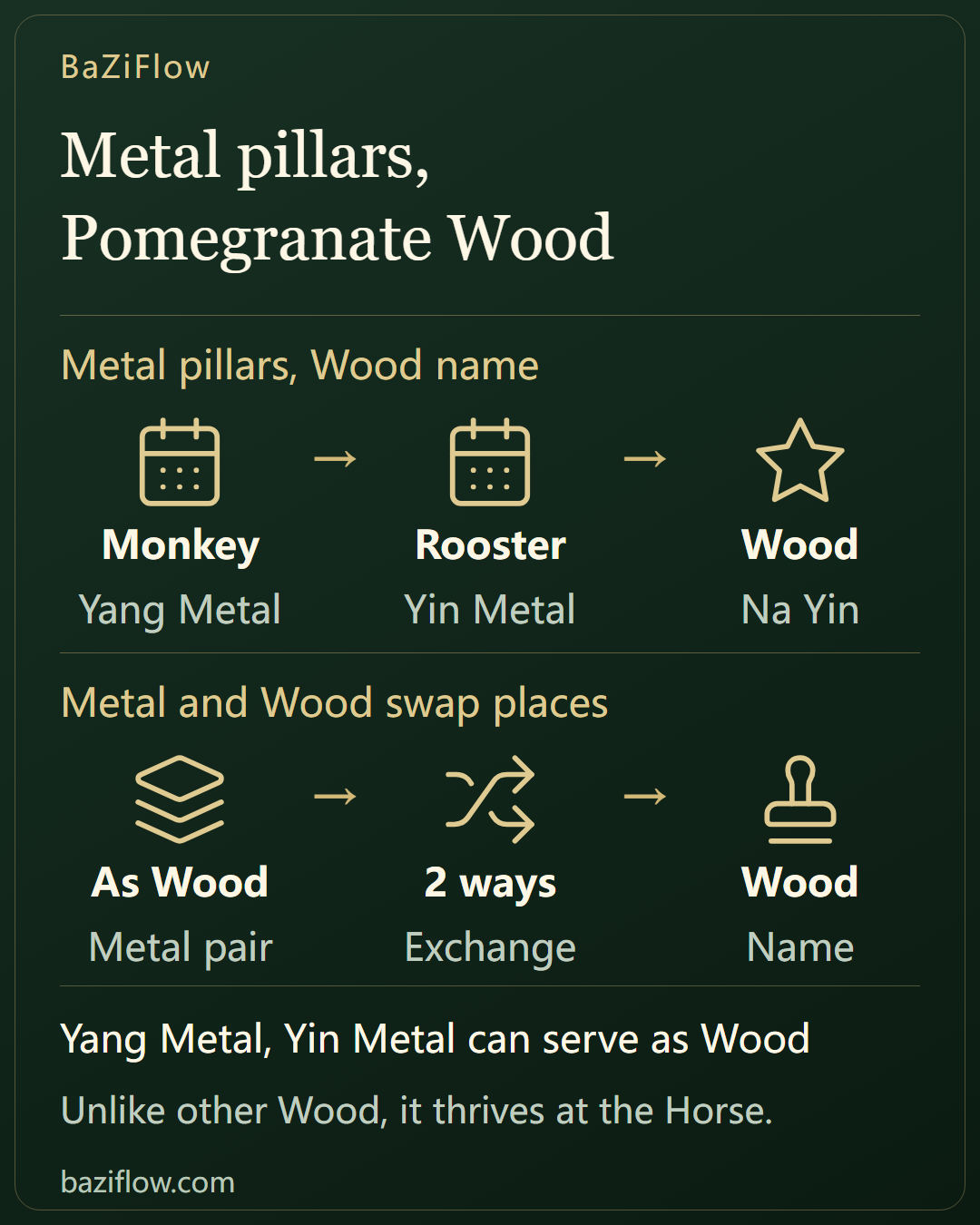
Yang Metal Monkey and Yin Metal Rooster are Metal through and through, yet share a Wood name: the Sanming Tonghui's two lines of imagery, the rule that Metal stems may serve as Wood, a Wood–Metal swap, pairings, years.
The short version10 min read
Pomegranate Wood is the twenty-ninth Na Yin name, shared by Yang Metal Monkey and Yin Metal Rooster. Both pillars are Metal in stem and branch; the book first lays down that Yang Metal and Yin Metal may serve as Wood, then explains this name by overcoming imagery.
- Yang Metal and Yin Metal are Metal, the Monkey and Rooster are Metal, the Rooster hides Yin Metal and the Monkey Yang Metal, Yang Water, Yang Earth: no Wood in any layer. The “wood” comes from the Na Yin, where the book says Wood on Metal ground bears fruit.
- The book’s rule: Wood names use only Earth, Metal and Water stems (Yang and Yin), Metal names only Wood, Metal and Water stems; counting this site’s Na Yin table pillar by pillar gives exactly the same result.
- “Yang Wood Tiger meeting Yang Metal Monkey is not a punishment” and the Wood–Metal swap called “merit equal to creation” show on the table as a Tiger–Monkey clash and as opposite positions on the ring; the book speaks of place, the table of relation.
Read first
What is Na Yin in BaZi? Why Yang Wood Rat Gold in the Sea does not replace Yang Wood ↗
All Metal on the surface, a Wood name: Yang Metal Monkey and Yin Metal Rooster
Pomegranate Wood (石榴木) is the twenty-ninth Na Yin name, held jointly by Yang Metal Monkey (庚申) and Yin Metal Rooster (辛酉). Yang Metal and Yin Metal are Metal and the Monkey and Rooster are Metal too; the Rooster hides only Yin Metal, the Monkey hides Yang Metal, Yang Water and Yang Earth, and still no Wood appears in any layer.
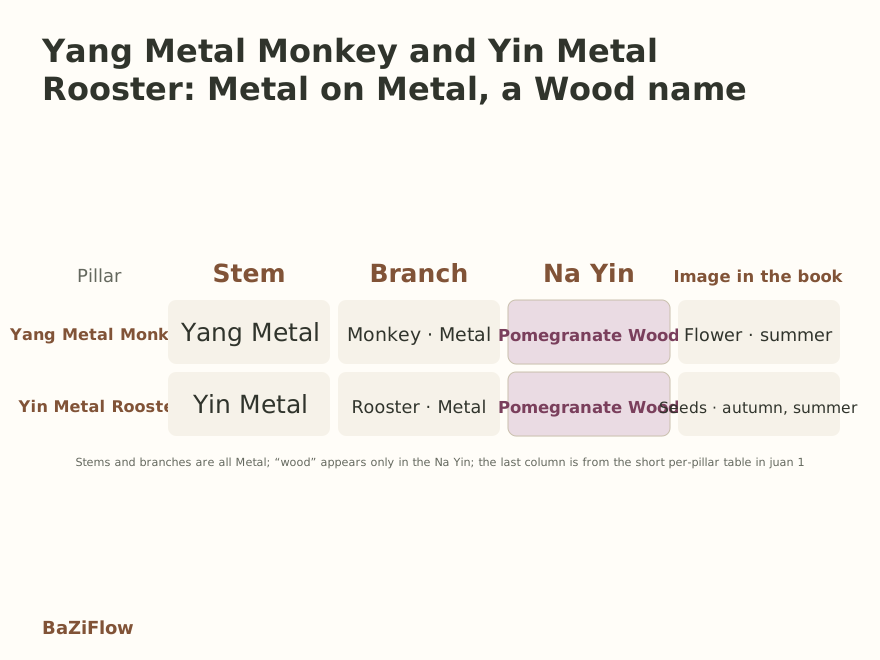
Four Metal characters under a Wood name; the blossom and seed in the last column come from the short per-pillar table of juan 1.
The last column is the wording of the short per-pillar table in juan 1: Yang Metal Monkey is the pomegranate blossom, which likes summer and does not suit autumn or winter; Yin Metal Rooster is the pomegranate seeds, which like autumn and also summer.
Wood on Metal ground bears fruit
Juan 1 of the Sanming Tonghui (三命通会) takes up Yang Metal Monkey and Yin Metal Rooster with an admission that the name does not follow the surface:
Yang Metal Monkey and Yin Metal Rooster: their element is Metal but their Na Yin is Wood, so the name is taken by overcoming; of woods whose nature is pungent there is only the pomegranate. The qi of the Monkey and Rooster has turned still and austere and things are gradually bearing fruit; Wood on Metal ground has a taste that turns pungent. So it is called Pomegranate Wood. Other woods die at the Horse, but this one flourishes at the Horse, taking its nature as one-sided.
“Taken by overcoming” admits that the surface is Metal and the name is Wood, and uses the relation of Metal overcoming Wood; “turned still and austere, gradually bearing fruit” is the picture of autumn’s harvest; Wood growing on Metal ground picks up Metal’s flavor, so it is the pungent one among the woods. The last sentence is the counterexample: other woods die at the Horse, the pomegranate flourishes there, and the book calls this its “one-sided nature”.
The account of the calendar specialists (日家) is the second:
Yang Metal Monkey and Yin Metal Rooster: the Monkey is the seventh month and the Rooster the eighth. At this time Wood is at Severance, yet the pomegranate bears fruit instead. So it is called Pomegranate Wood.
The “Severance” of Wood agrees with this site’s table: Wood (counted by Yang Wood) is at Severance on the Monkey and at Conception on the Rooster; other woods are at Death on the Horse, exactly the book’s “dies at the Horse”, and the pomegranate is the exception.
Enlarge diagram · scroll sideways to read
Five elements, six stems each
A passage after the thirty Na Yin entries in juan 1 lays down a rule on “which stems may serve as Wood”:
Of the ten stems, these six, the Yang and Yin of Earth, of Metal and of Water, may serve as Wood, and the Yang and Yin of Wood and of Fire take no part. … The substance of Yang Metal and Yin Metal is as hard as Yang Wood and Yin Wood, so Yang Wood and Yin Wood can be Metal and Yang Metal and Yin Metal can be Wood, exchanging with each other; the principle is one.
The book also says why the Fire and Wood stems cannot be Wood: Yang and Yin Fire burn wood, and as for Yang and Yin Wood, Wood changes: it withers back to Water, burns into Fire and decays into Earth, so the Na Yin does not take true Wood as Wood. The other four elements likewise have six stems each, and the book lists them. Counting this site’s Na Yin table pillar by pillar gives exactly the same result:
Enlarge diagram · scroll sideways to read
So Yang Metal and Yin Metal serve as both Metal and Wood, and Pomegranate Wood is one cell of the rule, not an exception.
The Monkey and Rooster against the Tiger and Rabbit: “not a punishment”, and a swap
In the book Yang Metal Monkey and Yin Metal Rooster have a second role: the west, Dui, set against the east, Zhen, which holds Yang Wood Tiger and Yin Wood Rabbit.
The Metal of Yang Metal Monkey and Yin Metal Rooster answers to Dui in the west, and the Wood of Yang Wood Tiger and Yin Wood Rabbit images Zhen in the east; so Yang Wood Tiger meeting Yang Metal Monkey is not a punishment, and Yin Wood Rabbit meeting Yin Metal Rooster is not a ghost: this is the proper form of Wood as wife and Metal as husband.
Metal overcomes Wood, so Metal is Wood’s “ghost”, and the Tiger and Monkey punish each other; the book still says these two pairs are “not a punishment” and “not a ghost”. The crossed pairs, Yang Metal Monkey with Yin Wood Rabbit and Yin Metal Rooster with Yang Wood Tiger, are “not a Yuan Chen”, a matter of adaptation. The table, pair by pair:
Enlarge diagram · scroll sideways to read
The entry also names one pattern. Gold Foil Metal (Yang Water Tiger, Yin Water Rabbit) has Water and Wood for stem and branch but Metal for Na Yin; Pomegranate Wood has Metal for stem and branch but Wood for Na Yin. Each “sheds its own nature and swaps to the strong position”, Wood being strong at the Tiger and Rabbit and Metal at the Monkey and Rooster, each in its place: the pattern called “merit equal to creation”.
Enlarge diagram · scroll sideways to read
The entry’s earth, metal and fire, checked against the table
The entry likes “earth that is a finished vessel”: Earth on the City Wall (Yang Earth Tiger, Yin Earth Rabbit) is best, Earth on the Roof (Yang Fire Dog, Yin Fire Pig) second, on the condition that yin and yang cross, with Yang Fire–Yin Metal and Yin Fire–Yang Metal “mutual officers” and Yang Earth–Yin Metal and Yin Earth–Yang Metal “mutual resources” (the Siku text prints Snake–Tiger (巳寅) for the last pair; read here as Yin Earth–Yang Metal, a likely copying slip). The entry names only Na Yin kinds; the rows are this article's sample pairs, engine results on the right:
Enlarge diagram · scroll sideways to read
The two crossed pairs with City Wall earth are clean on the branches, while each of the two Roof pairs carries a Harm; the book ranks “City Wall best, Roof second”, which runs in the same direction as how clean the table looks. The book does not give that as its reason.
Two year pillars, three rounds
Yang Metal Monkey is the year 1980 and Yin Metal Rooster is 1981; the pair came before in 1920 and 1921 and returns in 2040 and 2041.
Enlarge diagram · scroll sideways to read
Two exercises
Two births, at 00:30 on 5 February 1980 and at 23:50 the evening before: what year pillar does each have?
Spring begins at 00:09 on 5 February. The 00:30 birth is past that moment and has Yang Metal Monkey with Pomegranate Wood; the 23:50 birth is not, and keeps Yin Earth Goat with Fire in the Sky.
Which calendar years belong to “a Pomegranate Wood person”?
1920 and 1921, 1980 and 1981, 2040 and 2041, each cut at the Start of Spring and not at 1 January.
Fire in the Sky comes just before it and Water of the Great Sea just after; the book sets it against Pine and Cypress Wood as “one firm, one pungent”, and the foil metal of the entry is Gold Foil Metal. Where Na Yin ends and the pillar’s own elements begin is explained in Na Yin and the plain five elements.
Questions readers ask next
Yang Metal Monkey and Yin Metal Rooster share one name. Does the book judge them alike?
No. The pillar comments, quoting the Yuxiao baojian, call Yang Metal Monkey self-severed Wood whose day-born are “of rare gifts”, heroic talent if a noble pattern forms; Yin Metal Rooster is “Wood out of place, trapped in Metal’s home”, meeting many hardships, eased only facing Yin Water Rabbit. Another source says Yin Metal Rooster waits for growth and strength. One name, two verdicts.
Why may Yang Metal and Yin Metal serve as Wood when Yang Wood and Yin Wood may not?
The book answers: Wood changes, it rots back to Water, burns into Fire or decays into Earth, so a Na Yin does not take true Wood as Wood; the substance of Yang Metal and Yin Metal is as hard as Yang Wood and Yin Wood, so Yang Wood and Yin Wood may serve as Metal and Yang Metal and Yin Metal as Wood, an exchange in both directions. This site’s Na Yin table matches the rule exactly.
Born at 12:30 a.m. on 5 February 1980: which year pillar?
Yang Metal Monkey. The Start of Spring in 1980 is at 00:09 Beijing time on 5 February, so 12:30 a.m. is past it and the Na Yin is Pomegranate Wood; someone born at 23:50 on 4 February still has Yin Earth Goat, with Fire in the Sky.
Was this article helpful?
Sources & references
Continue reading
Fire in the Sky (天上火): Yang Earth Horse, Yin Earth Goat and the Sun-and-Moon Patterns ↗
Water of the Great Sea (大海水): Yang Water Dog, Yin Water Pig and the Cycle Restarting ↗
Five Elements cycles: learn the relationships, not just the order ↗