

Yin-Yang Mismatch: twelve fixed pillars
Content version · · Sources & references
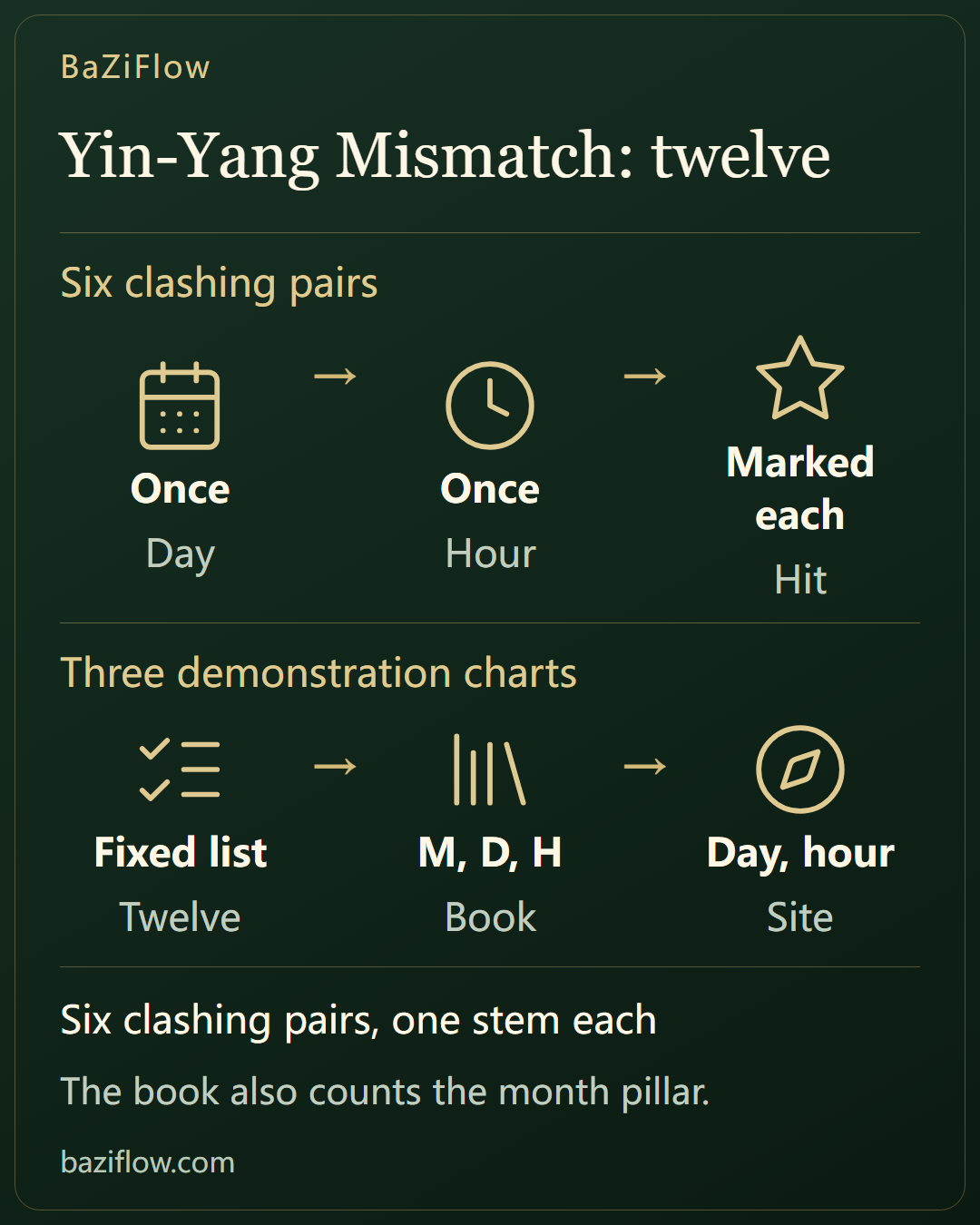
Yin-Yang Mismatch needs no conversion: the day or hour pillar itself must be one of twelve fixed pillars. A table, the Sanming Tonghui entry and three demonstration charts show how to spot it and where the site differs.
The short version8 min read
Yin-Yang Mismatch involves no conversion: it checks whether the day pillar and the hour pillar themselves are among twelve fixed pillars. The twelve are exactly six clashing branch pairs, each pair taking one shared stem.
- The twelve are Yang Fire Rat and Horse, Yin Fire Ox and Goat, Yang Earth Tiger and Monkey, Yin Metal Rabbit and Rooster, Yang Water Dragon and Dog, Yin Water Snake and Pig: each clashing pair takes one stem.
- The Sanming Tonghui, juan 3, lists exactly these twelve days and says two or three hits among the month, day and hour weigh more. The site checks only the day and hour pillars and not the month, a difference from the book.
- The book's comments concern in-law relations; the site wording, "timing easily out of step", is a milder modern phrasing of the book's "seldom in accord". Laid into the sixty-cycle, the twelve make four runs of three days.
Read first
Symbolic Stars in BaZi: Check the Reference and Rule Before the Meaning ↗
Twelve pillars, six clashing pairs
Like Kui Gang, Yin-Yang Mismatch (阴阳差错) involves no conversion. It checks whether the day pillar and the hour pillar themselves are one of twelve fixed pillars. If one is, it is marked once on that pillar.
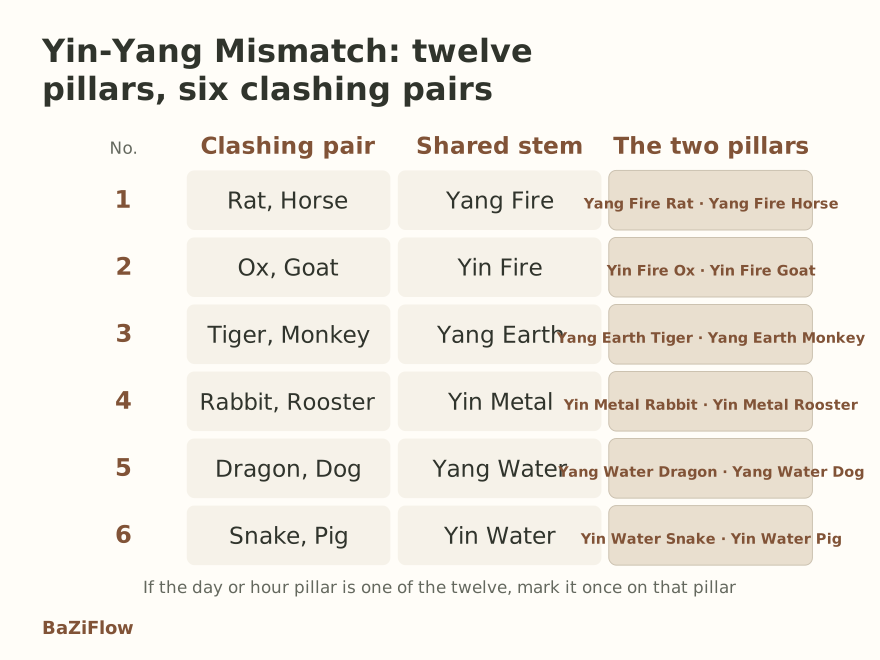
Table of the twelve pillars, laid out by clashing branch pairs. The values were checked against the site's engine and match the original entry of Sanming Tonghui juan 3 word for word.
The six rows are the six clashing pairs of branches: Rat and Horse, Ox and Goat, Tiger and Monkey, Rabbit and Rooster, Dragon and Dog, Snake and Pig. Each pair takes one shared stem: Yang Fire, Yin Fire and Yang Earth for the first three pairs, then Yin Metal, Yang Water and Yin Water for the last three, twelve pillars in all. This tidy structure only shows once the twelve are laid out in a table; the original entry simply lists them one after another.
The original entry in Sanming Tonghui juan 3
The source of this sha is the section "On miscellaneous sha from stem and branch characters" in juan 3 of the Sanming Tonghui (三命通会), and the entry opens with the list:
Yin-Yang Mismatch sha: Yang Fire Rat, Yin Fire Ox, Yang Earth Tiger, Yin Metal Rabbit, Yang Water Dragon, Yin Water Snake, Yang Fire Horse, Yin Fire Goat, Yang Earth Monkey, Yin Metal Rooster, Yang Water Dog, Yin Water Pig, twelve days.
The site's table matches this list word for word. The entry goes on with comments concerning in-law relations: for a woman who meets it, relations with the husband's parents and the wives of his brothers are said to be seldom in accord; for a man, relations with his wife's family. It adds that the sha applies to either sex. The entry then says how to count:
Two or three hits among month, day and hour weigh very heavily; even the day alone weighs especially heavily.
The book counts three pillars: month, day and hour. The site's engine checks only the day and hour pillars and leaves out the month. The code does not say why, so the source is still to be verified, and this article does not invent a reason for it.
Enlarge diagram · scroll sideways to read
Juan 7, in its section on women's charts, has a further note on days like the Lone Phoenix (孤鸾) and Yin-Yang Mismatch:
If there is an Officer or Killings star to lean on, then even meeting days such as the Lone Phoenix or Yin-Yang Mismatch turns favorable.
The first half of that note covers the other case: a chart with no Officer or Killings star at all should take such days with care. So the book treats it as a conditional reading and not as a verdict on sight.
Laid into the sixty-cycle: four runs of three days
Put the twelve back into the sixty-cycle, counting Yang Wood Rat as position 1. They fall at positions 13 to 15, 28 to 30, 43 to 45 and 58 to 60, which are the last three days of each block of fifteen:
Enlarge diagram · scroll sideways to read
This is a regularity read off the table; the book does not say it, and it does not explain where the name comes from. It does show that the twelve are not a loose list: the first run and the third, and the second and the fourth, are thirty places apart, half a sixty-cycle. Thirty places on, the stem stays and the branch becomes the one that clashes, which is why every clashing pair shares one stem.
Three charts, checked once
The three charts are only demonstrations. The hour stems follow from the day stem in each, so the day and hour pillars in all three are valid combinations.
Enlarge diagram · scroll sideways to read
Chart one is Yin Wood Rabbit, Yin Earth Ox, Yin Fire Goat, Yang Fire Horse (乙卯 己丑 丁未 丙午), chart two is Yang Wood Rat, Yang Fire Rat, Yang Metal Horse, Yang Fire Rat (甲子 丙子 庚午 丙子), and chart three is Yang Fire Monkey, Yin Metal Rabbit, Yang Wood Rat, Yang Wood Rat (丙申 辛卯 甲子 甲子), listed with the year pillar first and the hour pillar last.
The month pillar of chart three, Yin Metal Rabbit, is among the twelve, and the site does not mark it because it checks only the day and hour. The book counts the month too, so this is a difference between the site and the book and not a feature of that chart.
One day pillar on several lists
The twelve days overlap or resemble other lists in three places, and they should not be mixed up. The Qing almanac manual Xieji Bianfang Shu (协纪辨方书) has two lists called Yang Error (阳错) and Yin Error (阴错) in juan 4:
Enlarge diagram · scroll sideways to read
Yang Water Dragon is an interesting case: of the four Kui Gang day pillars, Yang Water Dragon is also among the twelve, so a chart with that day pillar shows two Symbolic Stars, each with its own source. They should not be read as one meaning.
The site's text says "a sense of mismatch in marriage and family ties, timing easily out of step with the other person, needing more spoken clarity than silent understanding", which corresponds to the book's "seldom in accord" and takes the milder end of it. How clashing branches are usually read is in the general reading of clash and punishment. How much weight such a sha carries in a whole chart is the subject of where Symbolic Stars sit in a reading, and the next one, counted from the year branch, is Heavenly Joy.
Questions readers ask next
My month pillar is Yin Metal Rabbit, which is on the list. Why does the site not mark Yin-Yang Mismatch?
The site's engine checks only the day and hour pillars and does not look at the month. The Sanming Tonghui, juan 3, counts month, day and hour together. Why the engine leaves the month out is not stated in the code, so the source is still to be verified and this article does not invent a reason.
Does Yin-Yang Mismatch mean a marriage will go wrong?
It should not be read that way. The book's comments are about in-law relations and use words like "seldom in accord"; the site rephrases this as "timing easily out of step, so say things out loud". It is a supporting clue, and juan 7 adds a note that a chart with an Officer or Killings star to lean on may find such days favorable instead, so read it with the whole chart.
My day and hour pillars are both on the list. Is it counted twice?
The site marks it once on the day pillar and once on the hour pillar, so two entries appear. The book also says "two or three hits in month, day and hour weigh heavily" and treats overlap as heavier; the site makes no judgment of degree and only tells you which pillar it landed on.
Was this article helpful?
Sources & references
Continue reading
Kui Gang (魁罡): Four Day Pillars, Read from the Day Pillar Alone ↗
Heavenly Joy (天喜): The Branch Opposite Red Phoenix, and Other Tables of That Name ↗