

Xiaoguo: passing and meeting trade places
Content version · · Sources & references
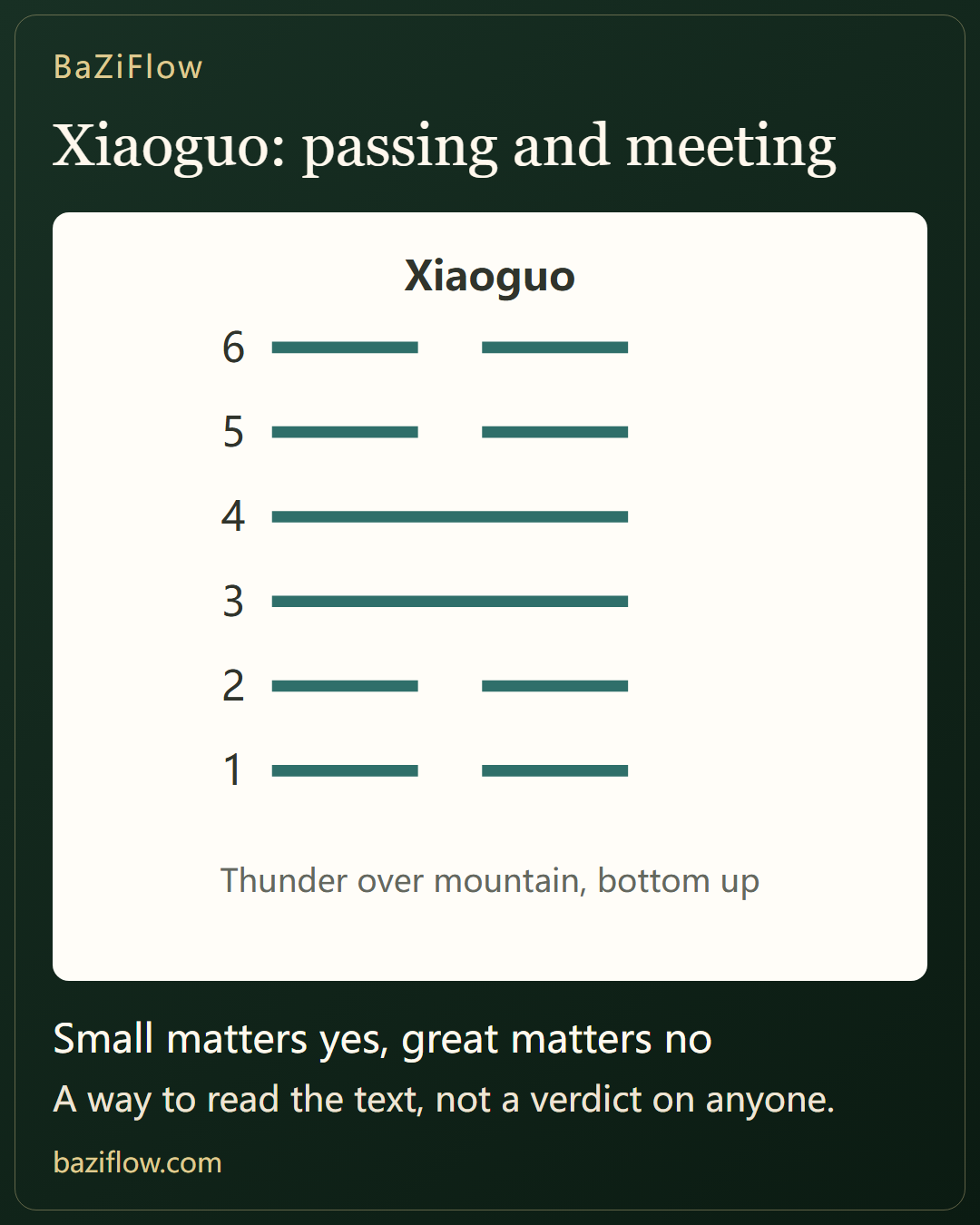
Xiaoguo is the 62nd hexagram: thunder over mountain, four yin lines around two yang, likened to a bird. Read the Judgment on going down, the Image on courtesy, grief and thrift, and the swap of "pass" and "meet".
The short version9 min read
Xiaoguo literally means "a little too far". The text names three places where going a little past is allowed, gives one direction, and moves the words "pass" and "meet" around the six lines.
- Xiaoguo puts Zhen (thunder) above Gen (mountain), with four yin lines around two yang lines. The Commentary on the Judgments says it "has the image of a flying bird", and "flying bird" occurs three times in the Judgment and the lines.
- After "success", the Judgment makes two points: small matters yes, great matters no; the bird leaves its call, so going down fits and going up does not. The Commentary explains the first with the soft holding the middle, the second with "against the grain".
- The Great Image puts the overstepping in three places, conduct, mourning and spending. In the lines, line 4 "not passing, meets it" and line 6 "not meeting, passes it" are the same four characters with two of them swapped.
Read first
The Sixty-Four Hexagrams: How Upper and Lower Trigrams Form One Figure ↗
Judgment and Line Statements: Whole Hexagram or Single Line? ↗
Thunder above the mountain: four yin lines around two yang
In Xiaoguo (小過) the upper trigram is Zhen (thunder) and the lower is Gen (mountain). In the Shuo Gua, Zhen is "moving" and Gen is "stopping", so the figure is still below and in motion above. Counting from the bottom, the lines run yin, yin, yang, yang, yin, yin. Two yang lines are held in the middle, with two yin lines on either side of them.
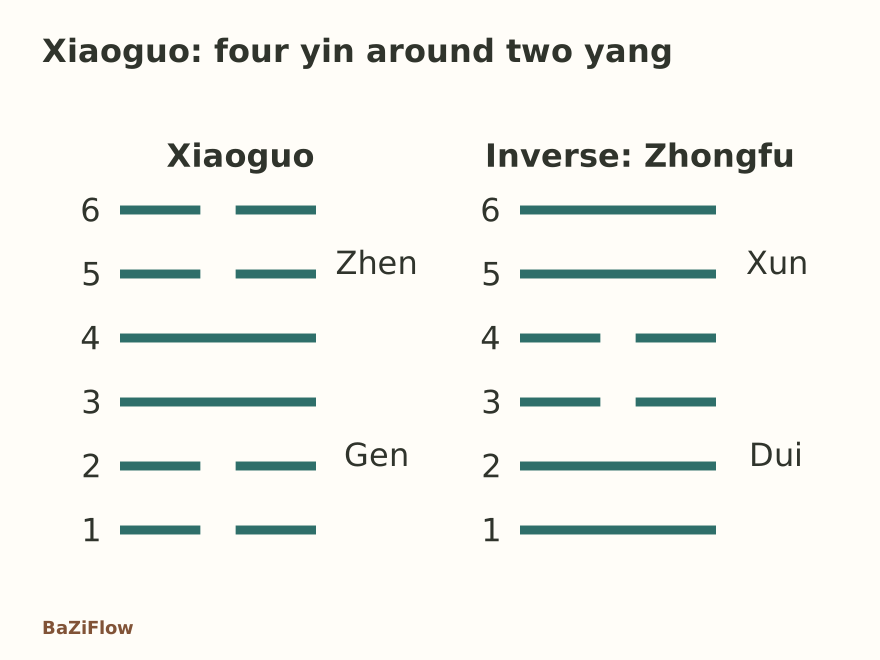
Xiaoguo and its inverse Zhongfu: change every line to the opposite polarity and four yin around two yang becomes four yang around two yin.
Enlarge diagram · scroll sideways to read
When it explains the Judgment, the Commentary on the Judgments says that the hexagram "has the image of a flying bird". Tradition usually pictures it this way: the two yang lines in the middle are the body, and the yin lines spread on either side are the wings. The body-and-wings picture is a later reading; the words "flying bird" themselves occur three times in the Judgment and the line statements: once in the Judgment, once in the first line, once in the top line.
Three words to know first
- Guo (go past)
- Literally to pass or to exceed. It is used in two ways in one hexagram: in the Great Image (大象), "going beyond in courtesy" means exceeding the usual measure, while in line 2, "passes his grandfather", it means going by someone.
- Yu (meet)
- Literally to come across. It keeps company with guo: passes the grandfather and meets the grandmother; not passing, meets it; not meeting, passes it.
- Up and down
- The Judgment says "not fitting to go up, fitting to go down", and the Commentary glosses it as "up is against the grain, down is with it".
The Judgment and the Commentary: small matters yes, great matters no
The Judgment of Xiaoguo reads:
Success. Fitting to hold firm. Small matters can be done; great matters cannot. A flying bird leaves its call behind: not fitting to go up, fitting to go down. Great good fortune.
The first two phrases, "success" and "fitting to hold firm", are what many hexagrams say. What follows is the hexagram's own: first the line between small and great matters, then the sound a bird leaves behind, and last a direction. Going up is not fitting; going down is.
The Commentary explains the first layer from the shape of the figure:
The soft holds the middle, and so small matters are fortunate. The firm has lost its place and is not in the middle, and so great matters cannot be done.
"The soft holds the middle" means that both yin lines of this kind sit in a middle place: line 2 in the middle of the lower trigram and line 5 in the middle of the upper one. "The firm has lost its place" points to the two yang lines: lines 3 and 4 are crowded into the center, outside the middle places 2 and 5, and line 4 also sits in a yin place. The Commentary also attaches a condition to the overstepping: it is "fitting to hold firm" and it "moves with the time". Going past is allowed, as long as it stays upright and keeps pace with the moment.
Enlarge diagram · scroll sideways to read
For the last layer, "the flying bird leaves its call behind", the Judgment gives no further account, and the Commentary adds only "up is against the grain, down is with it". What stays behind, in this layer, is the bird's call.
The Great Image: courtesy, grief and thrift
Thunder above the mountain: Xiaoguo. The noble person, in conduct, goes beyond in courtesy; in mourning, goes beyond in grief; in spending, goes beyond in thrift.
The sentence is built very evenly: three clauses of "goes beyond in", each with a matter first and a manner after it. Conduct goes with courtesy, mourning with grief, spending with thrift. Courtesy is modesty in how one carries oneself, grief is sorrow at a funeral, thrift is saving in what one spends.
Enlarge diagram · scroll sideways to read
The three share a direction. The excess always leans to the side of holding back: more modest, more sorrowful, more sparing, and never prouder, merrier or more lavish. That fits "fitting to go down" in the Judgment. All three are also personal, everyday conduct, and none concerns a great undertaking, which agrees with "small matters can be done".
Six lines: not passing, meets it; not meeting, passes it
Through the six line statements the words "pass" and "meet" keep trading places. Here is the text side by side:
Enlarge diagram · scroll sideways to read
The two end lines both have a flying bird as the subject. Line 1: "the bird flies, and so misfortune", with the comment "nothing can be done". Line 6: "the flying bird runs into it", with the comment "already too high". Tradition usually reads the word here as "to run into, to fall into". Both are marked as misfortune, one at each end of the figure.
Line 2 ends without blame: "passes his grandfather, meets his grandmother; does not reach his lord, meets his minister; no blame". In each pair the first figure (grandfather, lord) is passed by or not reached, and the second (grandmother, minister) is the one actually met. The Small Image comments only on the second pair: "a minister may not overstep".
Line 3, "not passing, guard against it", and line 4, "not passing, meets it", begin with the same two characters. These two yang lines are the ones the Commentary means by "great matters cannot be done". Line 3 is misfortune. Line 4 is "no blame", but it is followed at once by "going on is dangerous, one must be on guard; do not hold to it for good", and the Small Image calls the position unsuitable and says that in the end it cannot last.
Line 5, "dense clouds, no rain, from our western outskirts", is the same sentence that closes the Judgment of Xiaoxu. The next clause is "the lord shoots with a corded arrow and takes the one in the cave". This is the only place in the hexagram with the verb "take", and what is taken sits in a hole, which is to say low down. The Small Image is three characters long: "already gone up".
Lay the combinations of "pass" and "meet" out in a row and a pattern appears that you can check line by line. The lines in which a meeting actually happens, line 2 and line 4, both carry "no blame". The lines with no meeting, lines 3 and 6 (line 6 says outright "not meeting"), are both misfortune, and line 6 adds "this is called calamity".
Enlarge diagram · scroll sideways to read
Line 4, "not passing, meets it", and line 6, "not meeting, passes it", use the same four characters with only "pass" and "meet" swapped, and one is without blame while the other is a calamity.
The neighbors and the sequence: after Zhongfu, before Jiji
Xiaoguo is the inverse of Zhongfu (中孚). Zhongfu is four yang lines around two yin, and changing every line to the opposite polarity gives the four yin around two yang of Xiaoguo (see the figure above). The Xu Gua puts the two in sequence, and for Xiaoguo it has one sentence:
Those who hold to their word will carry it out, so it is followed by Xiaoguo.
Tradition usually understands it this way: what you trust in, you act on; and acting, one is bound sometimes to go a little past the usual measure; hence Xiaoguo comes next.
Turn Xiaoguo upside down and it is still itself, so its reversed hexagram (综卦) is itself. Only eight hexagrams are symmetrical like this and read the same backward; the general principle is in yin and yang lines. Its nuclear hexagram (互卦) is Daguo: take lines 2 to 5, use the middle two lines, 3 and 4, in both trigrams, and you get Daguo, with the yang lines in the middle.
Enlarge diagram · scroll sideways to read
Questions readers ask next
Does Xiaoguo mean "a small mistake"?
No. The Commentary on the Judgments reads the name as "the small pass beyond, and so there is success". Here "pass" means to go past the usual measure, and the three "beyond" clauses in the Great Image are measured excess, not errors.
What does "the flying bird leaves its call behind" mean?
Literally, a bird has flown by and what remains is the sound. The Judgment adds that it is not fitting to go up and fitting to go down, and the Commentary adds that up is against the grain and down is with it. The usual way to read it is as a figure for what goes smoothly and what does not.
How are Xiaoguo and Zhongfu related?
They are inverse hexagrams: change every line of Zhongfu to the opposite polarity and you have Xiaoguo. The Xu Gua also sets them in neighboring positions, with Zhongfu first and Xiaoguo after it.
Was this article helpful?
Sources & references
Continue reading
Zhongfu: solid outside, hollow within, from the calling crane to the feathered voice ↗
Jiji: water above fire, after every line has found its place ↗
The Sixty-Four Hexagrams: How Upper and Lower Trigrams Form One Figure ↗
Judgment and Line Statements: Whole Hexagram or Single Line? ↗