

Venus: six positions, sign and house
Content version · · Sources & references
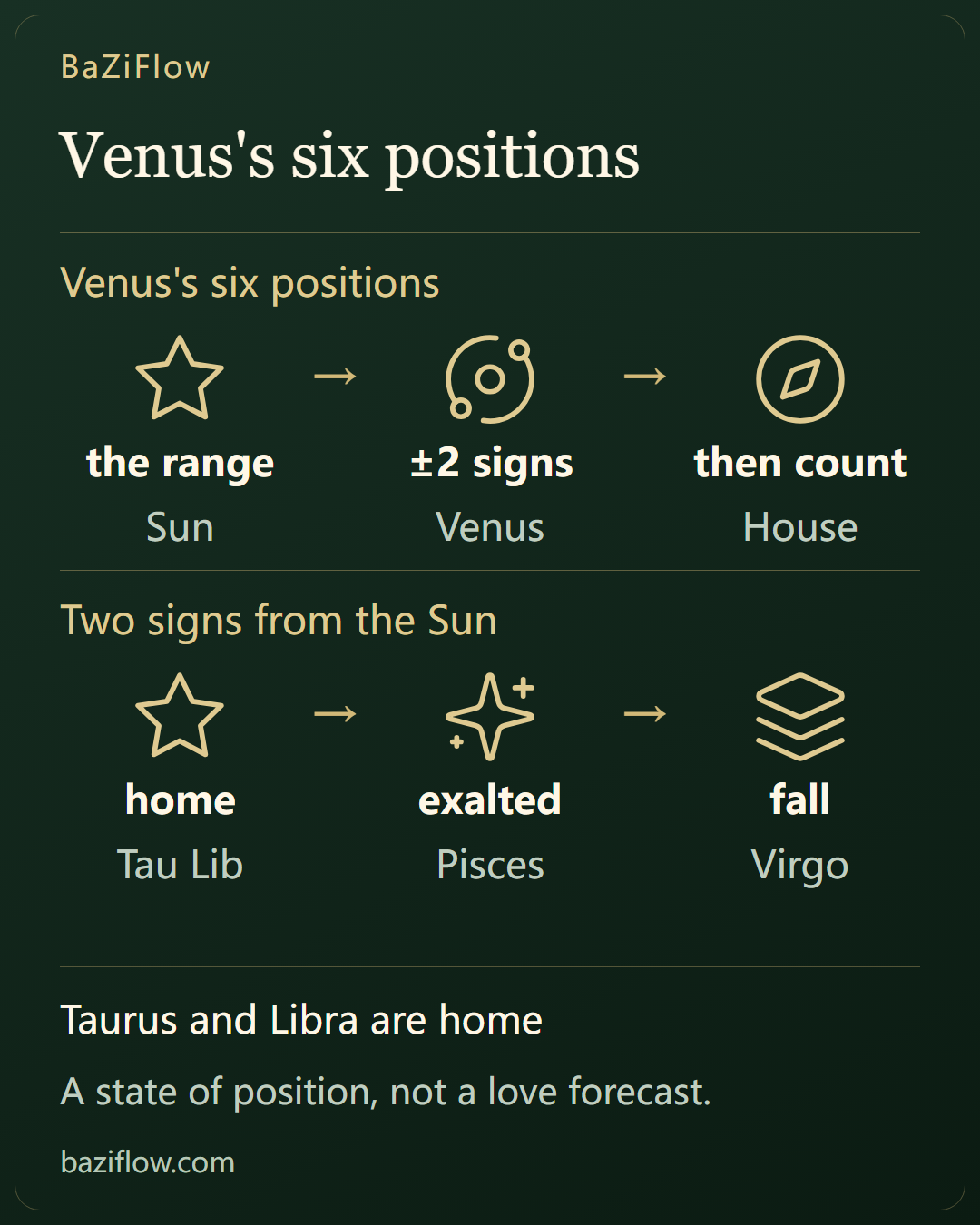
Venus is at home in Taurus and Libra, exalted in Pisces, in detriment in Scorpio and Aries and in fall in Virgo: three opposite pairs. A derivation chart, Ptolemy's reasons and an engine-checked two-sign rule.
The short version6 min read
Venus holds six signs in the site's table, among the most for any planet: domicile in Taurus and Libra, exaltation in Pisces, detriment in Scorpio and Aries, fall in Virgo. The last four follow from "the sign across". Ptolemy says she never strays more than two signs from the Sun, and the engine's daily scan agrees.
- The six positions are three opposite pairs: Taurus–Scorpio, Libra–Aries, Pisces–Virgo. Home and exaltation come first, detriment and fall follow from the signs across; Venus's detriments are Mars's homes and Mars's detriments are Venus's.
- Ptolemy calls Venus temperate with more moisture than heat; her homes sit in Taurus and Libra because they stand at a sextile to the luminaries' homes; she is exalted in Pisces where dampness begins to show, and falls in Virgo across from it.
- Ptolemy says Venus never strays more than two signs from the Sun; the engine's check of 1900 to 2100 gives a peak of 47.27 degrees, so once the Sun's sign is fixed Venus has five signs to choose from.
Read first
Personal, Social and Outer Planets: Use Groups as a Directory ↗
Six positions, three signs to remember
In plain words first: Venus holds six signs in the site's classical table, and six are blank: Gemini, Cancer, Leo, Sagittarius, Capricorn and Aquarius.
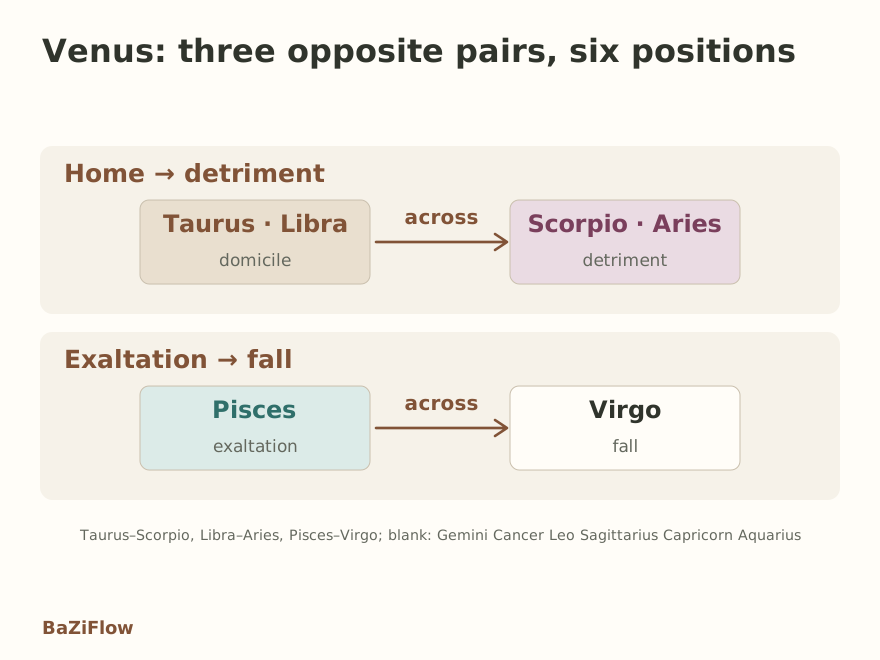
Derivation sketch: both rows go from a favorable state to the sign across; home and exaltation are the premise, detriment and fall are derived.
The two rows show one move repeated: from a favorable state to the sign across. Taurus and Libra are home, and the signs across from them, Scorpio and Aries, are detriment; Pisces is the exaltation, and Virgo across from it is the fall. So memorize Taurus, Libra and Pisces and the other three follow.
Ptolemy's Venus: temperate, more moist than hot
Ptolemy gives Venus a nature temperate like Jupiter's but in the opposite proportion, and moist like the Moon's:
Venus has a temperate nature too, but in the opposite proportion. The heat she makes by nearness to the Sun is smaller than the moisture she makes through the greatness of her light and by gathering the earth's damp vapors as the Moon does.
Three more labels. Venus balances warmth and moisture and so counts as benefic with Jupiter and the Moon (I.5); moist things are feminine, which puts her among the feminine bodies beside the Moon (I.6), and among the nocturnal ones too (I.7).
Enlarge diagram · scroll sideways to read
The four labels put Venus on the Moon's side of the table, farther from the qualities of the Sun, Mars and Saturn.
Home in Taurus and Libra: a sextile to the homes of the lights
The signs are handed out working inward from Saturn. Venus comes below Mars and takes the next two signs:
Venus is temperate, and her orbit lies beneath that of Mars, so she takes the two signs next in line, Taurus and Libra. These are fruitful signs, and they keep harmony with the homes of the lights at a sextile; and this planet is never more than two signs from the Sun.
Enlarge diagram · scroll sideways to read
Each arc in the picture is 60 degrees: Taurus to Cancer, and Libra to Leo. Those distances are the "harmony at a sextile" of the quote. For the other end of the homes, see Taurus and Libra.
Exalted in Pisces, in fall in Virgo: an axis of moist and dry
For the exaltation Ptolemy reasons down from Venus's nature:
Venus is moist and becomes most so in Pisces: from that sign dampness begins to be felt in the air, and she gains an increase of her own nature from standing there, so her exaltation is set in it; her fall is in Virgo.
The other side of Virgo was written for Mercury: he is drier than Venus and so stands opposite her, exalted in Virgo where the dryness of autumn first appears and in fall in Pisces. The two planets' reasons cross over these two signs:
Enlarge diagram · scroll sideways to read
To read the sign itself, see Pisces.
Which sign Venus is in: never two full signs away
Ptolemy writes that Venus is "never more than two signs from the Sun". The engine's day-by-day scan of 1900 to 2100, taken at 12:00 UTC, gives these numbers:
Enlarge diagram · scroll sideways to read
The largest Venus–Sun longitude gap is 47.27 degrees, short of the 60 degrees of two signs, and the sign difference runs only from −2 to +2, twice the reach of Mercury. In a look-up that means: whatever sign the Sun is in, Venus can only be within two signs either side of it, five signs in all.
A complete example: the Sun is in Scorpio, so Venus's five candidates are Virgo, Libra, Scorpio, Sagittarius and Capricorn. Look each one up: Virgo is fall, Libra is domicile, Scorpio is detriment, and Sagittarius and Capricorn carry no entry.
Two exercises
Sun in Scorpio: what state does each of Venus's five candidate signs have?
Virgo is fall, Libra domicile, Scorpio detriment; Sagittarius and Capricorn have no entry.
Sun in Aquarius: can Venus be in domicile?
No. Two signs either side of Aquarius run from Sagittarius to Aries and contain neither Taurus nor Libra; only Pisces (exalted) and Aries (detriment) carry an entry.
Which house Venus is in: at most two houses from the Sun
With one house per sign, a count of signs is a count of houses: Venus is at most two signs from the Sun and so at most two houses.
Find the Sun's sign first
The Sun needs only a date; a sign change needs the exact time, as the Sun article shows.
Filter Venus by two signs
Venus's candidates are the Sun's sign and two signs either side, five in all.
Count houses last
The Ascendant comes from the birth time and place, and in whole-sign houses each sign is one house.
In his account of the fifth house Lilly says Venus rejoices there, since it is the house of pleasure, delight and merriment. Take Sagittarius rising with Venus in Aries. Aries is the fifth sign counting from Sagittarius, so Venus is in the fifth house. The sign table calls Aries her detriment and the house table calls the fifth her joy; two records from two tables, neither canceling nor adding to the other. The Sun can then only be between Aquarius and Gemini, which is houses 3 to 7.
Two more exercises
Scorpio rising, Venus in Libra: which house?
The twelfth. Counting from Scorpio, Libra is the twelfth sign, the one just before the Ascendant.
The Sun is in house 6: which houses can Venus reach at most?
Houses 4 and 8. Venus stays within two houses of the Sun, so six minus two and six plus two.
After Venus comes Mars, and in Mars in sign and house that distance line disappears entirely: Mars can stand on either side of the Sun at any distance.
Questions readers ask next
Venus is in domicile in Taurus and Libra. Do people with Venus in those signs have easier love lives?
Domicile describes the state of Venus as a body standing in Taurus or Libra, so the subject is the planet. Ptolemy's reasons are that the two signs are fruitful and at a harmonious sextile to the lights' homes, and the book draws no conclusion about anyone's love life.
Why does nobody need to memorize Venus's detriment and fall separately?
Because they follow from the opposites: detriment is the sign across from a home, and fall the sign across from the exaltation. Know Taurus, Libra and Pisces and the signs across, Scorpio, Aries and Virgo, give the other three positions.
Why are Venus and Mars so often discussed together?
In this table Venus's detriments, Aries and Scorpio, are Mars's homes, and Mars's detriments, Taurus and Libra, are Venus's homes, so each stands across from the other. Ptolemy also gives Venus her homes right after Mars, in the next two signs.
Was this article helpful?
Sources & references
- Ptolemy, Tetrabiblos Book I (F. E. Robbins text on LacusCurtius): planetary natures, houses, exaltations ↗
- Deborah Houlding, Traditional Sign Rulerships (2003) ↗
- William Lilly, Christian Astrology (1647), Of the Twelve Houses, pp. 50–56 ↗
- William Lilly, Christian Astrology (1647), Book I, Of the Planets (Saturn pp. 57–61, Jupiter pp. 61–65, Mars pp. 65–68, Sun pp. 69–71, Venus pp. 72–75, Mercury pp. 76–79, Moon p. 80ff; Cazimi p. 113) ↗
Continue reading
Mercury: Two Homes, Two Detriments, and the Rule That He Never Strays a Sign from the Sun ↗
Mars by Sign and House: Six Entries, Opposition to the Sun and 162 Days in Cancer ↗