

Eight of Cups: changing attention
Content version · · Sources & references
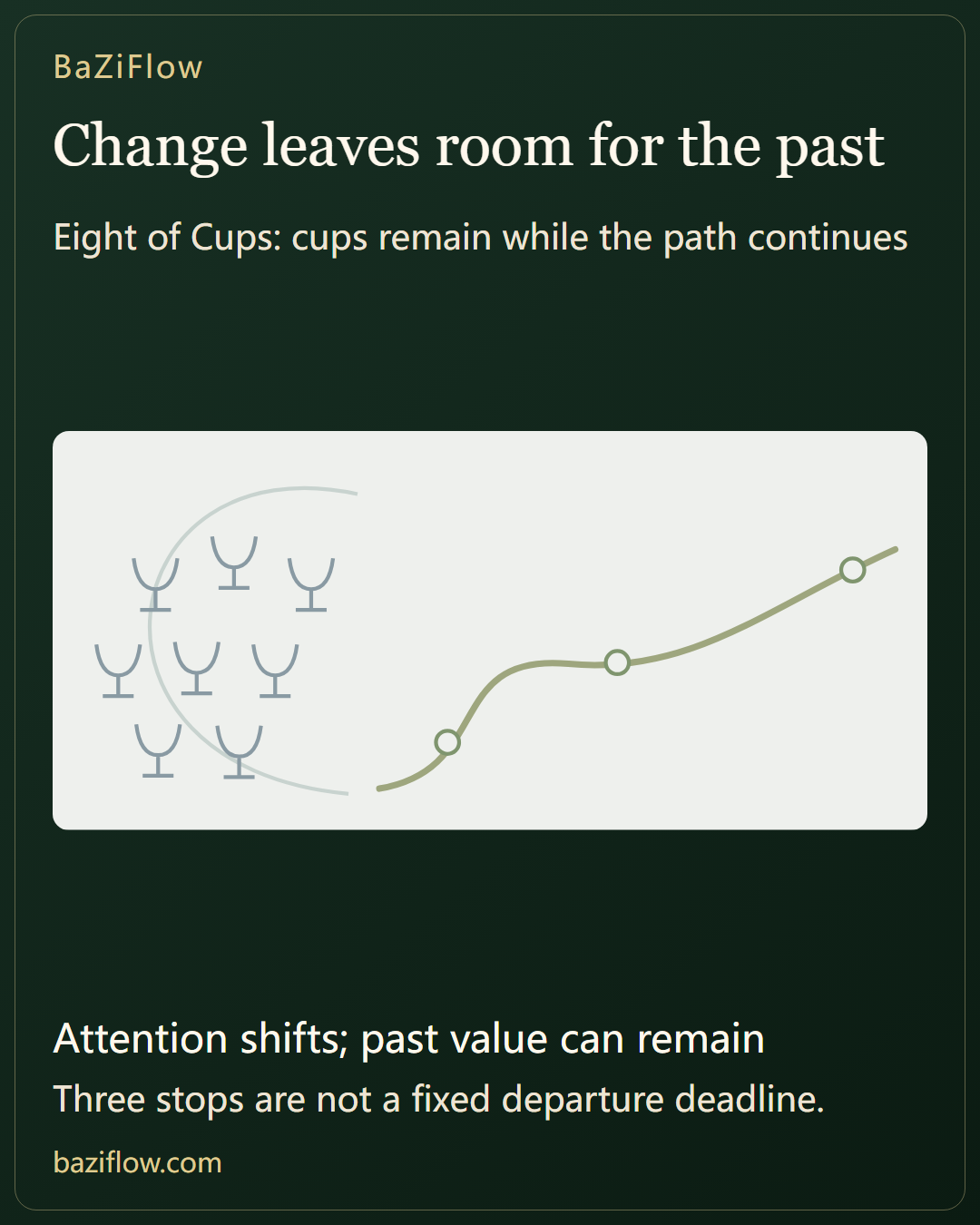
Waite records departure, declining importance, and contradictory readings for the Eight of Cups. Explore changing involvement without treating the card as an instruction to leave.
The short version6 min read
The Eight of Cups sets a departing figure against cups left behind. Past involvement and a present change of direction are visible together. Read that spatial relationship before distinguishing less participation, a temporary pause and an ending.
- The figure moves away from the cups. The change of spatial relationship provides a concrete starting point for discussing altered attention.
- Reducing frequency, taking a break and ending participation are different arrangements, each with its own remaining commitments.
- Waite records decline, opposed readings and reversed joy. His text does not offer only a story in which departure is necessary for growth.
Read first
Ask what has changed in the actual activity
On the RWS card, a figure in a red cloak, leaning on a staff and seen from behind, walks away toward the mountains and water. Eight cups are stacked in two rows in the foreground, with a gap in the upper row, and a round moon with a face, a crescent drawn within the disk, hangs in the sky.
Consider a weekly reading group that once suited you well. Recently you have wanted longer periods of solitary reading. The group may still be valuable, and the earlier enjoyment may have been real. The change could concern frequency rather than the people, or the kind of reading you want rather than the quality of the meetings.
That specificity matters. If the problem is a weekly commitment, attending occasionally may address it. If you no longer want to participate at all, describing the change as a brief busy period may leave others planning around an expectation you no longer share. The card cannot choose between those situations; your account has to distinguish them.
| Possible change | A concrete question |
|---|---|
| Fewer weekly notes | Is the desired change frequency or participation itself? |
| A period of reading alone | What is being tried, and when might it be reviewed? |
| Ending membership | Which outstanding arrangements need to be addressed? |
An agreement to host the next discussion remains a separate matter. You can fulfill it or renegotiate it in time, according to the group's arrangements. Wanting a different rhythm does not silently transfer the task to somebody else.
Reduce
- Less often
- Still involved
Pause
- A break
- Review later
End
- Stop taking part
- Settle tasks
These are scopes of an arrangement, not ranks of card meaning
Departure is an image, not an instruction
The RWS Eight of Cups shows someone leaving. That description does not establish that the reader ought to leave a relationship, a job, or a community. Moving from an image to a personal directive skips the circumstances that would make the decision understandable: what has changed, what remains agreed, and which alternatives actually exist.
Even Waite's text resists a single uplifting departure story. He describes a dejected figure deserting cups associated with felicity, an enterprise, an undertaking, or a previous concern. He then records readings that he calls entirely opposed, involving joy, mildness, timidity, honor, and modesty.
His practical account includes the decline of a matter, or the discovery that something previously considered important is of relatively little consequence, for good or ill. The reversed entry names great joy, happiness, and feasting. Neither a compulsory search for a truer self nor a fixed reversed meaning of being unable to leave captures all of that material.
Text layer
Image description
- Material retained
- A figure leaves cups
- Role in reading
- Observe action and object
Main meanings
- Material retained
- Declining importance; opposed terms
- Role in reading
- Keep differences visible
Reversed entry
- Material retained
- Joy, happiness, feasting
- Role in reading
- Not automatically being trapped
Read the path without turning it into a deadline
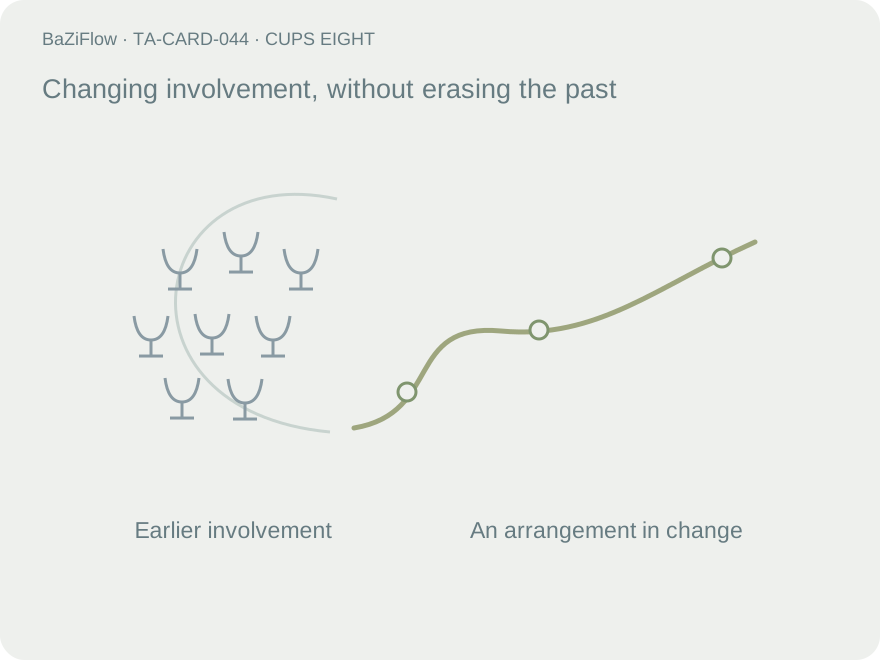
An original BaZiFlow diagram of changing attention. The path makes change observable; its stops are not a prediction in days or months.
The cups remain at the left of the drawing. A path passes beside them rather than breaking them, and its stopping points have unequal spacing. It illustrates the possibility of attending to changes at different moments, not a required sequence of three steps or a timetable of eight days or eight months.
For the group example, one note might record the arrangement for this month, another the discussion-hosting commitment, and a later one the experience of reading independently. Those entries acquire meaning from the situation. The diagram does not tell you when a departure must happen or where it must lead.
Remaining welcome at the group does not mean that you have agreed to return weekly. Saying that you are taking a break does not give others access to private reasons you do not wish to disclose. A clear account can communicate the part affecting shared plans while preserving personal boundaries.
Let the past retain its own truth
People sometimes make departure feel permissible by rewriting every earlier benefit as a waste. They may also feel that genuine past happiness obliges them to preserve the same involvement forever. Both moves collapse different moments into one verdict.
You can say that discussion used to be the part you most anticipated and that uninterrupted reading now matters more. You can also say that the time available has changed. Neither statement requires a judgment that other members should leave or that the activity has objectively lost all value.
Waite's account of altered importance offers a useful point of contact here, but the reading-group example is a modern application, not a historical case contained in his book. It should be assessed through what the participant actually reports. If no such change is known, the article does not invent one because the card appeared.
Then
- Discussion was useful
- Weekly attendance suited me
Now
- I want quiet reading
- A different frequency fits
Compare one person at two times, without speaking for other members
Review an arrangement that can still be revised
The supplementary chapter contains older gendered and marital predictions, which are not adopted here as evidence about a present relationship. Its reversed satisfaction is also a recorded interpretive claim, not proof that a decision will produce happiness. Keeping these source boundaries visible is preferable to combining contradictory terms into a promise.
The Seven of Cups can distinguish imagined possibilities from available options. This Eight may instead focus on changing involvement in something already familiar. Their sequence does not require every reader to enact a story from confusion to departure. State your convention when using upright and reversed methods.
At review, check whether outstanding commitments were handled, whether others understand the current arrangement, and whether the new rhythm still reflects what you want. If solitary reading proves unsatisfying, changing the arrangement again is allowed. There is no need to preserve the first interpretation at the expense of later information.
A useful record names what has stopped, what remains, and what will be reconsidered. It does not need a claim that leaving is always growth, staying is always fear, or a changed preference makes the past untrue.
Name the change
Describe the part of the actual activity that stops or becomes less frequent.
Retain valid agreements
Address hosting, handover and invitations individually instead of assuming cancellation.
Allow another adjustment
Experience after a trial may change the arrangement without defending the first reading.
Questions readers ask next
Why connect the Eight of Cups with changing attention?
The image separates a departing figure from cups behind, and Waite connects those cups with previous concerns. Action and object support discussion of altered importance; the reading-group example is a modern application, not his historical case.
Does drawing this card require ending a relationship?
No. The pictured departure leaves several practical possibilities open: reduced frequency, a pause or an ending. Distinguish them through actual wishes and agreements, rather than deriving a decision or date from cup count or path length.
Does the reversed Eight only mean being unable to leave?
Waite’s main entry includes joy, happiness and feasting, while the supplement adds satisfaction. These historical entries differ from some modern approaches. Identify the method being used instead of calling one convention the only original meaning.
Was this article helpful?
Sources & references
Continue reading
Seven of Cups: distinguish an attractive possibility from an available option ↗