

Kui: estrangement told through meetings
Content version · · Sources & references
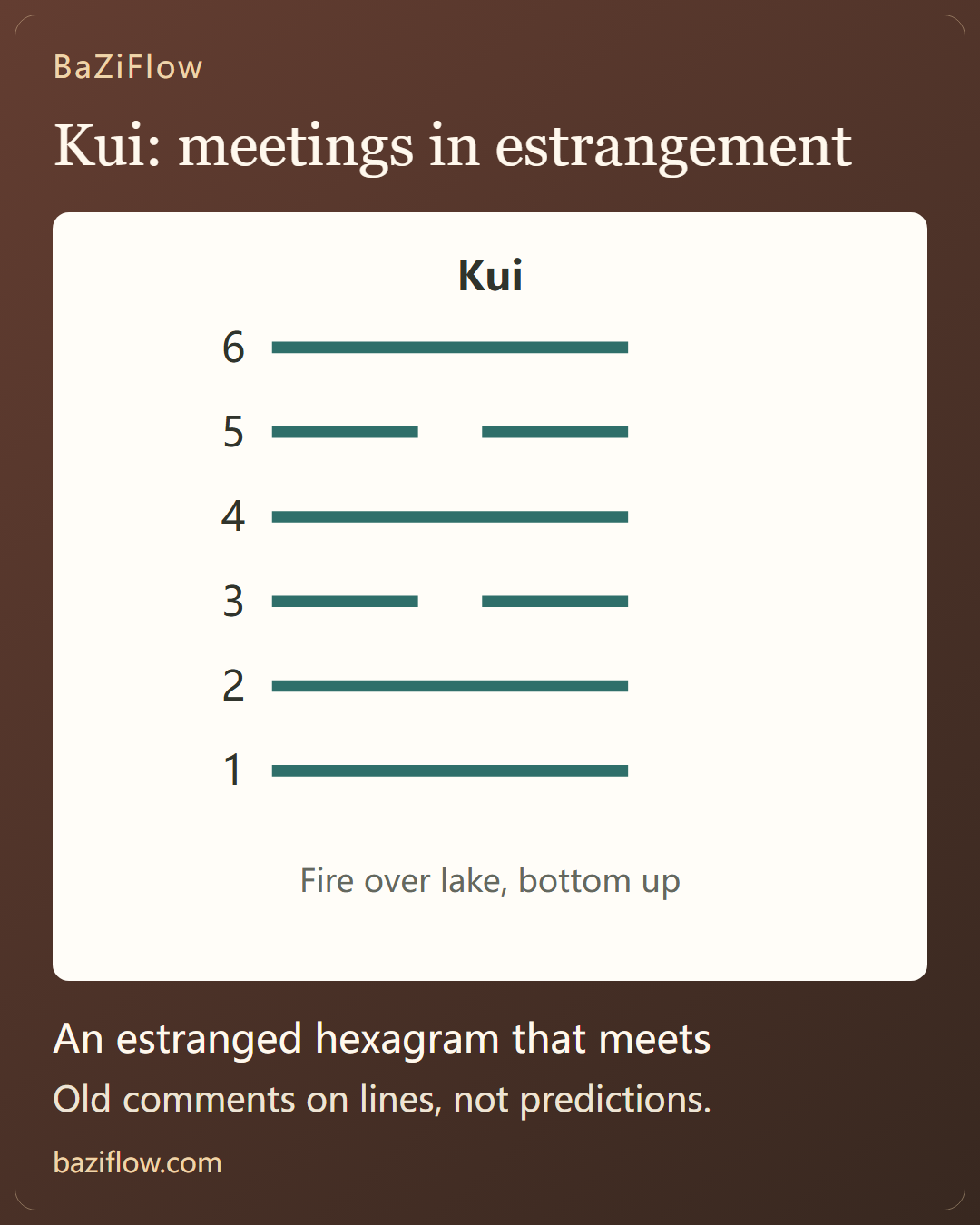
Kui is the 38th hexagram: Li (fire) above Dui (lake), one moving up and one moving down. Read the Commentary on the Judgments, the Great Image on being alike yet different, and the verbs “see” and “meet” in its lines.
The short version8 min read
The name means estrangement, yet nearly every line is about an encounter: a bad man, a lord in a lane, a dragged cart, a worthy man, rain. The text uses these verbs to show estrangement being met.
- Kui puts Li (fire) over Dui (lake). The Commentary on the Judgments says fire moves up and the lake moves down, so the two motions part from the start; the judgment grants only “good fortune in small matters”.
- The Commentary ends with three parallel pairs: heaven and earth at odds yet with the same work, man and woman at odds yet with wills that connect, the myriad things at odds yet of one kind. The Great Image turns the order around: alike yet different.
- Five of the six lines contain “see” or “meet”. “Alone in estrangement” occurs twice: line 4 meets a worthy man and exchanges trust, line 6 meets rain and the many doubts are gone.
Read first
The Sixty-Four Hexagrams: How Upper and Lower Trigrams Form One Figure ↗
Judgment and Line Statements: Whole Hexagram or Single Line? ↗
Fire above, lake below: a hexagram of two directions
Kui (睽) is Li (fire) above and Dui (lake) below. The Shuo Gua gives Li the word “clinging”, and Dui the word “pleased”. Read upward, the lines are yang, yang, yin, yang, yin, yang. The yin lines occupy only the third and fifth places, and each has a yang line on either side.
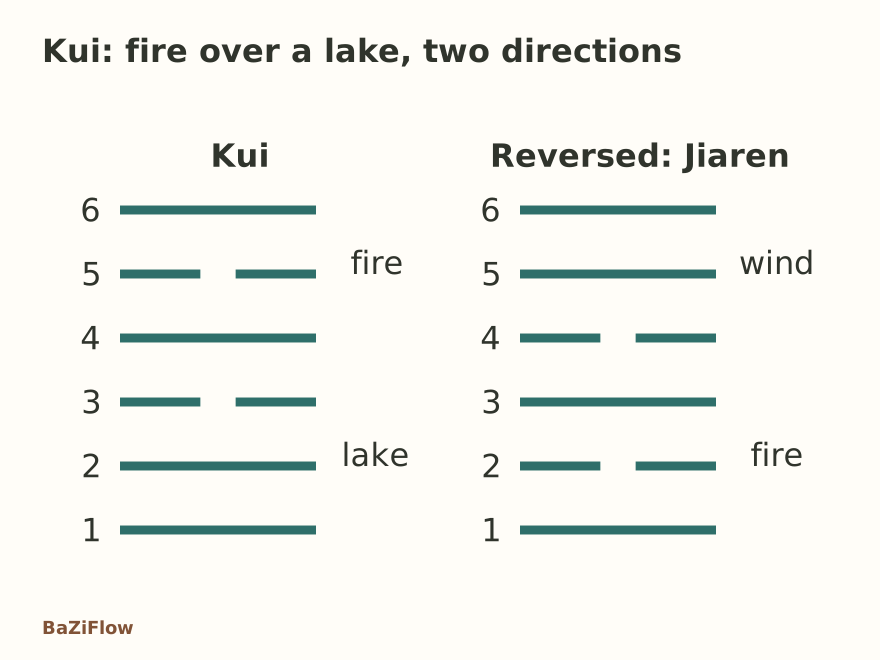
Kui and its reversed hexagram Jiaren: the reversed hexagram turns the whole figure upside down, so the fire that is above in Kui sits below in Jiaren.
Enlarge diagram · scroll sideways to read
Kui, two women, pleased and clinging
- Kui
- The Xu Gua glosses it directly: Kui means to be at odds, out of agreement.
- Two women
- In the Shuo Gua, Li is the middle daughter and Dui the youngest daughter. The Commentary says “two women live together, but their wills do not go the same way”, and it is speaking of the upper and lower trigrams.
- Pleased and clinging
- Dui’s “pleased” sits below and Li’s “clinging” above. The second half of the Commentary joins them in the phrase “pleased and clinging to brightness”.
The judgment and the Commentary: why apart, and why still fortunate
The judgment of Kui is three words: in small matters, good fortune. The Commentary on the Judgments takes it in three steps: why this is estrangement, why it is still fortunate, and finally three pairs that stretch the word to heaven and earth, man and woman, and the myriad things.
Kui: fire moves upward and the lake moves downward. Two women live together, but their wills do not go the same way. It is pleased and clings to brightness; the soft advances and moves upward, attains the middle and answers the firm. Therefore, in small matters, good fortune.
Enlarge diagram · scroll sideways to read
The first half can be seen on the figure at a glance: flames rise, lake water sinks, and the upper and lower trigrams part from the start. The second half can be checked too. The lower trigram Dui is “pleased” and the upper trigram Li is “bright”, with the pleased one below and the bright one above, which is “pleased and clinging to brightness”. Line 5 is the yin line seated at the center of Li, and it faces line 2, a yang line at the center of Dui; a yin and a yang that answer across the two trigrams are what “attains the middle and answers the firm” refers to. Because of these, fortune comes, but only for small matters.
The last three pairs of clauses in the Commentary share one pattern:
Heaven and earth are at odds, yet their work is the same. Man and woman are at odds, yet their wills connect. The myriad things are at odds, yet their affairs are of one kind. How great is the use of the time of estrangement!
Each pair admits the separation first and then names one thing held in common: the same work, wills that connect, affairs of a kind. The closing “use of the time” says that estrangement has its own use when its time comes.
The Great Image: alike yet different, in the opposite order
The Great Image (大象) of Kui is one sentence:
Above, fire; below, a lake: Kui. The noble person is alike, and yet different.
“Above, fire; below, a lake” just reads the figure. The conduct drawn from it is “alike and yet different”: the two words are joined by “and yet” and are not spelled out further. Tradition usually reads it as keeping one’s own differences within what is shared.
Enlarge diagram · scroll sideways to read
Read the two side by side and “same” and “different” come in opposite order. The Commentary speaks of heaven, earth and the myriad things and runs from apart to shared. The Great Image gives the noble person a way of acting and runs from shared to distinct.
Six lines: five of them say “see” or “meet”
Kui is a hexagram of estrangement, yet its six statements are nearly all about encounters. Line 1 “sees a bad man”, line 2 “meets the lord in a lane”, line 3 “sees the cart dragged back” (and its Small Image adds “meets the firm”), line 4 “meets a worthy man”, and line 6 “sees a pig covered in mud” and, going on, “meets rain”. In five of the six lines a word for seeing or meeting appears. Only line 5 is different: it speaks of “his clan”, his own kin.
Enlarge diagram · scroll sideways to read
The early encounters carry difficulty. Line 1 has lost a horse and is told not to chase it; it comes back by itself. He sees a bad man, and the Small Image says this is how to avoid blame. At line 2 he runs into “the lord” in a lane, and the Small Image comments that he has kept to the road. Line 3 is written heaviest: the cart is dragged back, the ox is held fast, the man is branded on the forehead and his nose is cut. The statement judges “no beginning, but an end”, and the Small Image says the position is unfitting and the end is “meeting the firm”.
Lines 4 and 6 both say “alone in estrangement”, and their endings are alike. Line 4 meets a worthy man, and they exchange trust: danger, but no blame. Line 6 first draws the bow and afterwards lays it down, because the visitors turn out to be no bandits but a party come to arrange a marriage. Tradition usually reads the “lay down” as setting the bow aside. Going on and meeting rain is fortunate, and the Small Image comment is “the many doubts are gone”.
The pig and the bow in line 6 can be linked to this Kan. Lines 3 to 5 of Kui are yin, yang, yin, which make Kan. The Shuo Gua says “Kan is the pig” and, elsewhere, that Kan is “the bow and the wheel”. Both images in line 6 can be found there.
Jiaren, Jian and Jiji: neighbors of Kui
Turn Kui upside down and you get Jiaren (家人), so Jiaren is the reversed hexagram (综卦) of Kui (see the figure above). The Xu Gua places Kui after Jiaren and says that when the way of the household runs out, things drift apart, adding that Kui means to be at odds. The Za Gua gives each of the two one word: Kui is “outer” and Jiaren is “inner”.
The inverse hexagram (错卦) is Jian (蹇), which you get by changing every line of Kui to its opposite. The nuclear hexagram (互卦) is Jiji (既济): lines 2 to 4 are yang, yin, yang (Li) and lines 3 to 5 are yin, yang, yin (Kan), and with Li below and Kan above they stack into Jiji.
Enlarge diagram · scroll sideways to read
The hexagram after Kui is Jian. The Xu Gua’s link is that estrangement is bound to bring hardship.
Questions readers ask next
Does Kui say two people are bound to be incompatible?
The text does not say so. The Xu Gua glosses the name as being at odds, but the Commentary goes straight on to “pleased and clinging to brightness” and “attains the middle and answers the firm”, and closes with three pairs that start apart and end alike.
What is “a cart full of ghosts”?
It is one of the sights in line 6, next to a pig covered in mud. Tradition usually reads both as the fears of a mind that sees danger everywhere, and the Small Image comment, “the many doubts are gone”, is addressed to exactly that.
How are Kui and Jiaren related?
They are each other’s reversed hexagram: turn Kui upside down and you have Jiaren. The Xu Gua says that when the way of the household runs out, estrangement follows, and the Za Gua gives one word to each: Kui is “outer”, Jiaren is “inner”.
Was this article helpful?
Sources & references
Continue reading
Jiaren: wind from fire, from “set a guard” to “turning back to oneself” ↗
Jian (蹇): water over a mountain, and four ways of coming after “going is blocked” ↗
The Sixty-Four Hexagrams: How Upper and Lower Trigrams Form One Figure ↗
Judgment and Line Statements: Whole Hexagram or Single Line? ↗