

The sextile (60°): conditions and orbs
Content version · · Sources & references
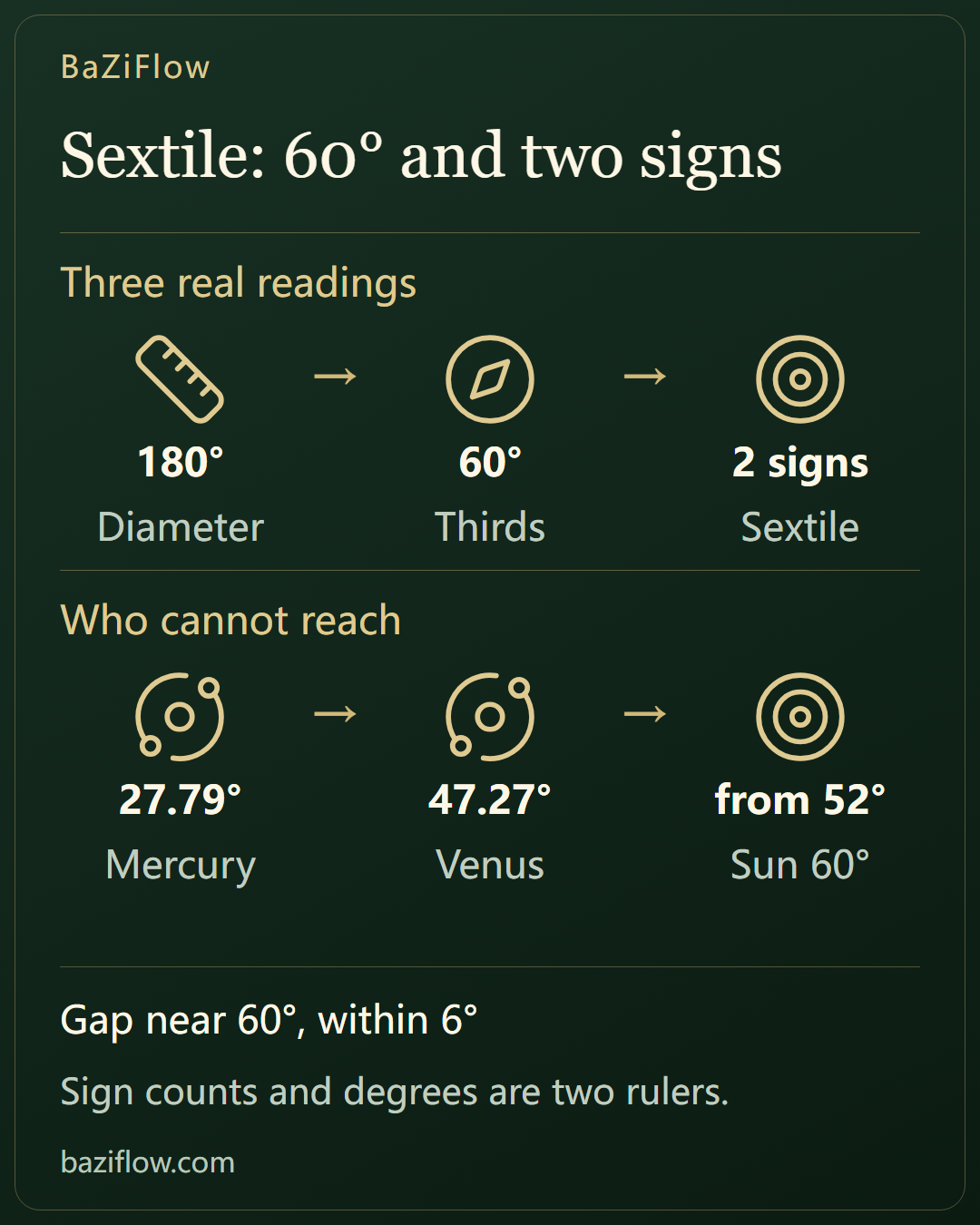
The sextile is a longitude gap near 60°. From Ptolemy cutting the diameter in thirds to three real 2026 readings, why Mercury and Venus cannot reach the Sun's sextile, and sign counting versus degree counting.
The short version6 min read
The sextile is a longitude gap of about 60°: Ptolemy builds it by cutting the diameter in thirds, and the site judges it by degrees, within 6° of 60° (8° when the Sun or Moon is involved).
- Ptolemy cuts the diameter into thirds and each part is 60°. That is also the span of two signs, and it joins signs of the same gender.
- The site tests the sextile by degrees: within 6° of 60° (8° with the Sun or Moon). Real readings are rarely exactly 60°, and tightness is a separate number.
- Mercury strays at most 27.79° from the Sun and Venus 47.27°, so neither reaches 52°, the lower edge of the Sun's sextile window. Other planet pairs have no such cap.
Read first
Aspects and orbs in astrology: how to calculate the angle between two planets ↗
Cut the diameter in thirds: where 60° comes from
In plain words first: the sextile is a third of a half-circle. In the chapter of the Tetrabiblos on the aspects between signs (I.13, which Ashmand numbers XVI), Ptolemy does not reach it from experience but from a drawing: join a diameter (two right angles, 180°), cut it in halves to get the quartile, and in thirds to get the sextile and the trine.
The same chapter adds one more step: the sextile of 60° plus half of itself is exactly the quartile of 90°, and the quartile of 90° plus a third of itself is exactly the trine of 120°. The three angles lock together.
Enlarge diagram · scroll sideways to read
Real sextiles are rarely exactly 60°
The site does not count signs for a sextile. It only asks how far the longitude gap is from 60°. The window is 54°–66°, or 52°–68° when the Sun or Moon is involved. Three readings from 2026 are ready to hand:
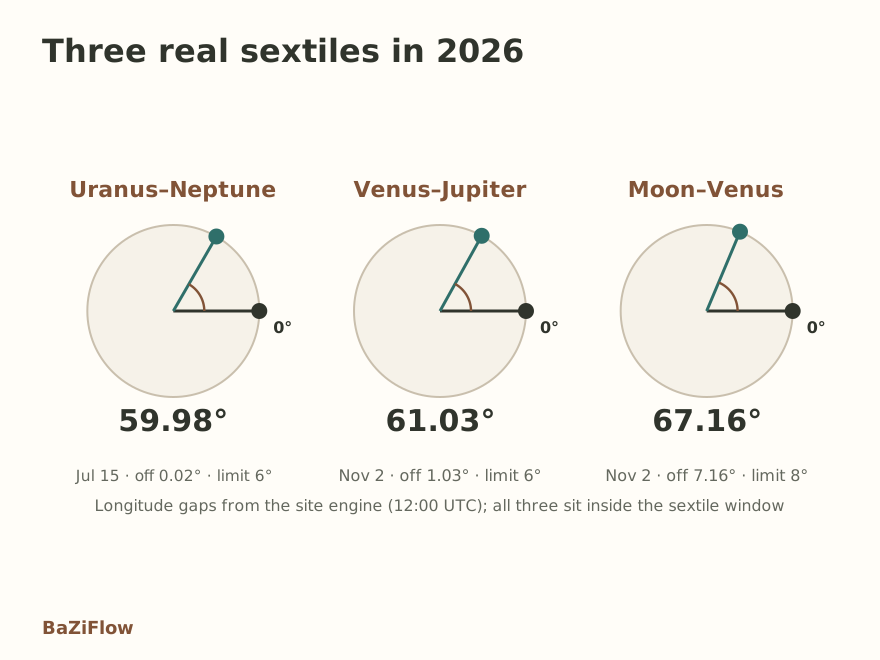
Readings from the site engine (12:00 UTC). On each dial the start line is at the right, the blue line is the second body relative to the first, and the number is the longitude gap.
Uranus and Neptune were 59.98° apart at 12:00 UTC on July 15, and exact at about 22:20 that day. Venus and Jupiter stood 61.03° apart on November 2, a deviation of 1.03° and closing. The Moon and Venus were 67.16° apart the same day, 7.16° off, inside the 8° allowed because the Moon takes part, so it holds too, but with a tightness of just 0.11.
Enlarge diagram · scroll sideways to read
How long they last differs even more. Uranus and Neptune first entered the window in the second half of 2023, came back in mid-May 2024 and stay until early September 2028, with two brief returns until June 2030. The Moon covers a dozen degrees a day, so a window involving the Moon usually lasts only a day or so.
Two signs apart means the same gender: why Ptolemy calls it "harmonious"
In Book I chapter 12 (XV in Ashmand's numbering) Ptolemy divides the twelve signs by alternation into masculine (diurnal) and feminine (nocturnal): Aries and Libra masculine, the Taurus and Scorpio that follow them feminine, and so on in turn. Because the sign count alternates odd and even, two signs two apart always share a gender.
Enlarge diagram · scroll sideways to read
Chapter 13 of the same book then says the sextile and the trine are "harmonious" because they join signs of the same kind, all masculine or all feminine. That "harmonious" is a classification of the signs' gender. The site table keeps the same label, but a sextile holds by degrees and the engine never checks which sign either planet is in.
Mercury and Venus can never form a sextile to the Sun
A window starting at 52° needs two bodies able to stand that far apart. Sun-Mercury and Sun-Venus have a built-in cap: Mercury strays at most 27.79° from the Sun and Venus 47.27° (a daily scan of 1900–2100 on the site engine). Ptolemy, in Book I chapter 17 (XX in Ashmand's numbering), says nearly the same: Mercury never goes more than one sign from the Sun, Venus never more than two.
Enlarge diagram · scroll sideways to read
So the Sun never forms a sextile to Mercury or Venus, while other planet pairs have no such cap. Mercury and Venus can open up to 73.76° from each other (March 14, 2060), so a sextile between them is possible: on August 5, 2026 Mercury stood at 24°06′ Cancer and Venus at 28°40′ Virgo, 64.57° apart, and it holds.
Counting signs or measuring degrees: two rulers, two sextiles
Ptolemy counts a sextile in signs: two apart is a sextile. The site measures degrees. The two usually agree, but they part company near sign borders.
Enlarge diagram · scroll sideways to read
On April 19 Venus stood at 24°18′ Taurus and Jupiter at 17°27′ Cancer, two signs apart and a sextile by count; but the longitude gap of 53.14° is 6.86° from 60°, past 6°, so the site does not count it. On June 29 Mars stood at 0°29′ Gemini and Jupiter at 29°50′ Cancer, adjacent signs, which Ptolemy calls "inconjunct"; yet the gap is 59.35°, only 0.65° off, and the site counts a sextile with a tightness of 0.89.
Two exercises
A longitude gap of 62° between two planets: a sextile or not?
Off by 2° with a limit of 6°, so it holds; tightness 1 − 2÷6, about 0.67.
Can the Sun and Venus ever form a sextile?
No. Venus strays at most 47.27° from the Sun and the window starts at 52°.
Next along the table comes the square (90°), and before it comes the conjunction (0°); to measure a gap yourself, begin with aspect angles and orbs.
Questions readers ask next
Does a sextile have to be exactly 60°?
No. The window is 6° either side of 60°, or 8° when the Sun or Moon takes part. Readings of 59.98° and 61.03° both hold; they differ only in tightness, 0.997 against 0.83.
How long can one sextile last?
It depends on how fast the two bodies move relative to each other. Uranus and Neptune were exact on July 15, 2026 and stay inside the window until early September 2028, while a sextile involving the Moon usually passes in a day or so.
Are two planets two signs apart always in sextile?
No, the site needs degrees. On April 19, 2026 Venus stood at 24° Taurus and Jupiter at 17° Cancer, two signs apart, yet only 53.14° apart in longitude, outside the window.
Was this article helpful?
Sources & references
Continue reading
The Conjunction (0°): When Two Longitudes Count as One, Seen in Jupiter and Saturn in 2020 ↗
The Square (90°): Signs Three Apart Form a Cross, and the Quarter Moon Is One ↗
Conjunction, opposition and square aspects: measure the angle before judging good or bad ↗