

Knight of Pentacles: slow horse, shown coin
Content version · · Sources & references
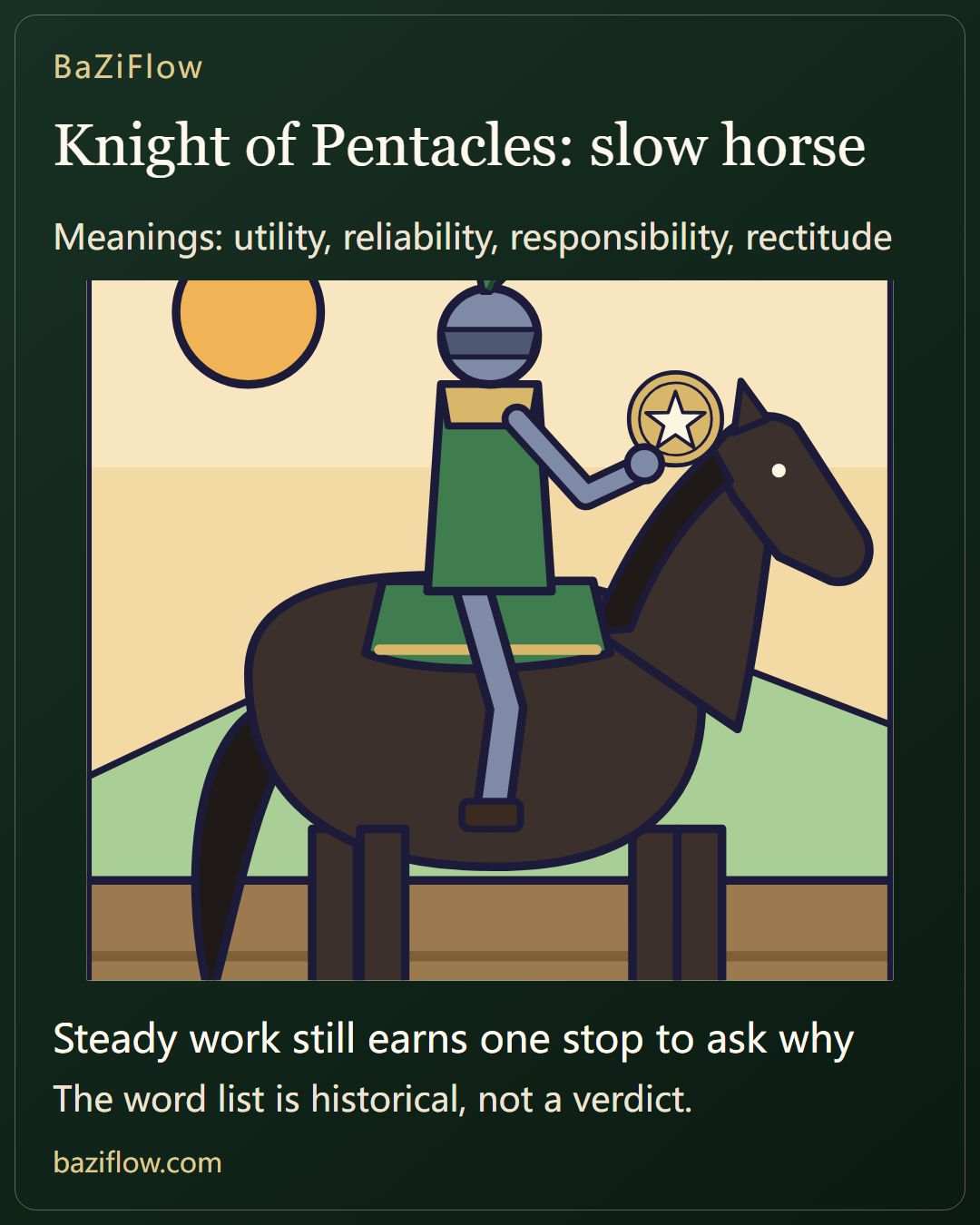
The Knight of Pentacles rides a slow, heavy horse and shows his coin without looking in. Separate Waite’s word list, its limiting phrase and the extras, then practice pace, a checklist and one stop to look inside.
The short version6 min read
The Knight of Pentacles rides a slow, heavy horse and holds the coin out without looking into it. Waite’s word list therefore sits on visible matters: useful, reliable, checkable.
- Waite’s description is two sentences: a slow, enduring, heavy horse, with the rider’s aspect matching it, and a symbol exhibited but not looked into.
- The list runs utility, serviceableness, interest, responsibility, rectitude, with one limiting phrase: all on the normal and external plane. The extras read “a useful man; useful discoveries”.
- Reversed reads inertia, idleness, repose of that kind, stagnation, then placidity, discouragement, carelessness; the extras give a brave man out of employment.
Read first
A heavy horse and a coin shown: rider and mount keep one tempo
Waite describes this knight in two sentences. He rides a slow, enduring, heavy horse, to which his own aspect corresponds. He exhibits his symbol, but does not look therein.
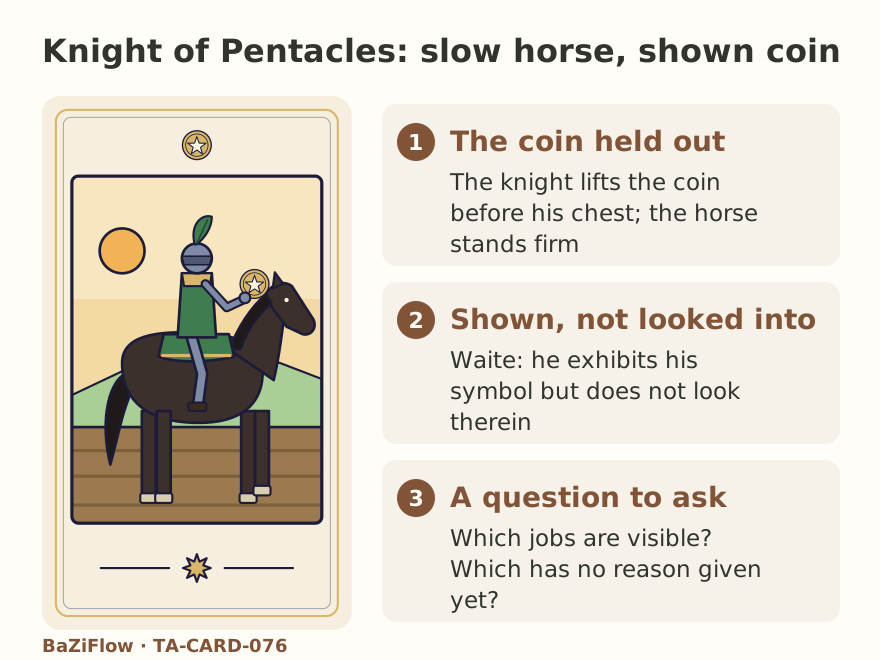
Knight of Pentacles: slow horse, shown coin
On the Rider-Waite-Smith card the armored knight wears a helmet crested with green leaves and holds the coin in a red glove before his chest. The black horse stands in profile, planted firmly on the ground, its harness hung with red-and-dotted straps; behind are furrows of red and brown and a small clump of trees on the horizon. In BaZiFlow’s original card the horse stands just as firmly, the knight’s helmet carries a green plume, one hand holds the coin out before him, and a sun, green hills and a plowed field lie behind.
“His own aspect corresponds” means rider and mount keep one tempo, so they are read together.
Enlarge diagram · scroll sideways to read
What Waite lists: utility, reliability, responsibility, all “on the normal and external plane”
Waite’s divinatory meanings are five words and a limiting phrase: utility, serviceableness, interest, responsibility, rectitude, noted as “all on the normal and external plane”.
Utility, serviceableness, interest, responsibility, rectitude—all on the normal and external plane.
That phrase is the key to the whole card. All five words name things others can see and check: whether the work was done, whether it was done steadily. The additional meanings are only two phrases: a useful man, and useful discoveries.
Enlarge diagram · scroll sideways to read
“Interest” in English covers curiosity and concern as well as advantage. Waite does not expand on it, so let the context of the question decide.
Horse, coin, external plane: three things and where each comes from
Three things on this card deserve a word of their own: the horse, the coin and the limiting phrase.
Three things, each with its source
- Horse
- Slow, enduring, heavy: all three words are Waite’s, and he adds that the rider’s aspect corresponds. He attaches no symbolism to the horse.
- Coin
- Shown for others to see; Waite writes that the knight does not look therein and does not explain what that implies. The sign of the whole suit is a coin engraved with the pentagram, as he notes under the King of Pentacles.
- External plane
- This is Waite’s limit on the word list, and “normal” and “external” are his words. Reading it as “things that can be checked” is teaching’s paraphrase.
Enlarge diagram · scroll sideways to read
How to read it: a hanging checklist, one stop to look into the coin at each station
The card’s shape is a slow horse, a coin shown, and an outer plane. Carried to an everyday matter, it becomes three moves: set a pace, list the boxes, stop and ask.
Set a pace for the horse
Waite’s horse is slow, enduring, heavy. First ask whether the job gets done by steady daily progress or by a sprint on the last night; fix the daily amount before you talk about the total schedule.
List the outer plane as boxes
The list is limited to the normal, external plane, so write out the checkable jobs: is the frame level, is the label stuck on, does the light reach the picture? Each box takes only yes or no.
At each checkpoint, stop and look into the coin once
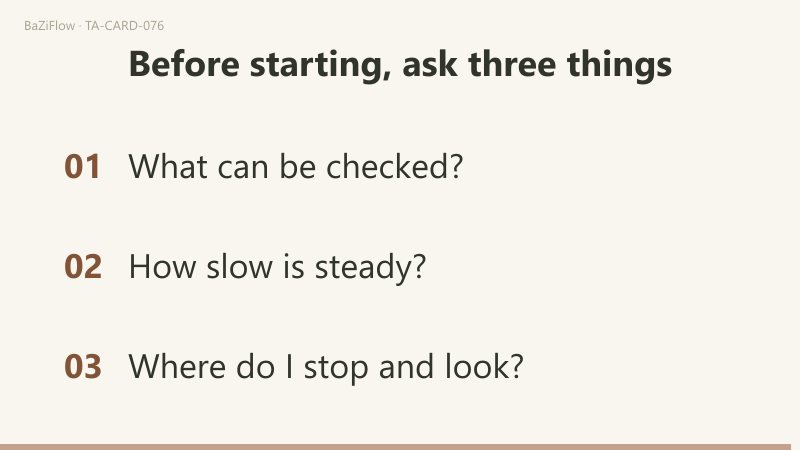
The knight shows the coin and does not look. After each stretch, stop once and ask who this box is for and why it is there. Then ride on.
An example: three people hang a small photography show, opening on Friday evening, with hanging starting on Wednesday. The checklist can run in two rows:
Enlarge diagram · scroll sideways to read
What this knight gives and leaves out
Gives
- A checklist you can verify
- A steady rhythm of progress
Leaves out
- What each box is for
- Whether others are pleased
Add a line
- Ask why at each checkpoint
- Walk the show as a visitor
Reversed and neighboring cards: stillness “of that kind”, and three horses at other paces
Waite’s reversed reading is: inertia, idleness, repose of that kind, stagnation; also placidity, discouragement, carelessness.
Inertia, idleness, repose of that kind, stagnation; also placidity, discouragement, carelessness.
“Of that kind” can be read as pointing back to the normal plane of the upright entry (Waite does not explain it, so this is one reading); read that way, this stagnation is also a matter of the same plane; placidity sits under “also”, in a milder tone than inertia. In the additional meanings the upright is “a useful man; useful discoveries” and the reversed “a brave man out of employment”, wording of other readers of the time.
Enlarge diagram · scroll sideways to read
Four knights, four horses, four paces
As if on a journey
Short wand in hand, on the move, with a horse that hints at a hasty mood. The list: departure, absence, flight, emigration.
Flat out
He charges as though driving enemies before him, a romantic hero of chivalry. The list: skill, bravery, capacity, defence; the same entry also holds hostility and war.
An easy canter
Graceful rather than warlike, under a winged helmet. The list: arrival, approach, proposition, invitation. The Knight of Pentacles is the fourth horse, and the slowest and heaviest.
Questions readers ask next
The Knight of Pentacles is a slow card. Does it mean procrastination?
Waite writes that the horse is slow and enduring, and the upright list has no word for delay; inertia, idleness and stagnation come only in the reversed entry. Upright, slowness stands beside utility, reliability and responsibility, which reads more like a way of writing stamina. Whether it turns into stagnation depends on the matter you are asking about.
The list says “interest”. Is the card about money?
The word in English covers advantage as well as curiosity and concern. Not one word in Waite’s list speaks of money directly, so let your question decide which sense applies, and if unsure write both down.
What is “repose of that kind” in the reversed list?
The phrase can be read as pointing back to the normal plane named in the upright entry (Waite does not explain it, so this is one reading): read that way, this stillness is a matter of the same plane and is not moved to a different one. The extras’ “brave man out of employment” is the older wording of other readers.
Was this article helpful?
Sources & references
Continue reading
Page of Pentacles: eyes lifted to one coin, and “insensible of that which is about him” ↗
Queen of Pentacles: a gaze at the coin in her lap, and a list of opulence and security ↗