

Tian Fu: Wood in Xun Four and the Tian Fu hour
Content version · · Sources & references
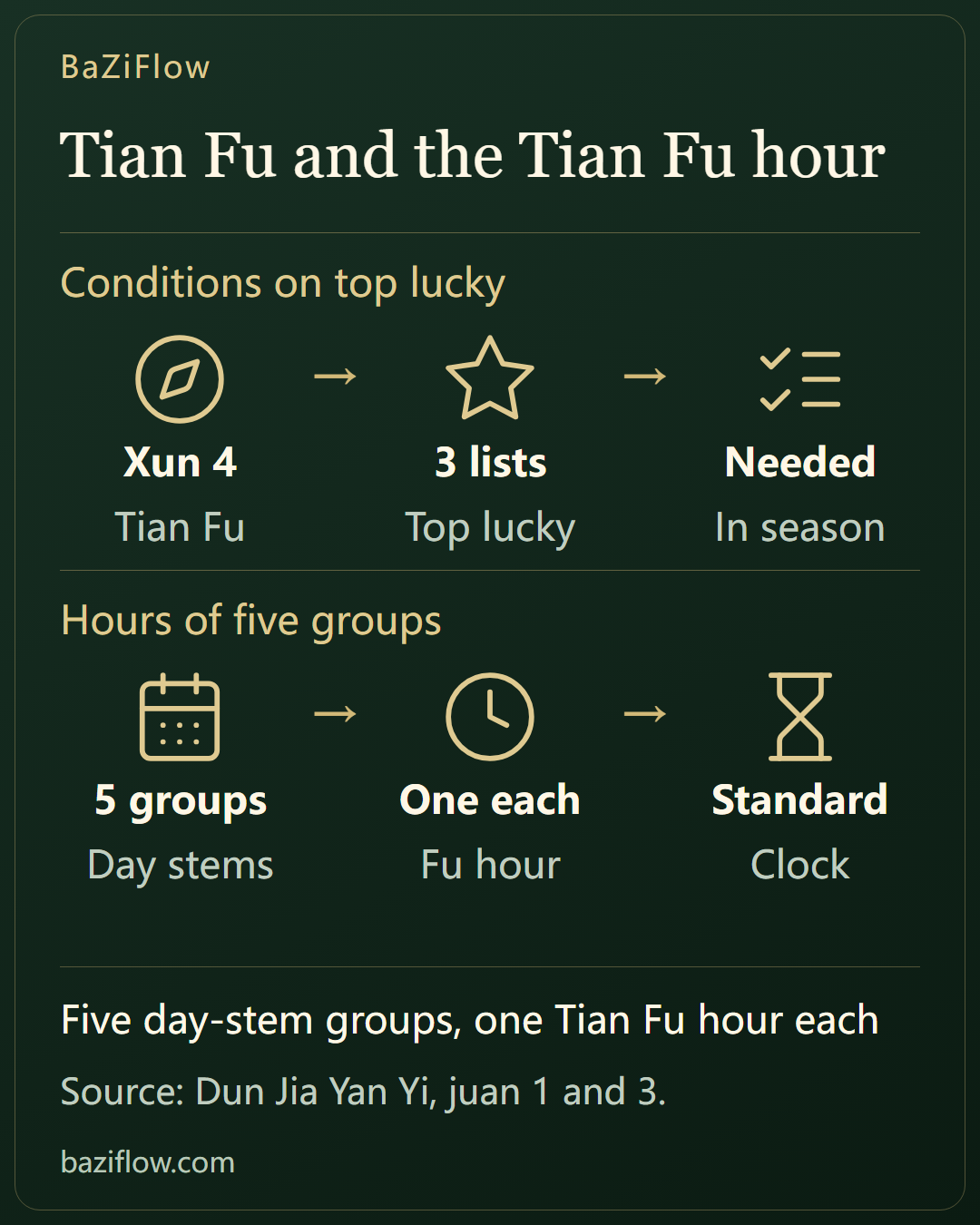
Tian Fu, the Wood star of Xun Four, heads the lucky end of all three lists. The strong-season condition behind "top lucky", the Tian Fu hour for five day-stem groups, and a nine-star month table that can be derived.
The short version8 min read
All three lists of the nine stars put Tian Fu, the Wood star of Xun Four, first at the lucky end, yet the verse and the Sanyuan jing attach the condition of a strong season, and juan 3 adds a separate "Tian Fu hour" worked out by day stem.
- All three passages put Fu at the lucky end, but the Sanyuan jing and the verse both add conditions: only in a strong season is it very lucky, and in a resting or confined one "do not press ahead".
- Juan 3 lists a "Tian Fu hour" per day-stem group, five in all; counted into the day they are the 6th, 9th, 7th, 5th and 3rd double-hours, and four of the five are the day's only Yang Wood hour.
- The juan 3 month table has one row per element, and each row follows from same, generated, generating, controlled and controlling; Tian Fu's Wood row flourishes in Yin-Mao and is confined in Shen-You.
Read first
Wood in Xun Four, the "Fu" of the southeast corner
Tian Fu (天辅) opens its entry in juan 3 with a courtesy name, Zi Qing, and a first clause: "suits guarding one's person and holding to the Way, giving instruction and making repairs".
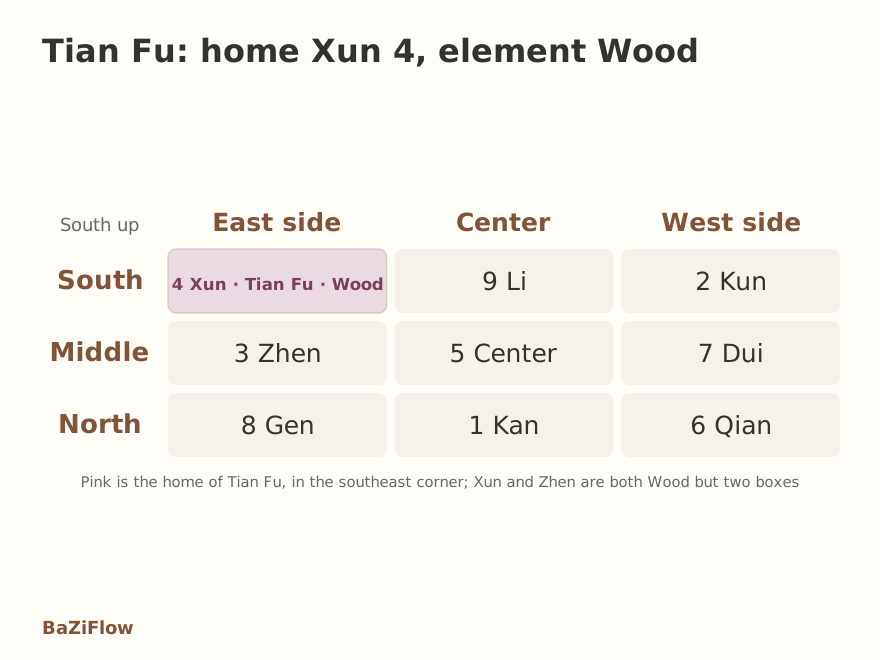
Nine-palace base grid with south at the top and east on the left; the home and element of Tian Fu follow the verse line "Zhen and Xun are Wood". Pink is the home position, not the landing at every hour.
Pink marks Xun Four, the left end of the top row, the southeast corner, number 4. According to the verse Xun is Wood, as Zhen beside it is; they share an element but are two neighboring boxes. The box has its own article, Xun Four.
The condition on top lucky: three lists put Fu first, and two of them add "a strong season"
The nine stars are ranked in three places (the full nine-star table sits in the Tian Peng article): the first part of the verse says "Fu, Qin and Xin are top lucky", the Yellow Emperor's Hidden Talisman (黄帝阴符经) section of juan 1 says "Tian Fu, Chong, Ren, Qin, Xin: lucky", and the Sanyuan jing (三元经) again says "Fu, Qin and Xin are top lucky". Fu stands at the lucky end every time, and the Hidden Talisman section even writes it first. But the verse and the Sanyuan jing both follow their lists with a condition. After the Sanyuan jing verse, juan 3 quotes a further passage introduced only as "the classic says", which states it most fully:
A top or second-best lucky star without a strong qi is middling; riding a flourishing or supporting qi it is very lucky; riding death, rest, confinement or abandonment it is ominous. Judge by the sense of the case.
The verse says the same in other words: "A lucky star that also meets a strong season, ten thousand undertakings complete, success certain; if it meets rest, confinement, abandonment or ruin, do not press ahead."
Enlarge diagram · scroll sideways to read
How the three grades land on particular months the book leaves to "judge by the sense of the case". So "top lucky" is a starting point on a list whose grade moves with conditions, and until the conditions are checked one cannot say this star is "lucky". How the months are sorted into grades is in the table of the next section.
The nine-star month table: a table that can be derived
The "nine stars: flourishing, supporting, abandoned, resting, confined" table of juan 3 sorts the stars by element into five rows: Water (Tian Peng), Earth (Tian Ren, Rui and Qin), Wood (Tian Chong and Fu), Fire (Tian Ying) and Metal (Tian Zhu and Xin). Each row sorts the twelve branch months into five cells. The table need not be memorized, because every row follows from the row's element: the months of the same element flourish, the months of the element it generates support, the months of the element that generates it are abandoned, the months of the element it controls rest, and the months of the element that controls it are confined. Put the element months in (Water Hai-Zi, Wood Yin-Mao, Fire Si-Wu, Metal Shen-You, Earth Chen-Xu-Chou-Wei) and all five rows come out as the book prints them.
Enlarge diagram · scroll sideways to read
Tian Fu's own Wood row flourishes in the Yin-Mao months, supports in Si-Wu, is abandoned in Hai-Zi, rests in Chen-Xu-Chou-Wei and is confined in Shen-You. The verse of juan 1 uses Tian Peng as its example (see Tian Peng) and swaps the names of the first two cells, calling the same-element months "supporting" and the generated ones "flourishing"; the other three cells match the table.
The Tian Fu hour: five hours worked out from the day stem
At the end of the nine star entries, after Tian Ying's, juan 3 gives a separate rule fixed by the hour, the "Tian Fu hour":
At the Tian Fu hour, guilt beyond doubt, the axe in front: even Heaven pardons; at this hour anyone guilty can free themselves.
Five hours follow, one for each group of day stems. The stems of a day's twelve double-hours come from the day stem (Yin Wood and Yang Metal days start at Yang Fire Rat, Yang Fire and Yin Metal days at Yang Earth Rat, which is the standard rule), so the book's five hours can be placed in their day:
Enlarge diagram · scroll sideways to read
One pattern in the table can be verified: for the last four groups the Tian Fu hour is the only "Yang Wood" hour of the day; a Yang Wood and Yin Earth day has two Yang Wood hours, Yang Wood Rat and Yang Wood Dog, and the book chooses neither but writes Yin Earth Snake. The book gives no derivation for these hours, so the table only checks positions. How clock time differs from true solar time is in true solar time, time zones and daylight saving.
Sort the day stem into a group
Yang Wood and Yin Earth, Yin Wood and Yang Metal, Yang Fire and Yin Metal, Yin Fire and Yang Water, Yang Earth and Yin Water: each pair of day stems shares one hour.
Read the stem-branch off the table
A Yang Fire day belongs to the Yang Fire and Yin Metal group, so the Tian Fu hour is Yang Wood Horse.
Turn it into clock time
Wu is 11:00 to 13:00; to use true solar time, convert first, then match the double-hour.
Your turn
What is the Tian Fu hour on a Yin Fire day?
Yin Fire belongs to the Yin Fire and Yang Water group, so the Tian Fu hour is Yang Wood Dragon, 07:00 to 09:00 on the standard clock.
In the Fire row, which cell do the Shen-You months fall in?
Shen and You are Metal, and Fire controls Metal, so they are the months the row controls: resting. The Fire row rests in Shen-You.
The next star is Tian Qin, the only one of the nine without an outer-ring box of its own.
Questions readers ask next
Tian Fu is "top lucky"; does meeting it mean things go smoothly?
Top lucky is a classification on the book's list, and the conditions follow straight after: a lucky star must meet a strong season, and in a resting or confined state one should not press ahead. Which palace it is in and which stem it carries also have to be looked at. The list entry does not replace any of this.
Is Tian Fu the same as the Tian Fu of Zi Wei Dou Shu?
No. This Tian Fu is one of the nine Qimen stars, home Xun Four; the Zi Wei one is one of the fourteen main stars of another system. Both are romanized Tian Fu, so check the characters first, then the system.
Is there a Tian Fu hour on every day?
By the juan 3 wording, each day-stem group has one: Yin Earth Snake for Yang Wood and Yin Earth days, Yang Wood Monkey for Yin Wood and Yang Metal, Yang Wood Horse for Yang Fire and Yin Metal, Yang Wood Dragon for Yin Fire and Yang Water, Yang Wood Tiger for Yang Earth and Yin Water. The clock hours follow the standard double-hour split, without a true-solar-time correction.
Was this article helpful?
Sources & references
Continue reading
Tian Chong: Wood in Zhen Three and the Four Jobs of the Character Chong ↗
Tian Qin: Earth of Center Five, Two Seatings in the Verses and the Lodging in Kun Two ↗