

Page of Cups
Content version · · Sources & references
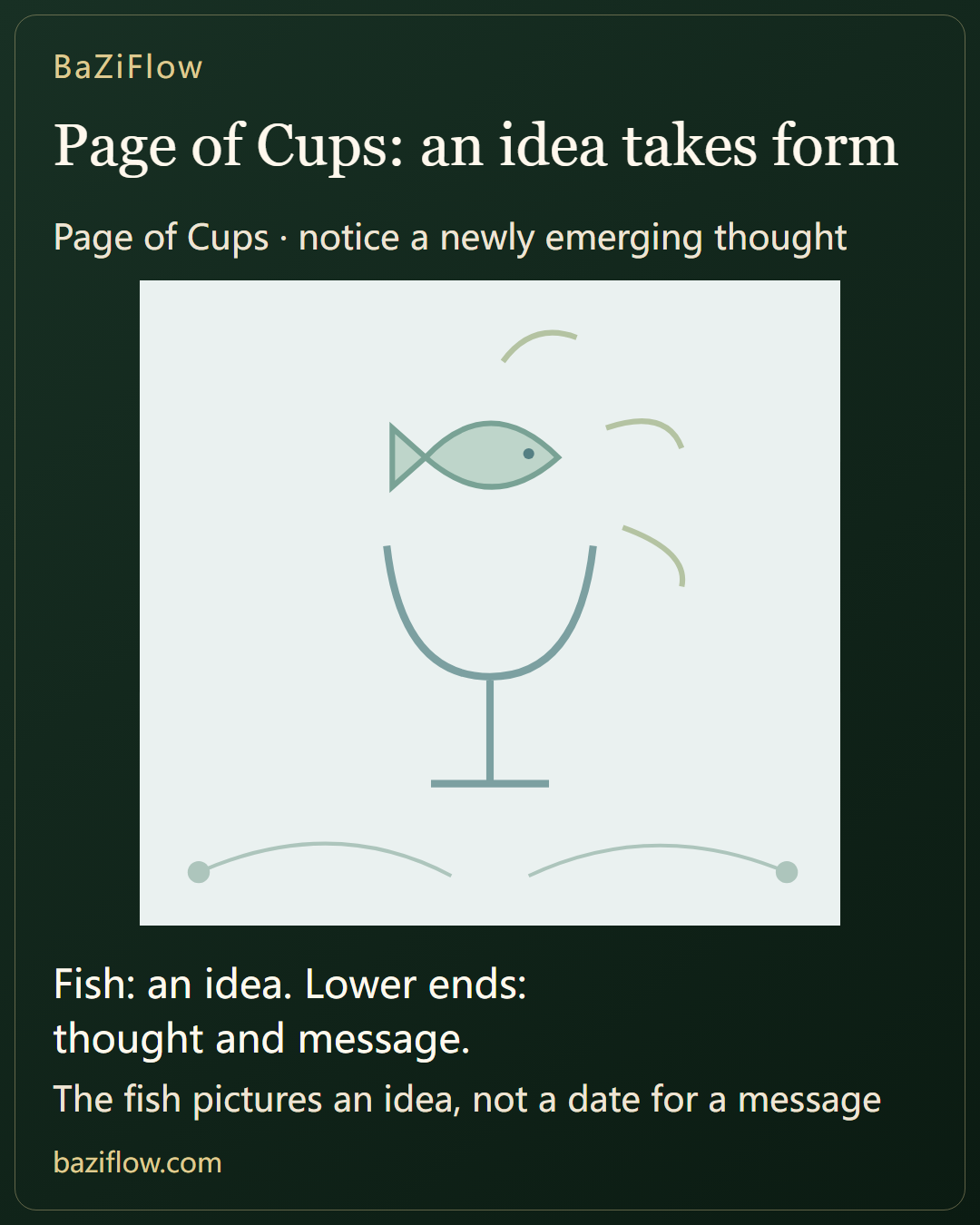
Waite’s fish and attentive Page connect mental images, study, reflection, and news. Distinguish what an image inspires from what another person actually communicated.
The short version6 min read
The Page attends to a fish rising from the cup, and the fish looks toward him. Waite explains this as mental images taking form. The focus can be a new thought, study or exchange, without turning every stirring of imagination into somebody else’s promised confession.
- The fish and attentive gaze form a relation of noticing; Waite links it to mental images taking form, not only romantic news.
- Turning a color relationship into one story sentence gives inspiration an editable form without requiring a finished work immediately.
- Your association and the friend’s message have separate sources; a simple exhibition note does not make your creative response less valuable.
Read first
The fish is more than a shorthand for a romantic message
On the RWS card, a figure in a blue hood and a blue tunic patterned with flowers holds a cup in one hand, the other on the hip. A fish rises from the cup and the page looks at it with head tilted; waves roll behind.
Waite describes an attentive, studious Page considering a fish that rises from the cup and looks toward him. He explains the image in terms of pictures of the mind taking form. His meanings also include service, study, news, application, reflection, and meditation, with business or practical affairs among the possibilities.
That range matters. Reducing the Page of Cups to an incoming confession of love would discard much of the account. The card can provide a point of departure for thinking about an emerging idea without claiming that somebody else is about to communicate a particular feeling.
The older entry also contains physical, age-related, and gendered descriptions. Those are not used here to identify a real person or decide who is immature. A court-card role in an illustration is not a reliable profile of a stranger, friend, or prospective partner.
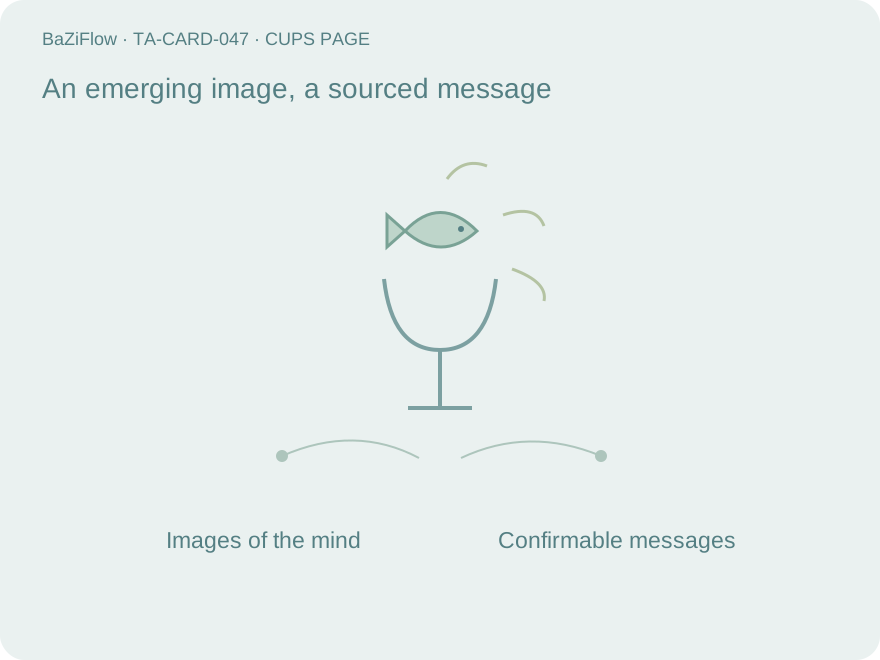
An original BaZiFlow distinction between an emerging image and a message. The fish illustrates Waite’s concept, not a copied card or a prediction of news.
An image can inspire more than its sender intended
A friend sends a postcard from an exhibition and says they recently visited it. Its colors suggest a short story to you. You wonder whether your friend might like to develop something together. All of that can be real as an experience, but the three parts have different sources.
The visit is in the message. The story is your response. Collaboration is a possibility that has not yet been discussed. Preserving those distinctions lets you take the idea seriously without making the sender responsible for an intention they did not express.
| Part of the experience | What can be recorded |
|---|---|
| Message received | The friend says they visited this exhibition |
| Image or thought it prompted | A possible story involving color and memory |
| Unanswered question | Whether the friend wants to hear or discuss it |
If they later say they only meant to share the exhibition, your idea does not become worthless. It never needed a hidden invitation in order to be interesting. If they agree to hear a paragraph, that agreement does not automatically extend to making a whole work together.
An original fish shape appears above the cup, with short curves suggesting that a newly formed idea can develop. Underneath, mental images and confirmable messages have separate positions. The connecting line deliberately leaves a gap rather than equating one with the other.
This is a teaching diagram, not a reproduction of the historical card's layout. The fish does not specify a person, a date, or the arrival of a letter. It refers to the concept in the text: an internal picture gaining a form that can be noticed and considered.
In the postcard example, you might save a rough sentence or color note on one side and retain the exact scope of the friend's message on the other. A later reply can update the message record without rewriting what was originally received. Your creative response can develop independently.
Prompt
- Blue beside orange
Sentence
- A blue umbrella rests by an orange wall
Next question
- Who left the umbrella there?
An invented writing exercise: the sentence is a creative response, not the postcard’s message.
Ask at the scale of the next exchange
A small question such as Would you like to hear the fragment this made me think of? offers a clear choice. Announcing that the two of you should now produce something together moves several decisions ahead of the conversation.
No reply means no reply has been received. It is not a reason to fill the space with a theory about deception, concealed affection, or a test of loyalty. The Page's reversed historical vocabulary includes inclination and attachment as well as seduction, deception, and artifice. Those terms are not evidence of this sender's motives.
The additional-meanings chapter records older romantic and obstructive predictions, too. They are identified as source material rather than adopted as forecasts. A source can show what a tradition has said without proving that the corresponding event will happen to the present reader.
Hear a fragment
- Share this short passage
Create together
- Discuss scope and shared work
Let study remain an experiment with an identifiable source
An appealing technique from the exhibition might lead to a small exercise. Admiring it is not the same as mastering it. Practicing from a reference is not permission to present somebody else's work as your original creation. Inspiration, study, and authorship need their own descriptions.
If the fragment never becomes a finished story, it can still reveal what caught your attention: a color relationship, a rhythm, or a memory. There is no need to turn the absence of a finished work into a verdict about talent. The question is what became clearer through the attempt.
The Ten of Cups considers distinct experiences within a shared setting; this Page can narrow attention to the way an idea first becomes noticeable. Their sequence is not a compulsory life course. Keep the interpretive convention explicit through the upright and reversed methods guide.
When reviewing the entry, inspect three changes separately: what form the idea acquired, what new information actually arrived, and which question remains unanswered. Care for an emerging thought does not require belief in every association it produces. It requires enough attention to tell those associations apart.
Save one visible fragment
A sentence or a color sketch is enough to begin.
Change one expressive choice
Add an action and compare stillness with movement.
Choose what you want to keep
Keep a sentence, a color relation or a new question.
Questions readers ask next
Does the fish always mean that a romantic message is coming?
No. Waite explains it through mental images taking form and includes study, news, reflection, application and practical affairs. Romance can be one context, but it does not replace that wider range or guarantee a particular person’s confession.
Can an idea be worthwhile if it never becomes a finished work?
Yes. Giving a vague color impression one sentence already clarifies what caught your attention. Discovering that the palette interests you more than the story can be a learning result, rather than a failure measured only by whether a long work was completed.
Does agreement to hear the story permit starting a joint project?
It confirms listening, not necessarily writing, editing or continuing collaboration. Share the agreed fragment first. If both people later explicitly want a joint project, discuss its scope and work so that a new answer supports the new arrangement.
Was this article helpful?
Sources & references
Continue reading
Ten of Cups: shared happiness can contain different experiences ↗