

Six of Cups
Content version · · Sources & references
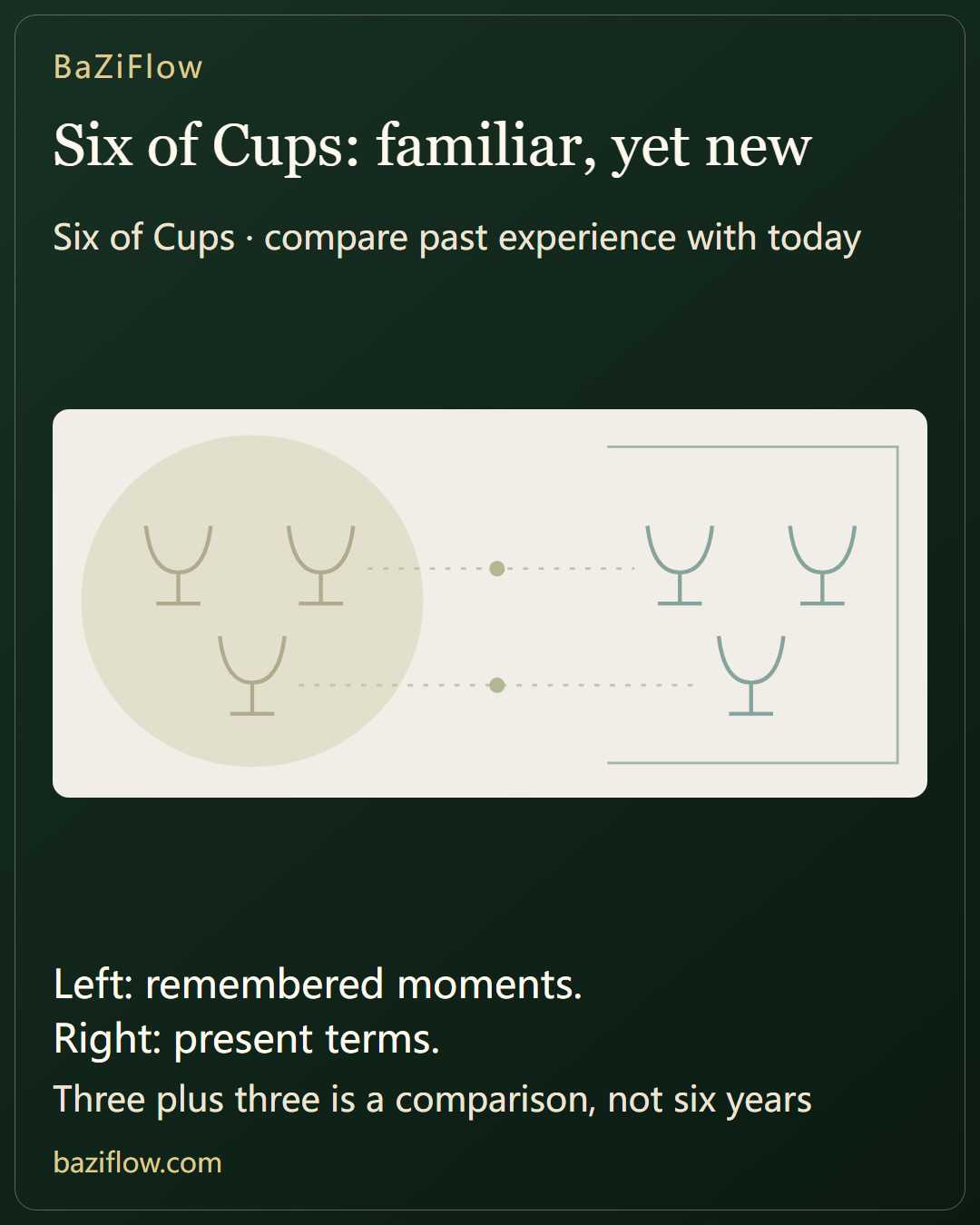
Read the RWS Six of Cups through its competing past and new-environment interpretations, comparing remembered experience with current conditions without forecasting reunion.
The short version6 min read
Children, an old garden and flower-filled cups often bring memory to the foreground. Yet Waite also records new ties, knowledge and surroundings in the same entry. The Six can ask how something familiar becomes a fresh experience under today’s conditions.
- The main entry preserves both past-oriented and new-environment readings; nostalgia is not its complete original meaning.
- The same board game can remain while available time, rules and enjoyment take their form from present conditions.
- Renewed enjoyment deserves recognition too: comparison need not assume that everything has changed or demand an exact return.
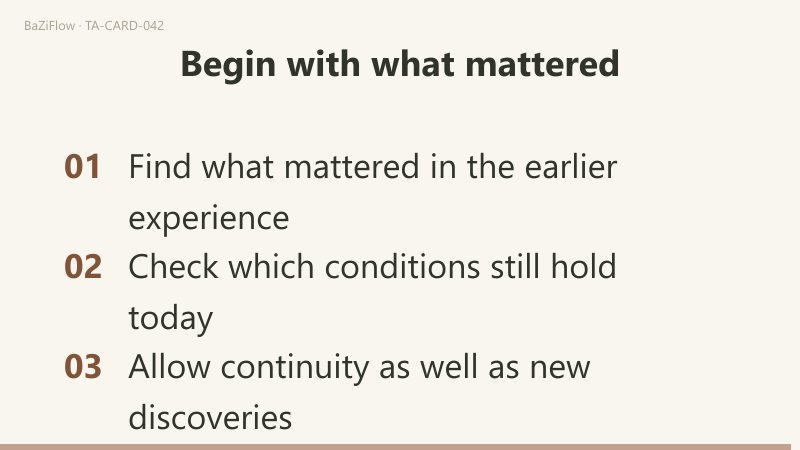
Read first
The source gives more than one direction in time
On the RWS card, an older child in a red hood hands a cup of white flowers to a smaller child; all six cups hold white flowers. The setting is an old courtyard with a stone tower and houses, and a figure holding a staff stands in the background at left.
Waite’s Six of Cups begins with past experience and recollection, then explicitly records a different interpretation involving new connections, knowledge and surroundings. In that second account, the children occupy an unfamiliar place. A lesson that presents nostalgia as the complete original meaning would omit this alternative.
The reversed main entry turns toward the future and renewal. It does not simply say that an old partner returns. The supplementary list introduces still other assignments. These are competing historical interpretations to distinguish, not fragments to combine into a confident schedule of events.
The visible description is of children in an old garden with flowers filling cups. It cannot establish that every reader had a happy childhood. No one needs to invent a warm memory in order to engage with the card.
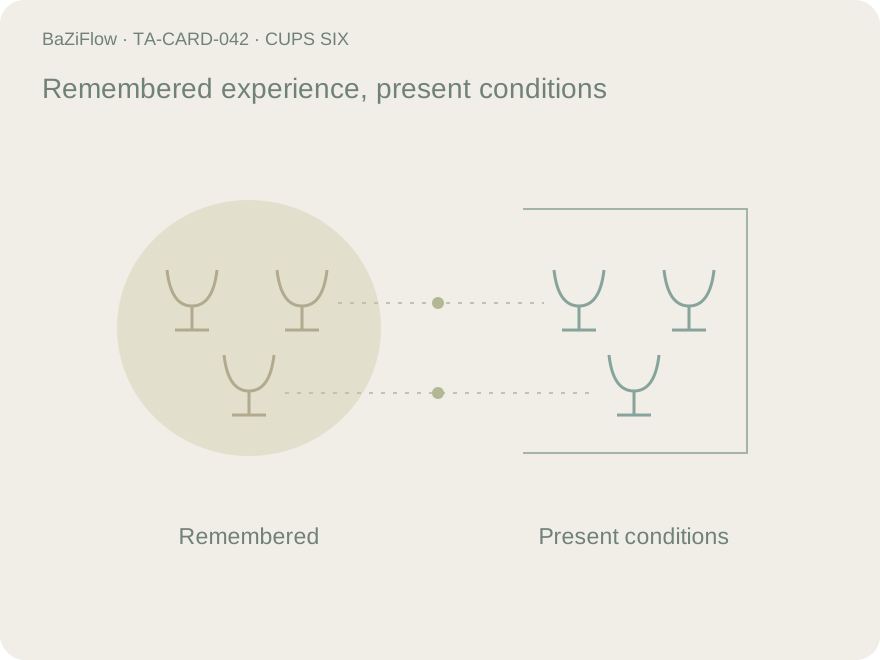
An original BaZiFlow time-comparison diagram for the Six of Cups; the grouping is not six years and does not guarantee a reunion or a happy past.
First reading
- Past, childhood, recollection
Alternative reading
- New ties, knowledge, surroundings
These are alternative interpretations, not two events bound to follow each other.
A childhood game found in a cupboard
You find a board game you once played for long afternoons with friends. You remember the atmosphere fondly. When you try it now, the rules feel slow and the available time is shorter. That difference need not prove that the old enjoyment was false.
The present exercise is to identify what was valued and what conditions have changed. Perhaps you miss the shared company more than the exact game. Perhaps you still enjoy the game but want a shorter version. These are possible discoveries from trying and comparing, not facts the card supplies in advance.
| Remembered element | Present condition to check |
|---|---|
| Several friends stayed for hours | Who wants to take part now, and for how long? |
| A particular set of rules felt familiar | Do those rules still suit the participants? |
| The game belonged to a certain place | Is there an appropriate space today? |
A half-hour meeting is not evidence that people now care less than they once did. It is a time condition. Inferring a motive would require more information than the contrast with an old afternoon.
Today: 30 min · 30
0 min ↔ 120 min
- Earlier example · 0–120
- Today’s example · 0–30
Minutes. Different durations do not measure the strength of affection.
The object can remain while the arrangement changes
A short round, a different game or a conversation may preserve what matters without recreating everything. Adjusting the rules is not automatically a betrayal of memory. Keeping the object without using it is also an available choice.
If you invite an old friend, make the invitation specific and open to refusal. The person may have a different routine or different wishes now. A past relationship does not hold their present role in reserve until you want it again.
You can also revisit the game alone or write about the object without contacting anyone. Remembering does not have to culminate in reunion, and a single trial does not become an obligation to revive a long-term habit.
The six cups are divided between an old record and a present area. Fine links mark aspects that can be compared. The diagram does not instruct the present to reproduce the past, and the groups do not mean three years before and three years after.
Its count also does not identify six former friends. The purpose is to separate time contexts so that a statement about then is not silently applied to now. We enjoyed this once and we both want it today are distinct propositions.
The unfamiliar-environment interpretation in Waite’s paragraph can be retained alongside this exercise without pretending that the alternatives have become one certain prediction. It reminds the reader that the source itself is less uniform than a single keyword suggests.
Compare the Five of Cups, where loss and remaining resources were distinguished. Looking back with the Six need not begin in loss. It may reveal a new aspect of something familiar or help explain why an old activity no longer fits.
Object
- The same old game
Experience
- Made by today’s play and participants
Understanding
- Company or rules may be what matters
Renewal is not a date for another person’s return
The supplementary chapter gives a past-oriented association and an inheritance-related reversed assignment. Neither provides evidence of a forthcoming financial event. The chapter’s reservations about inconsistency and loose connections to the designs should remain visible when describing these lists.
An upright and reversed method might ask which part of an earlier experience remains useful under current conditions. That is a contemporary inquiry, not a command to return to the past or discard it.
For the board game, record three things: what you remembered before opening it, what actually happened during the present trial and what you would like to keep next time. They may differ. A new understanding does not need to erase the earlier experience, and a cherished recollection does not require other people to resume their old roles.
The result can be a specific choice made today. Familiarity offers a comparison, not a script that everyone must perform again.
Choose one part to revisit
Try a familiar round without recreating an entire earlier life.
Let participants describe today
Keep different responses, from enjoyment to indifference or poor fit.
Continue only what is wanted now
Base continuity or change on this actual experience.
Questions readers ask next
Is nostalgia the only original meaning of the Six of Cups?
No. Waite first lists the past, recollection and childhood, then explicitly records another reading involving new ties, knowledge and surroundings. These coexist in the main entry rather than forming a compulsory sequence from memory to reunion.
If an old game feels dull now, was the remembered enjoyment false?
Not necessarily. Participants, available time and the focus of attention may have differed. Earlier enjoyment and present dislike can both be real. Comparing specific conditions explains the difference better than dismissing the whole memory.
What if playing again is genuinely enjoyable?
Recognize that present pleasure instead of insisting that the past is unreachable. The participants can keep the rules and arrangements they now want. One successful experience still does not oblige them to revive every old relationship or routine.
Was this article helpful?