

Yin and yang lines in a hexagram
Content version · · Sources & references
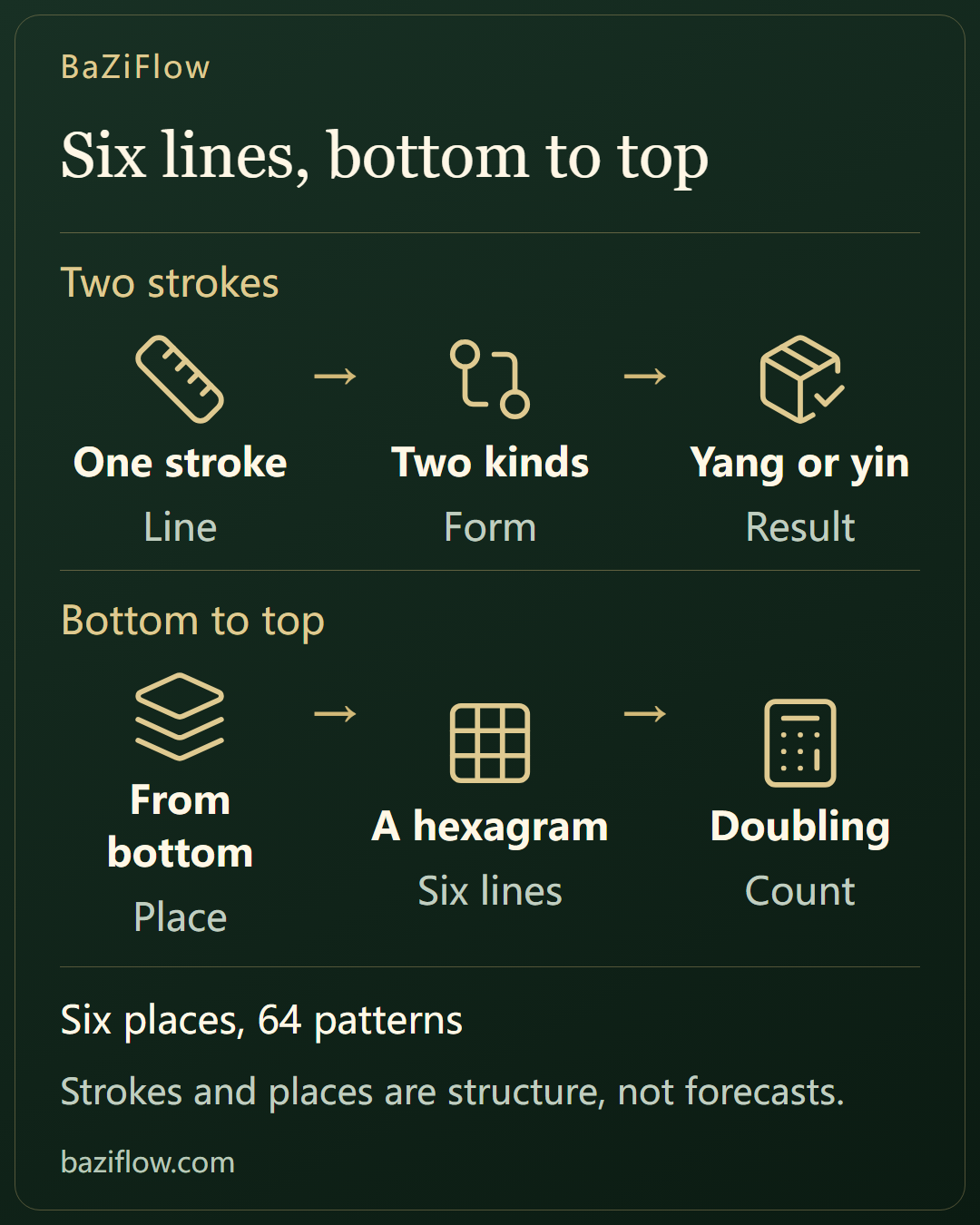
A yang line is unbroken and a yin line is broken in the middle. Six lines stack from the bottom into one hexagram, giving 2 × 2 × 2 × 2 × 2 × 2 = 64 patterns. Jiji and Weiji show why order matters.
The short version7 min read
A yang line is one unbroken stroke and a yin line is broken in the middle; six lines stacked from the bottom make one hexagram, and there are 2 × 2 × 2 × 2 × 2 × 2 = 64 ways to stack them.
- There are only two line forms, unbroken yang and broken yin, and each line also holds a fixed place in the stack.
- The text names the lowest line Initial (初) and the highest Top (上). Most hexagrams turn into a different one when read upside down; only 8 symmetric ones do not.
- Six places with two forms each multiply to 64. That number counts structures; it forecasts nothing.
Read first
Two kinds of stroke: unbroken and broken
Every hexagram in the Zhou Yi is a stack of six strokes, and a stroke comes in only two forms. An unbroken stroke is a yang line; a stroke broken in the middle is a yin line. The word for one stroke is line (爻, pronounced yáo).
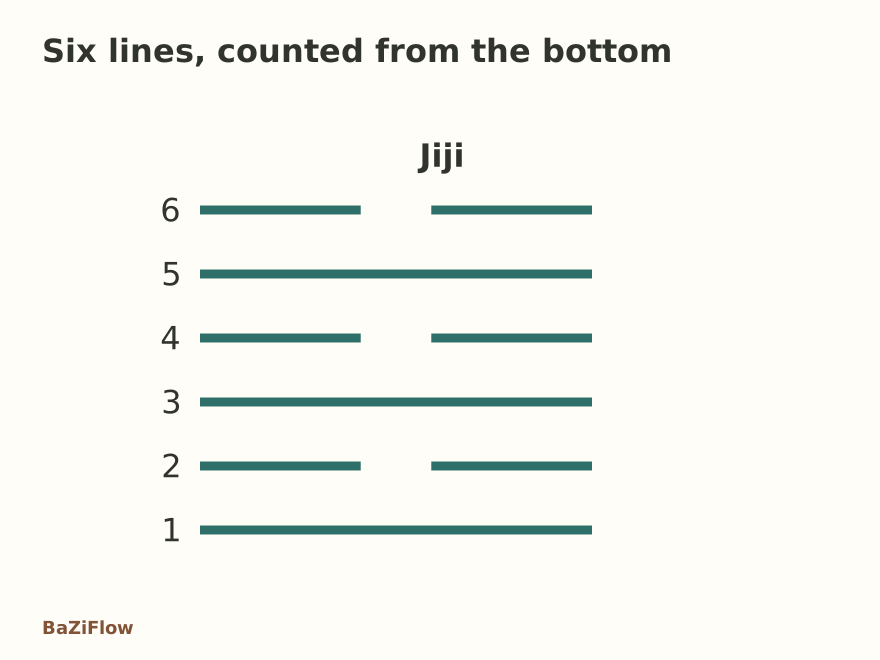
Sketch: the six lines of Jiji from the bottom up are yang, yin, yang, yin, yang, yin. A structure diagram, not a reading.
The figure shows Jiji (既济). Counting from the bottom, lines 1, 3 and 5 are yang and lines 2, 4 and 6 are yin. Because the two forms alternate, each line's place and form can be read off separately.
The two strokes
An unbroken stroke
Drawn as one continuous bar, it occupies one of the six places.
A stroke broken in the middle
Drawn as two short bars with a gap, it also occupies one place.
What the Great Commentary says a line is
A line is more than a drawing convention. The Great Commentary (Xi Ci, 系辞) mentions it in several places, and each time the vocabulary is about change and movement.
Enlarge diagram · scroll sideways to read
The upper part of the Xi Ci says: "The Tuan (彖) speaks of the images; the lines speak of change." The lower part says: "The lines imitate the movements under heaven." The verb there means to model oneself on something, so a line is described as copying the motions of the world.
Because the Way has change and movement, it is called a line; lines have grades.
This sentence ties the word line to movement and then says lines have "grades", which commentators mostly take to mean different ranks. That points to the next section: the six lines are not laid side by side, each one rests on the one below.
Reading from the bottom: place first, then form
Count the six lines upward. The lowest is called Initial (初), the highest Top (上), and the four between are Two, Three, Four and Five. These are the names the Zhou Yi itself uses.
Enlarge diagram · scroll sideways to read
Most hexagrams become a different hexagram when read upside down, as Jiji becomes Weiji. Only eight are symmetric end to end and read the same either way: Qian (乾), Kun (坤), Yi (颐), Daguo (大过), Kan (坎), Li (离), Zhongfu (中孚) and Xiaoguo (小过). The table writes the six lines of Jiji out by place:
| Place | Name | Line in Jiji |
|---|---|---|
| 6 | Top (上) | Yin (broken) |
| 5 | Five | Yang (unbroken) |
| 4 | Four | Yin (broken) |
| 3 | Three | Yang (unbroken) |
| 2 | Two | Yin (broken) |
| 1 | Initial (初) | Yang (unbroken) |
The six lines intermingle, each answering only to its own time and thing. The initial line is hard to know, the top line is easy to know: they are root and branch.
The passage sets the Initial line and the Top line side by side as root and branch. So within the text itself the six lines form an ordered series with a start and an end.
Write the places
Number the page from 1 to 6, bottom to top: Initial at the foot, Top at the head.
Fill in the forms
Give each place one entry only, yang (unbroken) or yin (broken).
Read it back
Recite the forms in order from 1 to 6, then compare with the drawing from its bottom up.
Stacking line by line: why sixty-four
Each place has two choices, so one line has 2 forms. Put a second line on top and two lines give 2 × 2 = 4 patterns. Every extra line doubles the total.
Enlarge diagram · scroll sideways to read
The Changes have the Supreme Ultimate; it gives rise to the two modes; the two modes give rise to the four images; the four images give rise to the eight trigrams.
The sentence names two modes, four images and eight trigrams in turn. Later commentators often match these to the 2 patterns of one line, the 4 of two lines and the 8 of three lines. The text stops at the eight trigrams; three more doublings give 16, 32 and 64, which is the same procedure carried on. The lower part adds: "When the eight trigrams stand in rows, the images are within them; when they are doubled, the lines are within them." Doubling the trigrams into six lines is exactly this step.
Grouping the sixty-four by how many yang lines they hold gives a second count:
Enlarge diagram · scroll sideways to read
Only one hexagram has six yin lines, Kun (坤), and only one has six yang lines, Qian (乾). A second way of reaching 64, by pairing a trigram with a trigram (8 × 8), is set out in the sixty-four hexagrams.
Same line, new place, new hexagram
Hexagrams with the same forms and the same counts are still different hexagrams when the places differ. Exactly 6 hexagrams contain a single yang line, one for each place.
Enlarge diagram · scroll sideways to read
Fu and Bo each have one yang line and five yin lines. The only difference is whether that yang line stands in place 1 or place 6. To read further you need the name and meaning of each place; those are covered in line positions, from Initial to Top.
Questions readers ask next
Is a yin line a bad line and a yang line a good one?
No. Yin and yang are first of all names for the shape of a stroke: whether it is continuous or broken. How a given line reads inside a given hexagram depends on the wording of the Judgment and the line statements, which is a separate question.
Why are the six lines counted from the bottom?
The text itself calls the lowest line Initial and the highest Top, and that fixes the order. Reverse it and most hexagrams turn into a different one; Jiji and Weiji are such a pair. Only eight symmetric hexagrams (Qian, Kun, Yi, Daguo, Kan, Li, Zhongfu and Xiaoguo) read the same either way. Writing position numbers first is the safest habit.
How is sixty-four counted, and why is it not 6 × 2 = 12?
Each of the six places independently takes one of two forms, so the choices multiply: two to the power six. Six times two counts the options per place but never pairs up the choices made at different places.
Was this article helpful?
Part of a learning path
Sources & references
Continue reading
Eight Trigrams: Three-Line Structure and Basic Images, Read Through the Shuo Gua ↗
The Sixty-Four Hexagrams: How Upper and Lower Trigrams Form One Figure ↗