

Wood: growth, bending and straightening
Content version · · Sources & references
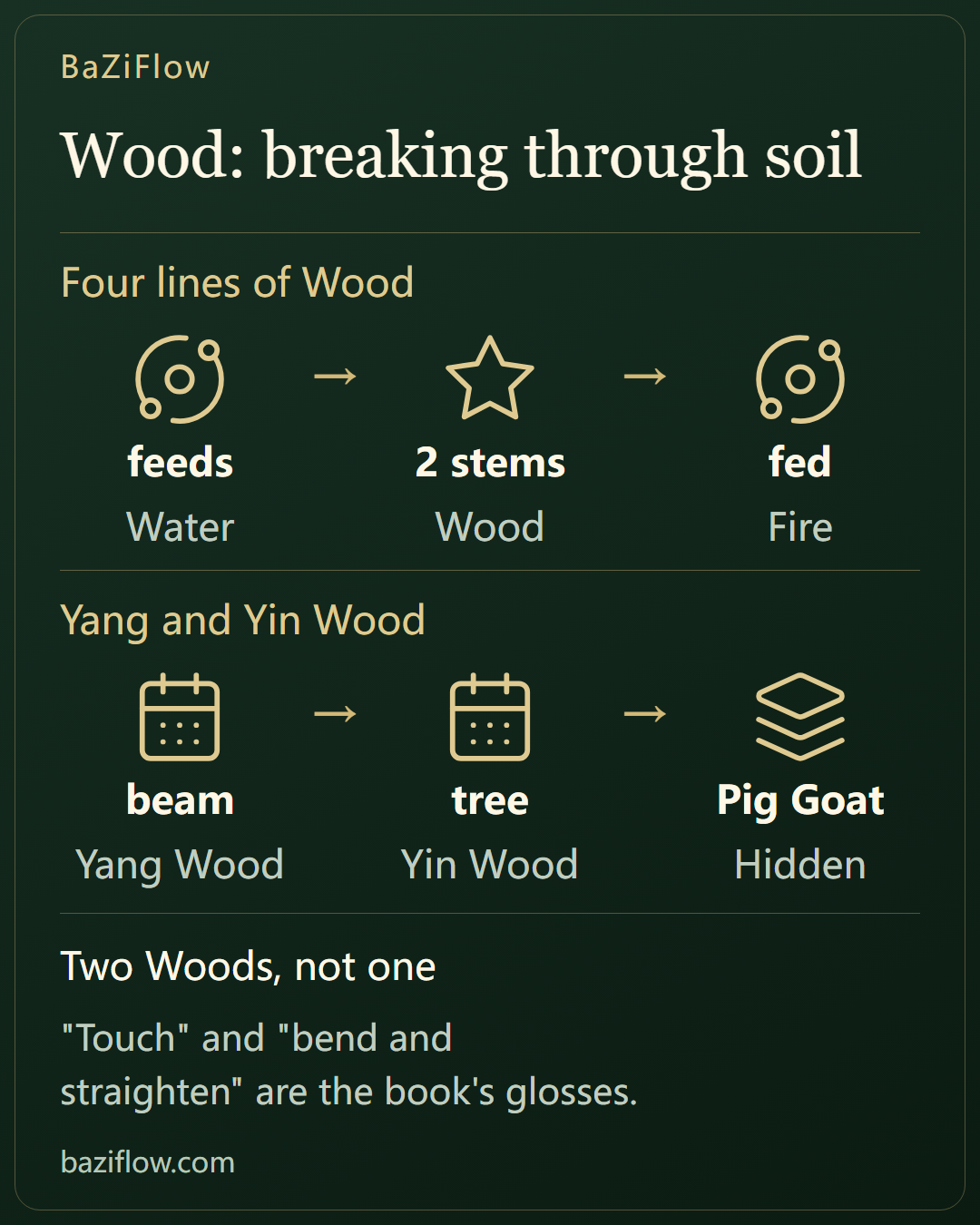
How the Sanming Tonghui defines Wood: the word for "touching off", "bending and straightening", Yang Wood against Yin Wood, Tiger and Rabbit plus three more branches that hide Wood, and the four lines through it.
The short version8 min read
Wood is the element of growth. The Sanming Tonghui explains it with one character meaning "to touch off" (触), describes it as "bending and straightening", and then splits it into a hard Wood and a soft Wood: the stems Yang Wood and Yin Wood.
- Wood takes the stems Yang Wood and Yin Wood and the branches Tiger and Rabbit; in this site's table it generates Fire and controls Earth, and is generated by Water and controlled by Metal.
- The book reads the word as two moves, stirred by yang qi and then breaking the ground, and describes the nature as bending and then straightening again.
- The two Woods swap stages: the Pig branch is Growth for one and Death for the other. Before saying "there is Wood in the chart", ask which Wood and which branch hides it.
Read first
Five Elements cycles: learn the relationships, not just the order ↗
What the character says: touching off
In plain words first: Wood is the element for things that push up out of the soil and spread upward and outward. The Sanming Tonghui (三命通会), a Ming-dynasty compendium, sums it up in a single character meaning "to touch off" (触).
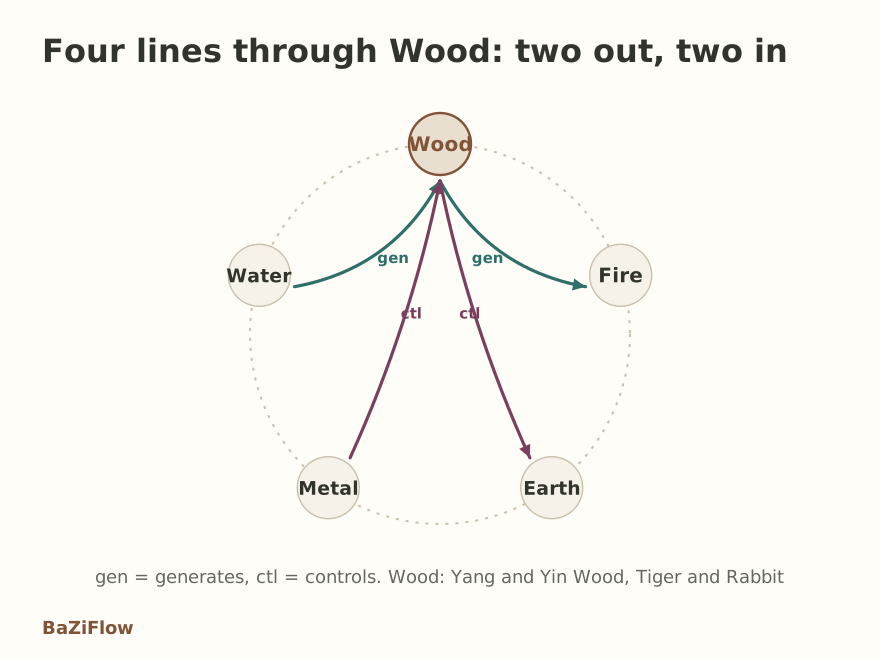
Relation sketch: the elements run in generating order and only the four lines touching Wood are drawn; stem and branch assignments and directions follow this site's usual entry-level tables.
The five elements sit on a ring in generating order, with Wood at the top. In this site's element table Wood generates Fire and controls Earth, is generated by Water and controlled by Metal, and all four lines are drawn. Wood takes the stems Yang Wood (甲) and Yin Wood (乙) and the branches Tiger (寅) and Rabbit (卯).
Wood rules the east and answers to spring. The word wood means to touch: yang qi touches and stirs, and the shoot breaks the ground and lives. Water flows toward the east and so generates Wood; Wood grows up and then covers what lies below. That is its natural substance.
The sentence has three layers. "Yang qi touches and stirs" is the cause: yang qi nudges the surface of the soil. "Breaks the ground and lives" is the result: the sprout pushes through. "Grows up and then covers what lies below" is the direction: leaves and branches rise and then shade what is under them. The opening clause, "Water flows toward the east", explains why Water is the element that generates Wood. After this one sentence it is clear why the book puts growth on Wood.
Bending and straightening
The Book of Documents (尚书) gives Wood its stock description, "bending and straightening" (曲直). The Sanming Tonghui quotes a short explanation from Master Zhang (Zhang Zai): Wood bends and then springs back straight. Wood can be pressed down or twisted, and after it has been bent it stretches out again; that is its nature.
Elsewhere the book looks at Wood's momentum:
Wood's nature is to rise without stopping. When its qi is heavy it wants Metal to put it to use; with Metal, Wood has the virtue of being both tall and restrained.
"Rise without stopping" says that Wood keeps growing upward. "Wants Metal to put it to use" says that when it grows too vigorous, Metal is the tool that trims and uses it; with Metal, Wood becomes tall yet kept in bounds. The next two lines pair Wood with Water and Earth: Wood depends on Water, which moistens it when scarce and sweeps it away when plentiful; heavy Earth lets the roots coil deep, thin Earth leaves the branches lush and the roots in danger.
Enlarge diagram · scroll sideways to read
Yang Wood and Yin Wood: one character, two kinds of Wood
In its chapter "On Yin and Yang, Life and Death of the Ten Stems" the book writes two different Woods. Yang Wood (甲) takes the images of thunder, dragon, beam and rafter. The book says its roots and branches are already cut, calls it "dead wood", and says it must be hewn by axe to become a vessel. Yin Wood (乙) takes the images of wind and tree and is called "living wood": it fears the cutting yang Metal and the leaf-fall of autumn, and wants moist earth to bank its roots and live water to feed its leaves.
Enlarge diagram · scroll sideways to read
Look at the bottom row. The twelve-stage table runs forward for yang stems and backward for yin ones, so the Pig (亥) branch is Growth for Yang Wood and Death for Yin Wood, and the Horse (午) branch is the reverse. One branch stands at opposite stages for the two Woods, so settle which stem you are looking up first; the book's "dead wood" and "living wood" describe states of wood and are a separate matter from the Death cell of the table. The whole table is explained in the twelve life stages and void branches.
Tiger and Rabbit, and three more branches that hide Wood
In this site's element table the branches of Wood are the Tiger (寅), the first month of spring, and the Rabbit (卯), the middle month. The book says of the Tiger that "its qi gathers three yang and fire is born in it", and of the Rabbit that "its qi is richly flowering". But Wood does not appear only in these two. By this site's hidden-stem table the Pig and the Tiger hide Yang Wood, and the Rabbit, the Dragon and the Goat hide Yin Wood.
Enlarge diagram · scroll sideways to read
The book mentions two of these branches. Of the Dragon it says "Yang Wood is in decline here, yet a remnant of Yin Wood remains", and the Goat is described as holding both Wood and Fire. This is why counting only the Tiger and the Rabbit misses Wood: Wood must be looked up through the hidden stems as well, and what the hidden stems, the visible stems and the month command each answer is set out in how hidden stems unfold.
The four lines and what "too much" looks like
Back to the ring at the top. Wood has four lines: Water generates Wood, Wood generates Fire, Wood controls Earth and Metal controls Wood. In its chapter on Wood the Sanming Tonghui gives a sentence for how each line looks in measure and another for how it looks in excess.
Enlarge diagram · scroll sideways to read
The four excess sentences have one thing in common: they describe damage to Wood itself, being floated off, burned, snapped or chopped. That is because the lines were written from Wood's side; read the same line from another element and the one who suffers changes. The book also gives a sentence running the other way: "strong Wood needs Fire to resolve its stubbornness", where Fire drains the strength of Wood that has grown too heavy. So whether a line helps or hurts depends on how much stands at each end, not on the line itself.
Two exercises: where Wood hides
The exercises need no birth data, only the tables above.
Look it up
A chart shows the Goat and the Pig. Which hidden stems are Wood?
The Goat hides Yin Earth, Yin Fire and Yin Wood, so Yin Wood is Wood; the Pig hides Yang Water and Yang Wood, so Yang Wood is Wood. Neither is the Tiger or the Rabbit, yet each holds one Wood.
Where does Yin Wood have Growth, and Yang Wood?
Yin Wood has Growth at the Horse branch and Yang Wood at the Pig branch. Both are Wood, but their starting points are half a circle apart.
The next element along the ring is Fire. These statements describe the class "Wood" and its relations; they are not a verdict on anyone's personality or life. Whether an absent Wood must be supplied is taken up in what a missing element means, and the structure of all the lines is in the generating and controlling cycles.
Questions readers ask next
Is the difference between Yang Wood and Yin Wood only yang against yin?
The book is more specific. Yang Wood is pictured as thunder, dragon, beam and rafter and is called "dead wood" that needs the axe to become a vessel; Yin Wood is wind and tree, called "living wood", that fears the cutting metal and wants moist earth and live water. Their stages in the twelve-stage table differ too.
Do only the Tiger and Rabbit branches hold Wood?
Only those two have Wood as their main qi, but this site's hidden-stem table puts Yang Wood in the Pig and the Tiger and Yin Wood in the Rabbit, the Dragon and the Goat. Wood has to be looked up through hidden stems as well; the main qi and the hidden stems are two layers.
Does "Wood controls Earth" mean Wood is stronger than Earth?
It names a direction: Wood restrains Earth, which is not a comparison of strength. A line quoted in the book says that when Earth is heavy Wood breaks instead, so the controlling side can be the one that suffers.
Was this article helpful?
Sources & references
Continue reading
Fire (火): No Body of Its Own, Body and Use, Four Seasons, Yang and Yin Fire ↗
Missing element in BaZi: does it need a remedy? Four questions after a zero ↗