

Daoist thought and Daoism: the difference
Content version · · Sources & references
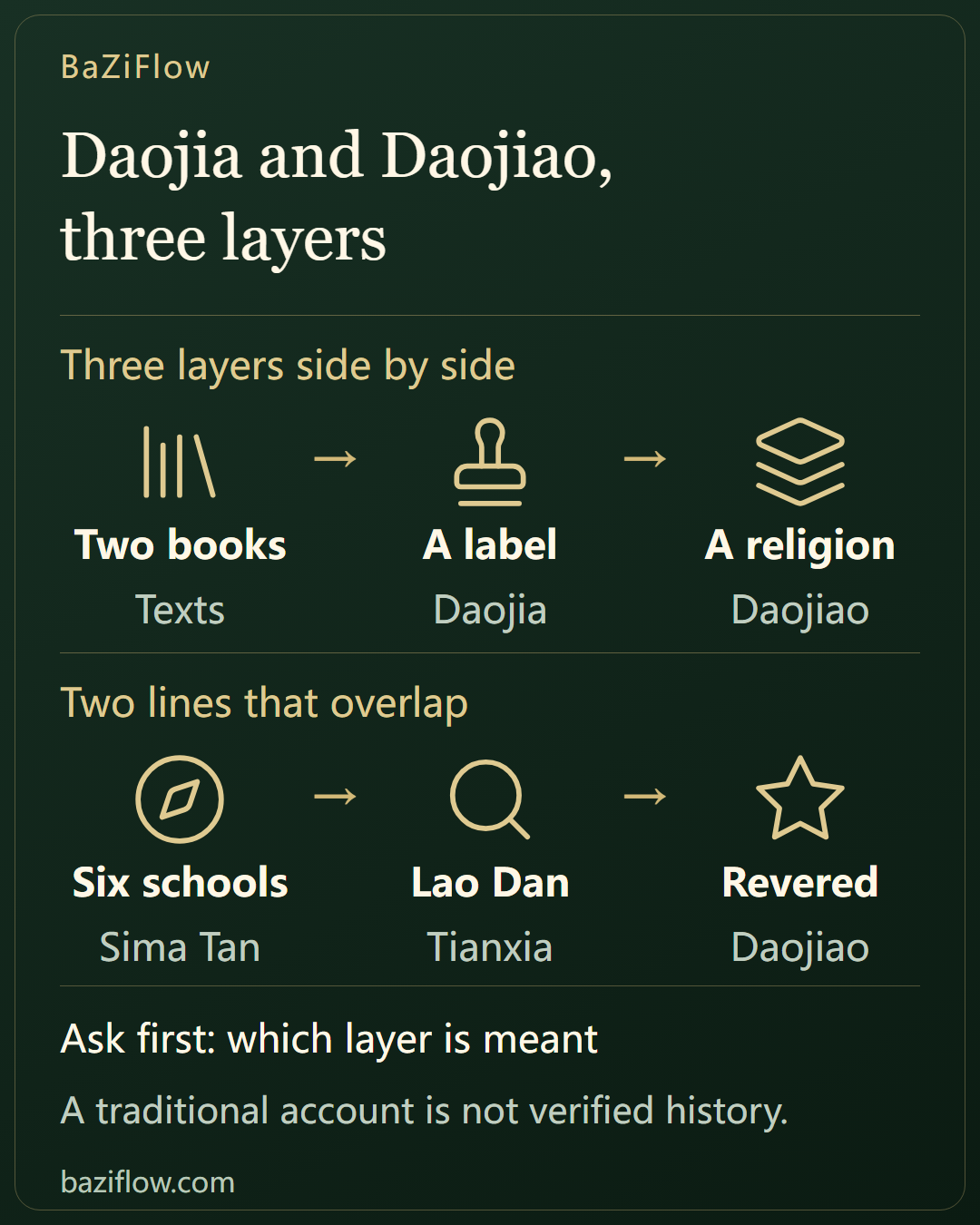
A three-column comparison separates the Laozi and Zhuangzi (two books), the label "Daojia" (a Han classification) and the religion "Daojiao"; Sima Tan’s essay and a Zhuangzi chapter show where the name comes from.
The short version8 min read
"Daojia" is a name Han writers gave to one kind of thought, and "Daojiao" is a religious tradition that formed later; the Laozi and the Zhuangzi are material both sides share, yet the three sit on different levels.
- "Daojia" is a classifying name from the Han period: in his essay on the six schools Sima Tan first writes "Dao and De" and then "Daojia", and means an art of rule built on adapting to circumstances.
- When "All Under Heaven" in the Zhuangzi describes Guan Yin and Lao Dan it speaks of "the ancient arts of the Way" and never uses the word Daojia; the same people and books go by different names in different places.
- Religious Daoism has clergy, rites and a pantheon. It honors Laozi as the deity Supreme Venerable Lord and calls the Zhuangzi the "True Scripture of Southern Florescence"; it overlaps with Daoist thought but has materials of its own.
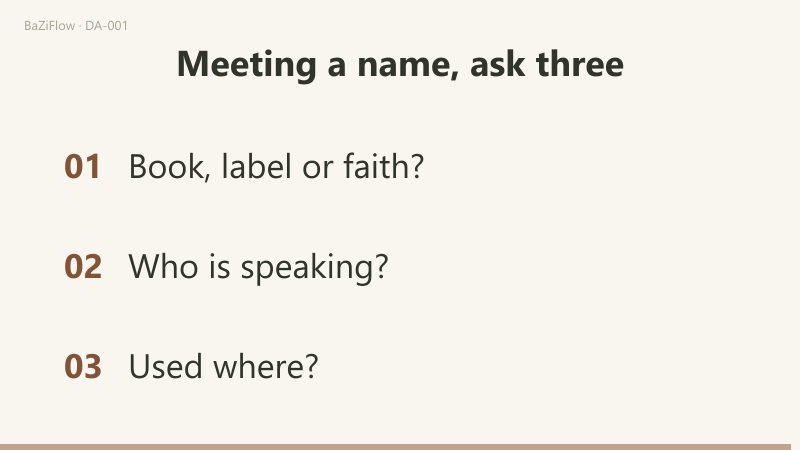
Three different things: books, a name, a religion
Meeting "Daojia" (道家) and "Daojiao" (道教), people usually react in one of two ways: they treat them as one thing, or as "one is philosophy, the other is superstition". A steadier habit is to ask first: what kind of thing does this word point to?
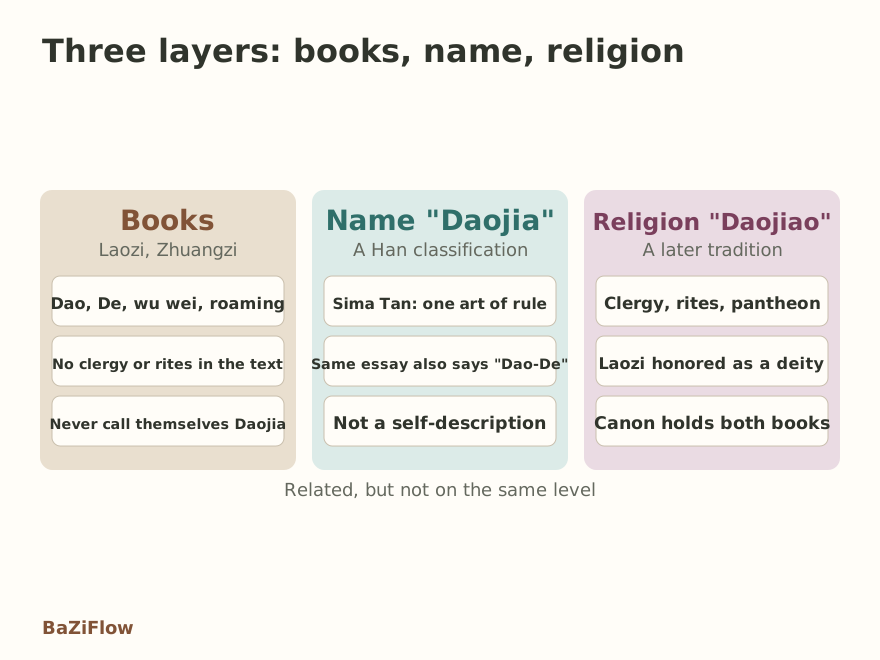
Sketch of three layers: books, a name and a religion are related but not interchangeable; the sources are in the sections below.
The three columns in the figure are three different kinds of thing:
- Books: the Laozi and the Zhuangzi, two texts in their own right and the material for everything that follows.
- A name: "Daojia", a label later writers attached to one kind of thought, which makes it a classification.
- A religion: "Daojiao", with clergy, rites, a pantheon and a line of scriptures, a community plus a body of practice.
The Han "Daojia": how Sima Tan sorted six schools
For the name "Daojia" there is one source that is easy to check: Sima Tan's essay on the essentials of the six schools, which Sima Qian copied into the Grand Historian's Postface of the Shiji (史记). Sima Tan opens by saying that the many teachings under heaven reach one goal by different roads, and then lists six schools.
The Yin-Yang school, the Confucians, the Mohists, the School of Names, the Legalists, and Dao and De: these are all people who work at government. They only speak of it from different roads, and some see more clearly than others.
Two points stand out. The last school is written "Dao and De" (道德), not "Daojia"; and the six are described as people who "work at government", that is, all of them study how to rule. He then goes through them one by one, and only there switches to the word "Daojia".
Enlarge diagram · scroll sideways to read
Five schools get "a fault, yet a strength that cannot be dropped"; the Daojia row gets only praise. Sima Tan himself "learned the discourse on the Way" from a teacher named Huang, so he is not a neutral judge, and the passage should be read with that in mind. This is what he says about the Daoists:
The Daoists make people single-minded in spirit, their every move in tune with the formless, and they provide amply for the myriad things. As an art it follows the great order of yin and yang, takes the good of the Confucians and Mohists, and picks the essentials of the Names and the Legalists; it shifts with the times, changes with things, and is fit for setting up customs and carrying out affairs, with a brief aim that is easy to hold, little work and much result.
The Daoists speak of non-action and also of "nothing left undone". In fact it is easy to practice, but its words are hard to grasp. Its art takes emptiness and non-being as the root and going along with things as the function.
Here "Daojia" is first of all an art of rule: it does not cling to one side, it takes what is usable from the Yin-Yang, Confucian, Mohist, Names and Legalist schools, and it takes "emptiness as the root and adapting as the function". That differs from the usual later associations of the word, with mountains and hermits.
Lao Dan in the Zhuangzi: no "Daojia" in sight
How are the same people and books named elsewhere? The chapter "All Under Heaven" of the Zhuangzi first says that many specialized arts are practiced under heaven, then asks where "the ancient arts of the Way" can be found, and arrives at Guan Yin and Lao Dan:
Among the ancient arts of the Way, some lay in just this. Guan Yin and Lao Dan heard of it and were glad. They set it up on constant non-being and being and made the Great One its master. Softness, weakness and lowly humility were its outer show; emptiness that does not harm the myriad things was its substance.
Lao Dan is the name traditionally linked with Laozi. The passage writes by person: it says which "art of the Way" Guan Yin and Lao Dan liked, and the chapter never uses the word Daojia. The Postface of the Shiji, when it sums up the biography of Laozi, says only "Li Er acts by non-action and the people change by themselves; he keeps still and the people set themselves right". Elsewhere it says that at the start of the Han "Cao Can recommended Master Gai, who spoke of Huang-Lao", which is yet another name.
Enlarge diagram · scroll sideways to read
By person, by art of rule and by school are three different angles of classification. "Daojia" is one of them, and it is the one used by Han writers looking back.
Religious Daoism: another line, starting from communities and rites
"Daojiao" today means a religious tradition with clergy, rites, a pantheon and a line of scriptures. The traditional account treats the Celestial Masters (天师道, also called the Way of the Five Pecks of Rice) of the late Eastern Han as an early organized community, usually traced to Zhang Daoling; finer dates and persons are told differently by scholars and by believers, so only this widely held thread is used here.
How did the religion take over the Laozi and the Zhuangzi? Three points come up most often:
Enlarge diagram · scroll sideways to read
The same "Laozi" is a legendary author in the book and a deity in the religion; the same Zhuangzi is a collection of essays on a shelf and a true scripture inside the religion. The Daoist Canon (Daozang, 道藏), compiled in later times, is the collected library of Daoist writings; it holds the Daodejing and the True Scripture of Southern Florescence with their commentaries, along with large bodies of ritual and training texts.
Three words used inside the religion
- Celestial Masters
- An early community traditionally traced to Zhang Daoling, also called the Way of the Five Pecks of Rice.
- Ritual manuals
- The procedures for retreat-and-offering rites: how to bow, chant and submit petitions.
- Daoist Canon
- The collected library of Daoist writings, compiled over later centuries.
Overlap and difference: where the two lines meet
Putting the sections together, the two lines and their overlap can be drawn like this:
Enlarge diagram · scroll sideways to read
The overlap is large. Daoist believers read and comment on the Laozi and the Zhuangzi and have placed Laozi in their pantheon, while readers of the Laozi and the Zhuangzi need have nothing to do with a community. In history some people stood on both sides and some on one.
On meeting a name that carries "Dao", place it in three steps:
Ask what it points to
Is the word speaking of a book, a classifying name, or a community and its practice?
Ask who is speaking
Is it a Han historian, the narrator in the Zhuangzi, or a scripture inside the religion? The same word from different speakers can point to different things.
Ask where it is used
Is it in an argument about government and living, or in the procedures of rites and training?
To read the texts themselves, start with Dao and De and go on to wu wei; how the two books fit together is in Laozi and Zhuangzi.
Questions readers ask next
Are "Daojia" and "Daojiao" the same thing?
They sit on different levels but overlap a great deal. "Daojia" appears in Han classification and names a kind of thought; "Daojiao" is the later religion with clergy and rites. Both sides use the Laozi and the Zhuangzi, which is why the two get mixed. On meeting either word, first ask whether it points to a book, to ideas or to a religion.
Was Laozi the founder of religious Daoism?
The traditional account treats the Celestial Masters as an early community, usually traced to Zhang Daoling, while honoring Laozi as the Supreme Venerable Lord. Inside the religion Laozi is a revered deity and the author of a scripture; whether that counts as "founding" depends on how founding is defined, and accounts differ, so no one-line verdict is safe.
Do I need to be a religious Daoist to read the Daodejing?
No. The book can be read as a text, asking what each chapter says; Daoist believers also recite it in religious life. The same book has both kinds of reading side by side.
Was this article helpful?
Part of a learning path
Sources & references
Continue reading
Dao and De in the Laozi: Reading Chapters 1, 21, 25, 38 and 51 ↗
Wu Wei: Why It Is Not Doing Nothing, Read Through Chapters 2, 48, 57 and 64 ↗
Laozi and Zhuangzi: Reading Them Side by Side by Genre, Audience and Word Use ↗