

Xiaoxu (小畜): the clouds gather, has it rained?
Content version · · Sources & references
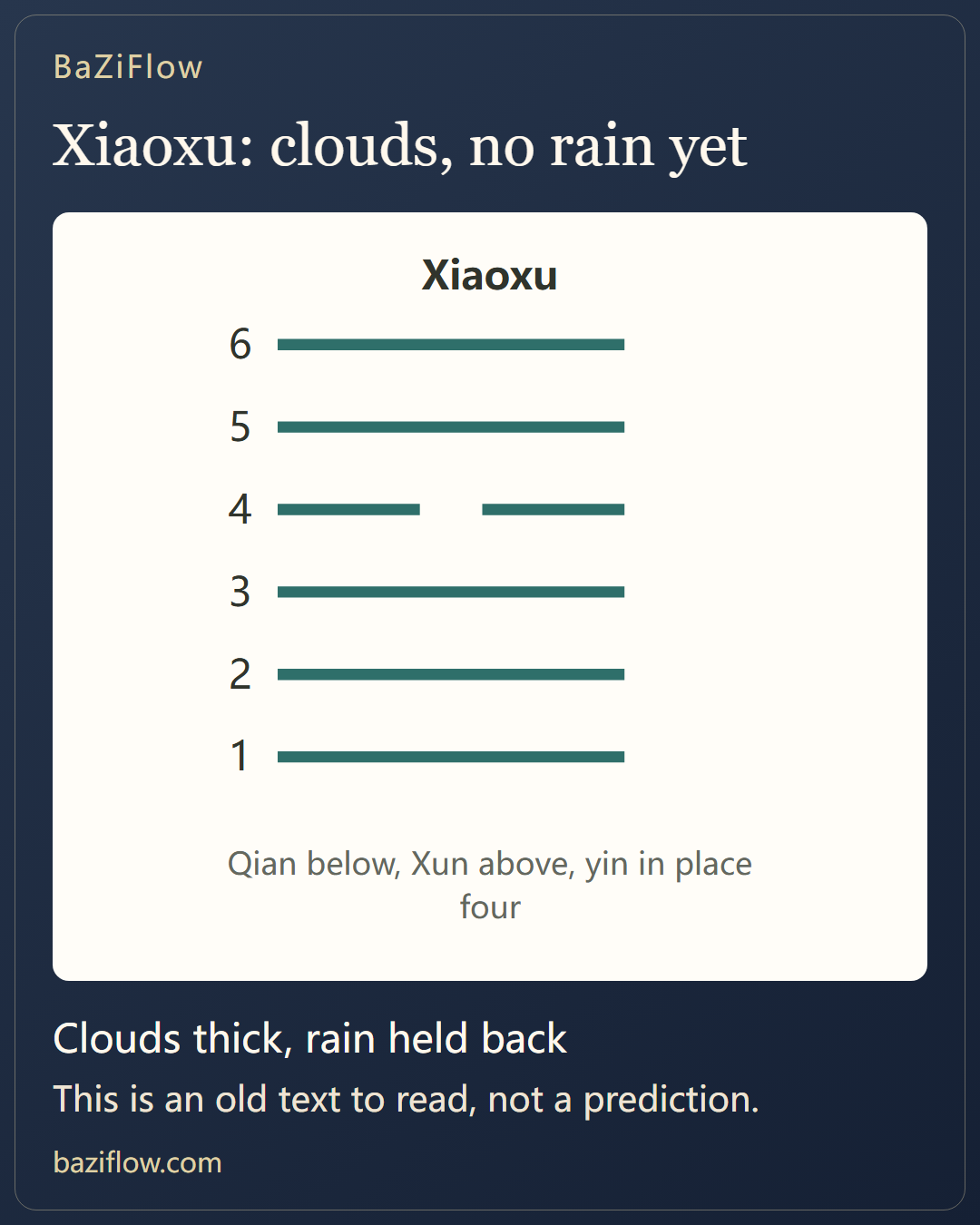
Xiaoxu has Qian (heaven) below and Xun (wind) above, with one yin line among five yang. Read the Judgment "dense clouds, no rain", the Great Image "wind over heaven", and the words return, sincerity and rain.
The short version7 min read
Xiaoxu is drawn as five yang lines and one yin line, but its text paints weather: clouds gather and no rain falls. Three words come back through the six lines, return, sincerity and rain, and carry that weather until the rain has fallen.
- Xiaoxu stacks Xun (wind) on Qian (heaven), and only its fourth line is yin. The Commentary on the Judgments explains the name with that one line: "the yielding line gets its place, and those above and below answer it".
- The Judgment says "dense clouds, no rain" and "from our western outskirts"; the Commentary on the Judgments answers "still going forward" and "the bestowing has not yet gone out". In Qian the clouds move and rain is bestowed; in Xiaoxu the rain is held back.
- Return appears in lines 1 and 2, sincerity in lines 4 and 5, rain in the top line. Line 3 is the only line where husband and wife turn away from each other.
Read first
The Sixty-Four Hexagrams: How Upper and Lower Trigrams Form One Figure ↗
Judgment and Line Statements: Whole Hexagram or Single Line? ↗
Wind over heaven: one yin line among five yang
The lower trigram of Xiaoxu (小畜) is Qian (乾, heaven) and the upper trigram is Xun (巽, wind), so it is read as Qian below, Xun above. Of its six lines only the fourth is a broken yin line; the other five are yang, so the whole figure has a single yin line, in the fourth place. In the Shuo Gua, Qian gets the word "strength" and Xun the word "entering".
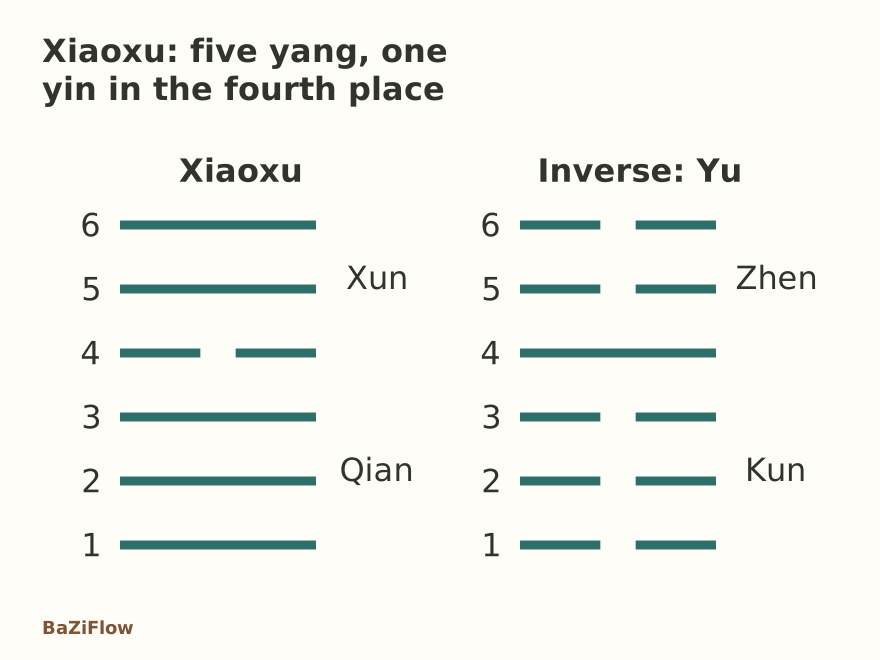
Xiaoxu and its inverse hexagram Yu: a figure with its yin in place four and a figure with its yang in place four are each other's inverse.
Enlarge diagram · scroll sideways to read
Three terms to start with
- Xu
- The word in the name. The Xu Gua says "when things have been gathered, there is ritual", so xu is gathering things up. The Commentary on the Judgments says why the hexagram is called Xiaoxu: "the yielding line gets its place, and those above and below answer it".
- The yielding line gets its place
- The Commentary on the Judgments' phrase. The yielding line is the yin line, and its place is the position it holds. Line four is yin and stands in the fourth place, which belongs to yin, so it "gets its place".
- Xun
- The upper trigram, with the image of wind. The Shuo Gua says "Xun means entering": wind goes in by following the gaps.
The Judgment: clouds gathered, rain not yet fallen
The Judgment of Xiaoxu is short: "Success. Dense clouds, no rain, from our western outskirts." It gives one word of success and then paints the sky: the clouds are thick, no rain falls, and the clouds come from the western outskirts of "us". The Commentary on the Judgments replies to each of the three in turn:
Enlarge diagram · scroll sideways to read
The Commentary on the Judgments first explains "success": Qian is strong, Xun enters, and the yang lines in the middle let the will be carried out, so there is success. "It is still moving forward" means the clouds are still going on, and "the bestowing has not yet gone out" means the rain has not yet been given. The same word, "bestowing", appears in the Commentary on the Judgments on Qian, "clouds move and rain is bestowed": the clouds move and then the rain comes down. In Xiaoxu the clouds are already thick and the rain is not yet bestowed. It is the same sky, caught half way.
The Great Image: wind moves over heaven, and a noble person refines the virtue of culture
The Great Image (大象) of Xiaoxu reads: wind moves over heaven, Xiaoxu; the noble person uses it to refine the virtue of culture. The first half is the figure: wind (Xun) above heaven (Qian). The second half is the conduct: "refine the virtue of culture", where refine means to make fine and the virtue of culture means the virtue of civil learning.
Enlarge diagram · scroll sideways to read
Set it beside the Great Image of Qian. Qian over Qian is "heaven moves with strength", and what moves is heaven itself. Xiaoxu changes the upper trigram to wind, so what moves is the wind above heaven. The conduct shrinks with it: for Qian it is strengthening the self without rest, and for Xiaoxu the noble person does one thing, making the virtue of culture finer.
Six lines: return, sincerity, rain
Three words come back through the six statements: "return" in lines 1 and 2, "sincerity" in lines 4 and 5, and "rain" in the top line. The Judgment's "no rain" has become "it has rained" by the end.
Enlarge diagram · scroll sideways to read
First nine, "returns by his own way", comes back along his own road, and "how could that be a fault" asks what blame there could be. Nine in the second place, "led back", is drawn back, and the Small Image (小象) says "nor does he lose himself". Both yang lines wanted to go up, both turned back first, and both statements end on "good fortune".
Nine in the third place is different: "the carriage loses its spokes; husband and wife turn their eyes away from each other". The Small Image comments "he cannot put the household right". It is the only one of the three lower lines without "good fortune".
Six in the fourth place is the one yin line: "sincere; blood departs, alarm goes out: no blame". Pain leaves and fear goes out. The Small Image adds "it joins the will above". Nine in the fifth place: "sincerity that binds; rich together with one's neighbors". Sincerity ties people together and wealth is shared with the neighbors; the Small Image says "he is not rich alone".
The neighbors of Xiaoxu: Yu, Lü and Kui
The inverse hexagram of Xiaoxu is Yu, where each line is its opposite: the lone yin among five yang turns into a lone yang among five yin, still in place four. Turn Xiaoxu over and you get its reversed hexagram, Lü (履), with the yin line now in place three. Take lines two to five, split them again into a lower and an upper trigram, and the result is its nuclear hexagram, Kui (睽).
Enlarge diagram · scroll sideways to read
Where there is gathering there must be accumulation, so it was followed by Xiaoxu.
Xiaoxu follows Bi, and after it comes Lü, since the Xu Gua says ritual comes after things are gathered. The Za Gua gives Xiaoxu a single word: "few". Look at the figure once more: one yin line, five yang lines, and the few are the yin.
Questions readers ask next
What does "xu" in Xiaoxu mean?
The Xu Gua says "when things have been gathered, there is ritual", so xu is gathering things up, and the Za Gua gives Xiaoxu one word, "few". In the lines the gathering is slow and gradual: the clouds are gathered and the rain has not come.
Is "husband and wife turn away" in line 3 about marriage?
Literally, a carriage loses its spokes and the husband and wife riding in it turn their eyes away from each other; the Small Image comments that "he cannot put the household right". It is a picture in an old text, and reading it means seeing how the line is written.
Why do rain and "the noble person who sets out meets misfortune" sit in the same top line?
"It has rained and it has settled" says the rain has fallen and come to rest, and the Small Image files it under virtue built up and carried. "The noble person who sets out meets misfortune" starts a second layer, which the Small Image comments on separately as "there is something he doubts". Each comment stands on its own sentence.
Was this article helpful?
Sources & references
Continue reading
Bi (比): five yin lines, one yang, and the question of whom to join ↗
Lü (履): one tiger's tail, three different endings ↗
The Sixty-Four Hexagrams: How Upper and Lower Trigrams Form One Figure ↗
Judgment and Line Statements: Whole Hexagram or Single Line? ↗