

Gen: where in the body does it stop
Content version · · Sources & references
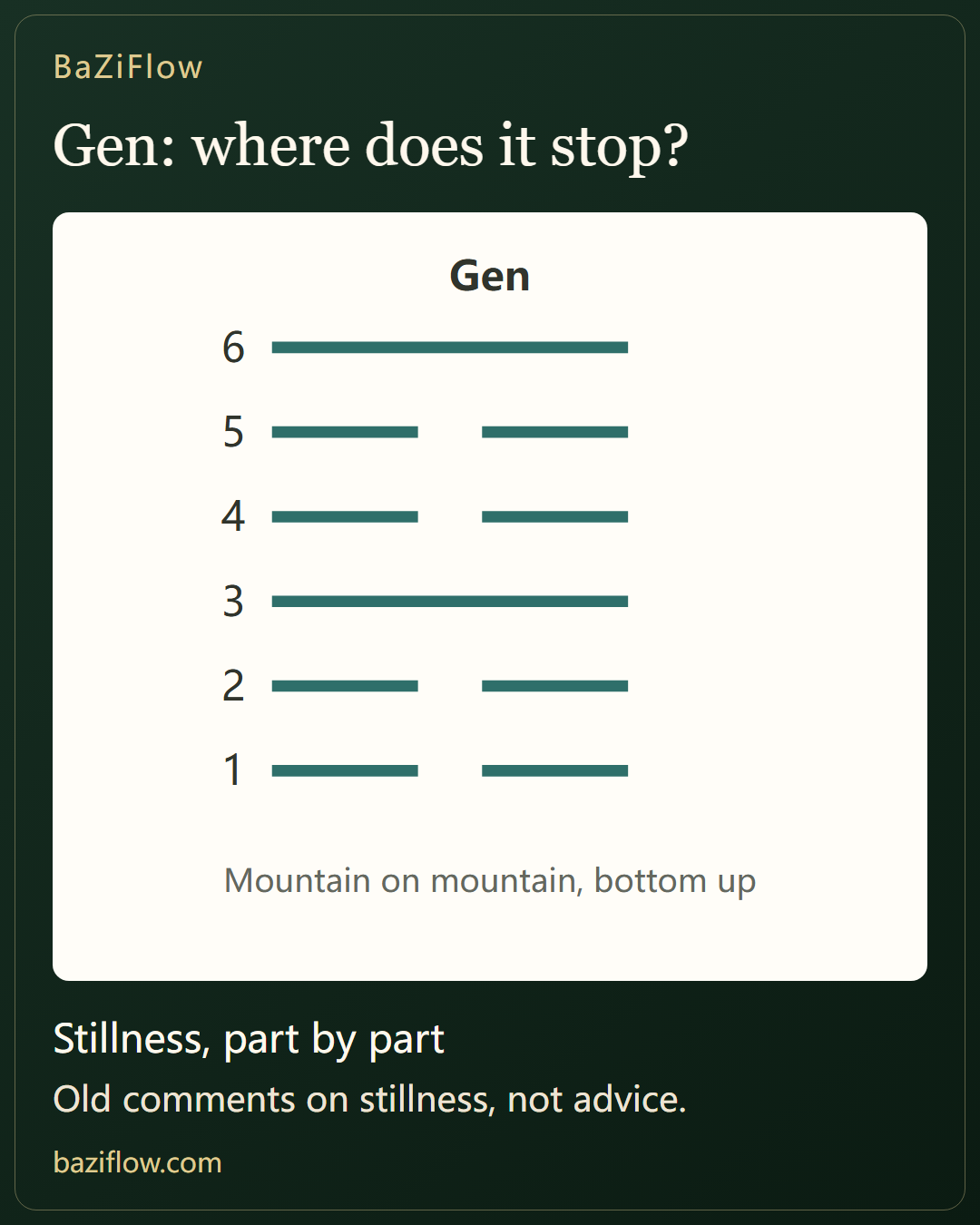
Gen is the 52nd hexagram, mountain on mountain. Read the judgment’s still back, the Commentary’s “stop when it is time to stop, go when it is time to go”, and six lines that ask where stillness falls, from toes to jaw.
The short version8 min read
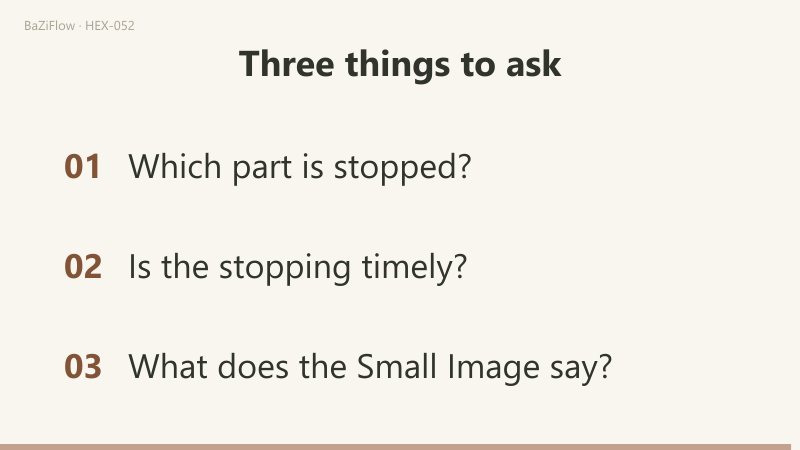
Gen means stopping, but the text never discusses stopping in the abstract. It asks place by place: at the toes, at the calves, at the waist, at the trunk, at the jaw.
- Gen stacks Gen on Gen, each trigram a yang line above two yin lines. The Shuo Gua says “Gen is stopping”, and the Great Image calls it mountains joined.
- The Commentary first says “stop when it is time to stop, go when it is time to go”, then closes with the figure: “above and below are opposed”, since lines 1 and 4, 2 and 5, 3 and 6 have the same polarity and do not answer each other.
- Five lines each stop one body part, from the toes upward. The last line names no part and says only “thick stopping”, which the Small Image assesses as “ending in generosity”.
Read first
The Sixty-Four Hexagrams: How Upper and Lower Trigrams Form One Figure ↗
Judgment and Line Statements: Whole Hexagram or Single Line? ↗
Two mountains joined: the yang line at the top
Gen (艮) is the 52nd hexagram. The same trigram sits above and below, and the Great Image calls the result “mountains joined”, one mountain attached to the next. The trigram itself is a yang line at the top over two yin lines. The Shuo Gua gives it one word, “stopping”, and its image is the mountain; it is also the “youngest son”.
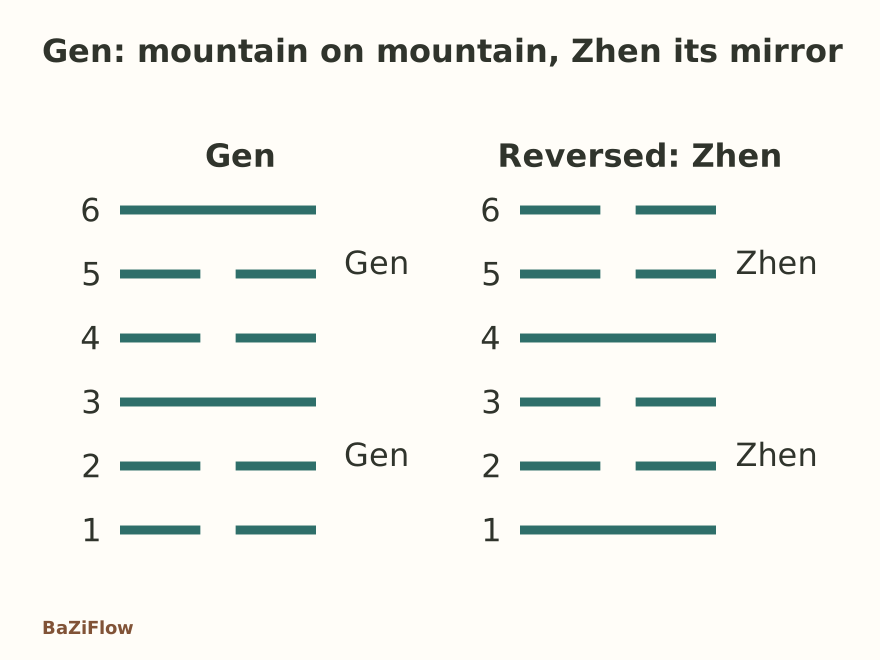
Gen and its reversed hexagram Zhen: turn Gen upside down and you have Zhen, so the mirror of mountain (stopping) is thunder (moving).
Enlarge diagram · scroll sideways to read
Tradition usually understands “stopping” like this: the yang line has reached the highest place in the trigram and there is no further position above it. In Zhen the yang line sits at the bottom and has two places still to go; in Gen there is none.
Four body words to know first
- Toes and calves
- The toes, and the calf muscles. Lines 1 and 2 begin with these two.
- Waist and spine
- Tradition usually reads the first word as the waist, the dividing line of the upper and lower body, and the second as the flesh beside the spine. Line 3 is about this region.
- Trunk and jaw
- The trunk is the torso, and the jaw means the cheek and the area beside the mouth. Lines 4 and 5 name them.
- Thick
- Heavy, generous. The top line is just three characters: thick stopping, good fortune.
The judgment and the Commentary: still at the back, so no one is seen
The judgment of Gen is a run of short clauses: keeping the back still; one does not get hold of the body; walking in the courtyard, one does not see the person; no blame. The back is the side of a person that he cannot see, and the judgment goes on to say that even while walking in the courtyard “one does not see the person”. On the surface, the back and “not seeing” answer each other. The text does not say more about why the back was chosen.
Gen means stopping. Stop when it is time to stop, go when it is time to go: movement and stillness do not miss their time, and its way is bright. “Keeping still at its stopping place” means stopping where it belongs. Above and below are opposed, and do not join each other. That is why “he does not get hold of his body; he walks in his courtyard and does not see the person: no blame”.
Enlarge diagram · scroll sideways to read
“Gen means stopping” is the definition of the name. The sentence that follows, “stop when it is time to stop, go when it is time to go”, puts stopping into a question of timing: it is not the same as not moving, but stopping when it is time and going when it is time, so that movement and stillness do not miss their time.
The last sentence checks against the figure. Lines 1 and 4, lines 2 and 5, and lines 3 and 6 are the three pairs of corresponding places in the two trigrams. In Gen, lines 1 and 4 are both yin, lines 2 and 5 are both yin, and lines 3 and 6 are both yang. All three pairs have the same polarity, which is “opposed”, and so they do not answer each other.
The Great Image: mountains joined, thought stays in its place
Mountains joined: Gen. The noble person’s thoughts do not go beyond his position.
Enlarge diagram · scroll sideways to read
“Joined” means attached, so mountains joined are two mountains in a row. What the noble person does is that his thoughts do not go beyond the position he holds.
Set beside the six lines, this shows a difference: the lines stop parts of the body, from the toes to the jaw, while the Image stops thought. The word “position” also connects with the Commentary’s “stopping where it belongs”: the place is the position where one should be.
Six lines: from toes to jaw, and then “thick”
The first five statements use one pattern: “keeping the … still”. The nouns that follow are five parts of the body from the bottom up; the last line switches to “thick stopping” and names no part.
Enlarge diagram · scroll sideways to read
Line 1: “keeping the toes still: no blame; fitting to stay on course for the long term”. The step is stopped just as it begins, so there is no fault, and the Small Image says “not yet off the right way”. Line 2: “keeping the calves still, but not lifting what they follow; his heart is not glad”. The calf is the calf muscle, and tradition usually reads the line as the calf following the part above it and being unable to hold it back, hence the unhappy heart. Directly above line 2 stands the yang line 3.
Then line 3: “keeping the waist still; the flesh along the spine tears; danger scorches the heart”. This follows the received text, where the word for “tears” is traditionally read as tearing apart; for “scorches” some versions have a different character, and the Small Image uses the same word as the received text. The waist is the dividing line between the upper and lower body, and line 3 is exactly the top line of the lower trigram, next to the upper one. Stopped on that line, the flesh beside the spine is torn, there is danger, and the heart is scorched. Of the six statements, only this one mentions danger.
Line 4, “keeping the trunk still: no blame”, is five characters in the original, and the Small Image says “stopped within the body”. Line 5, “keeping the jaw still: words are in order; regret vanishes”: the jaw is the cheek and the area beside the mouth, so the stopping here keeps one’s words in check, and they come out in order (some versions have “trustworthy” instead).
The last line names no part: “thick stopping: good fortune”, with the Small Image “ending in generosity”. Put the verdicts in order from bottom to top and they read: no blame, the heart not glad, danger, no blame, regret vanishes, good fortune. Line 3 is the lowest point and the run climbs from there.
Zhen, Dui and Xie: neighbors of Gen, and its place after Zhen
Gen’s reversed hexagram is Zhen (震), as the opening figure shows. Gen is stopping and Zhen is moving, and the Xu Gua puts Gen after Zhen with a very short reason: nothing can go on moving forever, so it must be stopped, and “Gen means stopping”. After Gen comes Jian, and there the Xu Gua says that stopping cannot go on to the end either.
The inverse hexagram (错卦) is Dui (兑), which in the Shuo Gua is “delight”. The nuclear hexagram (互卦) is Xie (解). Take lines 2 to 4 of Gen: yin, yang, yin, which make the lower trigram Kan; lines 3 to 5 are yang, yin, yin, which make the upper trigram Zhen.
Enlarge diagram · scroll sideways to read
Questions readers ask next
Why does the judgment choose the back?
The text does not say why. On the surface the back is the side of oneself that one cannot see, which echoes the later “does not see the person”. Beyond that the text gives no reason, and none should be added for it.
Does Gen tell you to do nothing?
The Commentary answers directly: stop when it is time to stop and go when it is time to go, so that movement and stillness do not miss their time. Stopping is about timing; it is not a standing order to stay still.
What do “keeping the waist still; the flesh along the spine tears” mean?
Tradition usually takes the first as the waist, where upper body meets lower, and the second as the muscle running beside the backbone. The statement then adds a warning of danger but does not describe the situation any further.
Was this article helpful?
Sources & references
Continue reading
Zhen: how near the thunder falls, and what stays in the hand ↗
Jian (漸): one wild goose, six landings, and what each stop brings ↗
The Sixty-Four Hexagrams: How Upper and Lower Trigrams Form One Figure ↗
Judgment and Line Statements: Whole Hexagram or Single Line? ↗