

Li (离): the hollow middle, clinging and the south
Content version · · Sources & references
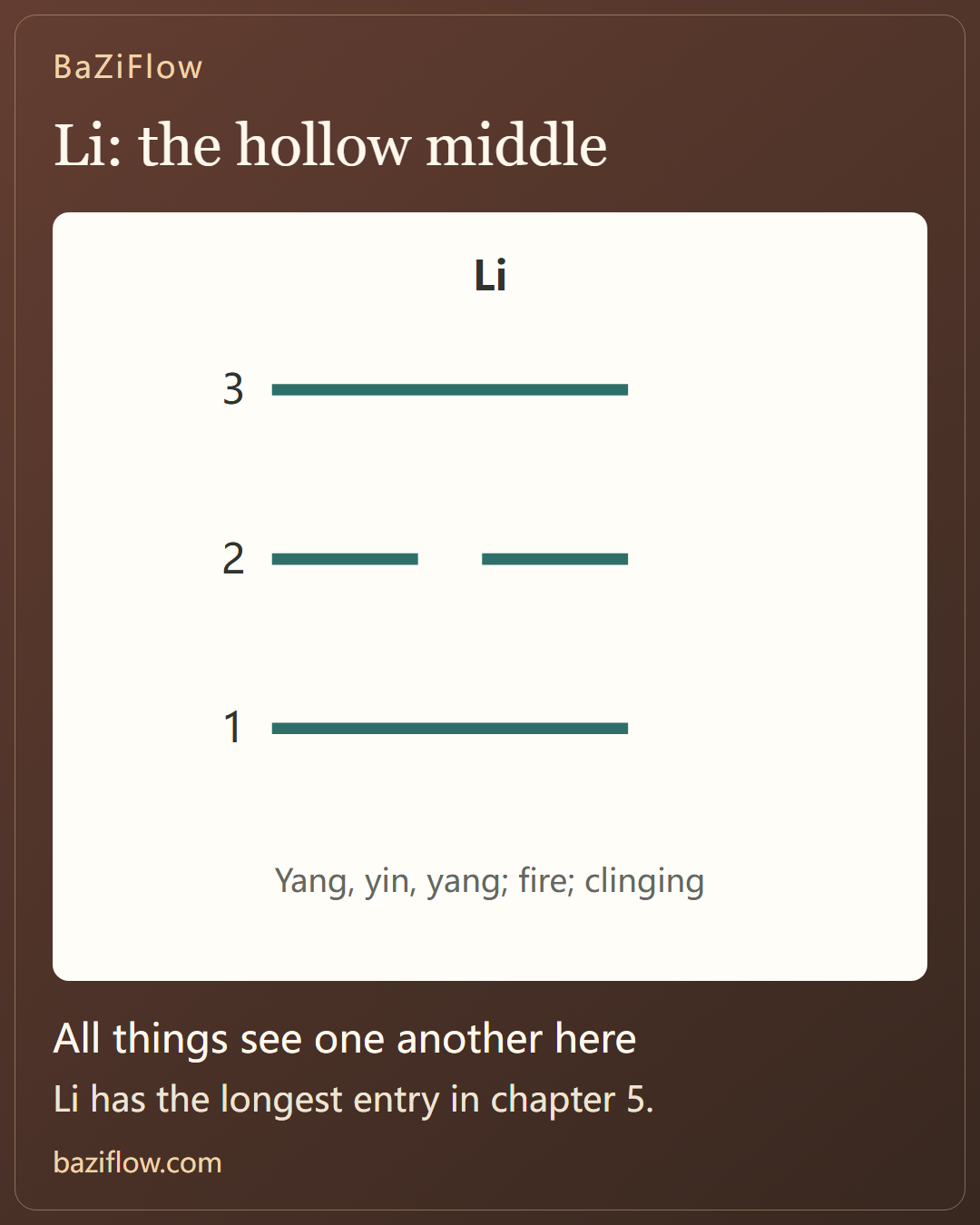
Li has two yang lines around a broken yin line. Follow its word, clinging, through three Ten Wings texts, then chapter 5 on facing the light, the shelled creatures of chapter 11, and the pheasant versus the cow.
The short version6 min read
The word the Shuo Gua gives Li is clinging; chapter 5 places it in the south and says that the sage governs turned toward the light. The figure is a broken yin line held between two yang lines.
- Turn Li upside down and it is still Li; swap every line and you get Kan. Li and Kan are inverses, and chapter 3 writes them as "water and fire do not shoot at each other".
- Clinging means attaching to something: the Commentary on the Judgments says sun and moon cling to heaven, grain and plants to the soil, and the Xu Gua says what sinks must cling to something.
- The chapter 11 list for Li starts with fire, sun and lightning and goes on to the turtle, crab, snail, clam and tortoise, creatures that carry shells.
Read first
Eight Trigrams: Three-Line Structure and Basic Images, Read Through the Shuo Gua ↗
A broken line in the middle: Li turned over is still Li
Li (离) has two yang lines around one broken yin line, and the mnemonic students used later remembers it as "hollow in the middle". The shape has one odd property: turn it upside down and what you see is the same trigram.
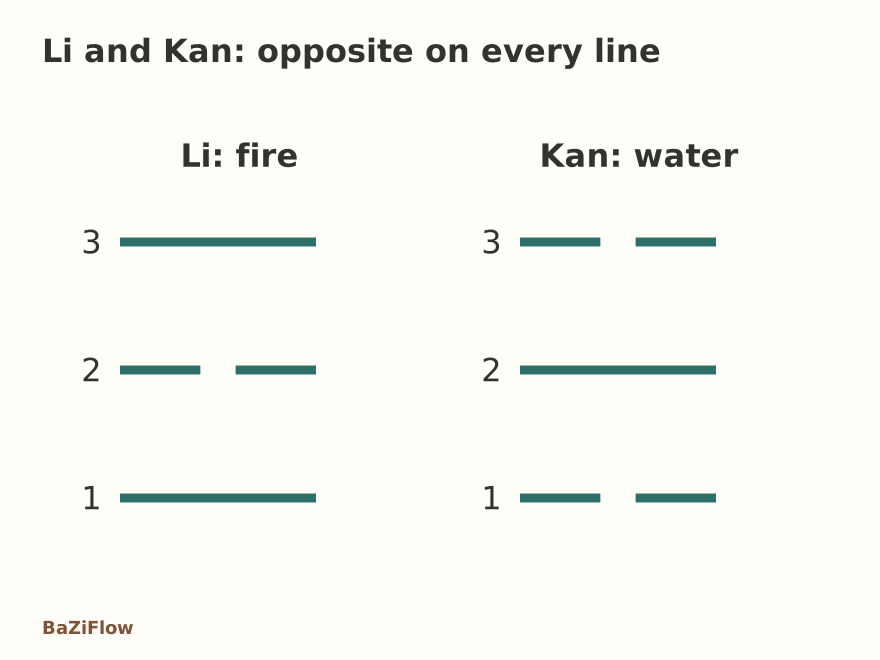
Li beside Kan: every line is opposite, which makes the pair inverses; Li's image is fire and Kan's is water.
The other change is a swap of polarity: replace all three lines with their opposites and you get Kan (坎). Li and Kan are therefore inverses, and chapter 3 of the Shuo Gua (说卦) sets them side by side as a pair, saying of water and fire that they "do not shoot at each other".
Enlarge diagram · scroll sideways to read
Clinging, and what it clings to
The word chapter 7 gives to Li is clinging. The Commentary on the Judgments (彖传) adds examples, and the Xu Gua (序卦) starts from Kan:
Clinging in three texts
Li is clinging
One of the eight nature words. Clinging means attaching, holding on.
Sun and moon cling to heaven; grain and plants cling to the soil
Two sets of examples: sun and moon attach to the sky, crops and plants attach to the earth, each with its own support.
What sinks must cling to something
Sinking is Kan's word. Whatever has fallen in needs something to hold, and so the next hexagram is Li.
The word is the same character in all three places, and in each it means having something to hold on to. Later readers often see the figure this way: the middle yin line holds on between two yang lines. That is a reading of the picture; the texts give only the word and the examples. The Great Image of Dui uses the same character in its phrase for lakes joined together, which is taken up in the Dui trigram.
Facing the light: the south in chapter 5
Of the eight trigrams, Li receives the longest entry in chapter 5:
Li is brightness. All things see one another there. It is the trigram of the south. The sage faces south to hear the world and governs turned toward the light; the practice is taken from this.
Brightness is another word for Li. That things can see one another belongs to the light of the south, and the sage faces south to take in the affairs of the world, a practice drawn from this trigram.
Enlarge diagram · scroll sideways to read
The Later Heaven diagram therefore puts Li in the south. On the Prior Heaven diagram Li is in the east, opposite Kan in the west. Li's one position rests on a sentence of chapter 5 and the other on the pairing of chapter 3.
Fire, sun and lightning, and creatures with shells
The chapter 11 entry for Li opens:
Li is fire, the sun, lightning, the middle daughter, armor, spears and weapons.
Fire, sun and lightning give light and heat; armor and weapons are hard-faced things made by hand. Next comes "in people":
In people: a big belly. Dryness, the soft-shelled turtle, the crab, the snail, the clam, the tortoise.
How far "in people" reaches depends on the punctuation: the Wikisource text runs everything after it on, while the Kanripo text stops after "a big belly" and start the dryness and shell list afresh. The word rendered "dryness" is the character that also names Qian, but traditionally it is read gān, "dry", and is not the trigram. The five that follow, turtle, crab, snail, clam and tortoise, are all animals that carry a shell. The last clause holds a single item, "among trees, one hollow with a withered top", traditionally explained as a trunk empty inside and dry at the crown.
Enlarge diagram · scroll sideways to read
The pheasant and the cow: two animals for one Li
Chapter 8 gives Li the pheasant. In the judgment of the six-line Li, though, the animal is a cow:
Keeping a cow brings good fortune.
The Commentary on the Judgments explains that cow itself:
The yielding clings to the center and the right place, therefore it prospers; hence keeping a cow brings good fortune.
The yielding is the yin line, which holds to a central, correct position, and from there the Commentary comes to the gentle cow.
Enlarge diagram · scroll sideways to read
Images serve their own statements in their own texts, and the pheasant of chapter 8 and the cow of the judgment are not on one list. The Great Image of the six-line Li reads "brightness doubled makes Li; the great person lights the four quarters by carrying on the brightness", with "great person" as subject rather than "noble person"; it is read in Li, the hexagram. To keep going with the partner of Li, move on to the Kan trigram.
Questions readers ask next
Is the "Qian" in the chapter 11 list for Li the trigram Qian?
No. Here the character is traditionally read gān, "dry", and only happens to be the character that names Qian. When a familiar character turns up, look at the sentence it stands in before deciding what it refers to.
Why is clinging called the nature of Li?
Chapter 7 gives the word to the trigram and the Commentary on the Judgments says "Li is clinging". Clinging means attaching: sun and moon attach to heaven, grain and plants to the soil. That pairing is written out by the Ten Wings themselves.
Li is fire, so why is its animal a pheasant, and why does a cow appear in the judgment?
Each text says its own thing. Chapter 8 gives Li the pheasant, the judgment of the hexagram speaks of keeping a cow, and the Commentary explains the cow by the yielding line clinging to the central, correct place. Images serve different statements in different texts; they are not one list.
Was this article helpful?
Sources & references
Continue reading
Dui (兑): a gap at the top, and the word "delight" seven times in the Shuo Gua ↗
Zhen (震): yang at the bottom, and the first stop of "the sovereign emerges in Zhen" ↗
Trigram imagery: why a round clay bowl has two possible routes ↗