

San Tai: one word, several uses
Content version · · Sources & references
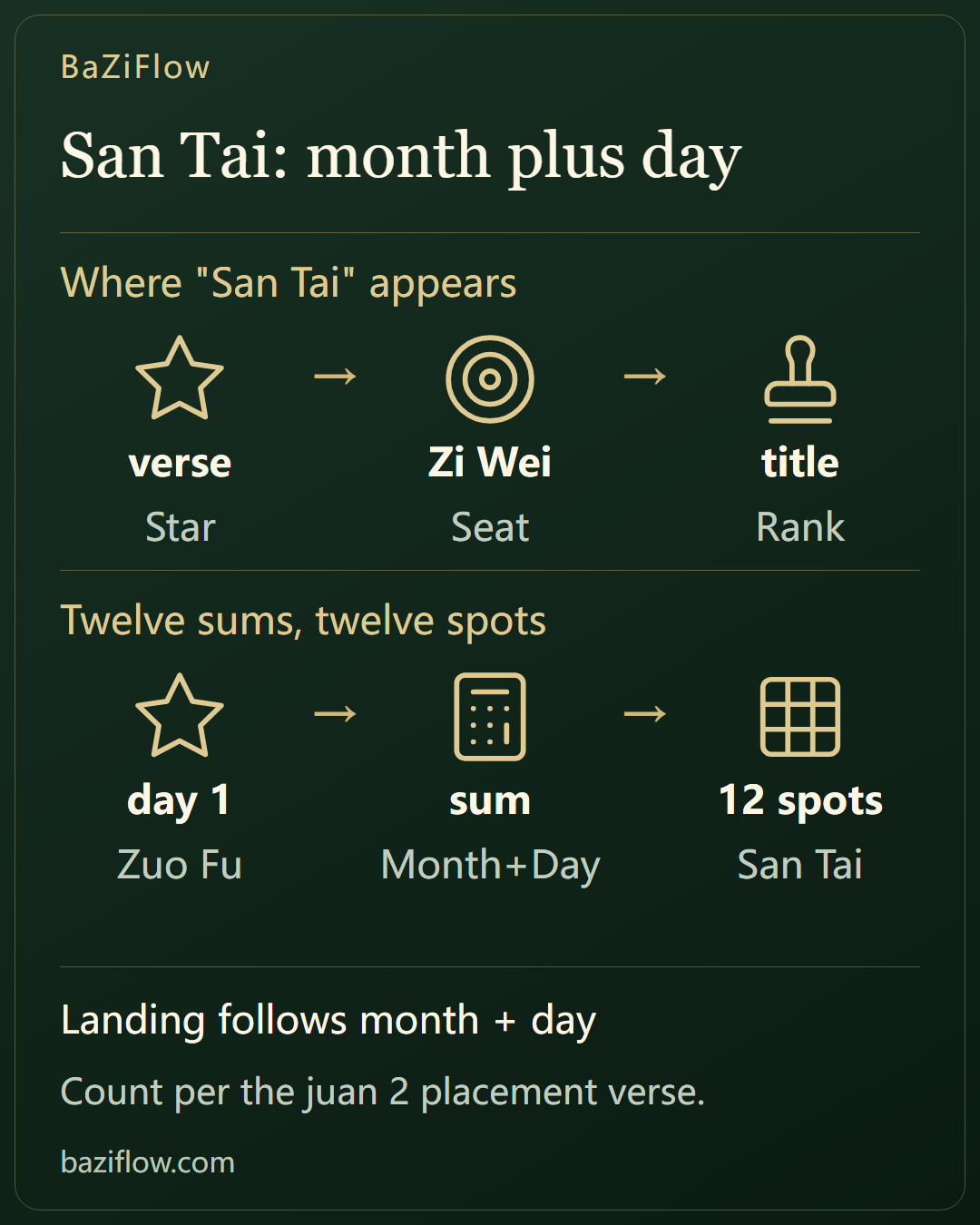
San Tai is a minor star counted from the Zuo Fu palace as day 1 to the birth day. First the other places the Quan Shu uses the words "San Tai", then a month-plus-day shortcut with twelve landings and the date to use.
The short version6 min read
The words "San Tai" appear in the Quan Shu in at least four ways: a minor star counted from birth month and day, three positions around Zi Wei, a rank idiom like "a place among the three terraces", and a star name listed beside other stars. The count covers the first, and its landing depends only on the sum of the lunar month and day.
- The book's San Tai is scattered over the placement verse, the Zi Wei entry, the verse lines and two passages on patterns; it does not say how they relate, and the star on a chart is the one in the placement verse.
- San Tai sits at the Dragon palace plus (month plus day minus two) places, so one more month and one more day have exactly the same effect, which leaves only twelve landings.
- The count uses the lunar day; a late Rat hour counts as the next day in the site default, and the second half of a leap month counts as the next month.
Read first
What do Zi Wei's supporting, malefic and minor stars actually do? ↗
Where the book uses the words "San Tai"
In plain words first: the San Tai (三台) on a chart is a minor star counted from birth month and day, but the two characters mean more than that in the Zi Wei Dou Shu Quan Shu (紫微斗數全書), and they turn up in at least four kinds of places.
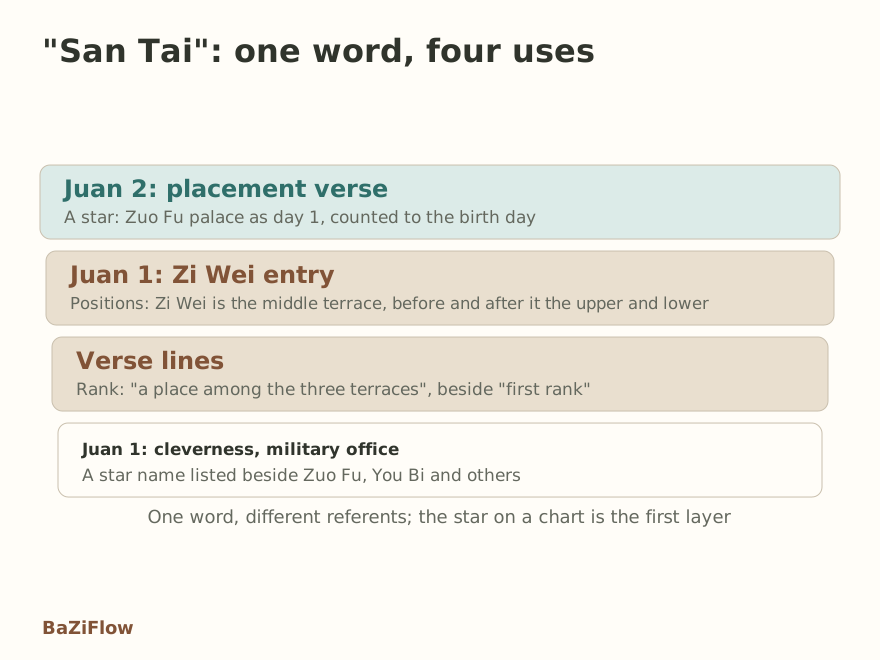
Layer sketch: each layer says which juan it comes from and what it refers to; only the first layer has a count by month and day, and its landings match iztro 2.6.0.
The first kind is the placement verse. Juan 2 has an entry on setting San Tai and Ba Zuo, where San Tai is a star to be put into some palace; the count comes in the next section.
The second kind is in the juan 1 entry for Zi Wei, and it is about three positions:
One must look at the three terraces: where Zi Wei guards the Life palace is the middle terrace, the place before it is the upper terrace, and the place after it is the lower terrace.
Here the "three terraces" are three seats in a row: the spot where Zi Wei holds the Life palace is the middle one, and the places before and after it are the upper and the lower. They follow where Zi Wei stands and are not counted from birth month and day.
The third kind is the verse lines about patterns, where the words stand beside ranks:
Ke bright and Lu hidden, a place among the three terraces; Sun and Moon in one palace, an office of marquis or earl.
"A place among the three terraces", the "marquis or earl" in the same line and the "rank of the three dukes" and "first rank" in the verses around it all speak of standing, and in old officialdom the three terraces often meant the highest grade of officials. Juan 3 adds a line "Zuo Fu (左辅) and Wen Chang (文昌), a place among the three terraces" used in the same way.
The fourth kind is two passages on "cleverness" and "military office", where San Tai and Ba Zuo are listed in one string with Zuo Fu, You Bi, Wen Chang and Wen Qu, and so are used as star names.
The book does not spell out how the four kinds relate, so what follows deals with the first one only.
Day 1 on the Zuo Fu palace, counted to the birth day
The rule itself is short: put the first lunar day on the palace where Zuo Fu sits, advance one palace per day in branch order, and the palace where the count stops at the birth day is San Tai. Juan 2 phrases it as taking "the first day and adding it to the Zuo Fu palace", then counting forward to the birth day.
Zuo Fu is set by birth month, at the Dragon palace for the first month and one palace further for each month, so the starting point of San Tai is fixed by the month; see Zuo Fu.
Enlarge diagram · scroll sideways to read
On day 1 itself San Tai shares the palace with Zuo Fu. Every twelve more days the landing comes back to the same place, so days 1, 13 and 25 put San Tai in one palace.
Month and day are one and the same in the formula
Put the two steps together: Zuo Fu is the Dragon palace plus (month minus one) places, and San Tai is Zuo Fu plus (day minus one) places, so San Tai is the Dragon palace plus (month plus day minus two) places. In the formula month and day sit in perfectly symmetric positions: one more month or one more day moves San Tai one palace on, so the landing depends only on the remainder of month plus day divided by 12.
Enlarge diagram · scroll sideways to read
Three different dates make a check:
Enlarge diagram · scroll sideways to read
The starting points differ and the step counts differ, yet the landing is one palace. The formula's results agree with charts drawn by the engine, and random spot checks turned up no exception.
Which day to count with
Three cases that change the day
- Lunar day
- The count uses the day of the lunar month, not the calendar date. The conversion steps are written up in leap months, hours and the day boundary.
- Leap month
- The second half of a leap month counts as the next month in the site default; convert the month first, then use the formula above.
- Late Rat hour
- A birth between 11 pm and midnight is placed on the next day in the site default, so the lunar day goes up by one.
Fix the lunar month and day
Apply the leap month and late-Rat-hour settings above to get the month and day used for the chart.
Add them and keep the remainder after 12
Find the branch for that remainder in the table above.
Then use the Life palace for the name
Once the branch is known, read which palace that branch is on this chart.
Two conversions
Born on the 5th day of the 7th lunar month: which branch holds San Tai?
7 plus 5 is 12, remainder 0, so the Tiger palace.
The birth day is the 5th and San Tai is on the Pig palace: which lunar month?
The Pig palace stands for remainder 9, and 9 minus the birth day 5 gives 4: the fourth month.
San Tai has a partner that counts the days in the opposite direction, covered in Ba Zuo; to read the palace it lands in, the order of the palaces is in the twelve palaces.
Questions readers ask next
A verse says "a place among the three terraces". Does that mean the chart has the San Tai star?
The book does not say these are the same thing. The same set of verses has "an office of marquis or earl" and "first rank" beside it, all about standing; equating it with the star on a chart needs a source of its own.
My friend and I were born in different months, so why is San Tai in the same palace?
San Tai responds only to month plus day. Starting from the same date, being born one month later or one day later moves San Tai on by the same single palace; any two people whose sums leave the same remainder when divided by 12 share it.
Does San Tai look only at the birth day, not the month?
It looks at both. The month fixes where Zuo Fu, the starting point, sits, and the day fixes how far to go from there; the two weigh the same in the arithmetic.
Was this article helpful?
Sources & references
Continue reading
Di Jie (地劫): Starting from the Pig Palace Like Di Kong, but Walking Forward ↗
Ba Zuo (八座): The Mirror of San Tai, Counted Back from You Bi ↗