

Friend–Decline: why 2 pairs with 7
Content version · · Sources & references
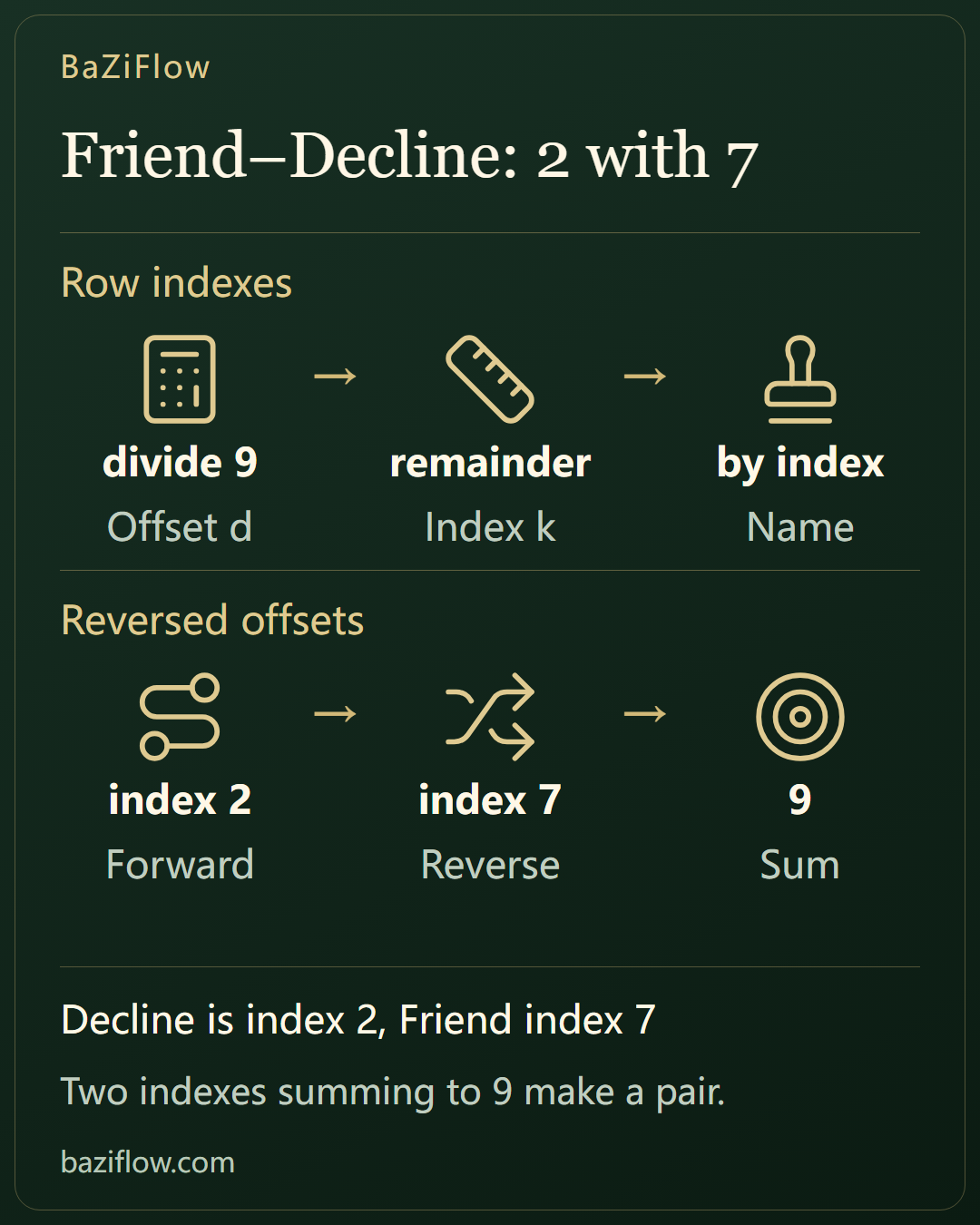
Friend lands on offsets 7, 16 and 25, Decline on 2, 11 and 20. A ring, an in-row index table, a scatter of reversed offsets and the book's own grouping of the two names show why the pair is always k and 9−k.
The short version6 min read
Decline is third in each row (index 2) and Friend eighth (index 7); since 27 is a multiple of 9, counting the other way always turns an index k into 9 minus k, so 2 and 7 always pair up.
- Number the nine places of a row 0 to 8: Decline is 2 and Friend is 7. The index of offset d is the remainder of d divided by 9, and the reverse offset 27−d has index 9 minus that.
- Decline lands on offsets 2, 11 and 20 and Friend on 7, 16 and 25. Taking the shorter way round, the gaps are 2, 7 and 11, and the two mansions at offsets 2 and 25 have exactly one mansion between them.
- The book's groupings differ from the table's pairs: Friend goes with Prosper, Ease, Attain and Kin as "good", Decline goes with Peril and Break, so the two halves of this pair sit in different groups.
Read first
Decline is third in the row, Friend is eighth
Read a row of the three-nine count from its head (Fate, Karma or Womb) and the nine places are called Prosper, Decline, Ease, Peril, Attain, Break, Friend and Kin in turn. Decline comes third and Friend eighth, and with three rows each of them has three landing places.
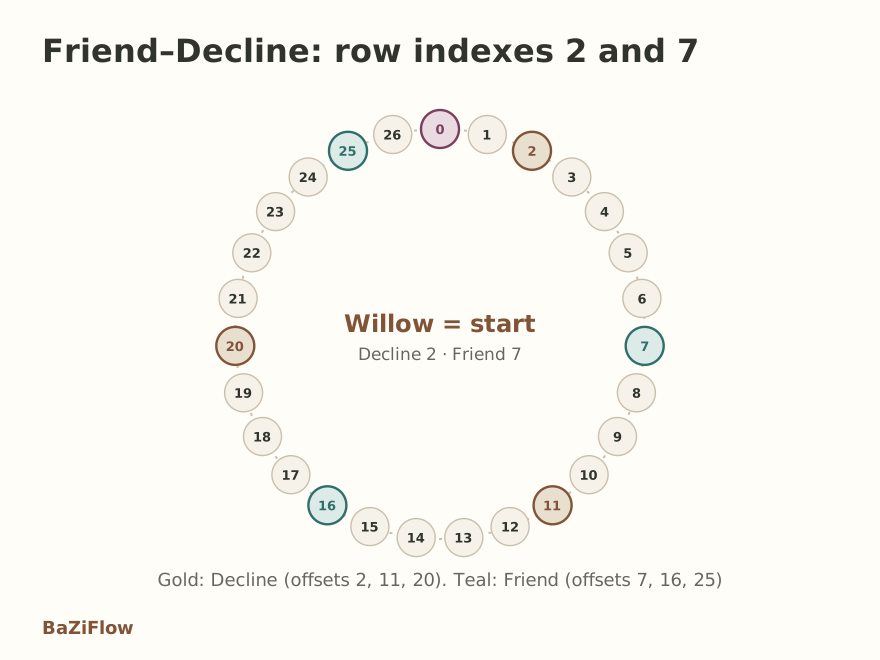
Sketch: the ring of 27 mansions starting at Willow, with the start at offset 0 (place 1 if the start is counted); the index is the remainder of the offset divided by 9, so Decline has index 2 and Friend index 7.
The picture starts at Willow (柳). The three gold slots are Decline at offsets 2, 11 and 20: Extended Net, Winnowing Basket and Stomach. The three teal slots are Friend at offsets 7, 16 and 25: Root, Encampment and Well. To make the arithmetic easy, give each place an "index within the row": the head is 0, Prosper 1, Decline 2, and so on up to Kin at 8.
Why 2 pairs with 7
The reverse offset is 27 minus d. Because 27 is three times 9, dividing an offset by 9 and keeping the remainder gives its index k in the row, and the reverse index is simply 9 minus k. Decline is 2, so its reverse is 7, Friend; Prosper 1 pairs with Kin 8, Ease 3 with Break 6, and Peril 4 with Attain 5.
Enlarge diagram · scroll sideways to read
A row head has index 0, and 9 minus 0 is 0 again, so Fate forms a group by itself while Karma (offset 9) pairs with Womb (offset 18). Try one concrete offset:
Enlarge diagram · scroll sideways to read
Both directions on one slanting line
My count to the other mansion is d and theirs to mine is 27−d. Plot the six values of d for Friend–Decline and the six points fall on one line running from upper left to lower right, each labeled with what I call the other person:
Enlarge diagram · scroll sideways to read
The points mirror one another: (2, 25) and (25, 2), (7, 20) and (20, 7), (11, 16) and (16, 11). Let the other person count first and the point jumps to its mirror image, with Decline turning into Friend and Friend into Decline. Taking the shorter way round, the three pairs have gaps 2, 7 and 11; at offsets 2 and 25 only one mansion lies between the two, as with Willow and Extended Net.
How the book groups Friend and Decline
When the Sukuyō Sutra gives verdicts it does not follow the table's pairs; it uses groupings of its own. The sentence on first friendships puts Prosper, Ease, Attain, Friend and Kin into one group and calls them suitable for making friends, with all the rest in another group. When choosing days and watching the stars it divides the names differently again:
Enlarge diagram · scroll sideways to read
A Decline day is described very briefly:
On a Decline day, it is only suitable to remove ills and treat illness.
In the passage on the Sun, Moon and planets drawing near a mansion, Decline, Peril and Break are described the other way round:
If they encroach on the Decline, Peril or Break mansions, what one seeks is as one wishes and everything goes smoothly.
So Friend travels with Prosper, Ease, Attain and Kin, while Decline travels with Peril and Break. Within one book a Decline day is for "only removing", and a luminary encroaching on a Decline mansion is "as wished": two statements about two settings.
Spotting Friend–Decline by the remainder
Checking takes three steps:
Count the offset
Count from me to the other mansion for d, then from them to me for 27−d.
Divide by 9 and keep the remainder
The remainder is the row index: 2 is Decline and 7 is Friend. A remainder of 0 means going back to see whether the offset is 0, 9 or 18.
See whether the indexes add to 9
The two directions should add to 9, except for Fate, Karma and Womb. If not, the direction was probably reversed.
Two remainder exercises
What does Turtle Beak see in Encampment, and Encampment in Turtle Beak?
Turtle Beak is place 3 and Encampment place 23. Counting from Turtle Beak to Encampment gives offset 20, which leaves remainder 2 when divided by 9: Decline. From Encampment to Turtle Beak it is offset 7: Friend. 2 plus 7 is 9.
Counting from Well to Emptiness, and back again?
Well is place 5 and Emptiness place 21, offset 16, remainder 7: Friend. The reverse is 27−16, which is 11, remainder 2: Decline.
In the table Decline sits between Prosper and Ease, and Friend between Break and Kin; the articles before and after this one are Karma–Womb and Ease–Break. The origin of the six groups is in the six relationship types. Putting the gaps 2, 7 and 11 into bands first needs a chosen convention, which is the subject of near, middle and far distances.
Questions readers ask next
Does "Friend" mean a friend?
Literally it is the "Friend mansion", and in the table it is just the name of the eighth place in a row. When choosing days the book says "on Friend and Kin days, making friends is very auspicious", which describes what such days suit; it does not say everyone who falls on this place is a friend.
Does Decline mean the other person is weaker than me?
No. Decline is the name of the third place in a row, a position, and the table has no notion of stronger and weaker. Whoever counts gets the name: I see them as Decline and they see me as Friend.
Why is it "Decline–Friend" in one place and "Friend–Decline" in another?
The site's relation pages write Friend–Decline, while the earlier article on the six types wrote Decline–Friend. The order is only a way of writing and changes nothing about which offsets belong to the group: 2, 7, 11, 16, 20 and 25.
Was this article helpful?
Sources & references
Continue reading
Karma–Womb (業胎): offsets 9 and 18, the thirds of the ring, and how the book treats the two ↗
Ease–Break (安壊): six places every third step, and opposite verdicts on Ease and Break days ↗