

Check position and unpaired branches separately
Content version · · Sources & references
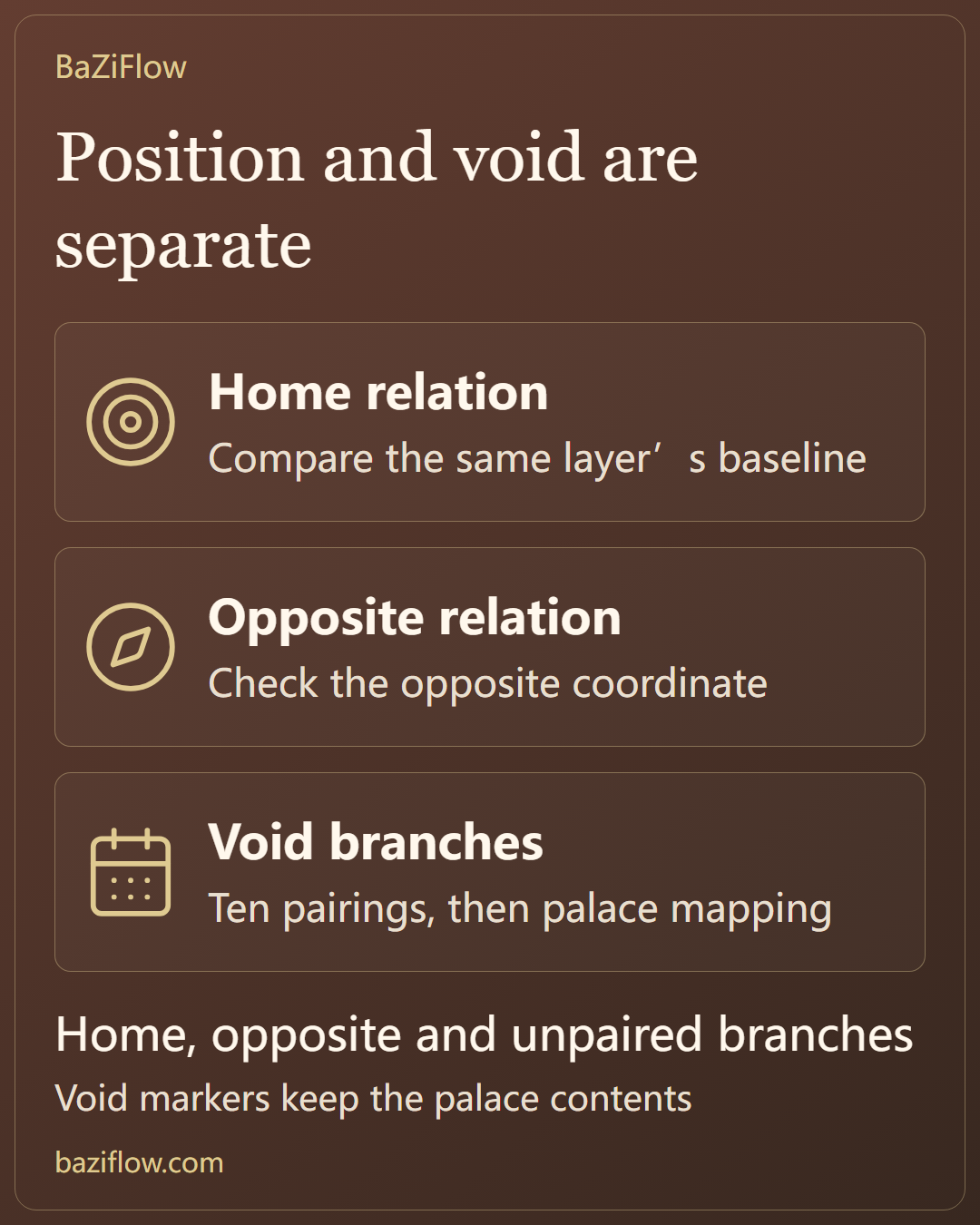
A star at its home or opposite palace is a positional relation. Two unpaired branches in a ten-part group are a different calculation. Keep the chart layer and time scope visible when reading these labels.
The short version6 min read
Tian Peng at one or nine is compared with its home or opposite palace. Dog and Pig instead come from the ten pairings in the Yang Wood Rat group. Both map to Qian six in the named table, where a void marker can coexist with the original chart contents.
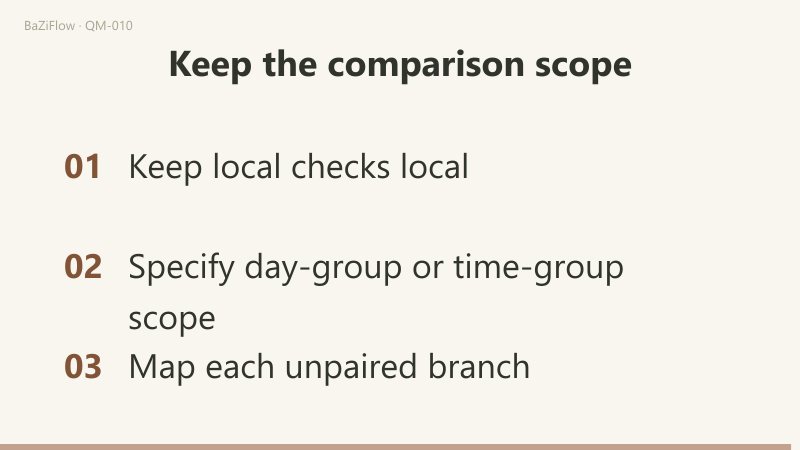
- Local position labels need an object, a home reference and a current palace.
- Calculate the group’s unpaired branches before applying the named palace mapping.
- A star’s relation does not cover the door layer, and void markers do not erase placed symbols.
Read first
Meet the Nine Palaces Before Reading a Qimen Chart ↗
Duty chief and duty door: track the role before the position ↗
What exactly does a whole-chart badge claim?
A screen may show Fu Yin (伏吟) or Fan Yin (反吟) above a chart without telling the reader which fields were compared. Did the program check every star, one duty star, the doors or matching stems? The label by itself cannot answer that question. Its scope has to come from the method that produced it.
This matters because a relation demonstrated for one star need not hold for a door in the same arrangement. It also has little to do with the calculation of void branches, despite the three terms often appearing beside one another in reading guides.
Here, Fu Yin is illustrated by a star at its home position and Fan Yin by the corresponding opposite-position example in the cited text. Kong Wang (空亡) is illustrated separately through the two branches absent from a group of ten stem–branch pairs. These are limited structural exercises, not three interchangeable descriptions of a stalled event.
Star input
- Current and home palace
Void input
- Complete cycle pair
A source example separates the star from the door
In the Siku Dun Jia Yan Yi, Tian Peng over its own home counterpart illustrates Fu Yin, while Tian Peng over Tian Ying illustrates Fan Yin. Tian Peng's home is Kan 1; Tian Ying's is Li 9, opposite Kan 1. The two examples can therefore be recorded without guessing at a full chart.
| Object being checked | Current palace | Reference | Local relation |
|---|---|---|---|
| Tian Peng | Kan 1 | Its home, Kan 1 | At home |
| Tian Peng | Li 9 | Opposite its home | At the opposite palace |
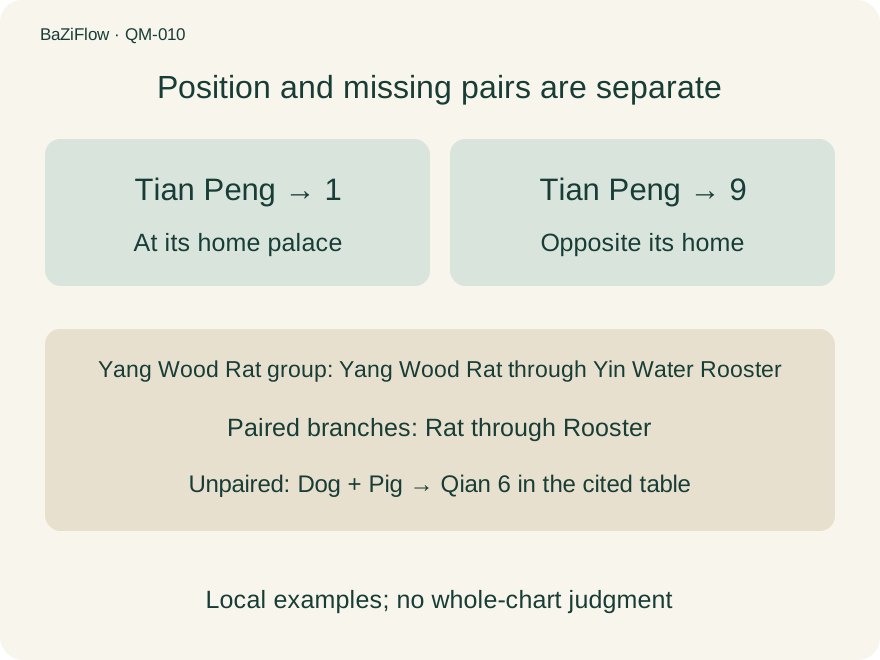
Original BaZiFlow structural comparison. Star examples follow Dun Jia Yan Yi, volume one; branch calculation and mapping use the specified modern implementation. No full-chart outcome is inferred.
The same work's Yang-one, Yin Wood Ox (乙丑) example places Tian Peng at 9 and Rest at 2. The star is opposite its home at 1, but the door has not moved to its own opposite palace at 9. A statement about the star cannot silently become a statement about the entire door layer.
The duty-chief and duty-door record explains those independent destinations. To describe an entire arrangement as Fu Yin or Fan Yin, use the definition and coverage required by the stated method. One correctly identified relation does not prove every omitted field.
Tian Peng; three independent placements
Find the two branches without consulting a star
For a separate exercise, list the Yang Wood Rat (甲子) group: Yang Wood Rat, Yin Wood Ox, Yang Fire Tiger (丙寅), Yin Fire Rabbit (丁卯), Yang Earth Dragon (戊辰), Yin Earth Snake (己巳), Yang Metal Horse (庚午), Yin Metal Goat (辛未), Yang Water Monkey (壬申) and Yin Water Rooster (癸酉). The branch sequence covers Rat (子) through Rooster (酉). Dog (戌) and Pig (亥) are the two branches not paired with stems in this group of ten.
That absence is the basis of the void-branch example here. It does not mean a palace contains no symbols, a person is absent or an event has failed to occur. Those statements require information that the pairing exercise does not provide.
The cited, fixed version of atopx/qimen calculates the two unpaired branches from a cycle value. Its palace-branch table maps both Dog and Pig to Qian 6. Under that declared data mapping, two branches can point to one palace. There is no reason to invent a second palace just to match the number of branches.
This is a description of that implementation's arithmetic and mapping. It is not an endorsement of every pattern definition in the library, a universal school rule or evidence of predictive accuracy. The source's scope is kept as narrow as the claim being checked.
Yang Wood Rat group
Yang Wood Dog group
Named palace-branch table
Empty is a marker, not a delete command
If a palace is associated with a void branch under a chosen method, preserve its existing stars, doors and stems in the record. The marker and the placed contents can coexist. Removing the contents would destroy the information needed to inspect the original arrangement.
The time basis also matters. A civil instant has a day stem–branch pair and a time stem–branch pair, among other fields. A calculation using the day group should be labeled as such; a calculation using the time group should retain that scope. The abstract Yang Wood Rat example here does not choose between them for an unspecified practice.
Do not import a day-based convention from six-line divination and relabel it as a Qimen time-group result without checking the method. Nor should one pillar's pair be applied to every chart layer. Record the actual pair used, its group and the resulting two branches so that the calculation can be repeated.
A boundary-setting change may affect that input. If the underlying date or time convention changes, identify the affected calculation rather than retaining an old void marker on a new chart. A familiar label is not a substitute for a matching version of the data.
Palace contents
Stars, doors and stems remain
Extra marker
Association with a void branch
Keep three questions in three records
For the positional exercise, the record might read “star: Tian Peng; current palace: 9; home: 1; opposite relation.” For the branch exercise, it might read “selected group: Yang Wood Rat; unpaired branches: Dog/Pig; mapping: Qian 6 under the named table.” Neither record proves the other.
Matching stems on two layers, a star at home and a whole layer repeating are likewise distinct claims unless the selected definition explicitly connects them. Naming the object and comparison baseline makes an overextended label easier to spot.
Traditional interpretations may connect these terms with repetition, reversal or something not yet realized. Such associations do not establish that a real situation must be delayed, reversed or nonexistent. The choice of significator and palace still has to explain which object bears on the question.
When only one star is known, report the local position. When only the branch pairing is known, report the missing pair. Stopping at the supported scope preserves the useful result while making clear what further interpretation has not yet earned.
Record
Star position
- Given
- Peng: current 9, home 1
- Conclusion within scope
- Opposite relation for this star
Branch group
- Given
- Yang Wood Rat: Dog and Pig
- Conclusion within scope
- Qian 6 under the named mapping
Questions readers ask next
Does leaving palace one automatically make Tian Peng Fan Yin?
Check whether it actually reaches the opposite palace, nine. Three and other destinations leave home without satisfying the illustrated opposite-position relation. The two local labels do not exhaust every location.
Why can two void branches point to only one palace?
A mapping can be many-to-one. Yang Wood Rat’s Dog/Pig both map to Qian six, whereas Yang Wood Dog’s Monkey/Rooster map to Kun two and Dui seven. Look up each branch instead of assuming a palace count.
Can an old void marker survive a day-boundary change?
Check whether the complete input pair changed and whether the method uses the day or time group. Recalculate affected groups and mappings. An unchanged input provides a reason to retain a marker; the familiar label alone does not.
Was this article helpful?
Sources & references
Continue reading
Choosing a Qimen significator before looking for its palace ↗
Door restriction, striking punishment and tomb entry differ ↗