

Lü (旅): the traveler’s lodging, funds and servant
Content version · · Sources & references
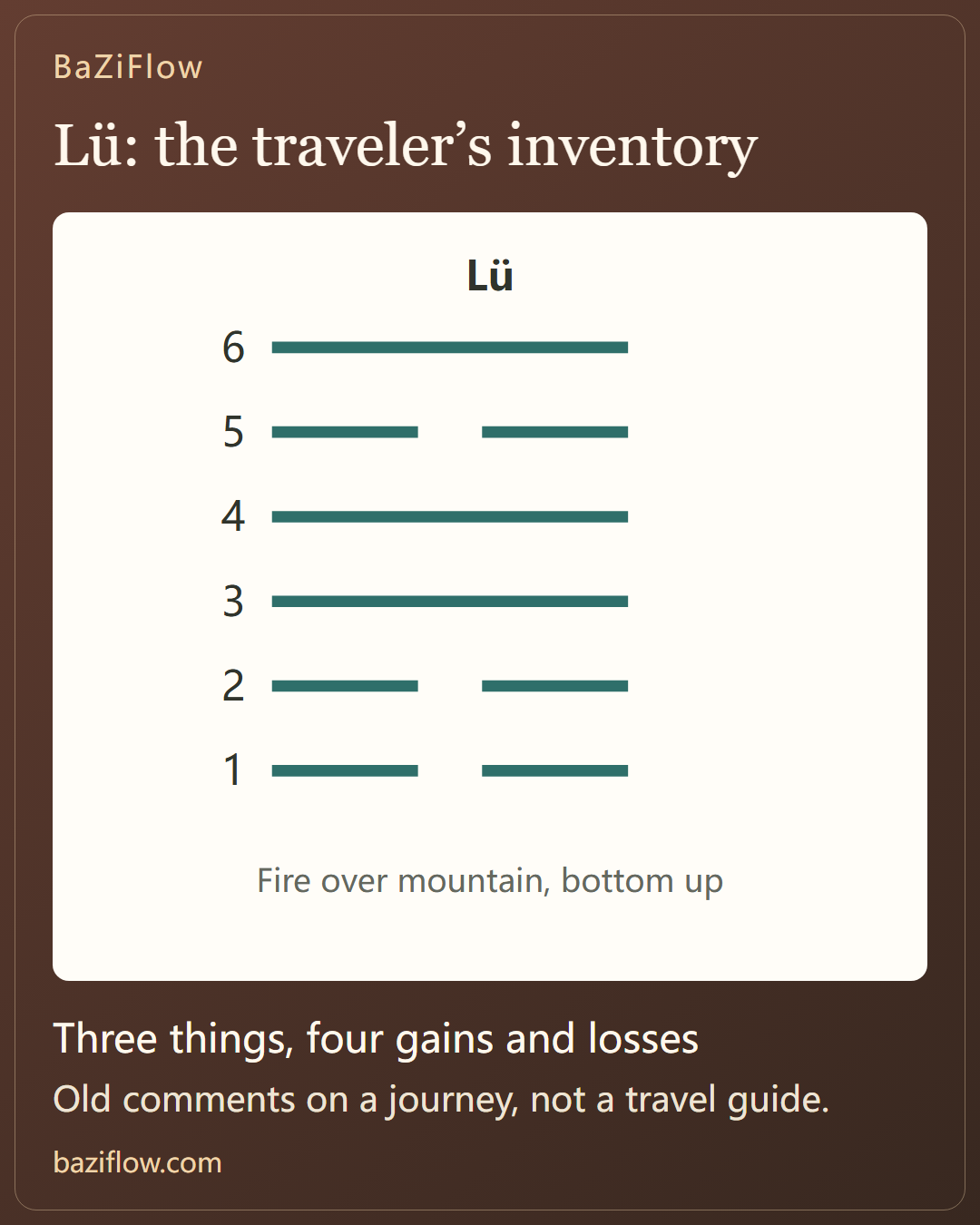
Lü (旅) is the 56th hexagram: Li (fire) above Gen (mountain). Read the judgment “small success”, the Great Image on careful punishment, and six lines that keep a traveler’s inventory: lodging, funds, a servant.
The short version7 min read
The lines of Lü read like an inventory of a traveler: lodging, funds, a young servant. One line has all three; another has the lodging burned and the servant lost; the last has even the nest burned.
- Lü stacks Li (fire) on Gen (mountain). The Commentary on the Judgments sums it up as halting and clinging to brightness: the lower trigram stops, the upper one attaches to light.
- The Great Image never mentions a traveler. It takes fire burning over a mountain without staying, and turns it into clear and careful punishment with no case left waiting in prison.
- Lodging (inn, place, nest), funds (money, ax, ox) and the servant recur in the lines: line 2 has all three, line 3 loses two, and the top line has even the nest burned.
Read first
The Sixty-Four Hexagrams: How Upper and Lower Trigrams Form One Figure ↗
Judgment and Line Statements: Whole Hexagram or Single Line? ↗
Fire on a mountain: Gen below, Li above
Lü (旅) is Li (fire) above and Gen (mountain) below. In the Shuo Gua, Gen is “stopping”, Li is “clinging”, and elsewhere Li is also called “brightness”. Counted from the bottom, the lines are two yin, two yang, one yin and one yang. Gen is a yang line on top of two yin lines; Li is yang, yin, yang, a yin line held between two yang ones.
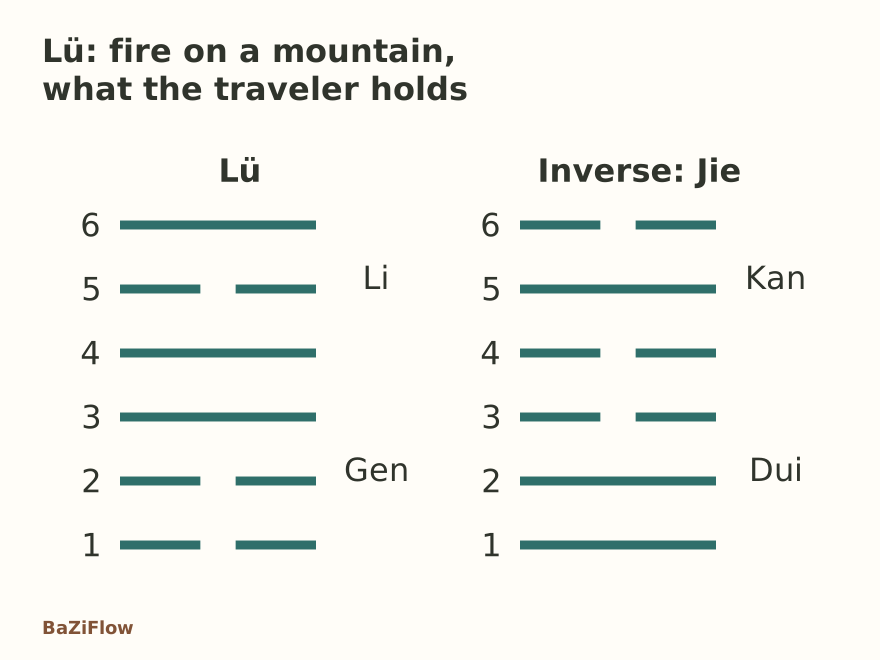
Lü and its inverse Jie: the inverse hexagram changes every line to the opposite polarity.
Enlarge diagram · scroll sideways to read
Three words to know first
- Lü
- A person away from home, outside his own dwelling. The Xu Gua puts it after Feng: carry greatness to its limit and the dwelling is lost, so Lü follows.
- Lodging
- The place where the traveler stops for the night, an inn. Line 2 says he reaches it; line 3 says it burns.
- Funds and ax
- Money and an ax. Tradition usually reads the pair as what a traveler carries: means and tools.
The judgment and the Commentary: small success, steadiness for the traveler
The judgment of Lü reads: small success; for the traveler, staying on course brings good fortune. The word “small” is measured, and the Commentary on the Judgments explains it by the shape of the figure.
Lü, small success: the yielding gets the middle on the outside and complies with the firm; it halts and clings to brightness. That is why there is small success, and why for the traveler staying on course brings good fortune. How great is the meaning of the time of Lü!
Enlarge diagram · scroll sideways to read
All three can be checked on the figure. Both central places of Lü (lines 2 and 5) hold yin lines; “the middle on the outside” is line 5, which belongs to the upper trigram, the “outside”. It has line 4 under it and the top line above it, two yang lines on either side, which is what “complies with the firm” points to. “Halts and clings to brightness” reads the two trigrams together: Gen below stops, Li above clings to light. A traveler who halts and yet turns toward the light gets only “small success”. The closing exclamation sets Lü within its time and praises the meaning of that time, without saying more.
The Great Image: fire on a mountain, clear, careful, nothing left waiting
The Great Image (大象) of Lü does not mention a traveler.
Fire on the mountain: Lü. The noble person is clear and careful in applying punishments, and does not let cases linger in prison.
Fire on a mountain burns across and does not stay in one place. From this the noble person takes three words: clear, careful, no lingering. Tradition usually reads them against the figure: Li is brightness, Gen is stopping, and stopping before one acts rashly is care; fire that does not stay is a case that is not left to sit in prison.
Enlarge diagram · scroll sideways to read
There is no “traveler” and no “journey” in the whole sentence. The Image borrows the track of the fire: it moves on and does not remain where it started.
Six lines: what the traveler holds and what he loses
In four of the six statements the traveler’s things are counted out one by one: where he stays, what he carries, who is with him.
Enlarge diagram · scroll sideways to read
The two lines that are not in the table tell something else. Line 1, at the bottom, says: the traveler is petty and fussy, and this is how he draws disaster on himself. The Small Image (小象) says his aim has run dry. Line 5 says: shoots a pheasant, one arrow lost, and in the end praise and a mandate. The Small Image says this “reaches up”, meaning it gets through to those above.
Back to the table. Line 2 is the one that has everything, and the Small Image says that in the end there is no fault. Line 3 reads: his lodging burns and he loses his servant. The Small Image first says that this is already harm, and then adds that a traveler who deals with those below him in this way loses what is right. Line 4 has a place and gets his funds and ax, yet says “my heart is not glad”, and the Small Image comments in two clauses: he has not yet got his position, and his heart is not yet glad. At the top, a bird’s nest burns and the traveler laughs first, then wails. Of “loses an ox at the border”, the last word is read in two common ways, as a field boundary or as carelessness. The Small Image ends: in the end no one hears of it.
Put side by side, the lines make a rising and falling curve: line 1 creates its own trouble, line 2 has everything, line 3 loses two things, line 4 has them but is not at ease, line 5 loses and gains, and in line 6 the nest burns and the ox is lost.
Feng, Da Guo and Jie: neighbors of Lü and its place after Feng
Turn Lü upside down and you get Feng (豐), so Feng is the reversed hexagram (综卦) of Lü. The nuclear hexagram (互卦) is Da Guo (大過): lines 2 to 4 of Lü form Xun, lines 3 to 5 form Dui, so Xun sits below and Dui above. The inverse hexagram (错卦) is Jie, shown in the figure above.
Enlarge diagram · scroll sideways to read
The Xu Gua says it in one line:
Those who push greatness to its limit lose their dwelling, so what follows is Lü.
Feng is “great”, and greatness carried to its end loses the dwelling, so Lü comes after Feng. After Lü comes Xun. The Xu Gua gives the reason in one clause: with no room for the traveler anywhere, “entering” is what follows. The inverse hexagram Jie points the other way: its first two lines both keep to a courtyard and do not go out. Lü is the hexagram of someone who is always outside.
Questions readers ask next
Does Lü say that traveling is bad?
The text does not say so. The judgment is “small success; for the traveler, staying on course brings good fortune”. Three of the six lines speak of loss (lines 1, 3 and 6) and three of gain or of praise at last (lines 2, 4 and 5).
What are the “funds and ax” of the line statements?
Literally money and an ax. Tradition usually reads the pair as what a traveler carries: means and tools. Line 4 of Lü says the traveler gets them, and in the very next hexagram, Xun, the top line says he loses them.
How are Lü and Feng related?
They are each other’s reversed hexagram: turn Lü upside down and you have Feng (豐). Feng is abundance, and the Xu Gua says that going to the limit of greatness costs one his dwelling, so Lü follows.
Was this article helpful?
Sources & references
Continue reading
Feng: the Dipper at midday, and why what grows “great” is a covering ↗
Xun: wind over wind, and “beneath the bed” written twice ↗
The Sixty-Four Hexagrams: How Upper and Lower Trigrams Form One Figure ↗
Judgment and Line Statements: Whole Hexagram or Single Line? ↗