

Canopy Star: the Storage spot of a group
Content version · · Sources & references
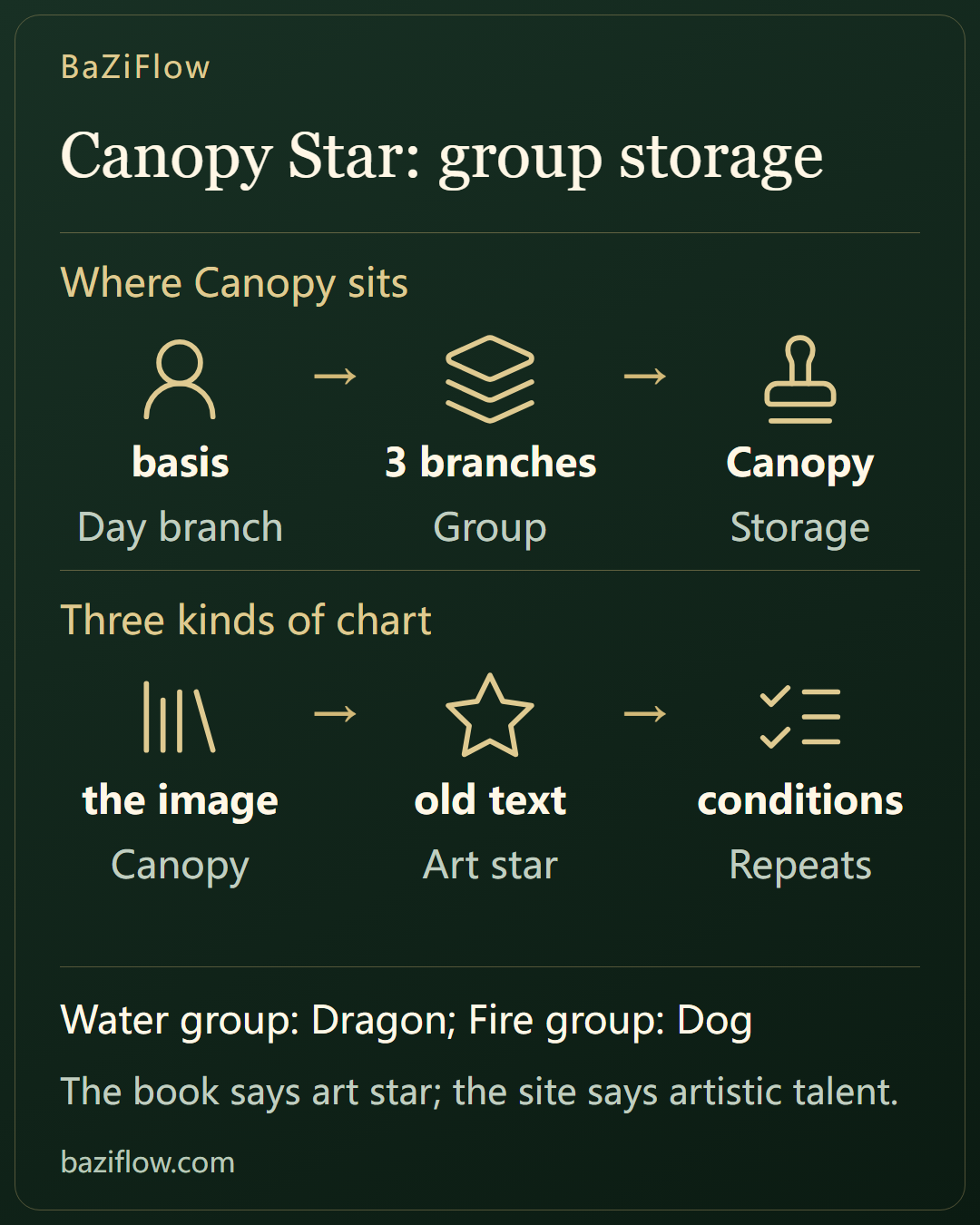
The Canopy Star starts from the day branch and takes the last branch of its Three Harmony group, the Storage of that element. A table, three chart types, and the old text's "jeweled canopy" and "art star".
The short version5 min read
On this site the Canopy Star is found from the day branch: it takes the last branch of the Three Harmony group the day branch is in, which is the Storage of that group's element, and always one of Dragon, Dog, Ox and Goat.
- Monkey-Rat-Dragon gives Dragon, Tiger-Horse-Dog gives Dog, Snake-Rooster-Ox gives Ox, Pig-Rabbit-Goat gives Goat. A group runs Growth, Peak, Storage, and the Canopy Star is the last of the three, searched in the other three pillars.
- When the day branch is Dragon, Dog, Ox or Goat, the group's storage is the day branch itself, so the day pillar does not count; only a repeat in the year, month or hour pillar gives a Canopy Star. The book speaks separately of a repeated canopy.
- The Sanming Tonghui likens the star to a jeweled canopy over the Emperor's seat, calls it the art star, and adds "good as it is, it has drawbacks". The site's "artistic talent, aloof" wording rests on those images.
Read first
Symbolic Stars in BaZi: Check the Reference and Rule Before the Meaning ↗
Where the Canopy Star sits: the last branch of a group
A Three Harmony (三合) group holds three branches, in the order Growth, Peak, Storage. The Canopy Star (华盖) starts from the day branch: see which group the day branch is in, and take the last branch of that group, its Storage.
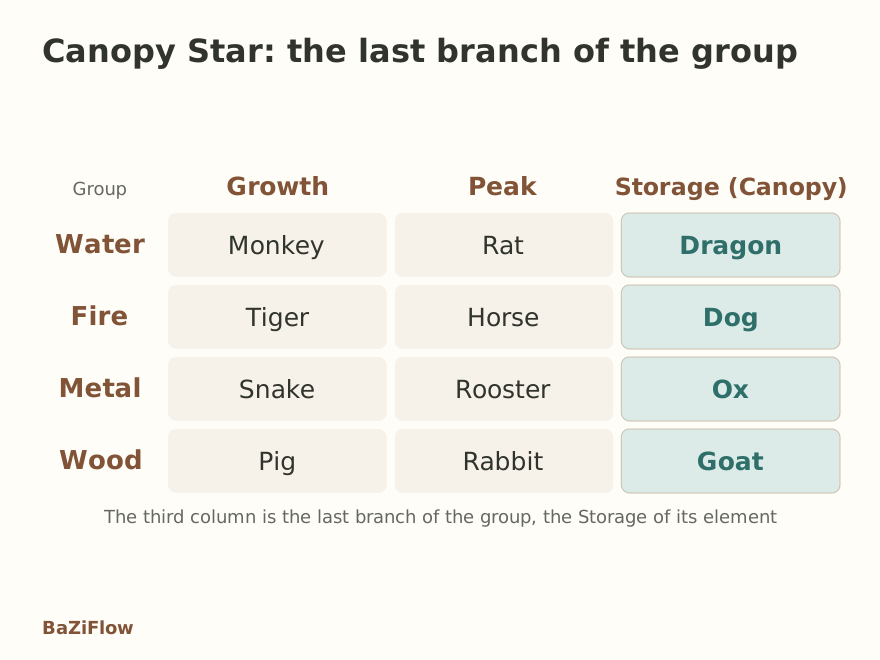
Look-up sketch: each row is a Three Harmony group, running Growth, Peak, Storage. The third column is the Canopy Star spot from the site engine, checked row by row against Storage in the twelve-stage table.
The third column of the table is the Canopy Star. In the Water group Monkey, Rat, Dragon it is Dragon; in the Fire group Tiger, Horse, Dog it is Dog; in the Metal group Snake, Rooster, Ox it is Ox; in the Wood group Pig, Rabbit, Goat it is Goat. Together the four branches are Dragon, Dog, Ox and Goat, the four storehouses as they are often called. You look for it in the other three pillars: year, month and hour.
Why the name: a canopy in the sky, spread over the storehouse earth
In juan 2 of the Sanming Tonghui (三命通会) the General Star and the Canopy Star share one chapter, which first says what the Canopy Star is:
The Canopy Star is like a jeweled canopy. There is such a star in the sky, shaped like a canopy and always covering the Emperor's seat, and so the place at the bottom of a Three Harmony group that gains a storehouse is called the Canopy Star.
The "bottom place" is the last position of the group. The book first draws on a star in the sky, shaped like a canopy and covering the Emperor's seat, then names the branch of the group that gains a storehouse the Canopy Star. The same chapter quotes the Dong Xuan Jing (洞玄经) to set it beside the General Star:
The General Star sits in the central army; the Canopy Star is spread over the storehouse earth.
Enlarge diagram · scroll sideways to read
Three kinds of chart: storage elsewhere, storage as the day branch, a lone storage
The result changes with the kind of chart. Compare three made-up teaching charts:
Enlarge diagram · scroll sideways to read
For the second kind, where the storage branch repeats, the book has a matching line:
Canopy Stars repeated again and again: it is good for them not to meet a break or a clash.
"Again and again" means the same position turning up repeatedly. The site records one hit for each of the other three pillars that holds the branch, however many that is.
How the book reads the Canopy Star
A few lines on the Canopy Star in the same chapter run roughly as follows:
Three lines about the Canopy Star
Hu Zhong Zi
"The Canopy Star is the star of arts and crafts." The book joins it to images of skill and technique.
Li Yu Ge
"Good as the Canopy Star is, it has drawbacks." The same song goes on to count solitude and the clergy as part of its image.
Another line
"Canopy Stars repeated again and again: it is good for them not to meet a break or a clash." When the star appears several times, the book wants it unbroken and unclashed.
The book calls the Canopy Star both "good" and "with drawbacks", and attaches conditions such as breaks and clashes. The site tells you only whether the Canopy Star exists and in which pillar, and does not judge breaks or clashes.
Where the site's wording comes from
The site describes the Canopy Star as "artistic talent, aloof and refined, good for religious and artistic pursuits". Set it next to the lines above:
Enlarge diagram · scroll sideways to read
In that chapter the General Star comes just before the Canopy Star, and the next Symbolic Star, the General Star, takes the middle position of a group. The one that takes the branch after the group's head, the Bath spot, is the Peach Blossom.
Questions readers ask next
My day branch is Dragon and there is another Dragon in the chart, yet no Canopy Star. Why?
The Canopy Star of a Dragon day branch is Dragon itself. The Dragon of the day pillar is the starting point and is not counted again. Only a further Dragon in the year, month or hour pillar gives a Canopy Star.
Does the Canopy Star mean I will be lonely or become a monk?
The book does connect the Canopy Star with solitude, the clergy and the arts, but those are images the old authors gave the position and not a prediction about anyone. The site keeps only the gentler "aloof and refined", and a real life depends on what actually happens.
The Canopy Star and the Heavenly Nobleman can both land on Ox or Goat. Is that double counting?
The two Symbolic Stars use different bases and different tables, and each hits on its own. When they land on the same branch, two rules happen to point at it, and the pair should not be added up into one stronger piece of evidence.
Was this article helpful?
Sources & references
Continue reading
Peach Blossom: Count One Step Past Growth to Bath, Which the Book Calls Xian Chi ↗