

Qian Six: the Heaven Gate of the northwest
Content version · · Sources & references
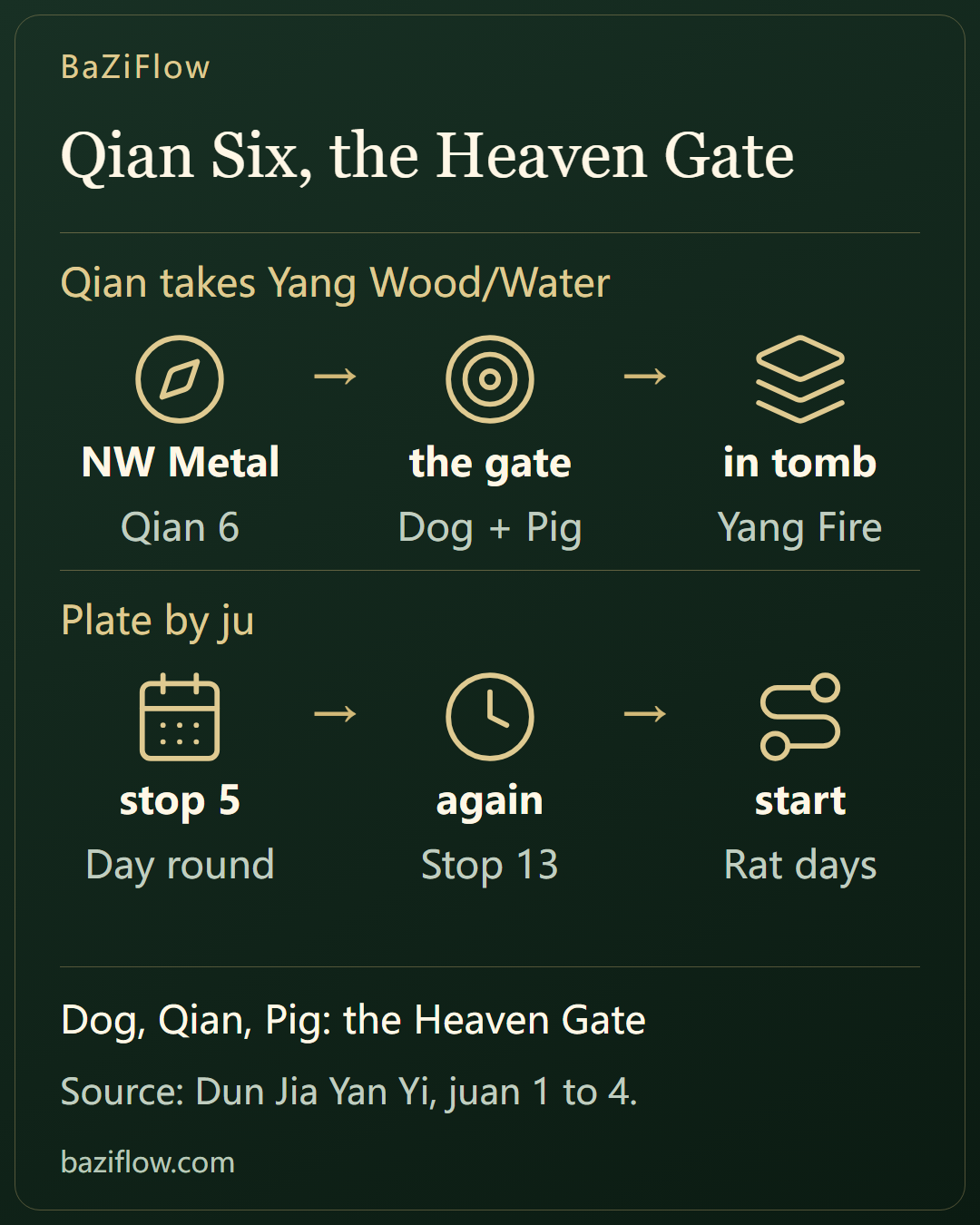
Qian Six is the northwest box of the nine palaces: number 6, trigram Qian, element Metal. The Heaven Gate, the names the wonders take there, the daily-round verse and the ground plates show what this box carries.
The short version11 min read
"Dog, Qian and Pig are the Heaven Gate direction," says Dun Jia Yan Yi of Qian Six, the northwest corner with Luoshu number 6, the Qian trigram and Metal. Each of the three wonders has its own name on arriving here, and Yang Fire is recorded as entering its tomb.
- Qian covers the Dog and Pig branches, and the book says "Dog, Qian, Pig are the Heaven Gate direction"; the tomb of Yang Fire lies at Dog, so Yang Fire on Qian is recorded as entering the tomb.
- Yin Wood arriving at Qian is "Jade Rabbit Enters the Forest" in juan 3, yet the restraint entry in juan 2 writes "Yin Wood at Qian with the Shock Gate"; the Shock Gate and the other conditions make the difference.
- Two stops of the sixty-day round open on the Rat days named in the verse "Yang Metal and Yang Fire, the Rat, return to Qian Six"; across the nine Yang ju each of the nine stems lies on Qian Six exactly once.
Read first
Fighting in Qian: the Metal corner of the northwest, and the six of the Luoshu
Qian Six (乾六) sits in the northwest, with number 6, trigram Qian and element Metal; straight across the center, in the southeast, lies Xun Four.
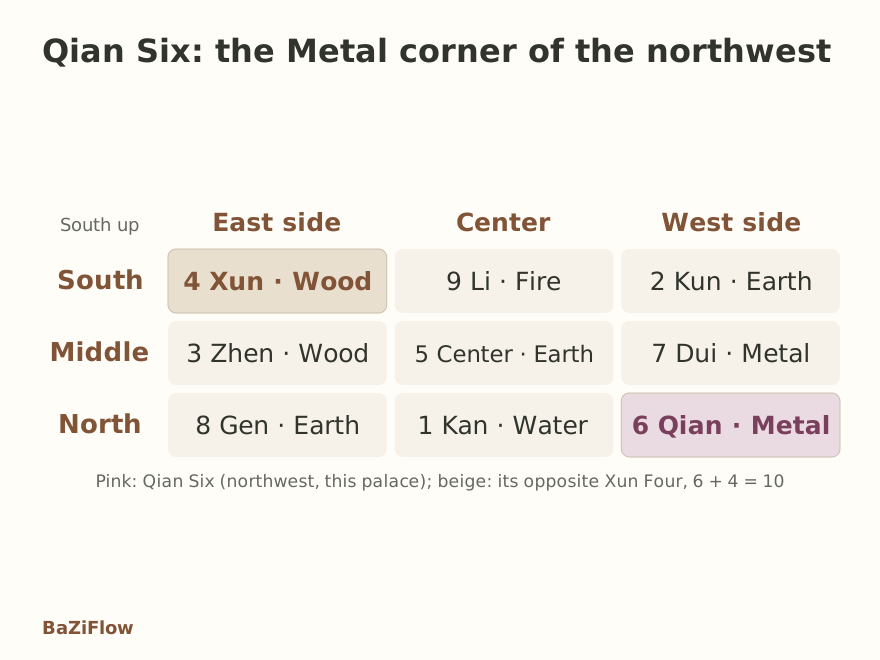
Nine-palace base grid with south at the top and east on the left; elements follow the usual assignment and numbers are the Luoshu numbers. Pink marks Qian Six and beige its opposite, Xun Four.
On the south-up, east-left grid Qian Six is the lower right box and Xun Four the upper left one. Chapter 5 of the Shuo Gua (说卦) places the eight trigrams one by one, and for Qian it has a single line:
Fighting takes place in Qian; Qian is the trigram of the northwest, which says that yin and yang press against each other.
The word rendered "press" means to draw close: in the northwest yin and yang meet at close quarters. Chapter 7 sums the trigram up as "strength", and chapter 10 puts it on the side of "heaven" and "father".
One layer further out, juan 3 of Dun Jia Yan Yi (遁甲演义) shares the palaces among the old states, beginning with Qian: "The Qian palace, the northwest, belongs to the share of Zhou and Qin." Direction, trigram, element, number and field allocation come with the palace; stars and gates are put into it later.
The Heaven Gate: Dog, Qian, Pig, and "Qian takes Yang Wood and Yang Water"
In one line: the book calls the Qian position the "Heaven Gate", and it covers two earthly branches, Dog (戌) and Pig (亥). Juan 4, on reading the direction the Dipper handle points to, names the spot:
Dog, Qian and Pig are the Heaven Gate direction.
The same juan's method of closing the Six Yang Earth (真人闭六戊法) draws a ring on the ground from Pig to Dog and, in the book's words, "leaves the Qian position open as the door"; at dawn one "pushes open the Qian door". The gap sits exactly at Qian.
When juan 3 explains the name Nine Heaven (九天), it cites Wang Zhang (王璋):
The Book of Changes says Qian takes Yang Wood and Yang Water. Qian is heaven, and the way of heaven rises. Counting from Yang Wood to Yang Water gives nine, so the six Yang Wood cycles are "above the Nine Heaven".
Count along: Yang Wood (甲), Yin Wood, Yang Fire, Yin Fire, Yang Earth, Yin Earth, Yang Metal, Yin Metal, Yang Water (壬), nine places exactly. Kun's pair, Yin Wood to Yin Water, likewise spans nine, so the six Yin Water sit "below the Nine Earth".
Enlarge diagram · scroll sideways to read
Wonders arriving at Qian Six: several layers in one book
Juan 3 has a section on how the wonders "rejoice or rage", naming what Yin Wood, Yang Fire and Yin Fire are called in each palace. At Qian it gives three names, and entries from juan 1 and 2 tie each to further threads:
Enlarge diagram · scroll sideways to read
The Yang Fire row has a chain to follow. The verse in juan 1 says "Yang Fire belongs to Fire, and the tomb of Fire is Dog", and Dog is one of Qian's two branches; the entry on wonders entering tombs in juan 2 then writes outright "Yang Fire on Qian". So the juan 3 phrase "also called Entering the Tomb" has a source: Qian Six is where the book records Yang Fire entering its tomb. For when a tomb entry holds, see what conditions make a three-wonder tomb entry hold.
For Yin Wood the book gives two readings at once. Juan 3 calls it "Jade Rabbit Enters the Forest", while the entry on restrained wonders in juan 2 says:
Yin Wood at Qian with the Shock Gate, Yang Metal and Yin Metal confined and dead: this is Wood entering the home of Metal.
The second line carries two conditions the first lacks: the Shock Gate in the same palace, and the metal stems in a confined, dead state. A name is one thing and its conditions another, so reading Yin Wood at Qian means asking what else is in the palace.
"Yang Metal and Yang Fire, the Rat, return to Qian Six": the fifth stop of the daily round
In the daily scheme the Rest Gate leaves Kan One and changes palace every three days, never entering the center (the sequence is in Kan One). Juan 1 gives each of the eight outer palaces a line of its own, and the line for Qian is:
Yang Metal and Yang Fire, the Rat, return to Qian Six.
When the Rest Gate arrives at Qian Six, the stop opens on a Yang Metal Rat day (庚子) or a Yang Fire Rat day (丙子). The book then lists the sixty days group by group, and Qian Six has two of them:
Enlarge diagram · scroll sideways to read
The two stops are eight stops apart, one lap of the outer palaces, and 8 times 3 is 24 days. Since 24 is a multiple of 12, the branch comes back to where it was, so both stops open on a Rat day; the stem advances four places (24 leaves a remainder of 4 when divided by 10), and Yang Fire (丙) becomes Yang Metal. That is why the verse needs only those two stems and the Rat.
Sixty days make twenty stops, which is two laps plus four, and the extra four fall on Kan, Kun, Zhen and Xun: the book puts stop twenty at Xun, and the next Yang Wood Rat day starts again from Kan. In sixty days Qian, Dui, Gen and Li therefore get two stops each, and Kan, Kun, Zhen and Xun three.
Where a ju starts, and what Qian Six holds in each
The hourly scheme has a "ju", and the ju says from which palace the Yang Earth of the Yang Wood Rat cycle starts. In the Wanli year 24 example of juan 1, Qian is a starting point:
The middle ju of Rain Water: Yang mode six, starting Yang Wood Rat from the Qian palace.
The summer-solstice example of juan 3 adds "the lower ju of the Summer Solstice starts from the sixth palace", which is Yin mode six, also starting from Qian Six. The ju fixes only the starting point; the stem in Qian Six comes out when the whole ground plate is laid. In Yang mode the six instruments (Yang Earth, Yin Earth, Yang Metal, Yin Metal, Yang Water, Yin Water) run forward through the palace numbers and the three wonders (Yin Fire, Yang Fire, Yin Wood) follow, laid backward. Across the nine Yang ju, Qian Six holds:
Enlarge diagram · scroll sideways to read
The first column agrees with the hourly example of juan 1: in Yang ju 1 the Yang Wood Tiger cycle sits at Qian, led by Tian Xin and the Open Gate and lasting ten double-hours, up to the Yin Water Pig hour. In ju 6 Qian Six holds the Yang Earth of the Yang Wood Rat cycle, and in ju 7 it holds Yin Wood, which hides no cycle at all.
Star, gate and element: Tian Xin and the Open Gate agree, and still take a layer each
The home star of Qian Six is Tian Xin (天心) and its home gate the Open Gate (see what gates, stars and gods each do). Tian Xin is a Metal star among the nine, the Open Gate is Metal by the usual assignment, and the palace is Metal, so all three layers share an element. They are still three separate pieces of information.
Enlarge diagram · scroll sideways to read
"Agreeing" describes the home places only; on an actual chart the star and gate have often moved. The door-restriction verse of juan 2 says: "If the palace controls the gate there is no restriction; if the gate controls the palace there is restriction." Qian Six is Metal, so a gate restricts it only by controlling it, that is, the View Gate, whose element is Fire, falling into Qian Six. The Open Gate shares the element and is not part of that rule. The full conditions are in what conditions make door restriction hold.
The traditional ranking of stars carries conditions too: the verse puts Tian Fu, Tian Qin and Tian Xin among the best, then adds that a good star must also be in a strong season, or "do not press ahead".
Two small checks by hand
On a Yang Earth Tiger (戊寅) day, where is the daily Rest Gate?
Yang Fire Rat, Yin Fire Ox and Yang Earth Tiger make stop 5, which is Qian Six.
On the ground plate of Yang ju 7, which stem lies in Qian Six?
The instruments run forward from Dui Seven: Yang Earth at 7, Yin Earth 8, Yang Metal 9, Yin Metal 1, Yang Water 2, Yin Water 3. The wonders follow, Yin Fire at 4, Yang Fire 5 and Yin Wood 6, so Qian Six holds Yin Wood.
Next door is Dui Seven, also Metal.
Questions readers ask next
Is Qian Six the same thing as "Nine Heaven"?
No. Nine Heaven is one of the eight gods and follows the duty star: in Yang mode it sits one palace behind it (juan 3), so the palace depends on the chart. The book borrows "Qian takes Yang Wood and Yang Water" only to explain the name, because counting from the first to the second gives nine.
Why does Qian Six appear only twice in the daily round while Kan One appears three times?
Sixty days make twenty stops of three days, and one lap of the eight outer palaces takes eight stops. Twenty stops are two laps plus four, and the extra four fall on Kan, Kun, Zhen and Xun. Qian, Dui, Gen and Li therefore get two stops each.
Does the ground plate in Qian Six change when the ju changes?
Yes. The palace number and trigram are fixed, but the ju decides which stem lies there: Yin Water in Yang ju 1, Yang Earth in ju 6, Yin Wood in ju 7. The nine Yang ju put each of the nine stems on Qian Six once.
Was this article helpful?
Sources & references
Continue reading
Center Five: the Directionless Middle Box, and Why the Book Lodges It in Kun Two ↗
Dui Seven: the Metal of Due West, and How the View Gate and Yin Fire Read There ↗