

Choosing a Yijing edition
Content version · · Sources & references
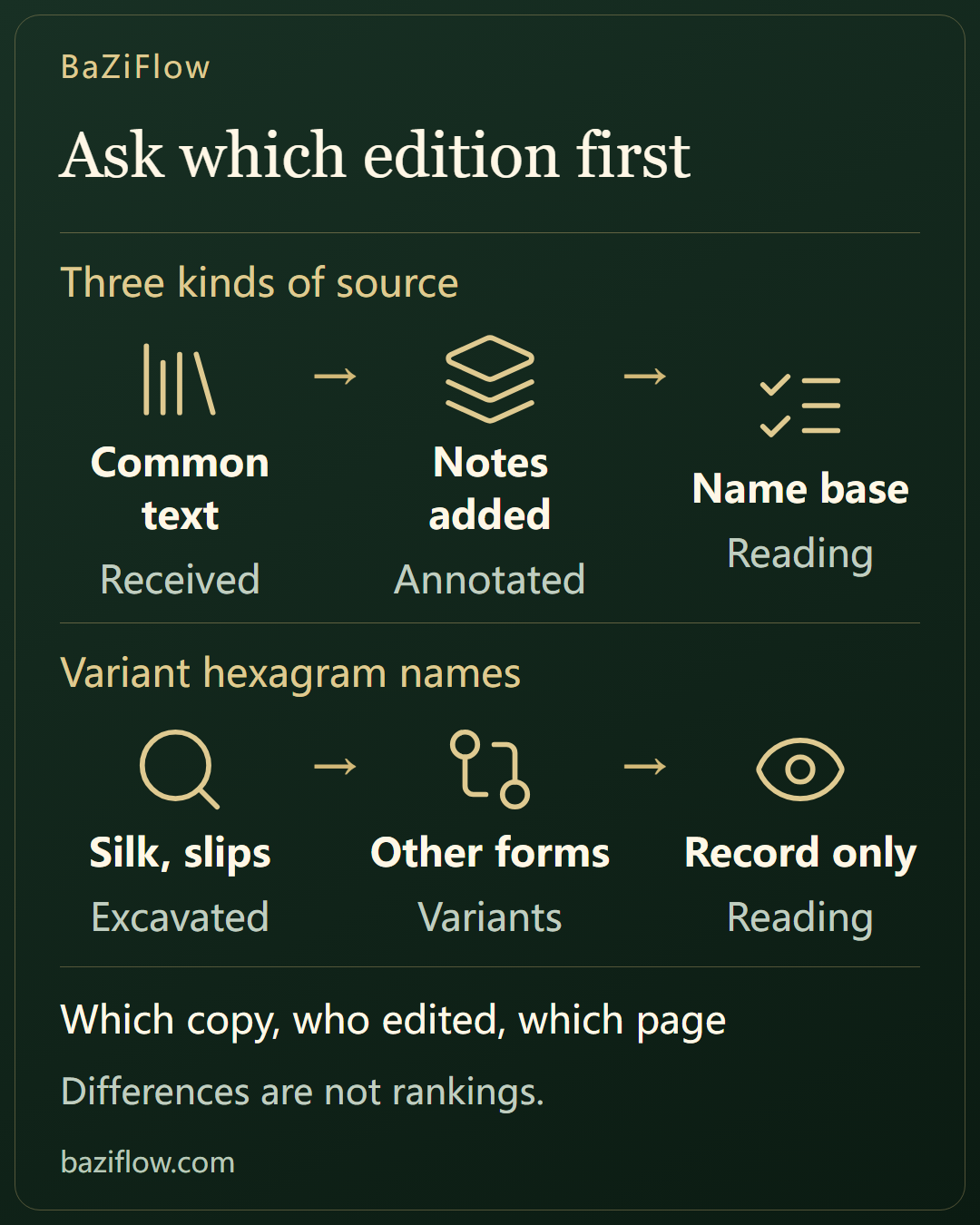
The Zhou Yi comes as received editions, annotated editions, excavated manuscripts and translations. Several comparisons sort the sources, show variant readings and give three questions for recording an edition.
The short version10 min read
There is more than one Zhou Yi: a received text, annotated editions, excavated silk and bamboo manuscripts and modern translations differ in origin and in wording. Before quoting, ask which one is in hand.
- This series quotes the received text, and the pages to check it against are the Wikisource hexagram pages, its Yi Zhuan page and the Zhou Yi Zhengyi.
- The three manuscript sets have different origins: Mawangdui silk found in 1973 at Changsha, Fuyang slips found in 1977 in Anhui, and Shanghai Museum slips bought from Hong Kong from 1994 with no known find-spot.
- Hexagram names and the order of the hexagrams are written differently in different sources. That is a difference to record, and it is not proof that one copy is closer to an original.
Read first
Yijing and Zhou Yi: Sorting the Names and Their Scope ↗
Core Text and Commentaries: Telling the Zhou Yi from What Explains It ↗
One title, several things in hand
A reader of the Zhou Yi (周易) should first ask which copy is in hand. A received edition, an edition with commentary, an excavated silk or bamboo manuscript and a modern translation can all be called Zhou Yi, and their wording, arrangement and accompanying notes are not the same.
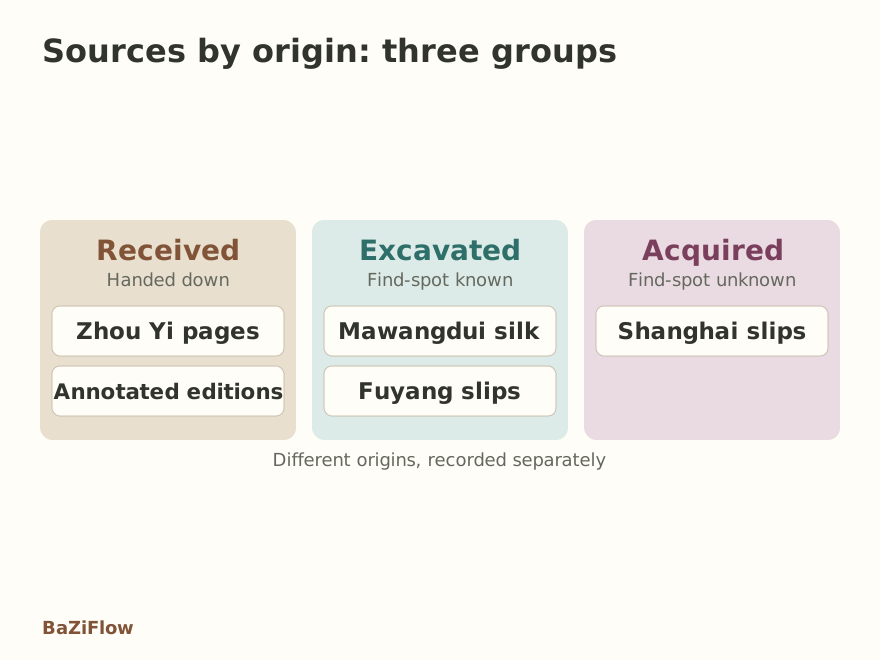
Sketch of sources by origin: received editions, finds with a recorded place and purchased pieces. Record them separately; the grouping is not a ranking.
The figure sorts the material used below by origin. A received edition is a book copied and printed down the generations. Excavated material means early manuscripts on silk or bamboo; all three sets discussed here were found or acquired after 1973. Two have a find-spot that can be looked up, and one was bought later with its find-spot unknown. A translation is a modern reworking of such a text, and the text it follows has to be recorded separately.
Four kinds of copy
- Received edition
- A text handed down through the generations. The Wikisource hexagram pages quoted in this series belong here.
- Annotated edition
- An edition that adds notes (注) and subcommentary (疏) to the text. The note explains the words of the classic and its commentaries; the subcommentary explains the note.
- Excavated manuscript
- An early copy on silk or bamboo, such as the Mawangdui silk, the Fuyang slips or the Shanghai Museum slips.
- Translation
- A modern rendering or annotation, which has to name the base text it follows.
Received editions: one title, several pages
On Wikisource more than one page carries a title built on Zhou Yi. Some give the bare text of each hexagram and some give an annotated edition, and each states its signatories, base text and divisions in its own way.
Enlarge diagram · scroll sideways to read
An annotated edition keeps the three layers together: the text at the bottom, the notes of Wang Bi and Han Kangbo above it and Kong Yingda's subcommentary on top. The Siku catalogue entry (四库全书总目) reproduced in the header of the Zhengyi page describes the form of a subcommentary this way: it is to expound the words of the notes and not to wish to depart from them. A subcommentary (疏) thus answers to the note.
Three Wikisource pages
Reproduced from a Song printing
The header lists Wang Bi and Han Kangbo for the notes, Wang Bi for a text of general rules (略例) and Xing Shu (邢璹) for notes, and says it follows a Song printing held in the Hanfenlou library in Shanghai. The contents run from juan (fascicles, 卷) 1 to 9, then a preface to the rules and juan 10.
Wenyuan Ge Siku Quanshu, vol. 7
It names Wang Bi and Han Kangbo for the notes, Lu Deming (陆德明) for sounds and meanings and Kong Yingda for the subcommentary. The text runs from juan 1 to 13, with the general rules as an appendix.
Notes by Wang Bi (Wei) and Han Kangbo (Jin); subcommentary by Kong Yingda (Tang)
The header names all three, and the catalogue entry reproduced there records that catalogues disagree about the number of juan.
That entry also gives juan counts: the Preface says fourteen, the Tang Zhi (唐志) gives eighteen and the Shulu Jieti (书录解题) gives thirteen, while the copy the entry describes has ten. The Siku copy of the annotated edition divides the text into thirteen. With counts varying like this, a juan number points to one place only inside one edition.
Excavated and acquired manuscripts: three sets, three origins
Beyond the received text, three early manuscripts are often cited, and each contains a Zhou Yi: the Mawangdui silk, the Fuyang slips and the Shanghai Museum slips. They came to light in different ways. What follows is taken from their Chinese Wikipedia entries.
Enlarge diagram · scroll sideways to read
Three sets, as the entries state them
Western Han · Hunan Provincial Museum
Found in 1973 in Tomb 3 at Mawangdui, Changsha, and written on silk. A list of excavated texts records it as Zhou Yi with commentaries (周易经传); the entry on the silk manuscripts says that its Yi Zhuan differs considerably from the received one.
Western Han · Fuyang Municipal Museum
Also called the Shuanggudui slips. Found in 1977 in the Yingzhou district of Fuyang, Anhui: several thousand bamboo and wood slips or pieces (counts range from just over five thousand to over nine thousand), whose contents include the Poetry and the Zhou Yi among many others.
Warring States, Chu · Shanghai Museum
Bought from the Hong Kong antiques market from 1994 on: a first lot of more than 1,200 slips from May, then a further lot later that year, about 1,700 in all by the count of research surveys. Figures differ somewhat between sources. The Zhou Yi is in the third volume of the published series, issued in December 2003.
The three differ in how they were obtained:
- The Shanghai Museum slips were not excavated by archaeologists, so their original find-spot is unknown; the entry can only estimate that the tomb they came from dates to the later part of the middle Warring States or the earlier part of the late period, around 300 BCE; dating by script style and by radiocarbon do not fully agree, and scholars differ.
- The Mawangdui silk and the Fuyang slips have find-spots that can be looked up.
Variant readings: one hexagram, several writings
Set the sources side by side and the first thing to show is the writing: one hexagram can carry different characters as its name.
Enlarge diagram · scroll sideways to read
The writings come from the Chinese Wikipedia entry on the sixty-four hexagrams, in a section comparing some early excavated texts. That table lists only some hexagrams, and an empty cell means the table gives no entry, not that the manuscript lacks the hexagram.
Two kinds of variant
A name written with other characters
By that table the silk manuscript writes Qian (乾) as Jian (鍵), and Lin (臨) as Lin (林). Dun has three writings, one each in the silk, the Fuyang and the Shanghai manuscripts; the Shanghai form is Tun (豚), and how it is read as Dun is left to the editors of the slips. The Fuyang and Shanghai columns rest on this encyclopedia table alone.
A small note on the page itself
On the Wikisource page for Qian, the Commentary on the Judgments sentence on "preserving the great harmony" is followed by a small note saying that one text has Tai He (太和) where the page has Da He (大和).
The order of the hexagrams differs too. The hexagram list on Wikisource's Yi Zhuan page opens with Qian, Kun (坤), Zhun (屯) and Meng (蒙); the Chinese Wikipedia entry gives the Mawangdui order as Qian followed by Pi (否), Dun and Lü (履). By that entry's account the silk text groups hexagrams by the outer (upper) trigram first and then orders them by the inner (lower) trigram. An article on the Shandong University Yijing centre's site (Yang Xian, 帛书周易浅析) cites Deng Qiubai's edition for the first group in silk writings: Jian (键), Fu (妇), Yuan (掾), Li (礼), matching these four.
Enlarge diagram · scroll sideways to read
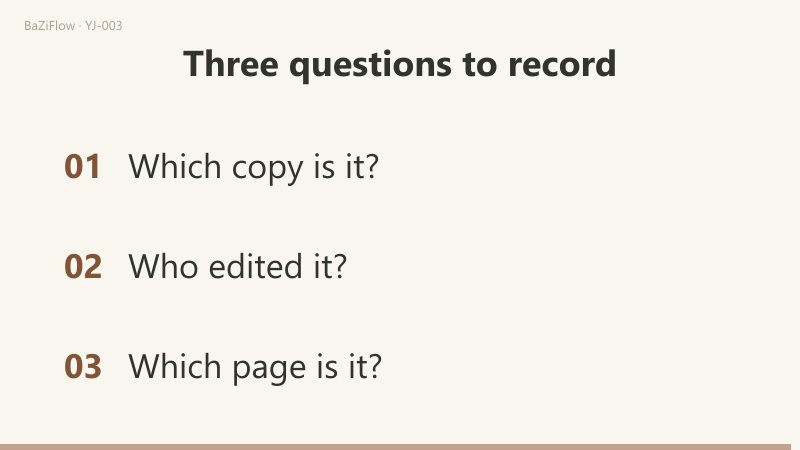
Recording an edition: three questions
Each time a passage is quoted or a translation is read, write down three things, so that someone else can find the same place.
Enlarge diagram · scroll sideways to read
Which copy is it?
Write the title and the version: a received hexagram page or an annotated edition, a silk or bamboo manuscript, and for a translation the base text it follows. For a website add the site and page name, for example Wikisource, Zhou Yi/Qian (周易/乾).
Who edited it?
Write the translator or editor, the publication details and the year. Keep the signatories of the notes and the subcommentary apart, since the Zhengyi page names different people for each.
Which page is it?
Write the page, juan or chapter, and any variant note on the page. When two copies are compared, record each in its own right.
How each of the Ten Wings is written and read is the subject of Reading the Ten Wings.
Questions readers ask next
Is an excavated manuscript more reliable because it is older?
Not automatically. Age, completeness and a documented origin are three separate questions. The tomb behind the Shanghai Museum slips is estimated at around 300 BCE, yet the slips were bought and their find-spot is unknown. Record the differences as they are.
What should go in my notes when I read an annotated translation?
The title, the base text it translates, the translator or annotator, the publication details and the page or chapter quoted. Without the base text there is no way to go back and see which Chinese wording the translation followed.
Why does the text of the same hexagram differ between websites?
Pages may rest on different base texts, convert between traditional and simplified characters, or carry variant notes of their own. Find the base text each page names before comparing two of them.
Was this article helpful?
Sources & references
- 維基文庫・周易(各卦頁:周易/乾「保合大和」附注「一作太和」、周易/遯;六十四卦速查表)、易傳(十翼篇目與六十四卦列表)、周易正義(頁首署名,及頁首所錄《四庫全書總目》提要)、四庫全書總目提要/卷001(周易正義條)、周易注疏 (四庫全書本)、周易 (四部叢刊本)(署名、底本、分卷) ↗
- 中文維基百科・六十四卦(「馬王堆漢墓」卦序;「部分古版出土文獻對照」表;百科條目,二手)、易經(「近代考古研究」;百科條目,二手) ↗
- 中文維基百科・簡帛列表(馬王堆帛書、阜陽漢簡、上博簡各列)、馬王堆帛書周易、馬王堆帛書、上海博物館藏戰國楚竹書(百科條目,二手;上博簡數量依研究綜述,各處略有差異) ↗
- 山東大學易學與中國古代哲學研究中心・楊賢《帛書〈周易〉浅析》(帛書卦序第一組鍵、婦、掾、禮……;僅核對搜索摘要,未逐字讀頁面,二手旁證) ↗
Continue reading
Yijing and Zhou Yi: Sorting the Names and Their Scope ↗
Core Text and Commentaries: Telling the Zhou Yi from What Explains It ↗