

Astrocartography planet lines
Content version · · Sources & references
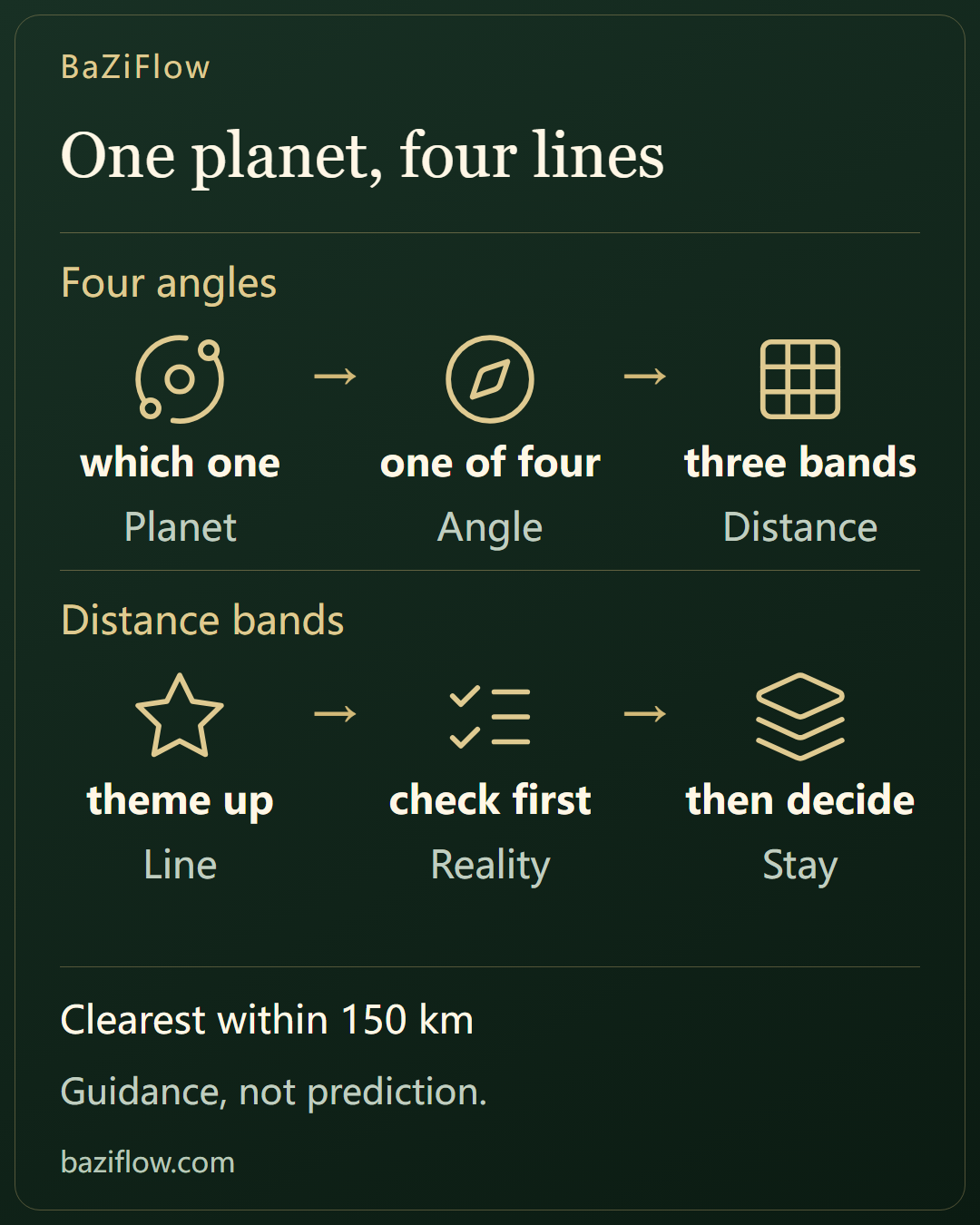
How astrocartography planet lines are drawn, what the MC, IC, ASC and DSC angles mean, how close to a line a city must be to matter, and what a line cannot tell you.
The short version5 min read
An astrocartography map projects where every planet stood at your birth onto the Earth and joins the points into lines. A line is not a verdict; it only says where on Earth that planet’s theme may be turned up.
- Each planet draws four lines: overhead MC, underfoot IC, rising ASC and setting DSC; MC and IC are straight, ASC and DSC curve.
- Influence fades with distance: this site uses three bands, 150 km is “on the line”, 500 km is “near”, influence is weak beyond 500 km, and nothing is scored past 600 km.
- A line shows where a theme may be amplified, not what will happen; read planet, angle, distance and the life you want together.
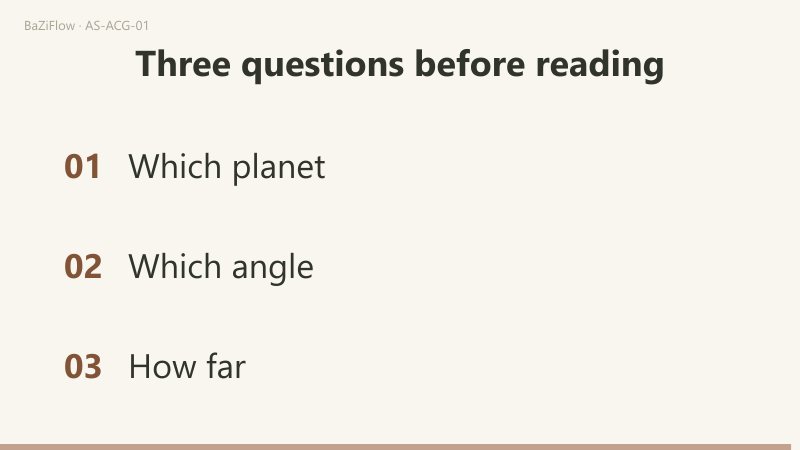
Read first
How planet lines are drawn
In plain words first: at the moment you were born, every planet stood somewhere relative to the Earth. Some were rising over the eastern horizon, some were overhead (on the local meridian at their highest point, not always exactly at the zenith), some were setting in the west, and some were on the far side of the world, underfoot. Every place on Earth that saw a given planet at the same angle at that instant lies on one curve.
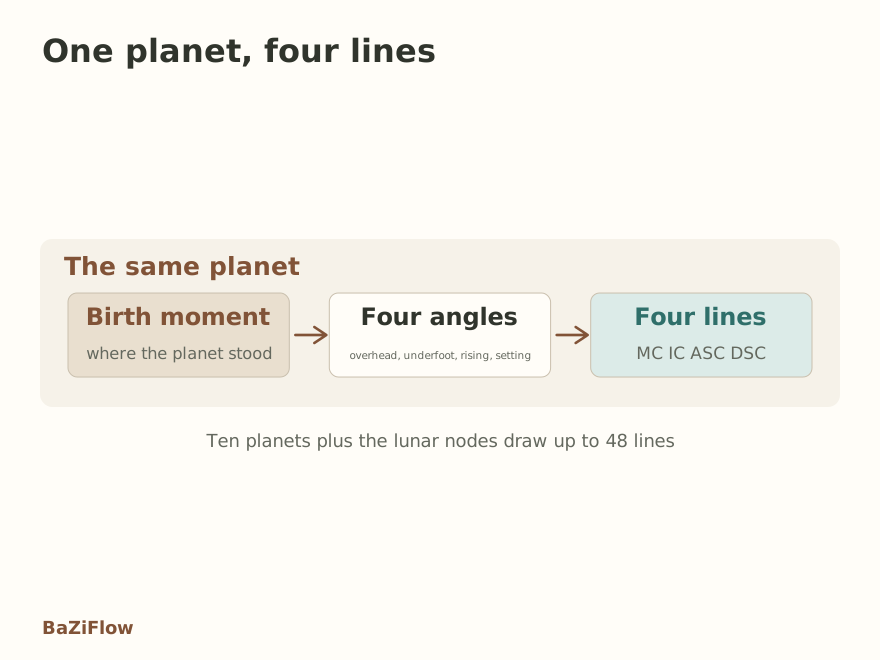
One planet gives four angles, and each angle traces one line across the Earth.
So each planet draws four lines; ten planets make up to forty, and with the two lunar nodes this site draws 48. They are not decoration: each position is calculated from the birth date, the birth time and the planet’s actual place in the sky, so a different birth time moves the lines.
The four angles: MC, IC, ASC, DSC
The Midheaven (MC) line is where the planet was overhead, traditionally tied to career, reputation and public image. The IC, or Imum Coeli, is its opposite: the planet underfoot, tied to home, roots and inner security. The Ascendant (ASC) line is where the planet was rising in the east, tied to the self, fresh starts and first impressions; the Descendant (DSC) line is where it was setting in the west, tied to relationships, partners and rivals.
In shape, a planet reaching its highest point (crossing the local meridian) depends only on longitude, so MC and IC are straight meridians; rising and setting also depend on latitude, so ASC and DSC are curves. Read the angle first and the planet second: the same planet governs different things at different angles. For the four angles themselves, start with the four angles.
Enlarge diagram · scroll sideways to read
How close to a line a city must be
There is no agreed hard edge; claims range from a few hundred km to over a thousand. The line itself is strongest and the effect fades with distance. This site scores within 600 km and groups distance into three bands: within 150 km is “on the line”, within 500 km is “near”, and beyond 500 km is “far”, a weak influence; past 600 km nothing is scored.
The city card labels these bands directly: for the same Venus line, a city on it and a city 500 km away feel and score very differently. So when you tap a city, the distance to its strongest line is more useful than whether a line passes through the region at all.
Enlarge diagram · scroll sideways to read
Good or bad lives in the planet, not the line
Traditionally Venus and Jupiter lines feel easier, while Saturn, Mars and Pluto lines bring pressure. Pressure is not the same as bad: a Saturn line can be hard going and still be where solid, long-term achievement is made. Reading a line as “lucky” or “unlucky” is the most common mistake.
A steadier reading puts three things together: the planet’s theme, the angle, and the life you want right now. To be seen, look at MC; to settle, look at IC; to meet people or start again, look at ASC and DSC. The same line means different things at different stages of life.
Three kinds of planet, three ways to read
Venus, Jupiter
Easier to relax, be liked and find chances; watch for leaning on comfort and over-expanding.
Saturn, Mars, Pluto
Hard and testing, yet can bring structure and long-term results; not for a stretch that needs rest.
Sun, Moon, Mercury
More about who you are and your daily rhythm; strength depends on the angle and your chart.
Enlarge diagram · scroll sideways to read
Checking your own map
Enter a birth date and time (the time is optional), birthplace and gender here and the map with every planet line is free. Tap a line to highlight it; tap anywhere on the map to see a nearby place name, the three nearest lines and their distance (cities you have not unlocked are not named). If the birth time is unknown, the lines are drawn for noon and every line position is only an estimate (about 15° off per hour of error); the city ranking is likewise an estimate, and the site gives no year readings.
After reading, remember one thing: lines give directional context, not a promise. Visas, work, family and budget always come first. If a city has the line you want and also meets those practical conditions, try a short stay before deciding on a long-term move.
Pick one planet
Use the legend to show a single planet’s lines instead of reading everything at once.
Then the angle
Decide whether it is MC, IC, ASC or DSC and match it to what you want to solve.
Measure the distance
Tap a city: within 150 km is clearest, within 500 km still counts.
Check reality last
Treat the line as a prompt, compare it with visas, work and budget, and try a short stay first.
Terms you meet on the map
- MC
- Midheaven line: the planet overhead.
- IC
- Imum Coeli line: the planet underfoot.
- ASC
- Ascendant line: the planet rising in the east.
- DSC
- Descendant line: the planet setting in the west.
Questions readers ask next
Why does each planet have four lines?
Because at birth it sits at four angles at once: overhead (MC), underfoot (IC), rising in the east (ASC) and setting in the west (DSC). Each angle traces its own line across the Earth.
How far from a line does the influence last?
There is no agreed hard edge; claims range from a few hundred km to over a thousand. This site scores within 600 km: beyond 500 km a line is “far” and weak, past 600 km nothing is scored, and the closer the stronger.
Can I read lines if my birth time is uncertain?
Yes, but every line position is only an estimate. With no birth time the site draws lines for 12:00 noon, and each hour of error shifts the whole set (MC, IC, ASC and DSC alike) by about 15° of longitude. The city ranking is likewise an estimate, and no year readings are given.
Was this article helpful?
Sources & references
Continue reading
What a Venus Line Means in Astrocartography: MC, IC, ASC, DSC ↗
Which Astrocartography Lines to Read When Choosing Where to Live ↗
How to Read an Astrocartography Map: Four Steps and Birth-Time Error ↗