

Hidden Stems: An Inner List, Not Extra Pillars
Content version · · Sources & references
Opening the Tiger branch reveals three stems in the common table. Learn what that list records, what it cannot prove, and why a seasonal duty schedule is a different kind of reference.
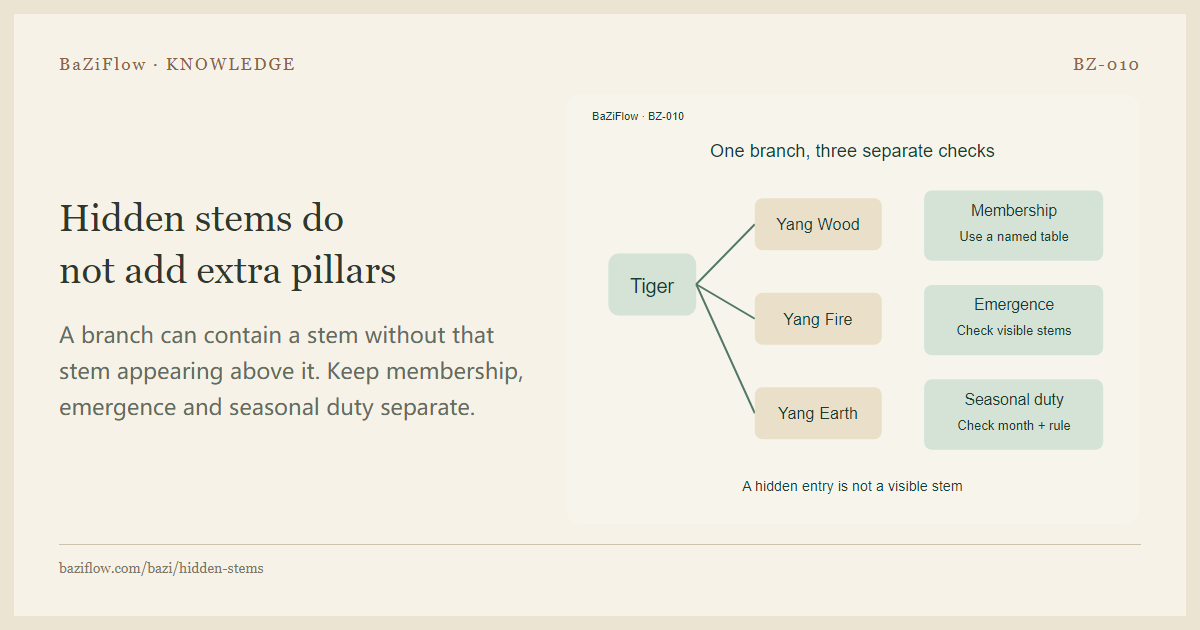
A branch can contain a stem without that stem appearing above it. Keep membership, emergence and seasonal duty separate.
Read first
The software expands a field. What changed?
An expandable BaZi display may show only “Tiger” until you open a detail panel. The panel then lists Yang Wood, Yang Fire and Yang Earth. The chart has not acquired three extra pillars. You are looking at a second layer of information attached to the same Earthly Branch.
These entries are called Hidden Stems. In a common introductory convention, each branch is associated with one, two or three Heavenly Stems. The list describes the branch's internal composition within traditional Zi Ping theory. It is not a measurement of physical substances, and it does not establish that the listed stems also occur in the chart's visible stem positions.
Suppose the visible stems contain no Yang Fire while a branch is Tiger. “Yang Fire is absent from the visible stems” and “Tiger contains Yang Fire” can both be true. The apparent contradiction disappears once the two statements retain their field names. Replacing the second statement with “Yang Fire has emerged” would add information that the list does not contain.
Three questions that need different evidence
It helps to separate a lookup from a relationship and a timing procedure. Membership asks which stems a selected table assigns to a branch. Emergence asks whether a corresponding stem is actually present in the visible stem layer. Seasonal duty asks which component a particular school treats as active at a point within a month.
| Question | What is needed | What one Tiger entry cannot establish |
|---|---|---|
| Which stems are listed? | A confirmed branch and a named lookup convention | Their relative strength in a whole chart |
| Has Yang Fire emerged? | The visible Heavenly Stem fields | Emergence from a hidden list alone |
| Which component holds seasonal duty? | Month identity, time relative to the solar term, and a duty schedule | A month's timing from a Day Branch |
For example, a Tiger Day Branch is not automatically a Tiger month. Applying a monthly duty schedule to it just because the animal name matches is a scope error. No birth data is needed to see the problem: the procedure requests a month field, while the supplied field is a day field.
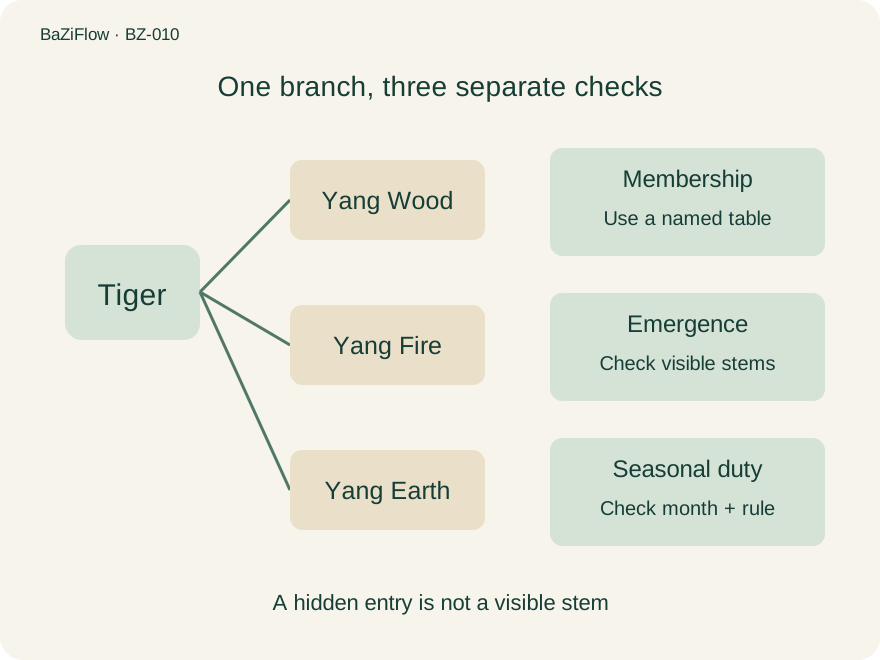
Original BaZiFlow diagram of a branch and its inner stem list, with separate evidence checks; not a personal chart.
Which reference is being used?
The hidden-stem song included in Yuan Hai Zi Ping records the familiar branch memberships. The online Wikisource transcription carries notices about completeness and an unverified textual source. It can help locate terminology, but should not be represented as a fully established critical edition. A second relevant passage, on human elements and their seasonal duty in San Ming Tong Hui, volume 2, discusses allocations within months. Its purpose and some details differ from a modern static lookup table.
This is why two references should not simply be merged. Adding every item from a duty schedule to every item in a membership table can create a new hybrid which neither source actually teaches. First identify the question each table answers. Then record the convention used in the chart you are studying.
For orientation, the common static list used here assigns Yin Water to Rat, Yin Wood to Rabbit, and Yin Metal to Rooster. Horse contains Yin Fire and Yin Earth; Pig contains Yang Water and Yang Wood. Tiger contains Yang Wood, Yang Fire and Yang Earth; Snake contains Yang Fire, Yang Earth and Yang Metal; Monkey contains Yang Metal, Yang Water and Yang Earth. Ox contains Yin Earth, Yin Water and Yin Metal; Dragon contains Yang Earth, Yin Wood and Yin Water; Goat contains Yin Earth, Yin Fire and Yin Wood; Dog contains Yang Earth, Yin Metal and Yin Fire.
The first entry is commonly treated as the main component. Labels for the remaining components and their ordering should be checked against the chosen reference. A list is not a universal percentage formula. Three entries do not mean three equal shares, and one entry does not mean that branch must dominate all others.
From an inner list to a supported interpretation
Rooting requires a reference stem and a relationship to suitable support in the branches. Hidden-stem membership supplies part of the structure used to investigate that relationship; it is not a synonym for rooting. Emergence is another relationship again. The comparison of roots, visible stems and seasonal support keeps those terms apart.
The Ten Gods also require a reference: the Day Master. Yang Wood has no single permanent Ten God label that remains correct for every Day Master. When the Day Master is unknown, record Yang Wood and leave its relational label open. A hidden-stem list alone cannot complete that calculation.
Finally, list length is not strength. Traditional assessment brings in season, placement, support and the surrounding configuration. An app that assigns numeric weights is applying an additional model; the model should be stated before its totals are compared with another app's totals. Two sets of percentages may disagree because their definitions differ, not because someone added the same numbers incorrectly.
Reliable notes therefore preserve a chain: a confirmed branch field, the lookup convention, the resulting hidden list, and any further evidence used for a relationship. Do not reverse the chain by searching free-form prose for characters that resemble stems or elements. Ordinary words are not authoritative chart fields. To examine the next layer without confusing it with membership, continue with how the Month Command affects element strength.