

Line positions: Initial to Top
Content version · · Sources & references
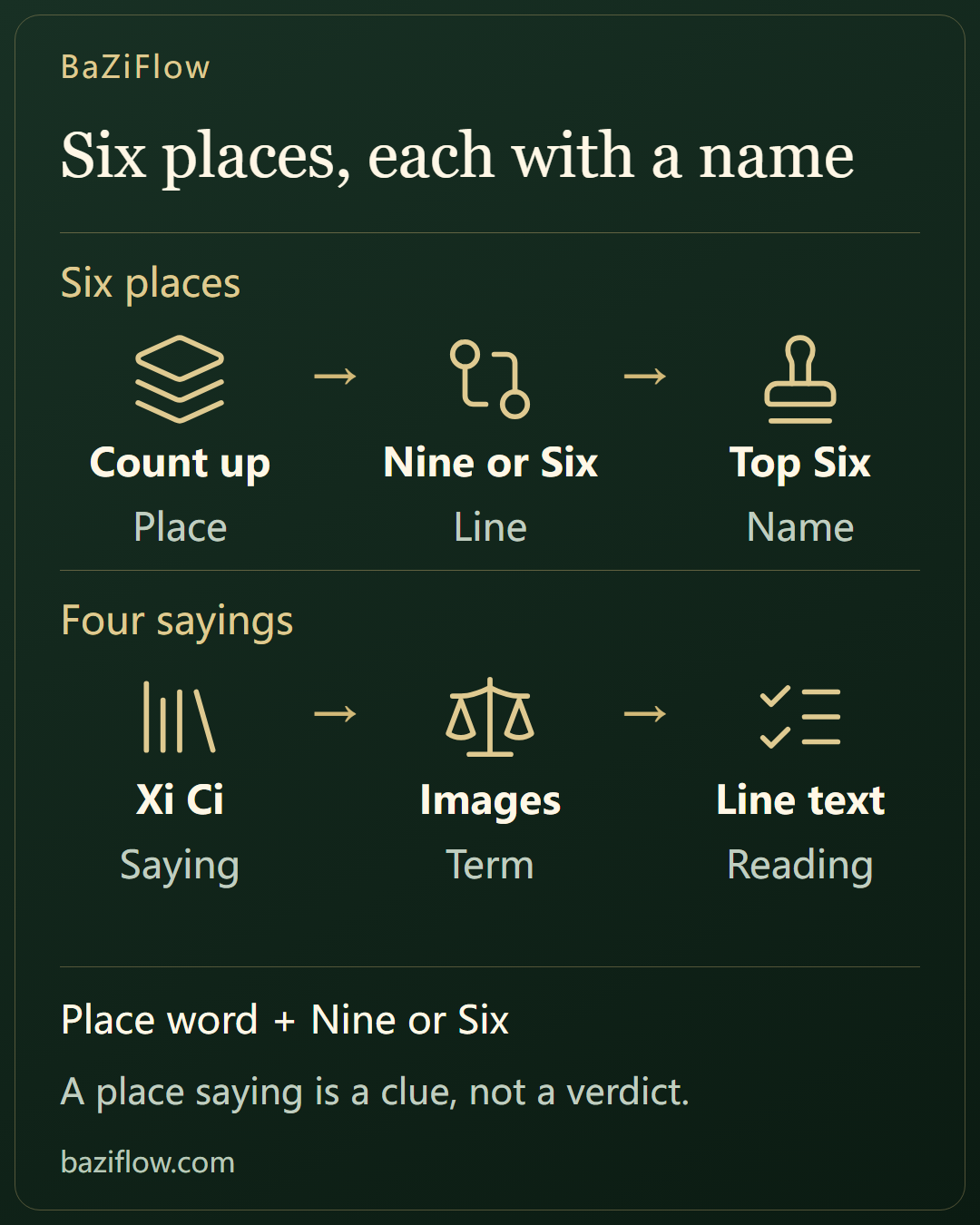
Six places run from Initial to Top; a yang line is Nine, a yin line Six. Build line names on Qian and Xu, then put "two is praised" and the later terms central place and correspondence in their own layers.
The short version10 min read
The six lines are counted from the bottom as Initial, second, third, fourth, fifth and Top. Add Nine for a yang line or Six for a yin line and you have the name of that line.
- In a line name the words Initial and Top come first and Nine or Six second; for places two to five the order flips, giving names like Nine in the second place.
- The four sayings about places two to five are in the Xi Ci; the passage gives direct reasons ("because it is near", the gradation of the lowly and the noble) and one more line on a yielding line in the middle.
- Central place, proper place, correspondence and adjacency are terms of the Commentary on the Judgments, the Images and later commentators, and commentators do not use them uniformly.
Read first
Yin and Yang Lines: Two Strokes, Six Places, Read from the Bottom ↗
Judgment and Line Statements: Whole Hexagram or Single Line? ↗
Six places, counted from the bottom
A hexagram has six lines, and each place has its own name. The lowest is called Initial, the next ones second, third, fourth and fifth, and the highest is called Top.
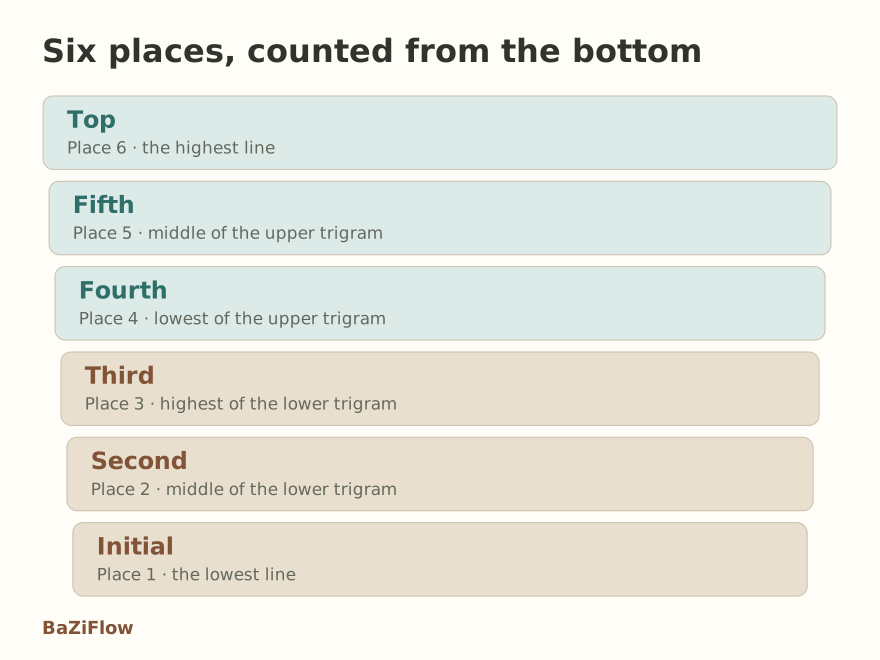
Place sketch: counted from the bottom, Initial is place 1 and Top is place 6. A table of places, not of fortunes.
The lower three places form the lower trigram, also called the inner trigram, and the upper three form the upper (outer) trigram; places two and five are the middle stroke of each. How two trigrams stack into sixty-four hexagrams is covered in The Sixty-Four Hexagrams: How Upper and Lower Trigrams Form One Figure. The phrase "six places" is already in the Commentary on the Judgments (彖传) for Qian (乾): "the great brightness of end and beginning, the six places complete in their times".
Why is the bottom line not "one" and the top line not "six"? Kong Yingda, a Tang-dynasty commentator, answers in his subcommentary on Initial Nine of Qian. He cites Zhuang's view that if the bottom is "initial", the top carries a sense of "end"; he adds that the Images (象传) say "yang is below", so "initial" also means "below"; then he gives a reason for each name:
The first place is called "initial" because it shows things building up gradually, from nothing into something; so it says initial rather than one or below. The sixth is called "top" because it shows a place at the top of the hexagram; so it says top rather than six or end.
Nine and Six: how a line name is built
A line name has two parts: a place, and a number for the kind of line. A yang line is written Nine and a yin line Six, so the second place holds either Nine in the second place or Six in the second place. The table below uses Qian and Xu (需).
Enlarge diagram · scroll sideways to read
Two things are worth noticing:
- The words Initial and Top come before the number (Initial Nine, Top Six), while places two to five put the number first (Nine in the second place, Six in the fourth).
- The number only records whether the line is yang or yin, so Xu carries Six just in the fourth and top places.
Qian also has a seventh text after Top Nine, "using Nine" (用九), a separate statement covered in Judgment and Line Statements: Whole Hexagram or Single Line?.
Why Nine for yang and Six for yin? The Zhou Yi Zhengyi lists two accounts:
Why Nine for yang and Six for yin
Three strokes and six strokes
Qian has three strokes and Kun six. Yang can take in yin, so its number is nine; yin cannot take in yang, so it stays six.
Old yang and old yin in yarrow counting
In yarrow-stalk counting, nine is old yang and six is old yin. Both change, and the Zhou Yi reads what changes, so line names use nine and six. Young yang is seven, young yin eight.
After these two accounts Kong cites a further view from Zhang and closes the discussion with "perhaps so", so these are traditional explanations, not anything the line statements say. How casting methods differ is compared in Yijing, Meihua and Liu Yao: Shared Hexagrams, Different Methods.
What the Great Commentary says about places two to five
The best-known sayings about places come from the Great Commentary (Xi Ci, 系辞), placed after the line statements, which pairs two with four and three with five:
Two and four share a function but differ in place... Two is often praised and four is often fearful, because it is near. ... Three and five share a function but differ in place... Three often meets misfortune and five often has merit; that is the gradation of the lowly and the noble. If yielding, it is in danger there; if firm, might it prevail?
Enlarge diagram · scroll sideways to read
What does "same function" mean? A note preserved in the Zhou Yi Zhengyi says two and four share "yin function" and three and five "yang function". "Different place" means two is in the inner trigram and four in the outer, while three and five differ in rank. For "four is often fearful" the original's direct reason is just "it is near"; for three and five it is the gradation of the lowly and the noble; the omitted line says two's use is to be yielding and central. The passage never mentions Initial or Top.
Later commentary makes the reasons more specific:
Two sits in a central, harmonious place, so it is often praised... Four presses close on the ruler's place, so it is often afraid... Three is the last place of the lower trigram, so it often meets misfortune; five sits centrally in the honoured place, so it often has merit.
These readings turn "near" into pressing close to the ruler's place; for "four is often fearful" the original's direct reason is only "it is near". The closing question carries a condition too: the subcommentary takes three and five as yang places, where a yin line is in danger and a yang line is equal to the task. The kind of line matters as well as the place.
Central place, proper place, correspondence, adjacency
Four more terms come up whenever places are discussed. None is wording from the Judgments or the line statements; they belong to the Commentary on the Judgments, the Images and later commentators.
Enlarge diagram · scroll sideways to read
Four terms and where they come from
- Central place (中)
- Places two and five, the middle line of each trigram. The Commentary on the Judgments for Shi (师) speaks of "firm and central, and answered"; the Images tie Nine in the second place of Xu to "the middle".
- Proper place (当位)
- The usual rule puts yang lines in odd places and yin lines in even places. The Commentary on the Judgments for Jiji (既济) says "the places are proper"; the Images for Top Six of Xu say "though not in a proper place, no great loss" (Top Six of Xu is a yin line in the sixth place, yet the Images call it improper; see Wang Bi's argument below).
- Correspondence (应)
- Places with the same number in the lower and upper trigram answer one another when one line is firm and the other yielding. The Commentary on the Judgments for Weiji (未济) says "though the places are not proper, firm and yielding correspond"; for Gen (艮), "above and below are in adverse correspondence". By this rule the three pairs of Weiji are each yang with yin, and those of Gen are each alike. The pairing is written out in the Tang-dynasty Xing Shu's note on Wang Bi's Zhou Yi Lüeli: "Initial, four, two, five, three, Top".
- Adjacency (比)
- Originally the name of the hexagram Bi (比), whose Commentary on the Judgments says "bi means to assist". For neighbouring lines see Wang Bi's Zhou Yi Lüeli, chapter on lines and change: "near does not have to mean close, far does not have to mean estranged".
Commentators do not apply them uniformly, and "proper place" is shakiest at the ends. Wang Bi (Wei dynasty) notes in his chapter on places that the Images never speak of gaining or missing the proper place for Initial and Top, and that the Xi Ci passage on "same function, different place" speaks only of places two to five. In the Wenyan (文言, the Commentary on the Words of the Text), Top Nine of Qian is "noble but without position", and the Images call Top Six of Xu "not in a proper place": if the top were a yin place, Top Six of Xu could not be called improper; if it were a yang place, Top Nine of Qian could not be called positionless. His conclusion:
Initial and Top are the beginning and end of an affair; they have no fixed yin or yang place.
Using places: Xu as a worked example
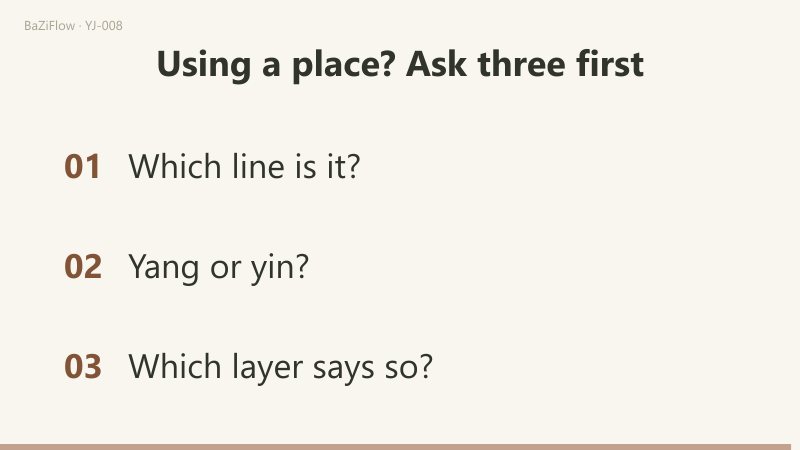
A place saying is a clue about which words to look at, not a conclusion. Practise on Xu (需): write each line name, read the line statement first, then see whether a commentary speaks of that place; where none does, supply nothing.
Enlarge diagram · scroll sideways to read
Three points to check in Xu
The Images tie it to "the middle"
The line statement is "waiting on the sand; a little talk, but good fortune in the end". The Images link it to the middle, and place two is the middle of the lower trigram.
Both commentaries speak of the place
The line statement is "waiting with wine and food; steadfastness brings good fortune". The Commentary on the Judgments, explaining the Judgment, says "in the heavenly place, because it is upright and central", traditionally taken to mean Nine in the fifth place; the Images say "because it is central and upright".
The Images say "not in a proper place"
The line statement is "entering the pit; three uninvited guests arrive; respect them and it ends in good fortune". Top Six is a yin line in the sixth place, yet the Images say "though not in a proper place, no great loss": Wang Bi's own example.
Another chapter of the Xi Ci had already said where this leads:
Changing and moving without settling, flowing through the six empty places, up and down without constancy, firm and yielding exchanging with each other, it cannot be made a fixed rule; only change is what it follows.
Questions readers ask next
Why is a line called Initial Nine and not "One Nine"?
Kong Yingda, a Tang-dynasty commentator, explains it in his subcommentary: "initial" shows things building up step by step from nothing, and "top" names the line that sits highest in the figure. The text of the line statements gives no such explanation itself.
Why is a yang line Nine, rather than One or Seven?
The Zhou Yi Zhengyi sets two accounts side by side. One says Qian has three strokes and Kun six, and yang can take in yin. The other says yarrow-stalk counting gives nine for old yang and six for old yin. Kong then cites a further view and closes with a hedge, so these are traditional explanations.
Does that mean the fifth place always goes well and the third always badly?
No. The wording is "often", and the same sentence goes on to ask whether a yielding line there is in danger and a firm one prevails. Another chapter of the Xi Ci says the Zhou Yi cannot be made a fixed rule, so these sayings are not formulas.
Was this article helpful?
Part of a learning path
Sources & references
Continue reading
Judgment and Line Statements: Whole Hexagram or Single Line? ↗
Yijing, Meihua and Liu Yao: Shared Hexagrams, Different Methods ↗