

The same-palace self-transformation test
Content version · · Sources & references
Use a positive and a negative palace example to understand one documented self-transformation test. Separate the palace stem from natal labels and avoid assuming all schools use identical terminology.
The short version6 min read
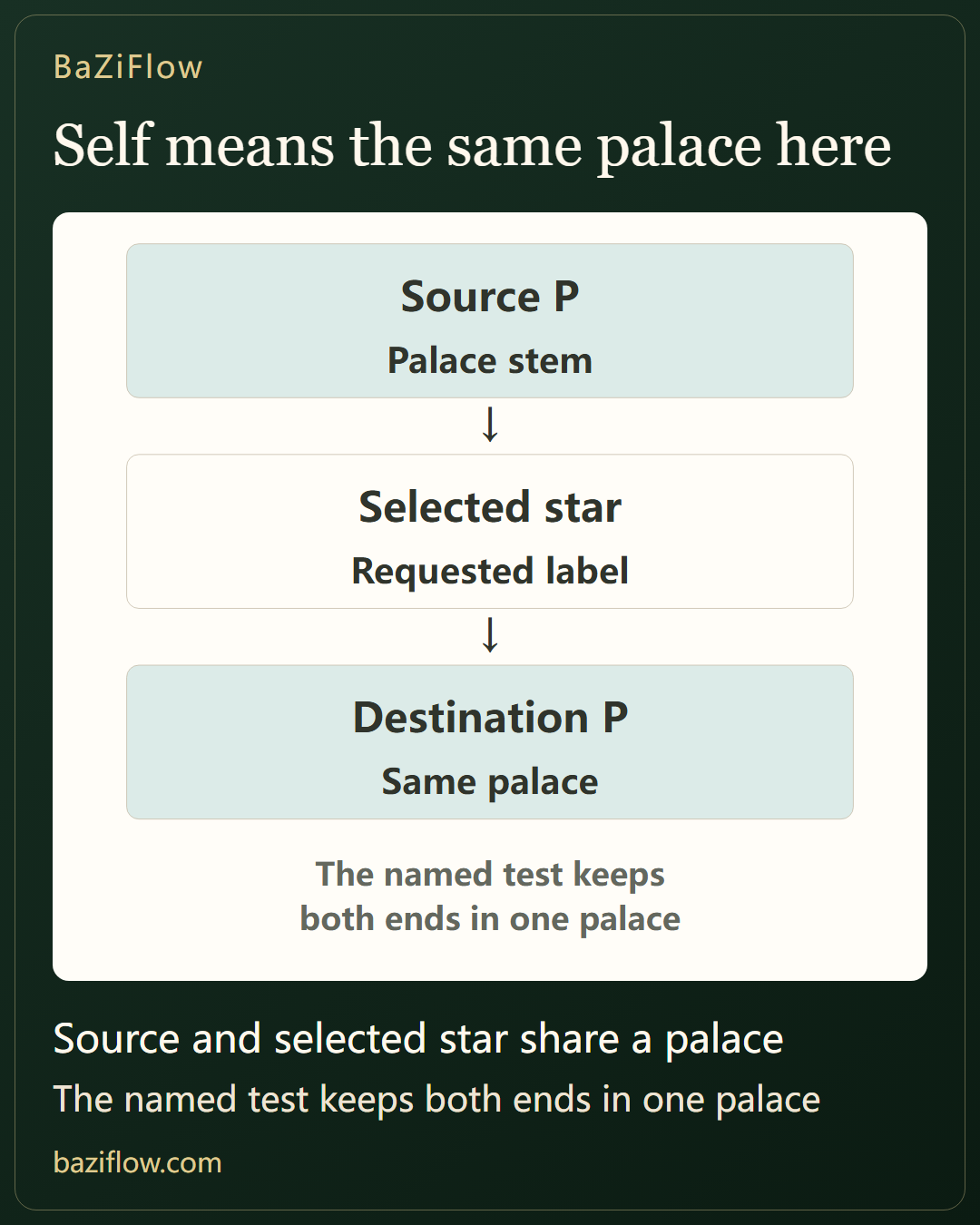
Under the iztro method used here, a self-transformation occurs when the star selected by a palace’s own stem is in that same palace. Yin Wood selects Tian Ji for Lu, but Tian Liang for Quan. Both the requested transformation and the star’s destination matter.
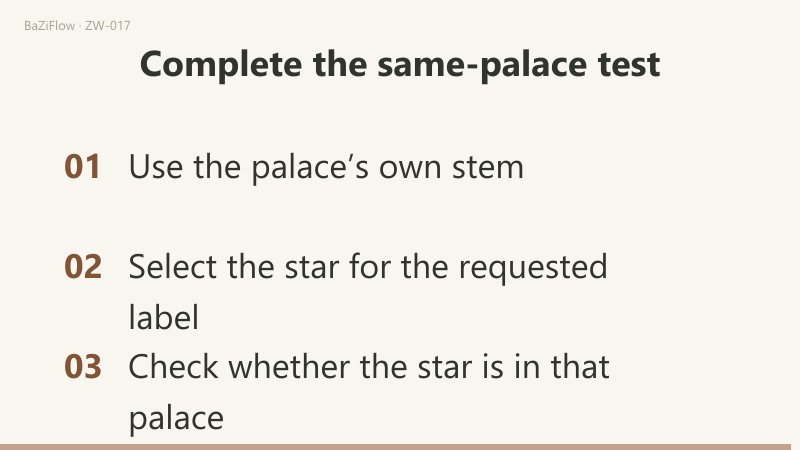
- The named test uses the current palace’s stem to select a star, then checks whether that star is resident in the same palace.
- Yin Wood selects Tian Ji for Lu: Tian Ji in P meets self-Lu at P, while Tian Ji in Q gives a P-to-Q relation instead.
- Yin Wood selects Tian Liang for Quan; Tian Ji at P does not answer that separate query, nor can a natal Lu mark replace it.
Read first
A label needs a falsifiable condition
If a term can be applied whether a star sits here or somewhere else, it is difficult to learn what the term actually identifies. Start with a defined test and an example that fails it. For this article, the test comes from iztro's palace documentation and its publicly readable implementation.
That implementation takes the current palace's stem, finds the star selected for a specified transformation, and checks whether that star is in the same palace. This gives us a concrete use of “self-transformation.” It is the named method used below, not a declaration that every Ziwei school uses the term in precisely this way.
The evidence concerns how a rule is evaluated. It does not establish a psychological effect on a person. The English word “self” is especially easy to overread: it is not permission to infer selfishness or self-absorption from a technical label.
The named test keeps both ends in one palace
Change the location and see what fails
Let P be a palace with the stem Yin Wood (乙). In the cited table, Yin Wood selects Tian Ji for Lu. We now compare two partial teaching conditions, without assigning birth data, branch positions or life-topic names.
| Condition being checked | Location of Tian Ji | Result under the stated method |
|---|---|---|
| Lu from Yin Wood at P | In P | P meets the self-Lu condition |
| Lu from Yin Wood at P | In another palace Q | Lu goes from P to Q; not self-Lu at P |
| Only a natal Lu mark is visible | Palace stem not verified | Insufficient information for this test |
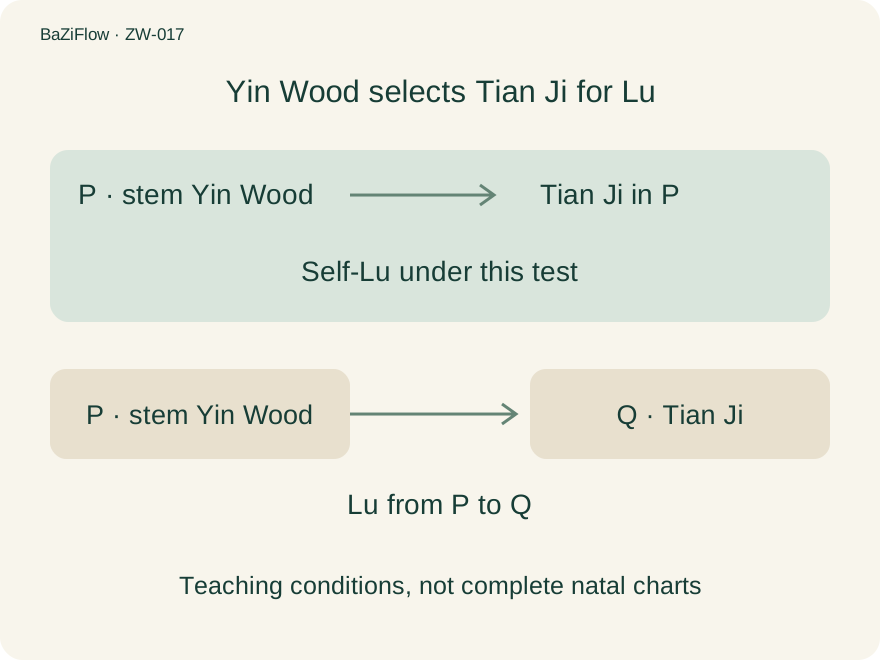
Original BaZiFlow positive-and-negative comparison based on the cited iztro method, without treating it as a universal definition across schools.
The first two rows hold the stem, transformation and selected star constant. What changes is whether the target star occupies the originating palace. This isolates the condition we want to learn. It does not imply that stars may be moved at will inside a valid natal chart; a full chart would still require its complete placement rules.
A useful negative example therefore does more than say “not self-transformation.” It tells you why the condition fails and preserves the relation that remains: P to Q. No personality story is needed to explain that difference.
Hold Yin Wood at P constant and change only the requested transformation from Lu to Quan. In the same table, Lu selects Tian Ji while Quan selects Tian Liang. Confirming Tian Ji in P answers the Lu location test; it does not locate Tian Liang. If Tian Liang’s position is missing, self-Quan is still unverified.
That is not a finding that P lacks self-Quan. If Tian Liang is subsequently supplied at P, the stated method confirms self-Quan; if it is supplied at Q, record Quan from P to Q. Palace stem, requested transformation, selected star and destination form one connected query. Failing to update a dependent field can carry an old answer into a different question.
Yin Wood for Lu
- Tian Ji
Yin Wood for Quan
- Tian Liang
A natal mark is evidence for a different lookup
A Lu annotation inside P may have been generated by the birth-year stem. The same-palace test described here instead uses P's own stem. Being printed inside the palace does not establish that the palace's stem generated the annotation.
If a cropped display supplies a star and a Lu mark but no reliable legend or palace stem, record that uncertainty. Once the legend identifies a natal origin, you can confirm the natal record without claiming to have tested self-transformation. The missing palace-stem lookup is still a separate task.
The palace-stem and birth-year comparison explains these origins in more detail. Keep them distinct even when they happen to select the same star. Otherwise, the presence of one mark can silently become a false assertion about a second rule.
Birth-year stem
- Natal annotation
Palace stem
- Same-palace test
Compare methods by their inputs, not their arrow shapes
Other materials may introduce inward or outward terminology, additional conditions, or arrows with meanings specific to their teaching system. Do not map those terms onto the test above merely because their names sound related.
For a useful comparison, identify the source palace, the stem used, the selected star and its destination. Then add the author's legend and any further conditions. If those definitions are unavailable, preserve the term as unresolved rather than supplying a guessed formula.
This approach does not rank schools. It first asks whether two sources are describing the same relation. A difference in terminology can conceal different inputs, while a shared name can conceal different tests. Neither can be settled by comparing two isolated screenshots.
A loop drawn on a chart is therefore a prompt to read the legend. It is not a universal definition by itself. Likewise, an implementation is evidence for its own documented behavior, not authority over every historical use of a technical term.
Source palace
Star destination
Added conditions
Keep the checked result smaller than the interpretation
A complete record of our positive example can be brief: “Under the cited method, P has Yin Wood; Yin Wood selects Tian Ji for Lu; Tian Ji is in P; the self-Lu condition is met.” Another reader can reproduce that result from the same inputs.
If Tian Ji later turns out to be in Q, correct the location and the relation. You do not need to replace one invented character portrait with its opposite. That is an advantage of separating the observable arrangement from a possible interpretation.
Authors may attach symbolic meanings to self-transformations. When discussing those meanings, attribute the method and keep its claims distinct from observed behavior. A rule match has not measured a person's motives, relationship habits or capacity to change.
Try writing the source palace, selected star and destination beside every self-transformation term in a study note. A missing field reveals where verification is still needed. This is the same relationship-first reading developed in star combinations, now applied to a more specific technical condition.
Tian Ji in P
- Self-Lu by this test
Tian Ji in Q
- Lu from P to Q
Questions readers ask next
What does “self” identify in the method used here?
It identifies equality between the palace supplying the stem and the palace containing the selected star. P with Yin Wood selects Tian Ji for Lu; if Tian Ji is also in P, the named test is met. The word does not identify a psychological trait.
Does Tian Ji in a Yin Wood palace establish self-Quan?
No. Yin Wood selects Tian Ji for Lu but Tian Liang for Quan. A self-Quan query must check Tian Liang’s location. The same stem supports four separate queries whose selected stars cannot be substituted for one another.
Why is natal Lu inside a palace insufficient?
Natal Lu comes from the birth-year stem; this self-transformation test uses the palace’s own stem. Sharing a display box does not equate those inputs. Read the palace stem, select the requested star and check its location separately.
Was this article helpful?