

Keep the original and correct the affected fields
Content version · · Sources & references
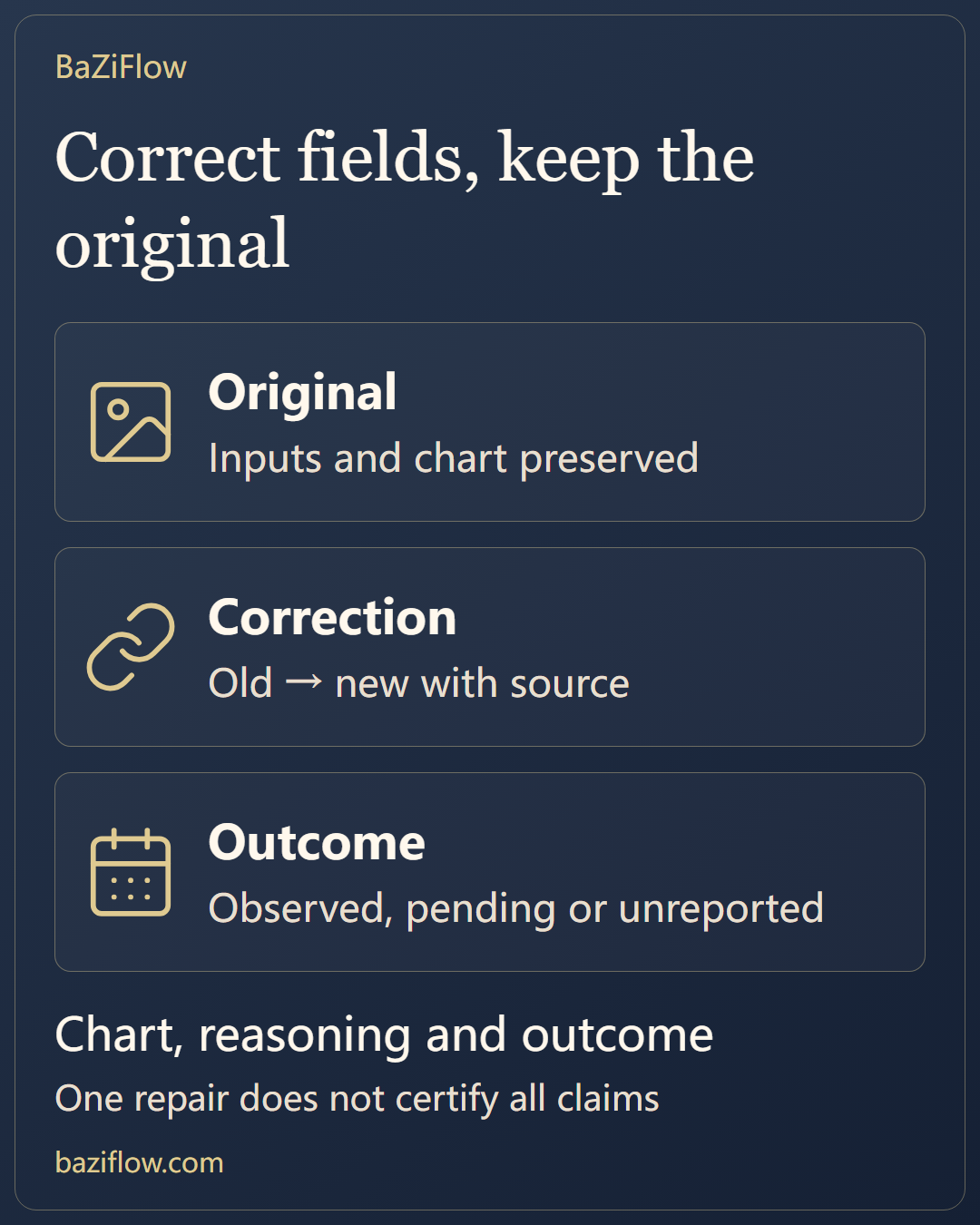
A fictional transcription error shows why the original chart, interpretation and later outcome need separate records. Correct one door position without rewriting the history or treating every conclusion as verified.
The short version6 min read
Q42 changes Rest from nine to two while keeping Tian Peng at nine. Reconsider reasoning that depended on the incorrect door position. Effective inputs, chart data, the original interpretation and later outcomes need separate records so one correction does not rewrite the history.
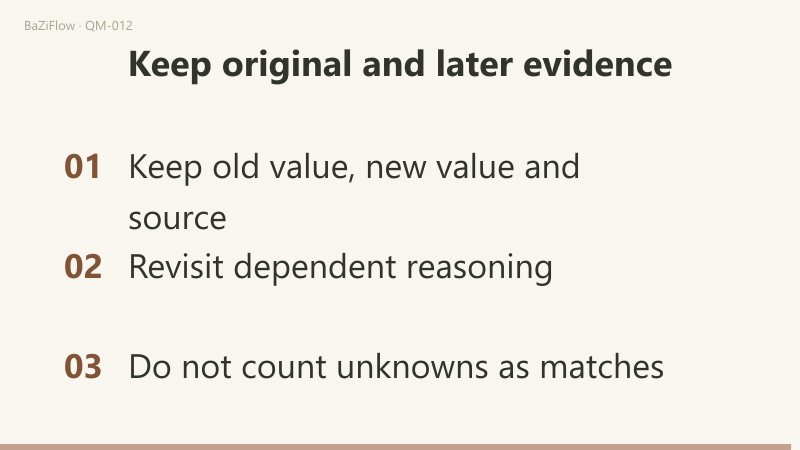
- Keep old value, replacement, source and correction time, then trace affected reasoning.
- Preserve an original time interval separately from a selected exercise timestamp.
- Under observation and unreported are distinct outcome states, not automatic matches or failures.
Read first
Duty chief and duty door: track the role before the position ↗
Choosing a Qimen significator before looking for its palace ↗
A later outcome cannot reconstruct the original reading
If the only surviving note says “wait before acting,” almost any later event may seem compatible with it. What chart was used? Which object was selected? What deadline was the reader considering? Without those details, a review can become a new story written after the outcome.
A useful record separates four things: the effective inputs, the chart output, what was said at the time and what happened later. Each answers a different question. A correction should show how one part changed without silently rewriting the others.
This is not a demand for a longer interpretation. It is a way to keep important claims attached to the fields and assumptions that produced them.
Effective inputs
Chart output
Original reasoning
Observed outcome
Use a small error whose correction can be checked
Consider fictional note Q42, a transcription exercise based on the Yang-one, Yin Wood Ox (乙丑) example in the Siku Dun Jia Yan Yi. The note correctly places Tian Peng at palace 9 but mistakenly puts Rest at 9 as well. The source's step-by-step example gives Tian Peng at 9 and Rest at 2.
| Q42 field | Original note | After source check | Action |
|---|---|---|---|
| Setup and time label | Yang one, Yin Wood Ox | Unchanged | Retain |
| Tian Peng palace | 9 | 9 | Retain |
| Rest door palace | 9 | 2 | Correct with source |
| Civil date and time | Not supplied | Still unknown | Do not invent |
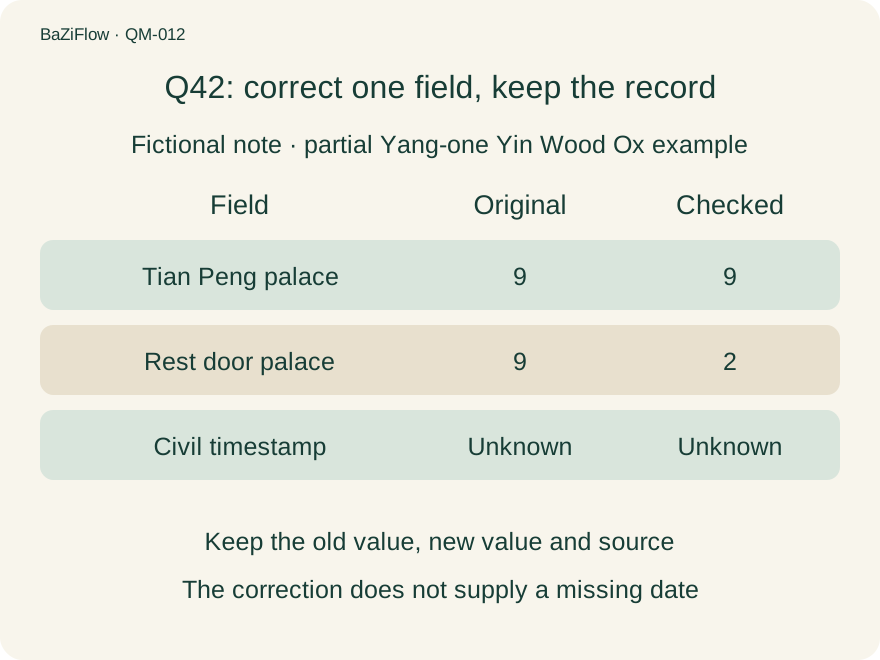
Original BaZiFlow correction exercise based on the Yang-one Yin Wood Ox example in Dun Jia Yan Yi, volume one. Q42 is an invented partial note, not a calculated modern chart.
Q42 is deliberately partial. It records only the cited star and door positions, with no civil date supplied. The missing date stays missing after the correction; fixing one field does not authorize filling unrelated gaps.
Retain the old value, the replacement, the reason and the source. If an earlier conclusion depended on Rest being at 9, mark that part for reconsideration. Tian Peng's position is not wrong merely because the neighbouring door field was wrong. Nor does correcting the door certify the whole interpretation.
Q42
Peng
- Old
- 9
- New
- 9
Rest
- Old
- 9
- New
- 2
Yang one · Yin Wood Ox
Save what the method actually used
For a full timed chart, preserve the supplied date and time, the relevant location or time-zone basis, effective time settings, placement method and version. A screenshot of an input form may not reveal a conversion or boundary rule applied later.
For example, the Hong Kong Observatory's solar-term table explicitly states that its times are Hong Kong time, UTC plus eight hours. A record drawing on that table should keep its time basis and the conversion to the same instant used by the chart method. The astronomical source supports the timestamp, not the validity of a divinatory interpretation.
If the original time is uncertain, keep the uncertainty. A selected time used for an exercise remains a selected assumption; it must not become something the person supposedly supplied with certainty when the case is reviewed months later.
These distinctions become especially useful near a day or seasonal boundary. Instead of saying only “the software gave this chart,” the record can show which effective setting produced it and which alternative would need a separate comparison.
Original range
- 09:00–09:20
Selected point
- 09:10 · assumption
Do not recover chart facts from the interpretation
Preserve the chart with palace numbers, layer labels and its legend. Where a structured export is available, keep it alongside the image. A cropped picture can leave a stem's earth or heaven layer ambiguous, or hide whether Zhi Fu (值符) refers to a star role or a spirit symbol.
Store the interpretation separately, including the selected object, the reason for selecting it, the supporting conditions and qualifications. The narrative may contain the very transcription error under investigation. Reconstructing the chart from that narrative would turn the error into a new input.
The question also needs a stable subject, event and time horizon. An arrangement planned for this week is not the same case as a similarly named arrangement a month later. If the question changes, keep a new record or a clearly labeled revision instead of editing the old wording to fit the new event.
Unknown outcomes should remain unknown
At the agreed review point, record what happened, when and how it is known. If the time horizon has not ended, the case remains under observation. If no follow-up has arrived, mark it as unreported. Neither state counts as a confirmed match or an automatic failure.
Keep the original conditional language. Deleting “may” after an event occurs would make the old claim look stronger than it was. Expanding a vague sentence into specific details that appeared only in the outcome would have the same effect.
Disconfirming cases need to remain visible too. A collection containing only favorable anecdotes cannot reveal where the selection rule or interpretation repeatedly breaks down. For public discussion, use only the anonymized details needed for analysis and say which inputs have been omitted; keep identifying questions and itinerary details out of the shared extract.
A corrected case and an improved practice are different results
The immediate correction in Q42 is Rest 9 to Rest 2. The broader lesson is to check star and door destinations independently. That lesson should be tried on other structures, including cases where the two coincide and cases where they separate. Repeating the repaired example alone might test memory of one answer rather than the recording practice.
The duty-chief and duty-door comparison supplies distinct position examples. Selecting the observation object addresses the next question: whether the chosen field actually bears on the enquiry.
A traceable review therefore leaves corrected data, the original account and unresolved interpretation in their appropriate states. A matching event does not alone establish predictive validity, and one repaired field does not amount to a completed review of every claim. The record is useful because it makes those differences inspectable.
Still pending
- Horizon not ended
- Or no follow-up
Observed
- Event + time + source
Questions readers ask next
Does repairing Rest certify the whole interpretation?
It verifies that placement against the cited example. Review sentences depending on the old door position and other independent claims separately; retain correct data unrelated to the correction.
How can a review distinguish method from memorizing Q42?
Use another time row such as Yang Fire Tiger and include both shared and separated star–door positions. Recheck each field against its source instead of treating Rest two as a universal repair.
Where should a case without follow-up be counted?
Keep it unreported with its observation horizon. That differs from a pending deadline, a confirmed match and a confirmed mismatch. Add reliable later evidence without editing what was originally said.
Was this article helpful?
Part of a learning path
Qimen: from the nine palaces to recording a chart · Step 6 of 6 available
Sources & references
Continue reading
Choosing a Qimen time or direction starts with real constraints ↗