

The Sun: four positions, sign and house
Content version · · Sources & references
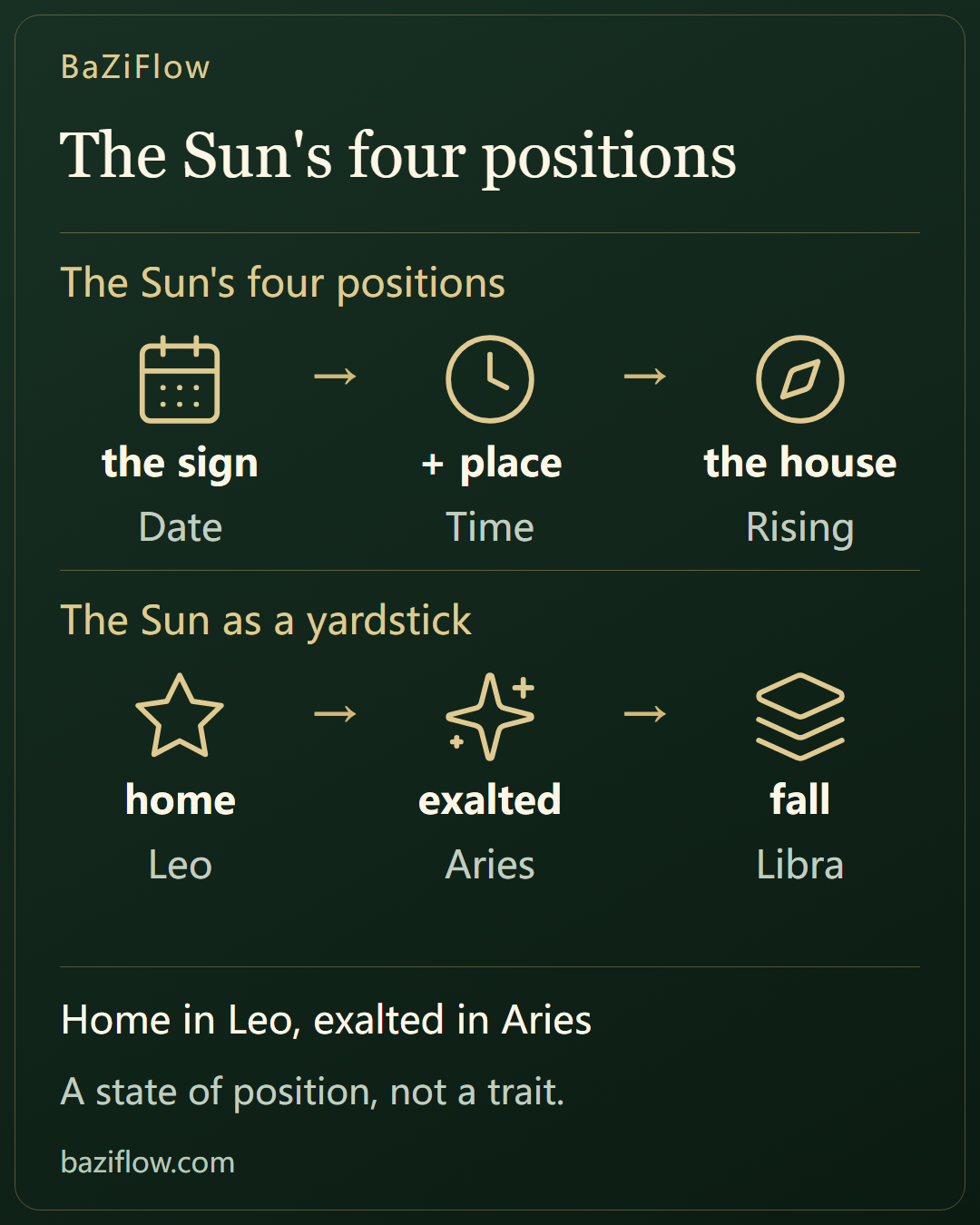
Four of the twelve signs carry an entry for the Sun: domicile in Leo, exaltation in Aries, detriment in Aquarius, fall in Libra. A ring chart, Ptolemy's reasons, a 2026 ingress table and house drills teach the reading.
The short version8 min read
The Sun and Moon each have a single home, and the Sun's is Leo. The site's table records four positions for the Sun and leaves eight signs blank; the sign needs only a date, while the house needs a birth time and place.
- The classical table in the engine records four entries for the Sun: domicile in Leo, exaltation in Aries, detriment in Aquarius and fall in Libra. Detriment sits opposite domicile, and fall opposite exaltation.
- Ptolemy's reasons all come from sunlight: Leo and Cancer are the most northerly, hottest signs and go to the two lights; after the equinox the days lengthen and the Sun starts adding heat in Aries, so that is where he is exalted.
- The Sun's sign needs only a date, down to the moment of ingress. The house needs the Ascendant, which means a birth time and place. The two layers are looked up and recorded separately.
Read first
Personal, Social and Outer Planets: Use Groups as a Directory ↗
Four entries for the Sun among twelve signs
In plain words first: the site's classical table records at most four kinds of position for a planet, domicile, exaltation, detriment and fall. The Sun has entries in four of the twelve signs, and the other eight are blank.
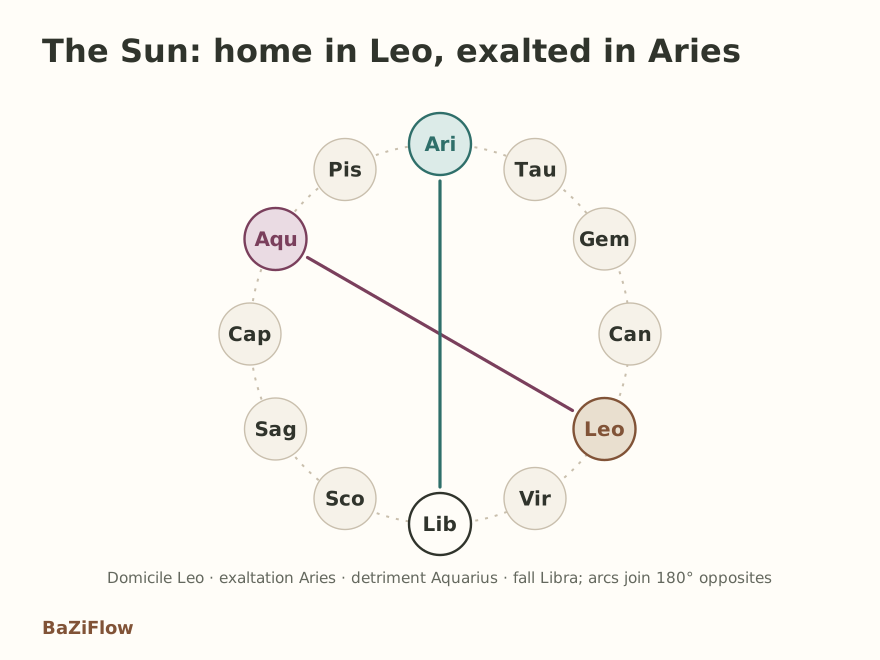
Position sketch: the twelve signs at 30 degrees each; an arc joins two opposite signs. The table records these four positions only.
In the picture Leo is the Sun's home and Aries his exaltation. Aquarius lies directly across from Leo and is the detriment; Libra lies directly across from Aries and is the fall. Each arc joins two opposite signs, 180 degrees apart. That gives a quick way to remember them: detriment always sits opposite domicile, and fall always sits opposite exaltation, so knowing the first two gives you the other two.
For how the planets are grouped, see personal, social and outer planets.
Four labels Ptolemy gives the Sun
Chapters 4 to 7 of Book I of the Tetrabiblos assign every body a quality, a benefic or malefic character, a sex and a time of day. The paragraph on the Sun runs like this:
The Sun brings heat and a mild dryness. He is so large, and his effect on the seasons so plain, that his power is easier to notice than anyone else's; wherever he stands near the zenith, that place is hotter.
Put together, the four labels make a short table:
Enlarge diagram · scroll sideways to read
Chapter 5 sorts the bodies into three classes. Jupiter, Venus and the Moon combine heat with moisture and count as benefic; Saturn is too cold and Mars too dry, so they count as malefic; the Sun and Mercury are "common" and turn good or bad according to the planets they join. So in Ptolemy the Sun carries no fixed verdict, and what it means depends on who stands beside it.
Ptolemy's reasons for the home and the exaltation both start from sunlight
The home first. Ptolemy begins with heat:
Leo and Cancer lie farthest north of all twelve signs, so they stand nearest the point overhead for the region we live in; that nearness brings warmth and heat. Each of the two great lights therefore received one of them: masculine Leo went to the Sun, feminine Cancer to the Moon.
Once the lights have their homes, the other five planets are laid out on either side in order of orbit, nearest first; the full arrangement is in the article on Leo. The Sun has only one home, so the domicile column holds just Leo. Detriment follows from it. In Lilly's Christian Astrology a planet standing directly across from one of its own homes is in detriment, and the sign across from Leo is Aquarius, so the Sun is in detriment there.
Now the exaltation. This time Ptolemy watches the Sun's course through the year:
As soon as the Sun enters Aries he is crossing into the higher northern half of the zodiac, and as soon as he enters Libra, into the lower southern half. Aries is therefore his exaltation, because there the days begin to lengthen and his heating strength rises; Libra is his fall, for the contrary reasons.
Enlarge diagram · scroll sideways to read
These reasons are all geometry and seasons, and not one word of them concerns a person who is born. Exaltation here means that, with the Sun in Aries, his heating strength is at the rising end; fall is the opposite end. To look at the exaltation from the sign's own side, read Aries.
The Sun's sign needs only a date
The Sun runs through 360 degrees of longitude a year and changes sign every 30. Ingress moments differ from year to year; these are the starting points for 2026 as computed by the engine, all in UTC:
Enlarge diagram · scroll sideways to read
The same clock reading can fall on another date in another time zone: the Sun enters Virgo at 02:19 UTC on August 23, which is 10:19 the same day in Beijing. Someone with a birthday near a boundary should convert the birth time to UTC before using this table.
Two exercises
Born 01:00 UTC on August 23, 2026: Leo or Virgo?
Virgo starts at 02:19, an hour and nineteen minutes later, so the Sun is still in Leo, in domicile.
And at 03:00 UTC on September 23 of the same year?
Libra began at 00:05, nearly three hours earlier, so the Sun is in Libra and in fall.
The Sun is also a yardstick for other planets
Everything so far asks where the Sun itself stands. Another way of reading turns it around and uses the Sun to measure how far another planet is. Lilly's Christian Astrology draws three lines:
Enlarge diagram · scroll sideways to read
In order: a planet less than 17 arc-minutes from the Sun is in cazimi, literally "in the heart of the Sun", and Lilly says all authorities hold it strengthened there; a planet in the same sign as the Sun and less than 8 degrees 30 minutes away, either side, is combust; and a planet within 17 degrees is under the Sunbeams. The site's dignity table judges none of the three. They appear here to show how the distance layer is looked up: subtract the two longitudes, then check whether they share a sign.
Two more exercises
Sun at 11°20′ Leo and Mercury at 3°10′ Leo: what is it?
The gap is 8°10′, inside 8°30′ and in the same sign, so by Lilly it is combust; being within 17° it is also under the Sunbeams.
Sun at 28° Leo and Mercury at 2° Virgo, only 4° apart: combust?
No. Lilly's wording requires the same sign. It is still inside 17°, so it is under the Sunbeams.
The house takes one more step: first find the Ascendant
Whole-sign houses are the site's default: the entire sign that holds the Ascendant is the first house, and each following sign is the next house. The Ascendant is computed from the birth time and place, so when the birth time is unknown the site gives no Ascendant, no house can be looked up, and only the sign is recorded.
Take a hypothetical record: the Ascendant is in Aquarius and the Sun is in Libra. Counting from Aquarius, Libra is the ninth sign, so the Sun is in the ninth house.
Enlarge diagram · scroll sideways to read
When Lilly describes the twelve houses he says the Sun rejoices in the ninth, which tradition calls the planet's joy. The same Sun therefore carries two unrelated entries from two tables: at sign level Libra is the fall, and at house level the ninth is the Sun's joy in Lilly's book. Each is recorded on its own. They do not cancel each other and they do not add up to a score.
How the systems part ways is covered in house systems compared.
Two last exercises
Scorpio rising, Sun in Leo: which house?
The tenth. Counting from Scorpio, Leo is the tenth sign.
Birth time unknown, Sun in Leo: can you name the house?
No. The sign needs only a date, but the house needs the Ascendant. With the time missing, record the sign alone.
Next comes the other light, the Moon in sign and house, where a sign change is measured in minutes.
Questions readers ask next
The Sun is in domicile in Leo. Are people born under Leo more energetic?
Domicile describes the state of the Sun as a body standing in Leo, so the subject is the planet. Ptolemy's reasons are about position on the ecliptic and heat, and the book draws no conclusion about the character of anyone born.
Is the "Sun sign" the same thing as the Sun's placement here?
It is the same position: the sign holding the Sun's ecliptic longitude at the moment of birth. Ingress moments differ from year to year, so for a birthday near a boundary compare the birth instant with an ingress table rather than memorizing fixed dates.
The Sun is a star. Why is it counted among the seven classical planets?
The classical scheme names bodies by their apparent motion: the Sun travels through the zodiac, so it joins the Moon and the five wandering planets as the seven. Astronomy classifies it differently, and both statements can stand together.
Was this article helpful?
Sources & references
- Ptolemy, Tetrabiblos Book I (F. E. Robbins text on LacusCurtius): planetary natures, houses, exaltations ↗
- Deborah Houlding, Traditional Sign Rulerships (2003) ↗
- William Lilly, Christian Astrology (1647), Of the Twelve Houses, pp. 50–56 ↗
- William Lilly, Christian Astrology (1647), Book I, Of the Planets (Saturn pp. 57–61, Jupiter pp. 61–65, Mars pp. 65–68, Sun pp. 69–71, Venus pp. 72–75, Mercury pp. 76–79, Moon p. 80ff; Cazimi p. 113) ↗
Continue reading
The Moon: Home in Cancer, Exalted in Taurus, and Why a Sign Change Needs the Clock ↗