

Companion: the Ten God that is the Day Master's own stem
Content version · · Sources & references
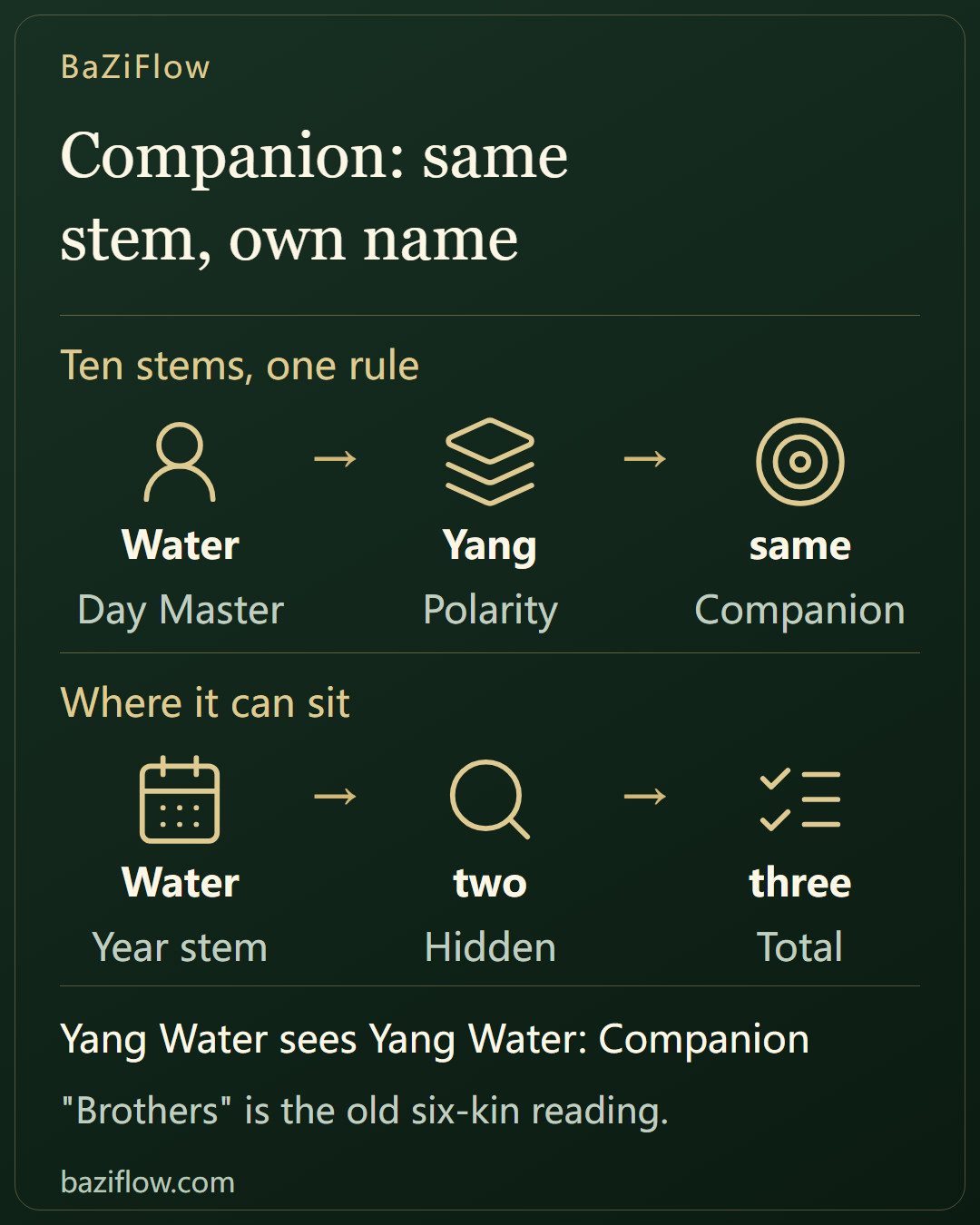
Companion is the only Ten God that maps a Day Master to itself. A ten-stem table, a practice chart and short passages from three classical texts show how to look it up, count it and read it.
The short version7 min read
Companion is the one Ten God name that never changes the character: the stem it points to is the Day Master itself.
- Each of the ten Day Masters maps to itself: Yang Wood to Yang Wood, Yin Wood to Yin Wood, and so on. The table has no second character, which makes it quick to use and easy to overlook.
- Counting depends on position. The Day Master is called the Day Master and is not counted; the same character in the year, month or hour stem, or inside the hidden stems of any branch, is one Companion each.
- Old books mostly read it through the word "brothers". The Sanming Tonghui contains both a note that lists Companion as unwelcome and a line saying many Companions can carry the load.
Read first
How the Ten Gods are derived: five relationships and two polarities ↗
A table where the character never changes
Companion (比肩) is "the character that looks exactly like the Day Master". If the Day Master is Yang Wood, the Companion is Yang Wood; if the Day Master is Yang Water, the Companion is Yang Water.
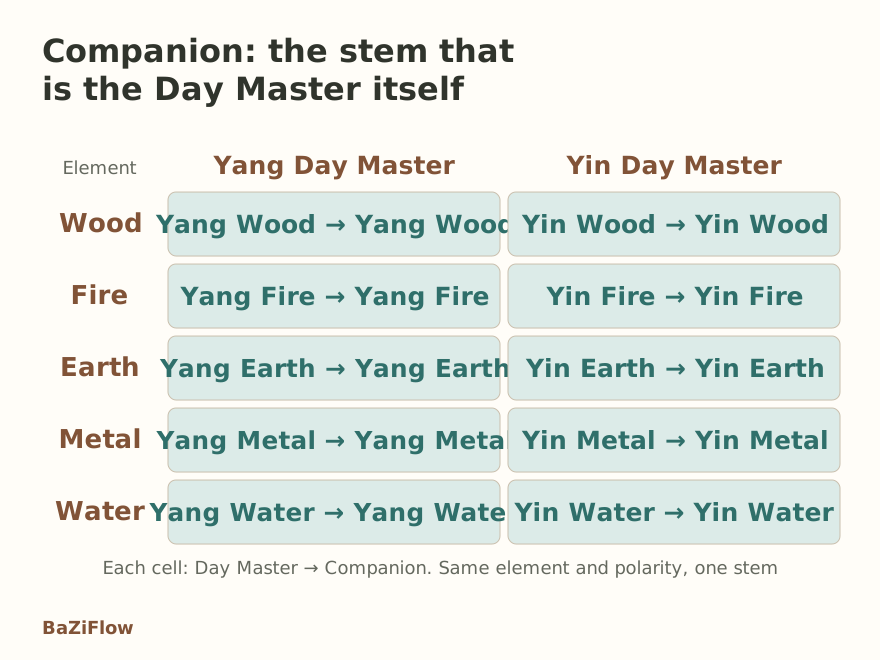
Look-up table: yang Day Masters on the left, yin on the right, the Companion after the arrow. The data come from the site's Ten Gods table.
"Exactly like" has to pass two tests. The first is the element: another Yang Wood is also Wood, so it lands in the same group as the Day Master, which the derivation of the Ten Gods calls "same as me". The second is polarity: both are yang. With element and polarity both matching, only one character is left.
In the picture each element has a row, yang stems on the left and yin stems on the right, and every cell reads "Day Master → Companion" with the same character at both ends. In every other Ten God the look-up returns a different character. Companion is the only one that does not change anything, so it costs no effort to look up and is the easiest to skim past: unlike Eating God or Indirect Wealth it does not show a new character in the table.
Where a Companion can show up in a chart
With the table in hand the next question is where to count. Below is a practice chart with Yang Water as the Day Master: year pillar Yang Water Monkey (壬申), month pillar Yin Metal Pig (辛亥), day pillar Yang Water Horse (壬午), hour pillar Yin Fire Goat (丁未). It is invented for the exercise and does not belong to a real person.
Enlarge diagram · scroll sideways to read
Go cell by cell. The year stem is Yang Water: same character, one Companion. The year branch, Monkey (申), hides Yang Metal, Yang Water and Yang Earth, and the middle slot holds Yang Water, so that is a second. The month branch, Pig (亥), hides Yang Water and Yang Wood, and its main slot is Yang Water: a third. The day stem is the Day Master and is not counted. The Horse branch hides Yin Fire and Yin Earth, the hour stem is Yin Fire, and the Goat branch hides Yin Earth, Yin Fire and Yin Wood, none of them Yang Water. The total is three.
Hidden stems follow the site's own table; the list for each branch is in hidden stems. A Companion in a stem and a Companion inside a branch sit in different positions, and later questions such as whether it has strength or shows on the surface depend on that position, so record it as you count.
The old books file Companion under "brothers"
Once the count is clear, look at how the old books use it. The Yuanhai Ziping (渊海子平) first gives a list using Yang Wood as the example, and its line for Yang Wood meeting Yang Wood reads "Companion, the brothers". A later section, on brothers and sisters, opens with:
Companion is the brothers. For instance, Yang Wood meeting Yang Wood is the elder brother and Yin Wood is the younger sibling; the Tiger and Rabbit branches work the same way.
Two things stand out. The name is attached to a family role: Companion stands for brothers. And when the book reads "brothers" it counts Yang Wood and Yin Wood together: for the Day Master Yang Wood, meeting Yang Wood is the elder and meeting Yin Wood is the younger sibling. In the look-up table Yin Wood is Rob Wealth, yet this section does not split the two characters into two separate names.
The Di Tian Sui (滴天髓) handles it the same way in its chapter on the six kin: Rob Wealth, Companion and Yang Blade are all filed as brothers, and the method comes with them, which is not to look at them alone but to weigh them against the god of the month command and against the favored god.
Enlarge diagram · scroll sideways to read
One book, two verdicts: Companion shares wealth, and carries it
The other side of Companion that gets most discussion is its link with wealth. In a note on Direct Wealth, the Sanming Tonghui (三命通会) lists Companion among the unwelcome items:
Unwelcome: a weak self, Companion, Yang Blade, void, extinction, clash and combination.
Yet the entry on the two Wood stems in juan 4, speaking of Wood born in summer when Fire and Earth hold the season, says the opposite:
So many Companions can carry it; do not say that many Companions only split the wealth.
"So" points back to the premises of the line before it: summer Wood, Fire and Earth in season, more Fire and Earth showing on the stems as wealth, and a Day Master that needs its own kind to take the weight. Then many Companions become the hands that can hold the wealth.
Enlarge diagram · scroll sideways to read
Read side by side, the difference is the premise. The first is a bare list of what Direct Wealth dislikes, with Companion next to a weak self and the Yang Blade and no situation attached. The second states its premise: heavy wealth with Fire and Earth in command, where the Day Master needs peers to bear it. The same Companion does different work depending on whether the Day Master can bear the load, and that thread continues in strong and weak Day Masters; how several Ten Gods chain together is in the conditions for Ten God combinations.
Count one yourself
Write down the Day Master first
Companion is that same character. For Yin Fire the Companion is Yin Fire; if this step is vague, every cell after it will be miscounted.
Look for the same character in every slot
Go through the year, month and hour stems, then expand the hidden stems of all four branches, and note each match except the day stem itself.
Record position and source
"The main slot of the month branch" and "the year stem" are two different positions. When you cite an old reading, say which book it came from.
Two exercises
Day Master Yin Fire. Year stem Yin Fire, month stem Yang Fire, day stem Yin Fire, hour stem Yin Water. How many Companions among the stems?
One. The year stem is the same character; the day stem is the Day Master and is not counted; Yang Fire is Rob Wealth and Yin Water is Seven Killings.
Day Master Yang Metal, and a Snake branch in the chart. Is there a Companion inside the Snake?
Yes. The Snake hides Yang Fire, Yang Metal and Yang Earth, and the Yang Metal in the middle slot is the same character as the Day Master, so it is one Companion.
To read Companion within a whole chart, its neighbor Rob Wealth is the natural next step.
Questions readers ask next
Does the day stem itself count as a Companion?
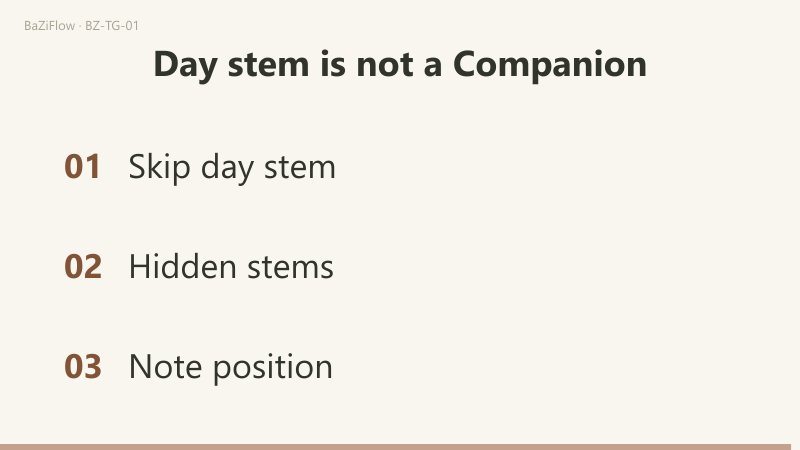
No. The day stem is the Day Master, the reference point for the whole Ten Gods system, and it is not compared with itself. Companion counts only the same character appearing in other positions: the year, month and hour stems, and the hidden stems inside each branch.
Why are Companion and Rob Wealth so often discussed together?
They share an element and differ only in polarity: the same polarity is Companion, the opposite polarity is Rob Wealth. When old books speak of brothers they often read the pair as one column, as in the Yuanhai Ziping line that Yang Wood meeting Yang Wood is the elder brother and Yin Wood the younger sibling. Rob Wealth has its own article for the look-up.
If a chart has many Companions, should they be suppressed?
The Sanming Tonghui says both things: its note on Direct Wealth lists Companion as unwelcome, while its lines on summer Wood say many Companions can carry the wealth. The second comes with a premise, heavy wealth with Fire and Earth in command, where the Day Master needs its own kind. So whether to restrain them depends first on the strength of the Day Master and the weight of the wealth; there is no single answer.
Was this article helpful?
Sources & references
Continue reading
Rob Wealth (劫财): Same Element, Opposite Polarity, and Why It Is Not the Robbery Sha ↗
Output Generates Wealth and Officer Generates Resource: Chains and Conditions ↗