

Girl: the third row of the three-nine begins here
Content version · · Sources & references
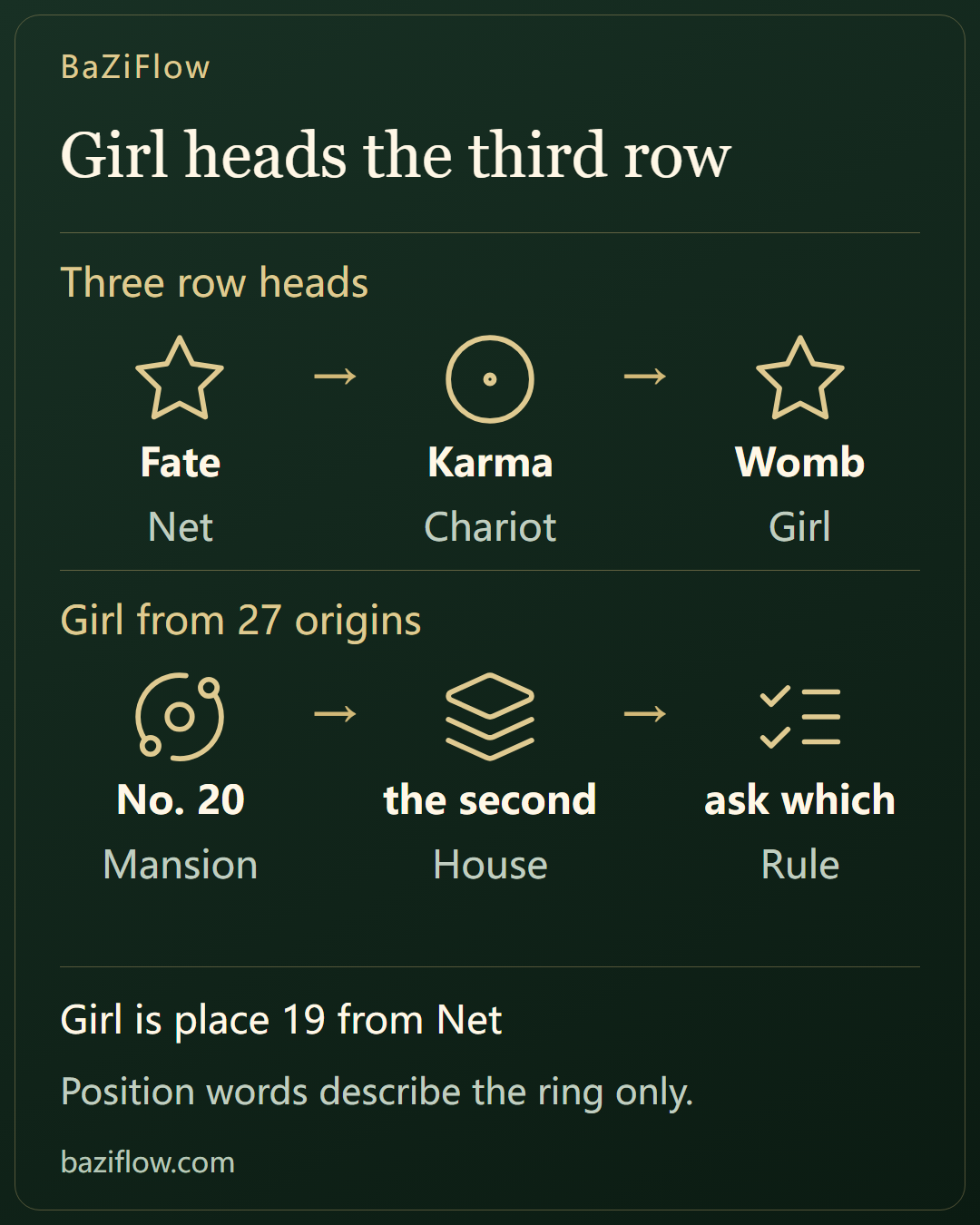
Girl is the twentieth of the twenty-seven mansions and, in the annotator's three-nine example, the head of the third row, Womb. See the two Girls in the book, what each origin calls Girl, and the Girl days of month 6.
The short version6 min read
Girl is the twentieth of the twenty-seven mansions, counted from Hairy Head. In the annotator's three-nine example, with Net as Fate, Chariot heads the second row as Karma and Girl heads the third as Womb, the three heads nine places apart.
- In the example Net is Fate, Chariot Karma and Girl Womb, nine places apart; nine places on from Girl is Net again, so the twenty-seven fall into three rows.
- The book has two "Girls": the mansion, No. 20, inside the Makara house, and the second house, called Girl, made of feet from Wings, Chariot and Horn. Ask which one a passage means.
- Taking each of the twenty-seven mansions as origin to look at Girl, the words repeat every nine; only the second cell changes, Womb, Karma, Fate. Day 15 of month 6 in the Japanese old calendar (new moon fixed by Tokyo time) is Girl, which is the Girl month.
Read first
What is Sukuyō astrology? How a birth mansion is found ↗
Sukuyō 27 mansions vs the 28 lunar mansions: what is the difference? ↗
Net, Chariot and Girl: three row heads nine places apart
The annotator gives the three-nine method a worked example: a person born on day 5 of month 2 belongs to Net (毕), and Net is the first place, Fate (命). Counting on from Net, the tenth place is Chariot (轸) and the nineteenth is Girl (女); they head the three rows, called Fate, Karma (業) and Womb (胎). The rule itself is stated plainly:
The nineteenth mansion on is the head of the third nine and is the Womb mansion.
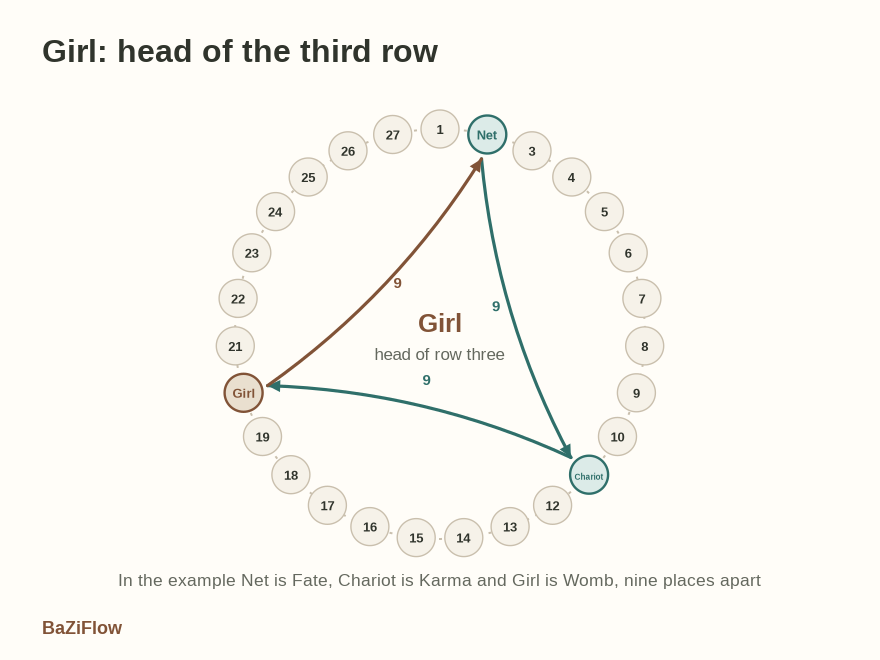
Position sketch: the twenty-seven names are spaced evenly in their order, with Hairy Head as No. 1; each arc labeled 9 spans nine places, and even spacing is typography, not sky width.
In the picture Girl is gold, Net and Chariot are green, and each of the three arcs spans nine places: Net to Chariot is 9, Chariot to Girl is 9, and nine more from Girl lead back to Net. The twenty-seven mansions divide in this way into three rows of nine whose heads are Fate, Karma and Womb in turn.
The two "Girls" in the book: a mansion and a house
Reading "Girl" in the Sukuyō Sutra, you cannot assume it means the mansion. The opening divides the sky into twelve houses, and the second one is itself called the Girl house (the same character, 女, as the mansion):
The second house takes three feet of Wings, four of Chariot and two of Horn. Mercury has its seat there, and the deity looks like a maiden, which gives the house its name, Girl.
Enlarge diagram · scroll sideways to read
No foot of the Girl mansion lies in the Girl house: all four of its feet are in another house. When you meet "Girl", ask whether it stands in a list of mansions or a list of houses.
The picture of Girl: three stars shaped "like a li-ge"
Girl's picture starts, like the rest, with star count and form; deity and clan name come after:
Girl has three stars, shaped like a li-ge (梨格). Its deity is Pi-sou-huan (毗薮幻). Its clan name is Mu-jie-lian-ye-na (目揭连耶那).
What the Girl picture says, item by item
Three in the picture, four in the note
The annotator's note says Chinese astronomy gives Girl four stars, one more than the picture.
Like a li-ge
The electronic text has just these two characters; the book does not explain them and no other picture uses the phrase. They are copied as written, meaning unknown.
Pi-sou-huan
A transcribed Sanskrit deity name, with no further explanation in the book.
A mansion of the north
Girl belongs with Dipper, Ox, Emptiness, Rooftop, Encampment and Wall in the northern group the notes mark.
Girl seen from twenty-seven origins: it repeats every nine
Seen from Net, Girl was Womb. Let each of the twenty-seven mansions in turn be the origin and ask what word it gives Girl. The table sets the twenty-seven origins in three rows of nine; each cell holds an origin and the word it gives Girl:
Enlarge diagram · scroll sideways to read
The three rows follow one rhythm, and only the second place differs: in the first Net sees Girl as Womb, in the second Chariot sees Girl as Karma, and in the third Girl sees itself as Fate. The heads of the three-nine rows come round every nine places, and so does every position word, which means that from twenty-seven origins Girl is read in only nine ways. They are set out by offset on the page about the six relationship types and, read from the other side, form the pairs Prosper with Kin, Decline with Friend, Ease with Break and Peril with Attain, with Fate, Karma and Womb for the first cell.
The Girl month: the fifteenth of month 6
Girl also turns up among the month names: month 6 is the "Girl month", glossed in the note as the Tang sixth month. On the site table month 6 opens at Ghost (No. 6), and day 15 lies fourteen steps on, at No. 20, which is Girl:
Enlarge diagram · scroll sideways to read
Girl days then recur about every 27 days: 24 August, 19 September, 17 October, 13 November and 10 December 2026, then 6 January and 3 February 2027; counted by old-calendar day number, each month’s Girl day falls two or three days earlier. On the ring, Dipper stands right before Girl and Emptiness right after it.
Questions readers ask next
Are the Girl mansion and the Girl house the same thing?
No. The mansion is No. 20 of the twenty-seven and holds four feet of the Makara house; the Girl house is the second of the twelve houses in fascicle 1, made of feet from Wings, Chariot and Horn, with a deity shaped like a maiden. They share a character and nothing else. When you meet "Girl", check whether it stands in a list of mansions or a list of houses.
Why is Girl "Womb" in the three-nine passage?
Because the annotator's example takes Net as the Fate mansion: Fate is place 1, Karma place 10 and Womb place 19, and Girl is exactly place 19 counting from Net. Pick a different Fate mansion and the place goes to a different mansion, with Girl taking a different word.
What shape is "like a li-ge"?
The electronic text has only those two characters, the book does not explain them, and no other picture uses the phrase. It is safer to copy the characters and note that the meaning is unknown than to guess an explanation.
Was this article helpful?
Sources & references
- Taishō T1299, Sukuyō Sutra (CBETA 2023.Q4): the three-nine passage and example, the house table, mansion pictures, month names ↗
- Wikisource: Sukuyō Sutra (Wenshushili pusa ji zhu xian suo shuo jixiong shiri shan e xiuyao jing) ↗
- National Astronomical Observatory of Japan: 28/27 mansions, calendar assignment table ↗
Continue reading
Dipper (斗), Mansion No. 19: Ox or Girl Next, and Where the Sutra Counts 28 or 27 ↗
Emptiness (虚), Mansion No. 21: A Shared Month Start and a Mansion Cut in Half ↗