

Born on a sign boundary
Content version · · Sources & references
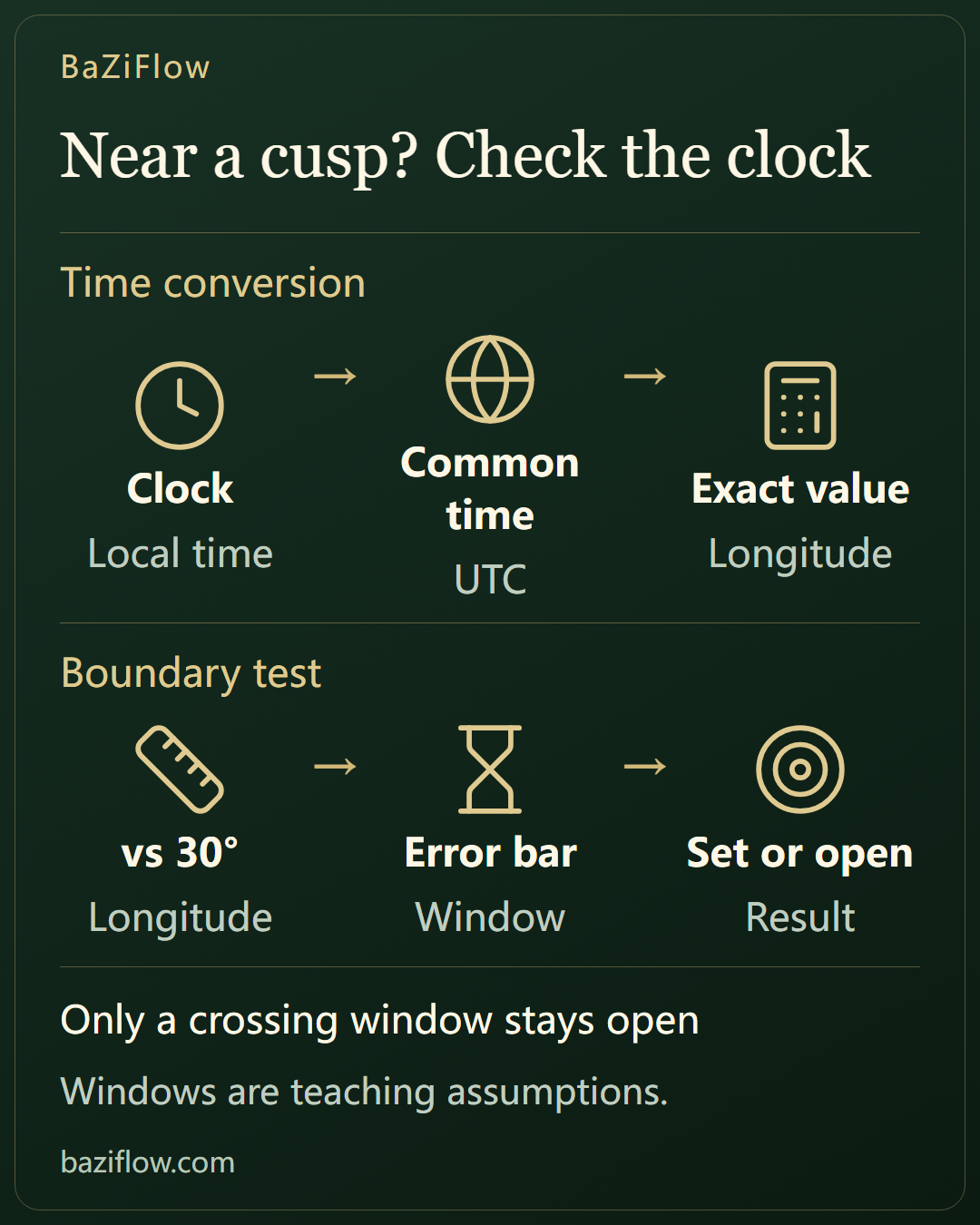
Two websites can give two signs for a birthday near a sign change. Convert the local clock time to UTC, judge the boundary with full precision, then record a time window as earlier sign, later sign or unresolved.
The short version5 min read
The Sun crosses a sign boundary at a specific moment, not on a date. Turn the clock reading into a common time, then see whether the error window crosses the boundary.
- Birthday tables bucket by date and leave out the year and the time; near a boundary, the answer depends on that year's moment at that place.
- Local clock time must become UTC first: 00:30 at UTC+8 is 16:30 on the previous day, so the date changes too.
- A longitude of 29.9996° displayed as 30.000° is still before the boundary. A window wholly on one side settles it; only a straddling window is unresolved.
Read first
Sun, Moon and Rising: Two Luminaries and One Intersection ↗
Birth Time and Place: From the Clock Record to the Local Sky ↗
One birthday, two signs: why the answers differ
A friend's birthday falls in the days around a sign change, and two websites give two signs. Before arguing, three questions decide the answer: is it the Sun sign you are checking, which year was the birth, and what did the local clock read?
The Sun crosses a sign boundary at one instant. It does not flip everywhere at once like a page on every local calendar. A birthday list says "from this date to that date" and omits the year, the clock time and the time standard, so at the edge both answers can be "found".
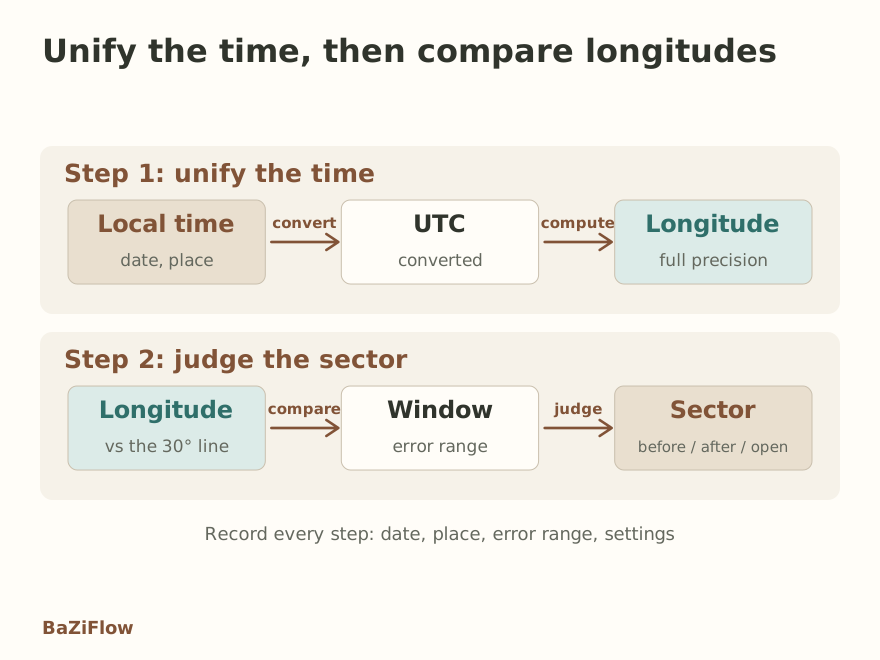
Decision flow: unify the time first, then compare longitudes. Windows and ingress are structural examples, not birth data.
Read the figure from left to right: the local time, with its date and place, becomes UTC; then the Sun's longitude is calculated; finally it is compared with the boundary. Every step needs a record.
Three questions first
Which object
Here only the Sun's sector is in question.
Which year
The moment of the ingress differs every year.
Which clock reading
Record it with the date, place and source.
Putting the clock reading on one timeline
A usable record has a date, a local clock time, a place, a source and an error range. The place helps you find the time zone and daylight-saving rules that applied then.
Enlarge diagram · scroll sideways to read
NIST's explanation of US daylight saving shows two oddities of the clock: in spring an hour is skipped, in autumn an hour repeats. A repeated local time needs extra information to say which instant is meant.
Five fields to write down
Date
With the year, not only month and day.
Local time
The original reading, not rounded first.
Place
Used to find that year's zone rules.
Source
Certificate, record or recollection.
Error range
"Around that hour" becomes a window.
A boundary is a number, not a date
In an equal-sign zodiac each sector spans 30°. Between Aries and Taurus, a longitude just below 30° is still in the earlier sector, and 30° belongs to the next. A convention that includes the start and excludes the end ensures no position is counted in two sectors.
Enlarge diagram · scroll sideways to read
A screenshot showing only whole degrees cannot be used to recheck a boundary. Judge with internal precision; the display is only a display.
Three time windows, three conclusions
Let an invented ingress be minute zero and look only at which side each input window falls on. All three windows below are made up; none is anyone's birth record.
Enlarge diagram · scroll sideways to read
All three inputs are imprecise, yet only B is stopped by this boundary. That prevents two opposite errors: saying "everything is unknowable" as soon as there is an error bar, or silently taking the window's midpoint. The exercise assumes one crossing within a short window; a real calculation checks the ephemeris for that year.
Writing the result so it can be rechecked
"I feel more like the other sign" cannot supply a missing timestamp, and a personality quiz cannot turn an inferred birth time into an original record.
Enlarge diagram · scroll sideways to read
Save the raw input
Date, local time, place and source, none omitted.
Save conversion and settings
Zone basis, UTC result, zodiac setting, ephemeris version.
State the grade of the conclusion
Earlier sector, later sector, or "not yet determinable".
Keep the information this uncertainty does not touch, but do not assume every other field is stable. Why birth time and place matter shows how other chart fields respond.
Questions readers ask next
Why do different websites give different signs for a birthday near a sign change?
A short list says "from this date to that date" and drops the year and the clock time. The Sun changes sign at one moment in one particular year, so for days at the edge both answers can be found.
If I only know the birth time roughly, is it impossible to decide?
Not necessarily. Write the rough time as a window. If the whole window lies before or after the ingress the answer is settled; only a window that straddles it has to be recorded as undetermined for now.
Is local time minus the time difference equal to UTC?
The hours are subtracted, but the date may step back or forward as well. You also need the time-zone and daylight-saving rules in force at that place in that year; today's offset cannot be applied to the past.
Was this article helpful?
Sources & references
Continue reading
Tropical and Sidereal Zodiacs: Two Readings of One Direction ↗