

Build Emolument: the month branch on the Day Master's seat
Content version · · Sources & references
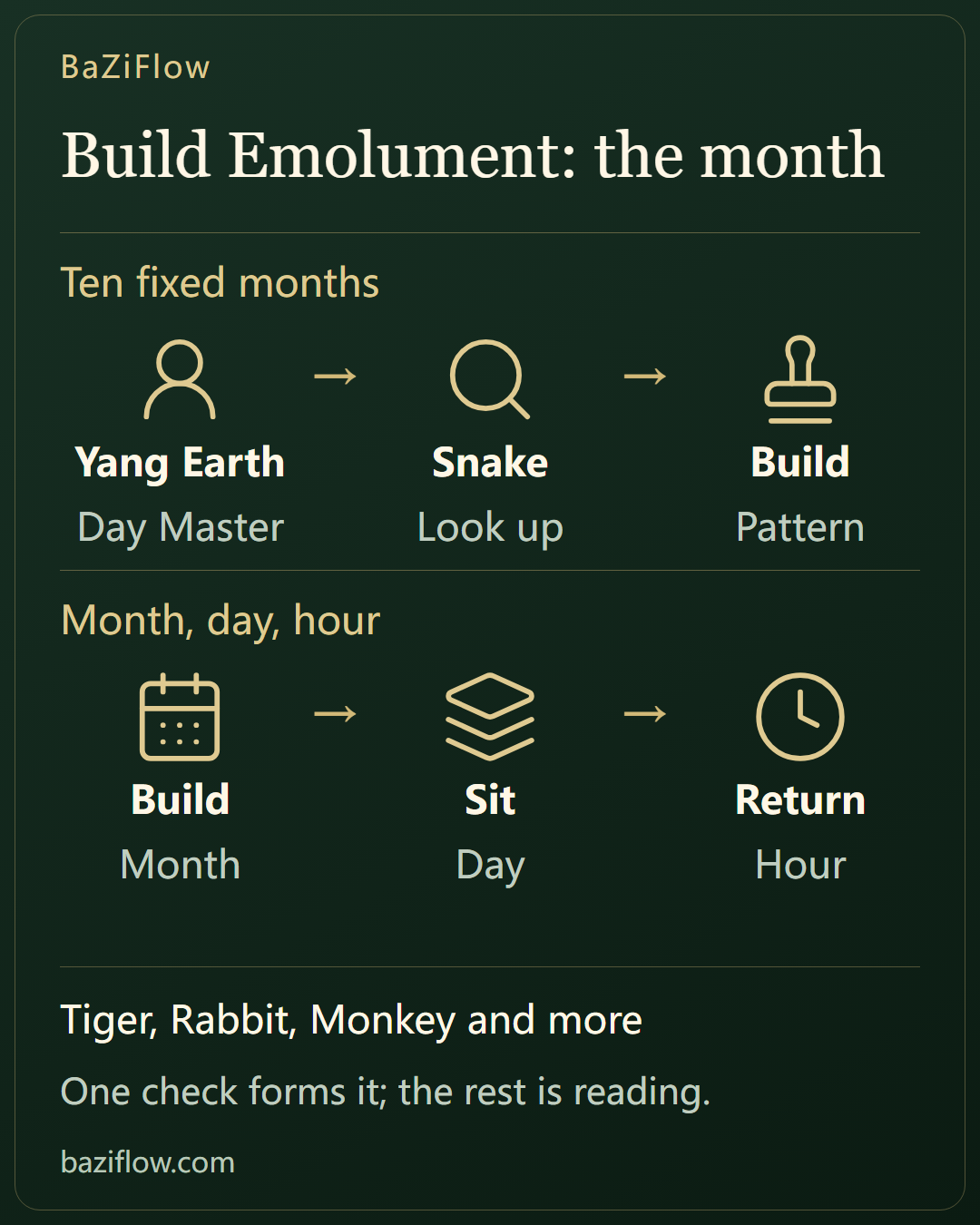
The Build Emolument pattern means the month branch is the Day Master's emolument seat, ten fixed pairs from Yang Wood in a Tiger month to Yin Water in a Rat month. One site check; the old books add what breaks it.
The short version9 min read
The Build Emolument pattern is the case where the month branch is exactly the Day Master's emolument seat, ten pairs in all; it only says the Day Master is deeply rooted in the month, and the reading depends on how Officer, Wealth and Resource show up.
- The site judges this pattern from one place only, the month branch. For eight of the ten Day Masters the main hidden stem of that month is a Companion; Yang Earth in a Snake month and Yin Earth in a Horse month come from the Twelve Stages table instead.
- The books split one word, emolument, by where it lands: the month, the day or the hour, and each has its own name and its own reading.
- The old books treat the pattern as a strong starting point where Officer, Wealth and Resource are all usable, and treat heavy Companion or Blade stars as the side that robs Wealth, shares Officer and takes Resource.
Read first
BaZi patterns explained: how formation, disruption and assistance work ↗
Start with a table: each Day Master has one month
The definition is short. The Build Emolument pattern (建禄格) is the case where the month branch is exactly the Day Master's emolument seat, which is the Establishment stage in the Twelve Stages (临官 / 建禄). No other pillar is needed; one look-up decides it.
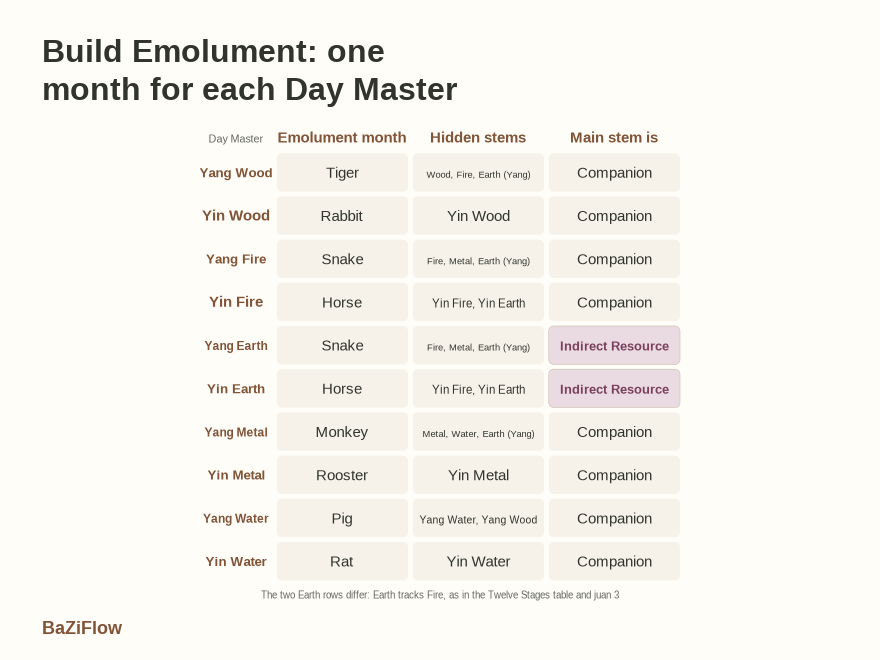
The ten fixed months: month branch, hidden stems and the ten-god of the main stem, from the site's Twelve Stages and hidden stem tables; the two Earth rows use the accent color.
Read the figure one row at a time. The Tiger month belongs to Yang Wood and the Rabbit month to its yin partner; the Snake and Horse months go to the two Fire stems, with the two Earth stems following them there; the Monkey and Rooster months go to the Metal pair, and the Pig and Rat months to the Water pair. The two stems of one element take neighboring branches, so the ten pairs run through eight branches in a fixed order: Tiger and Rabbit first, then Snake and Horse shared by Fire and Earth, then Monkey and Rooster, then Pig and Rat.
One word, three places: month, day and hour
The Sanming Tonghui (三命通会), juan 11, explains the line "meeting Wealth, Officer or Resource with Build, Sit or Return Emolument" by first sorting out the three names:
Build Emolument speaks of the month, Sit Emolument of the day, Return Emolument of the hour.
All three use the same table; only the landing place differs. On the month branch it is Build Emolument, and the pattern name follows. On the day branch it is Sit Emolument, and among the sixty pillars only four day pillars qualify: Yang Wood Tiger, Yin Wood Rabbit, Yang Metal Monkey and Yin Metal Rooster (pillars such as Yang Fire Snake cannot exist, because a yang stem only pairs with a yang branch). On the hour branch it is Return Emolument.
Enlarge diagram · scroll sideways to read
For Return Emolument the book adds a rule of its own. It says this pattern "only likes the hour", and if the same seat shows again on the month branch the name turns into Build Emolument and the book calls that "not wealthy". A seat that appears one more time is not counted as a bonus; the book counts it as another pattern.
Strong first, then ask whether Officer, Wealth and Resource can be used
The book reads this pattern by starting from a strong Day Master. Its one-line summary in juan 11 is:
Build Emolument meeting Officer is honor, meeting Wealth is riches, meeting Resource is refinement.
The commentary explains that with the month on the seat the Day Master is strong, so using Officer, Resource or Wealth is all fine. If there are Rob Wealth, Blade or Companion stars, the Day Master is too strong and they rob my Wealth, share my Officer and take my Resource. Build Emolument especially likes Resource and Wealth, so meeting robbery and a broken Resource leaves the chart "lopsided and unfinished", and when Wealth and Resource both appear in a mixed way the book calls it "neither rich nor refined".
Enlarge diagram · scroll sideways to read
The same section gives a ranking: Build Emolument meeting Direct Officer comes first and Direct Wealth second, and a Build Emolument on the month is the best case, the day next and the hour after. This is the book's own order; the site does not score by it.
How the site judges: compare three charts
The site's order is this. First it looks for the strict single-element pattern (see the Bend and Straighten, Flaming Upward, Yield and Reform and Soaking Downward articles); then it asks if the month branch lands on the Day Master's seat; if the Day Master is yang and the month is its Peak, the pattern is Yang Blade. The description attached to a Build Emolument result reads: the month gives a strong root, the pattern favors Wealth and Officer stems showing among the visible stems, and is hurt when more Companion and Rob Wealth stems appear. The warning list is always empty and the quality is always pure.
Enlarge diagram · scroll sideways to read
Chart A (乙未 辛巳 戊辰 丁巳) is a Yang Earth Day Master in a Snake month, which is the seat by the Twelve Stages table; the month stem is Hurting Officer and no Companion shows. Chart B (癸巳 庚申 庚戌 辛巳) is Yang Metal in a Monkey month, and the month stem is a Companion while the hour stem is Rob Wealth. The site still names it Build Emolument without any breaking warning, because the engine has no breaking check for this pattern, not because it judged that Companions do not matter. Chart C (丁亥 己酉 壬午 辛亥) comes from the commentary on the "Build, Sit or Return Emolument" line in juan 11: the hour branch is the Pig, the seat of Yang Water, so the commentary calls it a Return Emolument chart and notes that the Rooster month gives Resource. The site only reads the month, and the Yin Metal hidden in the Rooster shows at the hour stem, so it names Direct Resource.
What breaks it in the books, and what the site does not check
The breaking factors the books mention all fall on the seat being split or pressed. The engine does not test them, so they are listed here as the books give them:
Four ailments and one remedy
Rob Wealth, Blade, Companion in excess
The commentary says the Day Master becomes too strong and robs Wealth, shares Officer and takes Resource; Build Emolument especially dislikes a robbed Wealth with a broken Resource.
Both show together
The commentary calls this a chart that "comes to nothing" and says it is neither rich nor refined, because Wealth damages Resource.
Seat in the month, then meeting Killings
The Sanming Tonghui quotes the Xiji Pian: even with the month on the seat, beware of joining Killings.
Seat falls in a void
Juan 3 says a Build Emolument in a void has a name but no fruit: study through life, nothing accomplished in old age.
Traveling Horse and Nobleman help
The second half of the same line: if the horse or the noble comes to rescue, an office may be won and then stops again; rescue is not full repair.
Three places disagree with the site's approach and are better seen together:
For how any pattern is judged to be formed or broken, see what a pattern is: formed, broken and rescued. The next neighbor of this pattern is the Month Blade, one stage further along; how Day Master strength is counted is in strong and weak Day Masters; and how the site counts the month's strength is in why the month command matters.
Questions readers ask next
Is a Build Emolument chart simply a strong Day Master?
No. On the site the pattern answers one question about the month. Strength comes from adding up roots and controls across all four pillars. The book itself calls the pattern a sturdy start and then asks how Officer, Resource and Wealth cooperate.
What if the month is on the seat but a Companion also shows in the stems?
The pattern name does not change on the site. Its judgment has no breaking check; the description says more Companion or Rob Wealth hurts it, but the warning list stays empty. The book treats heavy Companions as a flaw that needs rescue, so the two work at different levels.
How do I tell Build Emolument from Yang Blade?
They sit next to each other in the Twelve Stages: emolument is the Establishment stage and the Blade is the following Peak stage, which only the five yang stems have. Which of the two the month falls on decides the pattern name on the site; the Month Blade article has the details.
Was this article helpful?
Sources & references
Continue reading
Hurting Officer Pattern: Three Roads, and Three Tones on Meeting an Officer ↗
Month Blade (月刃格): the Blade in the Month, Called Yang Blade on This Site ↗