

Two of Cups
Content version · · Sources & references
Read reciprocal action in the RWS Two of Cups, separating affinity from agreement and noting that Waite’s main entry does not supply a separate reversed paragraph.
The short version6 min read
Two figures pledge to one another with cups. Affinity and union can be read through an exchange in which both sides participate: a meeting point forms while two vessels remain distinct. Shared interest can become a small agreement without demanding complete sameness.
- Waite includes love, friendship, affinity and union, with the reciprocal cup gesture providing a concrete clue to mutuality.
- An intersection can be small: choosing pictures together does not agree to co-author every word or publish everything.
- The cited main entry has no separate reversed paragraph; distinguish the supplement’s passion from later imbalance conventions.
Read first
Waite describes a reciprocal action
On the RWS card, a maiden in a laurel wreath and a youth in a wreath of red flowers face each other, each holding a cup. Between the cups stands a staff entwined with two snakes, topped by a pair of wings with a lion’s head between them; a small hill with a red-roofed house lies in the distance.
The RWS entry presents two figures pledging to one another with cups. Above them Waite describes the caduceus of Hermes, with a lion’s head between wings, noting a relationship to symbols in earlier examples. He does not develop every possible emblematic interpretation in that passage.
His list includes affection and friendship as well as union and harmony, within the gendered and religious language of the text. The lesson here uses the mutual action without restricting real relationships to the sex pairing in the historical description.
Nor does the fact that two figures face each other establish a real person’s answer. The reader’s feeling supplies information about the reader’s side. Another party’s wishes require that party’s own communication and behavior in context.
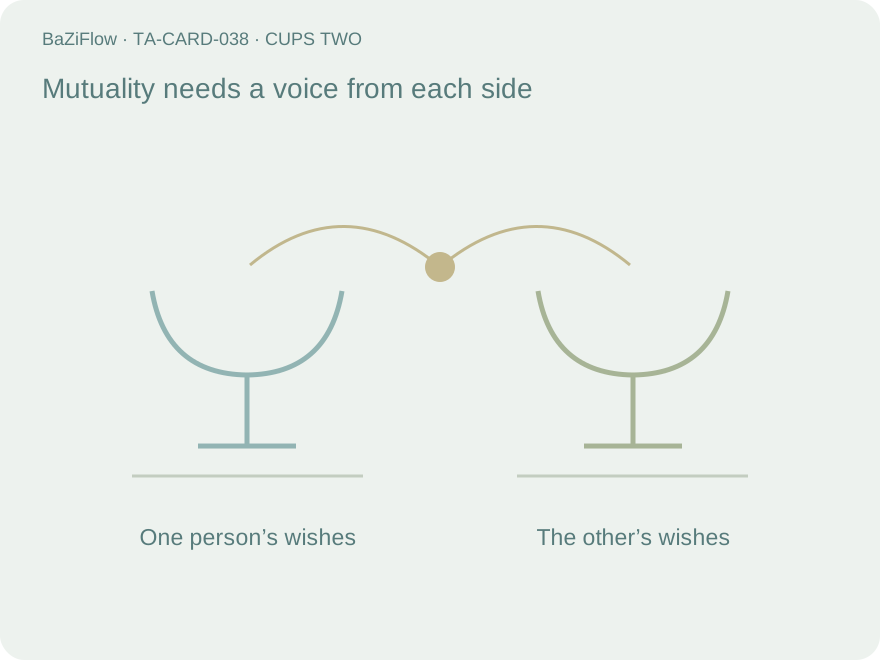
An original BaZiFlow mutuality diagram for the Two of Cups; reciprocal lines require both parties’ expression and do not certify romance, marriage or hidden feelings.
The positive upright theme is more than avoiding misunderstanding: it includes enjoyment in closeness, willingly attending to another person and finding something to undertake together. Two cup-bearers, rather than one vessel receiving everything, make mutual action central. The teaching diagram preserves two cups and two baselines to show that the people participating in agreement do not disappear into it.
Agreement is more specific than affinity
Two friends leave an exhibition wanting to preserve the experience. One imagines a brief photo record; the other wants a long critical essay. Their shared interest is real. Their plan is not yet shared in the same detail.
The Two of Cups can prompt a conversation about that distinction. What does each person want to contribute? What would be public? Which choices need both people’s agreement? A sense of connection should not silently answer those questions for them.
This example is a contemporary application, not a claim that the card measures compatibility. The image cannot establish another person’s romantic feelings or turn a reader’s certainty into the other person’s consent.
The friends might each select two photographs and jointly write short captions, while the longer essay remains an individual project. That arrangement does not mean they failed to connect. It gives their different interests a workable form.
| Shared point | Detail each person still needs to express |
|---|---|
| Both valued the visit | Which works or moments mattered to each? |
| Both want to make a record | Who wants to write, select images or simply comment? |
| Both may share it | Where, with whom and after what review? |
If one person only wishes to choose images, do not treat a shared enthusiasm as agreement to co-author all the text. If the date must change, tell the other person and revise the arrangement together. Reliability is not the absence of every change; it includes how changes are communicated and accepted.
These same distinctions matter when the subject is a relationship. A question can be asked directly, but drawing the card is not a reason to demand a particular answer. Hesitation, refusal or a different expectation must remain part of the evidence rather than being interpreted away as secret affection.
A wants
- A brief photo record
Both agree
- Two images each and shared captions
B separately
- An individual long essay
Two vessels do not have to become one
The diagram’s arcs meet, but each cup keeps a separate baseline. It represents a possible intersection of wishes rather than a demand that two people become identical. It supplies no relationship score and no requirement that both feel with equal intensity at every moment.
For the exhibition record, the intersection may be no larger than a short shared set of captions. That is still a concrete agreement. A larger collaboration could follow later if both want it, but it should not be built into the original yes without discussion.
Compare the Ace of Cups, where a felt opening and its expression are separated. The Two makes reciprocity more directly visible. A powerful beginning for one person is not automatically a jointly confirmed relationship.
Matter
Work
- Agreed here
- Short photo record
- Not included automatically
- Co-authored essay
Audience
- Agreed here
- Three friends first
- Not included automatically
- Public release
Revision
- Agreed here
- Review captions together
- Not included automatically
- Change the other person’s credit or view
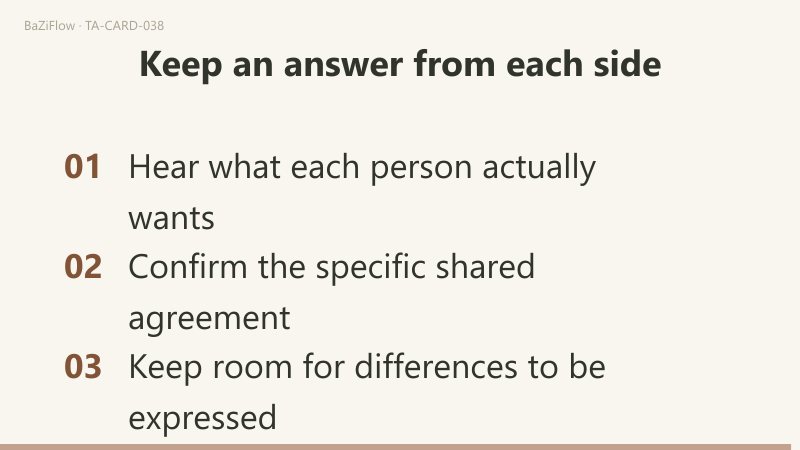
Name the content each wants
Let both observations appear before one person summarizes a shared account.
Find the part both will make
Here it is the short record and captions, with the individual essay kept separate.
Agree the audience
Showing three friends first differs from publishing openly.
There is no separate reversal in this main entry
The cited Two of Cups passage ends without a dedicated reversed interpretation. Waite’s supplementary chapter supplies additional assignments, including a brief reversed association with passion. A teacher should not invent a missing paragraph and attribute a modern reversal convention to the main entry.
You may choose a contemporary approach that examines imbalance, separation or difficulty communicating. The important point is to name that approach rather than claim the cited passage says something it does not. Absence of a reversed paragraph also does not prove that reversal has no possible use in any later system.
The supplementary chapter acknowledges inconsistency among additional meanings and their limited connection to the pictures. An upright and reversed method might ask whether both parties can state their wishes. That is a question to investigate, not a finding that orientation alone delivers.
For the two friends, preserve what each has actually said, the small scope both accepted and the differences still open. Mutuality is not achieved by speaking for the other person. It becomes visible when both contributions and both limits can be heard.
Main entry
- Mutual cups and affinity
- No separate reversal paragraph
Supplement
- Reversal: passion
- Cite separately from the main entry
Modern method
- May ask about communication or imbalance
- Name the chosen approach
Questions readers ask next
Does the Two of Cups only mean romance or marriage?
No. Waite’s list also includes friendship, affinity and concord, so mutuality can inform cooperation or friendly exchange. Two pictured figures do not establish a real romantic commitment. Actual communication determines the particular scope of the relationship.
Can the Two describe connection when people disagree?
Yes. Choosing pictures together while writing separate essays may suit both people. Reciprocity does not demand identical interests or expression. The shared portion needs both people’s agreement, while differences can remain visible.
Did Waite give separation or failed communication as the reversal?
The cited main entry has no dedicated reversed paragraph. The supplementary chapter lists passion, while later approaches may discuss imbalance or separation. Those methods can be named explicitly without inserting their wording into Waite’s main entry.
Was this article helpful?
Sources & references
Continue reading
Ace of Cups: an opening of feeling is not a promised relationship ↗