

Agreement is not proof
Content version · · Sources & references
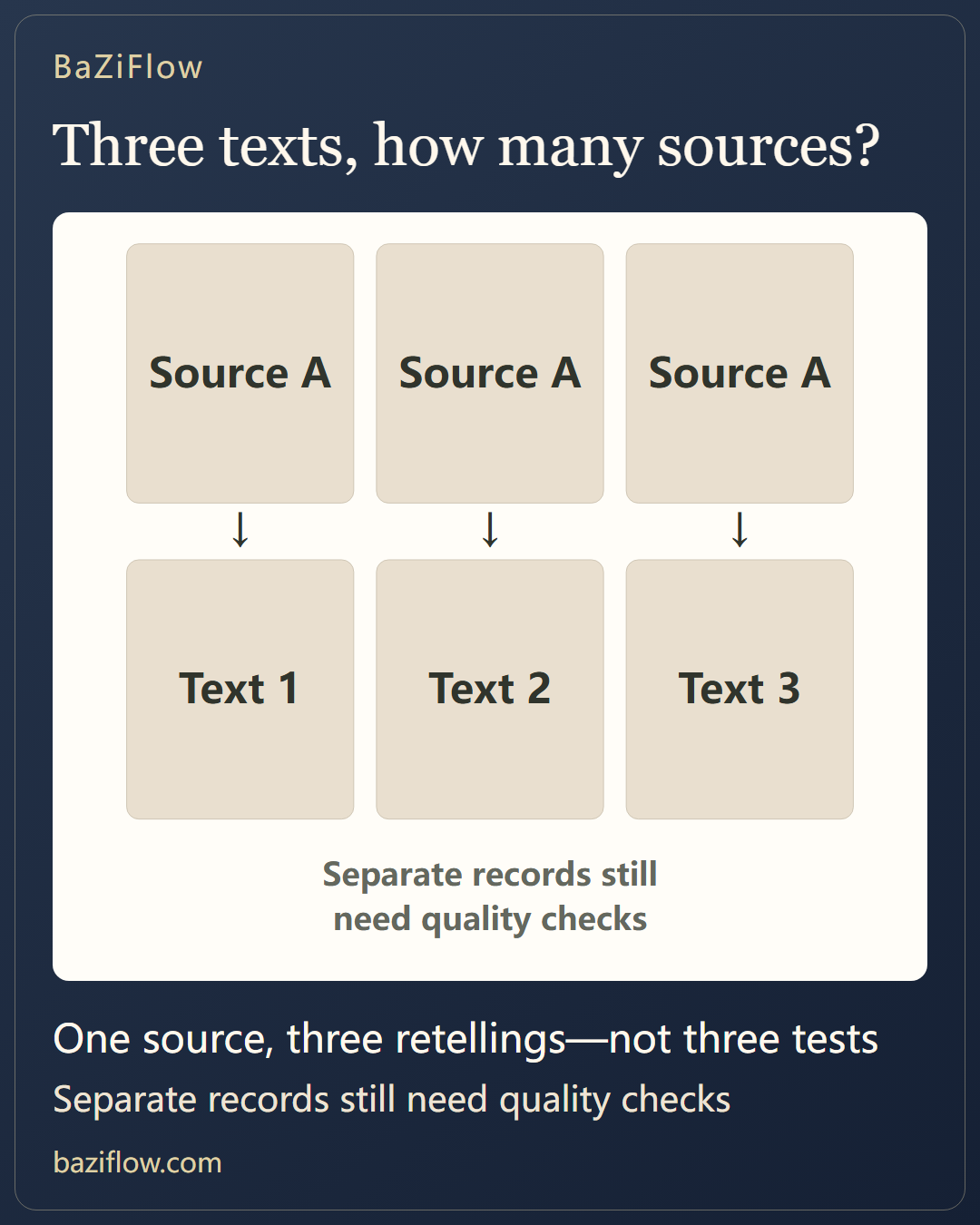
Distinguish repeated wording, input-specific explanation and outcome validation. Trace shared sources and define the claim before treating several agreeing readings as evidence.
The short version5 min read
Three tools recommending gradual accumulation first establish similar wording. If they retell one source, the number of observations has not tripled. Even independent records need a defined claim and a quality check.
- Shared records, shared rules and shared templates are different dependencies.
- Correctly citing an input field does not establish a claim about a future event.
- Compare complete outputs for contrasting inputs and trace substantive differences, rather than changing synonyms or forcing disagreement.
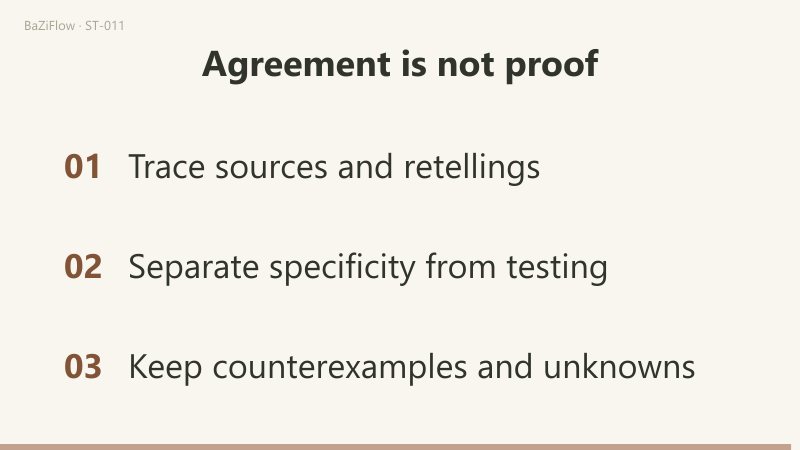
Read first
Decide what you are testing before collecting more answers
There are at least three different questions a reader might ask. Do these texts resemble one another? Does each explanation depend on its own input? Do their claims about the world hold up under a suitable test? The first can be investigated by comparing language. The second requires tracing fields into reasons. The third needs an outcome definition and a study design. Success on one does not automatically answer the others.
For a small editorial exercise, keep several structurally different teaching inputs and their complete outputs. Define the comparison before selecting attractive quotations. Look for important claims tied to current fields, advice that never changes, and conclusions whose subject or timing is unclear. This can expose weak personalisation without pretending to establish predictive validity.
| Question being investigated | Relevant evidence | Unwarranted shortcut |
|---|---|---|
| Are the texts similar? | Sentences and argument structure | Similarity proves the conclusion |
| Are they input-specific? | Field-to-claim links and contrasting inputs | Specificity proves a future event |
| Are predictions supported? | Defined outcomes and an appropriate comparison | A few remembered matches give an accuracy rate |
Similar wording
- Evidence required
- Complete text comparison
Input-specific claim
- Evidence required
- Trace fields into reasons
Outcome support
- Evidence required
- Defined test and observations
Trace provenance before counting evidence
- Shared input
- Several outputs use one underlying record.
- Shared rule
- Several authors rely on the same interpretive table.
- Shared expression
- One passage is reused under different names.
Follow a repeated claim upstream
Imagine three tools advising gradual accumulation. Before calling that three confirmations, identify the origin of each statement. The tools may share a birth record, an interpretation table, an author or a writing template. These are different kinds of dependency, but a different logo or tradition label establishes none of them as independent.
A shared input does not make every result wrong. Different rules can use the same record in different ways. The narrower point is that output count is not automatically evidence count. A mistaken input may affect several outputs together, while shared wording may indicate only that a template is being reused.
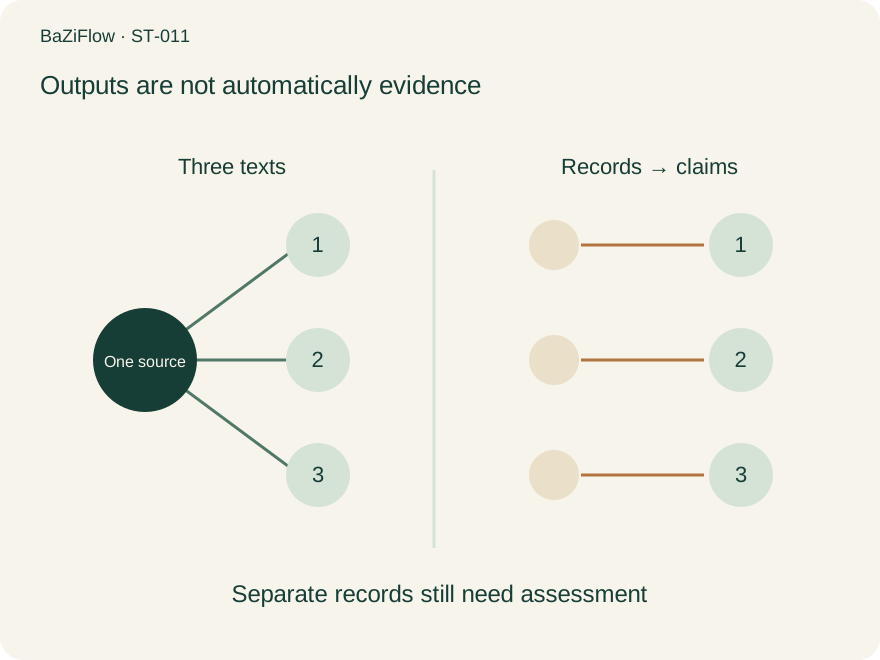
Original BaZiFlow provenance diagram. Separate observations still need assessment; no predictive system is marked as validated.
The left-hand structure has one source feeding three texts. The right-hand structure keeps separate observations visible. Even the right-hand drawing does not certify a claim: the quality of those observations, their selection and the assessment rule remain open questions. The diagram is a map of provenance, not a numerical reliability model.
Make the shared proposition narrow enough to disagree with
Words such as change, pressure or responsibility can cover many different experiences. Agreement on one of those words is difficult to evaluate until the object, time range and limits are specified. What would not fit the statement? If the answer is unclear, the agreement may be broad rather than informative.
This does not invalidate a reader's feeling of recognition. Recognition is an experience worth describing in its own terms. The problem arises when that experience is silently promoted into an independent test of a forecast. Keep those claims separate rather than dismissing the experience or inflating its evidential role.
Input-specific writing also needs more than name substitution. If changing the structure of the input leaves the same reasoning order, advice and substantive conclusions, synonym changes do not create individuality. Conversely, genuinely shared facts may justify some common explanation. Forcing every result to say something different would introduce arbitrary variation, not better evidence.
Broad word
- Change
- Object and period missing
Defined claim
- Named object and period
- States what would not fit
Understand what a formal claim would require
The NIST handbook's discussion of quantitative techniques places formal testing within a framework of specified hypotheses, data and uncertainty. Its section on exploratory-data-analysis assumptions emphasises that measurement processes have underlying conditions to examine. These references support methodological caution. They do not transform a few symbolic readings into a statistical study.
To make a claim about predictive performance, the outcome rule, comparison basis and observation range would need to be set in advance, with attention to selection effects and dependencies. A private notebook of memorable matches usually does not meet those conditions. Do not manufacture an accuracy percentage from it or describe three agreeing outputs as three times the confidence.
An appropriate evaluation can also distinguish a specific but unsupported prediction from a vague statement that is easy to endorse. Merely making a statement more detailed does not make it true. A careful author must retain both questions: where did the statement come from, and what evidence supports its claim beyond the symbolic framework?
Current-field citation
- What it cannot establish alone
- A future outcome
Several remembered matches
- What it cannot establish alone
- An accuracy percentage
Detailed prediction
- What it cannot establish alone
- That the prediction is true
Keep a modest, complete record
For ordinary learning, record the original text and input, the interpretation date and any observation period. Preserve non-matches, unresolved outcomes and changed conditions alongside matches. This reduces the risk that only memorable coincidences survive in the record, while still leaving the limitations of a small personal exercise visible.
Useful labels include similar terminology, shared source, input-specific rationale, independence unknown and outcome unobserved. They are more informative than a universal confirmed label. If a counterexample appears, update the relevant claim rather than rewriting the record so that agreement seems to have existed all along.
Disagreement has its own diagnostic task; locating conflicting conclusions explains that process. For agreement, the central question remains what additional information each path contributes. Evidence-based personal readings turns that question toward the link between a particular input and its particular explanation.
Similar terminology
- State to preserve
- Wording resemblance
Same upstream table
- State to preserve
- Shared source
No outcome observed
- State to preserve
- Awaiting observation
Draw one source and three branches
Connect source A to text 1, text 2 and text 3, retaining them as three retellings.
Check what a fourth text adds
If it cites text 2, it adds a retelling node rather than a new observation source.
Keep a new observation separate
Record how observation B was obtained and assessed. Independence does not automatically validate its quality or the whole claim.
Questions readers ask next
Are three outputs using one input necessarily wrong?
No. Different rules can use one record. The issue is counting outputs as independent evidence without tracing their dependencies.
Does input-specific writing validate a forecast?
No. Field citation and relevant reasoning are writing qualities; outcome claims require predefined criteria and appropriate observations.
Must every output be completely different?
No. Shared definitions and supported common facts can recur. Individual claims need their own grounds, not random wording or forced disagreement.
Was this article helpful?