

Po Sui: where the three landings come from
Content version · · Sources & references
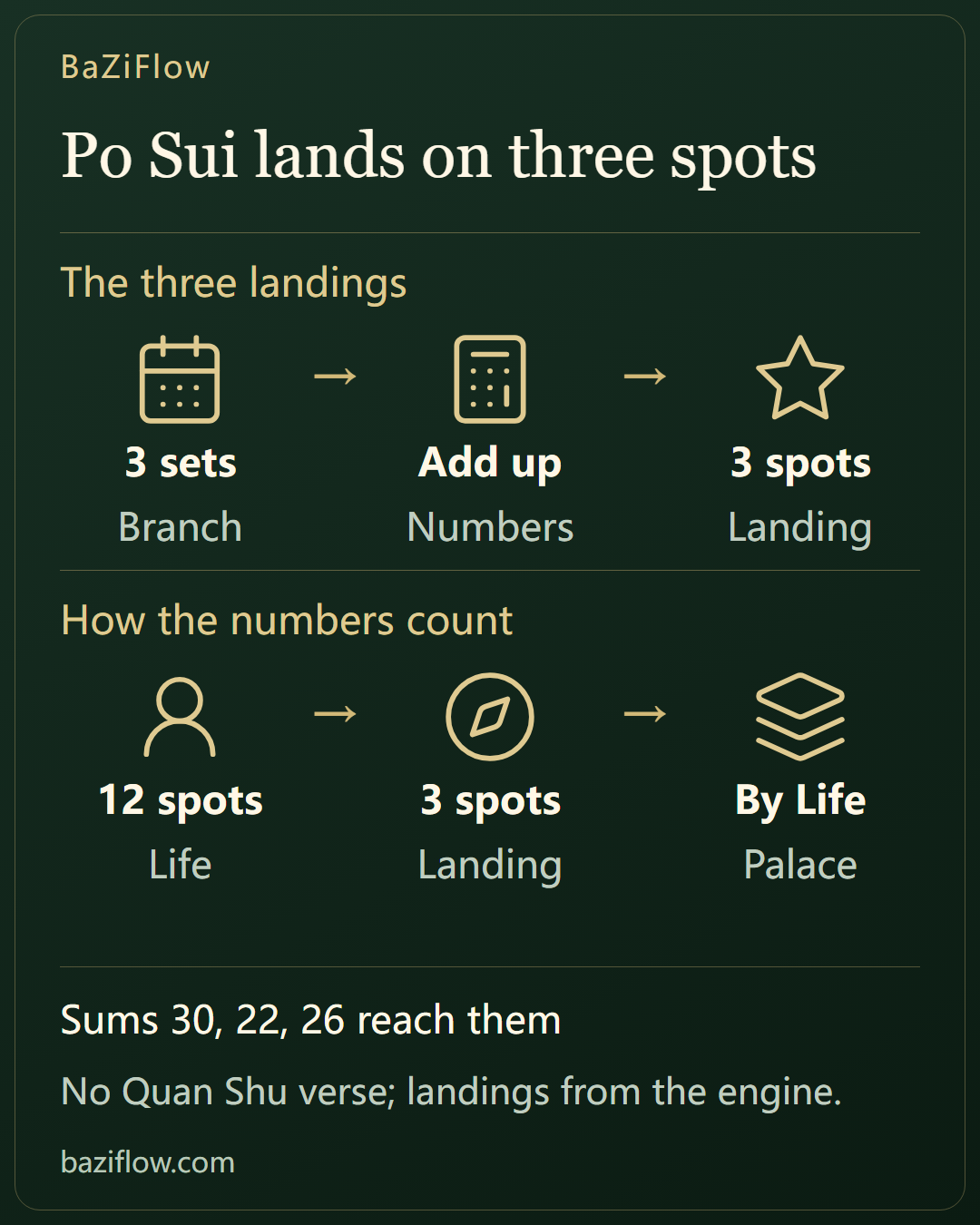
Po Sui lands on Snake, Ox or Rooster by year branch. The Sanming Tonghui pre-heaven numbers, the Metal stages, and a twelve-row palace table separate its placement from the same name used elsewhere.
The short version7 min read
Po Sui is a minor star set by the birth-year branch: whatever the year, it lands on Snake, Ox or Rooster, and the Sanming Tonghui counted out the same three places from a set of pre-heaven numbers.
- The twelve year branches fall into three groups of four, landing on Snake, Ox and Rooster in turn; the three places lie four steps apart and form a trine.
- Juan 3 gives each branch a number; the group sums 30, 22 and 26 counted from Rat stop on Snake, Rooster and Ox, matching the engine branch for branch.
- The book ties the three places to Metal at Growth, Peak and Storage and names each; the minor star uses one name for all three, and the Quan Shu texts at hand give no placing verse for it.
Read first
What do Zi Wei's supporting, malefic and minor stars actually do? ↗
Twelve year branches, only three landings
Po Sui (破碎) is a minor star set by the birth-year branch, and whatever year you were born in it can only land on Snake, Ox or Rooster. Four year branches share each landing.
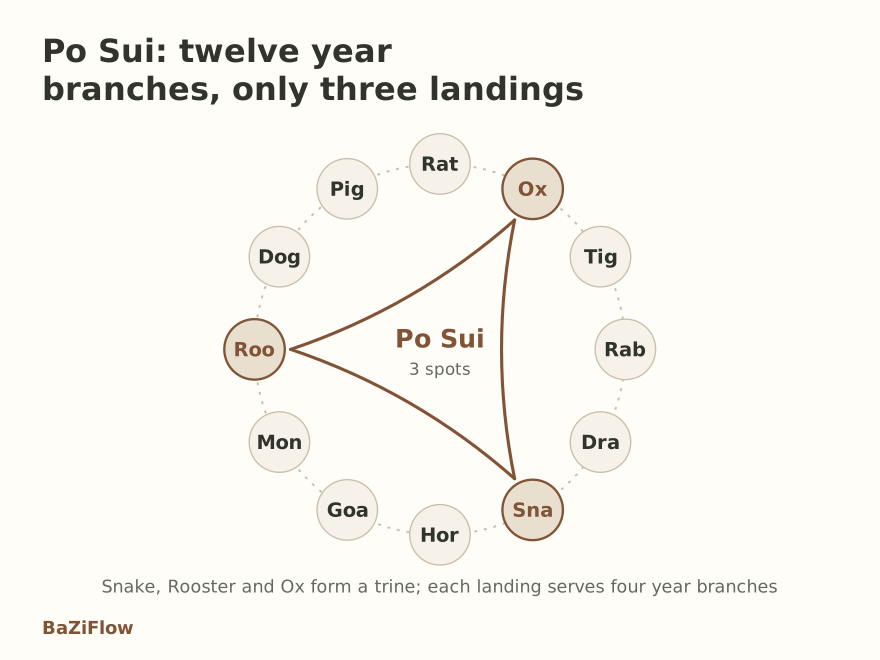
Landings come from the site engine (iztro 2.6.0, default settings); the triangle joins Snake, Rooster and Ox, which stand in trine.
The groups run like this. Birth-year branches Rat, Horse, Rabbit and Rooster put it on Snake; Dragon, Dog, Ox and Goat put it on Ox; Tiger, Monkey, Snake and Pig put it on Rooster. In the picture the three spots join into a triangle, each four steps from the next, which is the trine of the branches (Snake-Rooster-Ox, the Metal group). So wherever it lands, the other two spots are exactly the trine palaces of its own palace.
How the Sanming Tonghui counts the three places
Po Sui is not a name only Zi Wei Dou Shu uses. Juan 3 of the Sanming Tonghui (三命通会), in its section on the "sha of concealed metal", carries the same placement rule:
Rat, Horse, Rabbit and Rooster fall on Snake; Tiger, Monkey, Snake and Pig on Rooster; Dragon, Dog, Ox and Goat on Ox.
The book also says how the rule is counted out, calling the three places "the four clashes of the pre-heaven numbers". It gives each branch a number: Rat and Horse nine each, Rabbit and Rooster six each, Tiger and Monkey seven each, Snake and Pig four each, Dragon and Dog five each, Ox and Goat eight each. Add up the four branches of a group, then count from Rat, with Rat as place one, and stop on the place the total names:
Enlarge diagram · scroll sideways to read
Checked with a script: the three totals 30, 22 and 26 stop on Snake, Rooster and Ox in turn, matching the three sentences of the quotation, and the engine's landing for each of the twelve year branches agrees with the three groups.
Snake, Rooster, Ox: Metal's growth, peak and storage
Why these three? The book goes on to explain: Snake is where Metal is born, Rooster is where Metal peaks, and Ox is the storehouse and grave of Metal; "of the five phases only Metal can kill things", so the three places together are called the "sha of concealed metal". These three places are exactly where Metal sits at Growth, Peak and Storage among the twelve life stages, and the twelve life stages and void branches explains how that table is read.
Enlarge diagram · scroll sideways to read
Read closely, the name Po Sui strictly belongs to the Rooster landing only, and the other two places have names of their own; the minor star uses the single name Po Sui for all three. That is a difference in naming habit between two systems, and the places have not moved.
Which palace it becomes on a chart
Once the landing branch is fixed, the palace name depends on where the Life palace is. The table lists, for each of the twelve positions of the Life palace, what the Snake, Ox and Rooster positions are called; read the column for the branch where Po Sui lands:
Enlarge diagram · scroll sideways to read
Three examples. Born at the Dog hour on 9 September 1987 (a Ding Mao year, 丁卯), Rabbit is in the Rat-Horse-Rabbit-Rooster group, so Po Sui lands on Snake; Life is on Dog and the Snake spot is the Health palace. Born at the Monkey hour on 8 August 2013 (a Gui Si year, 癸巳), Snake is in the Tiger-Monkey-Snake-Pig group, so it lands on Rooster; Life is on Rat and the Rooster spot is the Children palace. Born at the Dragon hour on 1 May 2000 (a Geng Chen year, 庚辰), Dragon is in the Dragon-Dog-Ox-Goat group, so it lands on Ox; Life is on Rat and the Ox spot is the Parents palace. In the first example the other two landings, the Rooster and Ox spots, are the Siblings and Property palaces, which form a trine with the Health palace.
One name, three uses
The name Po Sui appears in three kinds of book. All of them point at Snake, Rooster and Ox, yet the usage differs:
Three places with this name
- Sanming Tonghui
- One of three names of the BaZi spirit "sha of concealed metal", the one for the Rooster landing; written as "branch X meets place Y", each with its own verdict.
- Xiejibianfang
- Juan 5, discussing the Moon Virtue Combination, says the three places Snake, Rooster and Ox are called the Three Sha, also Po Sui, also Red Sand, and uses Po Sui for all three without grouping.
- Zi Wei minor star
- Lands on one of Snake, Ox and Rooster by birth-year branch and then becomes a palace on the chart; it is marked beside the other minor stars and has no dedicated passage to quote.
The three agree on position and each goes its own way on use. When you meet the word Po Sui, ask first which system it comes from, then decide which table to check.
Look up Po Sui by year
Born 20 March 2005: which branch holds Po Sui?
That day is the eleventh of the second lunar month, in a Yi You (乙酉) year. Rooster belongs to the Rat, Horse, Rabbit, Rooster group, so Po Sui lands on Snake.
Po Sui is on Rooster: which year branches are possible?
Tiger, Monkey, Snake and Pig. One landing serves four year branches, so the position alone cannot tell you which of them it was.
Po Sui sits among the minor stars outside the helper group; see auxiliary, malefic and minor stars for the layers. The trine relation among the three places is explained in the three sides and four directions, and Fei Lian carries another year-branch table worth setting beside this one.
Questions readers ask next
Is Po Sui in Zi Wei the same thing as the "Po Sui sha" among the BaZi spirits?
The places agree: both use Snake, Rooster and Ox. The usage differs. The BaZi books look up "branch X meets position Y", while Zi Wei sets the star by birth-year branch and then turns it into a palace. The Zi Wei texts at hand do not say whether the two share an origin, so they can be set side by side but not read into each other.
A friend born in the same year has Po Sui in a different palace. Why?
The branch is fixed by the year branch alone, so it is the same for the same year. Palace names run from the Life palace in a fixed order, and the Life palace is set by birth month and hour, so one branch can carry different palace names on two charts.
How likely is Po Sui to land in the Life palace?
For a given birth-year branch the landing is one fixed branch, while the Life palace falls on one of twelve branches by birth month and hour, so roughly one chart in twelve. That is a positional overlap; the Zi Wei texts have no entry on Po Sui, so the book offers nothing further to read from it.
Was this article helpful?
Sources & references
Continue reading
Tian Xu (天虚): Counted from the Horse Palace, Landing Opposite the Birth-Year Branch ↗
Fei Lian (蜚廉): A Twelve-Row Year-Branch Table, Matching the Xiejibianfang's Year Spirit ↗