

Saturn by sign and by house
Content version · · Sources & references
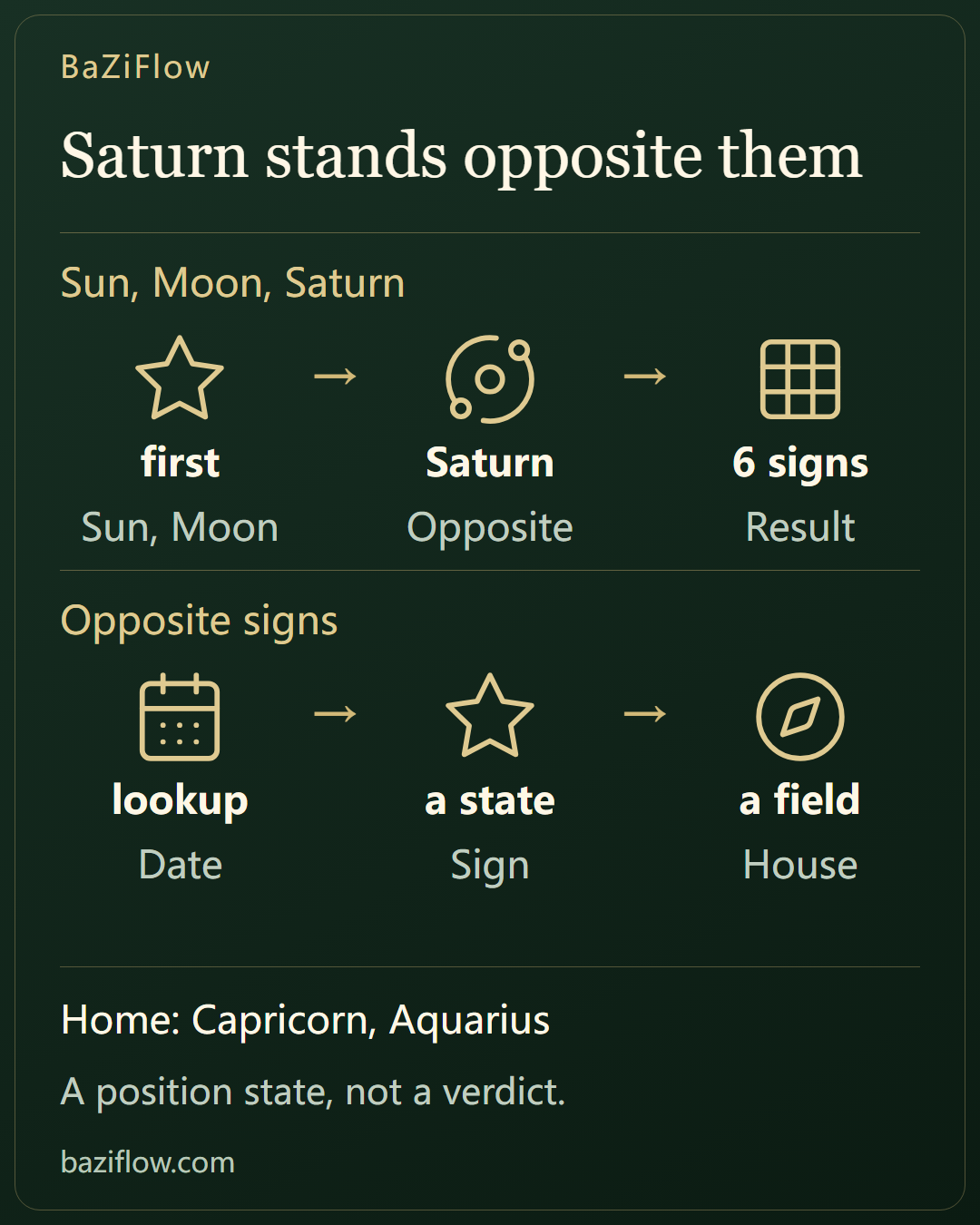
Saturn: domicile in Capricorn and Aquarius, exaltation in Libra, detriment in Cancer and Leo, fall in Aries, each facing a Sun or Moon record. Ptolemy's opposition logic, 2025-26 crossing dates and Lilly's houses.
The short version7 min read
Put the Sun, Moon and Saturn records in one table and all six of Saturn's signs fall opposite a luminary record, a pattern Ptolemy built on purpose.
- Domicile is Capricorn and Aquarius, exaltation Libra, detriment Cancer and Leo, fall Aries; each one is 180 degrees from a record of the Sun or the Moon.
- Ptolemy gives Saturn's cold to the daytime so that the day's heat offsets it: a cold planet is put into the hottest part of the cycle.
- In 2025-26 Saturn moves back and forth between Aries and Pisces, so within one year some days read fall and others read no entry.
Read first
Personal, Social and Outer Planets: Use Groups as a Directory ↗
Every Saturn record faces a Sun or Moon record
In plain words first: lay the Sun, Moon and Saturn records side by side in one table and all six of Saturn's signs stand opposite a luminary record.
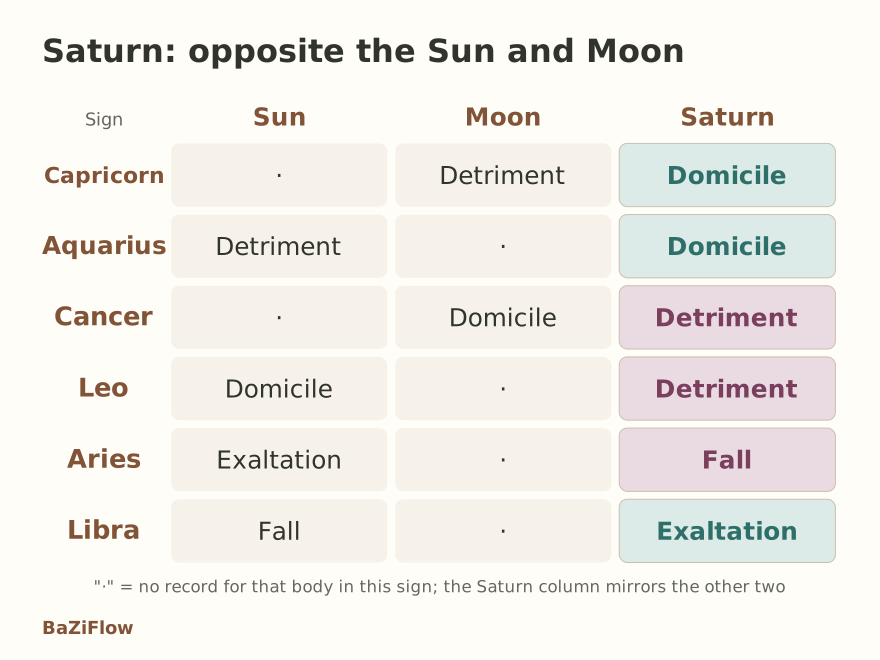
Mirror table: in each row Saturn's record faces a Sun or Moon record; the other six signs have no Saturn record on the site table.
Read a row from left to right. Leo is the Sun's home and Saturn is in detriment there; Cancer is the Moon's home and Saturn is in detriment again. Capricorn and Aquarius are the signs facing those two, where the Moon and the Sun are themselves in detriment, and Saturn is in domicile in both. Aries is where the Sun is exalted and Saturn falls; Libra is where the Sun falls and Saturn is exalted. All six rows pair up like this.
Ptolemy's two oppositions
The first is in I.17, where the homes are assigned. Saturn has the farthest orbit, is cold and at odds with heat, and sits farthest from the two luminaries, so it takes the two signs facing their homes: Aquarius and Capricorn. The second is in I.19, where the exaltations are assigned. When the Sun enters Aries the days begin to lengthen and warmth rises; Saturn has to stand at the opposite point, so its exaltation goes to Libra and its fall to Aries.
To keep its place opposite the Sun, in its home and in its exaltation alike, Saturn is exalted in Libra and falls in Aries. As heat grows, cold must shrink; as cold grows, heat must shrink.
Draw the three opposite pairs on a ring and the whole table appears:
Enlarge diagram · scroll sideways to read
Three chords, six signs: at one end a Sun or Moon position, at the other a Saturn position. Reading "Saturn obstructs the Sun" out of that would be the reader's own addition; the table gives only the pairing.
Why a malefic sits in the daytime
I.5 sorts the seven planets by heat, cold, dryness and moisture. Warm and moist nourish things, so Jupiter and Venus are benefics; cold and dry waste them, so Saturn, from too much cold, and Mars, from too much dryness, are the malefics. Yet when I.7 divides day and night, Ptolemy does not place these two with their own kind:
A benefit grows when like meets like, and a harm shrinks when unlike is mixed in. So the cold of Saturn is given to the day to offset its heat, and the dryness of Mars to the night to offset its moisture.
Enlarge diagram · scroll sideways to read
So the day-night assignment in Ptolemy works as a counterweight, with no gathering of like with like. The site's four-state table has no day-night column; this matters only when reading the original book or when someone discusses day charts and night charts.
Fall in Aries, down to the day: 2025 to 2028
Saturn circles the zodiac in about 29.45 years (JPL's sidereal orbital period) and stays in a sign for a little over two years up to nearly three. Aries in 2025-26 is worth a close look:
Enlarge diagram · scroll sideways to read
A July 1, 2025 birth puts Saturn in Aries, in fall; December 1 of the same year puts it in Pisces, with no entry; March 1, 2026 brings it back to Aries. Three dates a few months apart read "fall, none, fall".
A different angle comes from 2020: Saturn entered Aquarius on March 22, went back to Capricorn on July 1 and re-entered Aquarius on December 17. Both signs are domicile, so the sign state never changed, but the whole-sign house number changes with the sign. Near a border, a birth date touches the house more directly than the sign state.
Houses: four entries in Lilly
With whole-sign houses Saturn's house is counted: start from the sign of the Ascendant, which is house one. Saturn in Libra with a Capricorn Ascendant is in the tenth house; Saturn in Aries with a Libra Ascendant is in the seventh.
Lilly's 1647 entries give each house its matters first and then name the sign and planet that suit it by nature, a pairing he calls cosignificators. Four of the entries that bring in Saturn:
Enlarge diagram · scroll sideways to read
The first-house reasoning is easy to follow: it is the first house, Aries the first sign, and Saturn the first of the planets, so the three point to it together. The fourth house concerns the father, and Lilly writes that the Sun signifies him by day and Saturn by night. The eighth is co-signified by Scorpio and Saturn. The twelfth is the house where Saturn rejoices.
The sign table and the house table still each keep to their own business: the sign of the twelfth is Pisces, where Saturn has no record, while Lilly says elsewhere, in his chapter on the planets, that Saturn rejoices in the sign Aquarius, a statement about a sign, not about a house.
Four terms that get mixed up
Four terms
- Opposite sign
- The sign 180 degrees away. Saturn's detriment and fall sit on the opposites of its home and exaltation signs.
- Cosignificator
- Lilly's word for the sign and planet that naturally fit a house; a house can carry one sign and one planet.
- Joy
- Lilly's word for the one house in which each classical planet rejoices; Saturn's is the twelfth. It speaks of a house; Lilly says elsewhere that Saturn rejoices in the sign Aquarius, which is a statement about a sign and a separate matter.
- Day or night
- Ptolemy assigns Saturn to the day. The site's four-state table has no such column, so it matters only when reading the original book.
Two exercises
Saturn in Libra with a Capricorn Ascendant: which house, and what sign state?
The tenth house; Libra is Saturn's exaltation and also the Sun's fall.
Saturn on March 1, 2026: which sign, and what does the table call it?
Aries, fall; in the opposite sign, Libra, Saturn is exalted and the Sun is in fall.
The previous planet is Jupiter and the next is Uranus. How a return to the birth position is counted is in the position conditions of a Saturn return; the Aries end of this pairing is told in Aries and the Capricorn end in Capricorn.
Questions readers ask next
Saturn is in Aries in my chart. Does that mean everything gets blocked?
The table holds only a position state called fall: the Sun is exalted in Aries, and by the logic of opposition Saturn is placed on the facing side. What that means in a particular life is something the table cannot say; the house, the aspects and any house Saturn rules have to carry that.
Why does Ptolemy give cold Saturn to the day?
The idea is to offset an excess: cold Saturn is paired with the day's heat and dry Mars with the night's moisture, so each is moderated. The day-night assignment is a counterweight, with no thought of like gathering with like.
Does a Saturn return connect to this table?
Not directly. A return is Saturn coming back to its birth longitude, while this table is about its state in one sign, and the two should be written separately. The position conditions of a return have their own article.
Was this article helpful?
Sources & references
- Ptolemy, Tetrabiblos Book I (F. E. Robbins text on LacusCurtius): houses, triangles, exaltations ↗
- William Lilly, Christian Astrology (1647), Of the Twelve Houses, pp. 50–56 ↗
- NASA JPL Solar System Dynamics, Planetary Physical Parameters: sidereal orbital period ↗
- William Lilly, Christian Astrology (1647), Book I, Of the Planets (Saturn pp. 57–61, Jupiter pp. 61–65, Mars pp. 65–68, Sun pp. 69–71, Venus pp. 72–75, Mercury pp. 76–79, Moon p. 80ff; Cazimi p. 113) ↗
Continue reading
Jupiter in the Signs and Houses: Six Signs on Record and Four Houses Lilly Names ↗
Uranus by Sign and House: Why the Dignity Cell Is Blank, How One Sign Reaches Many Houses ↗