

Weakening: the seventh cell and three uses of the word
Content version · · Sources & references
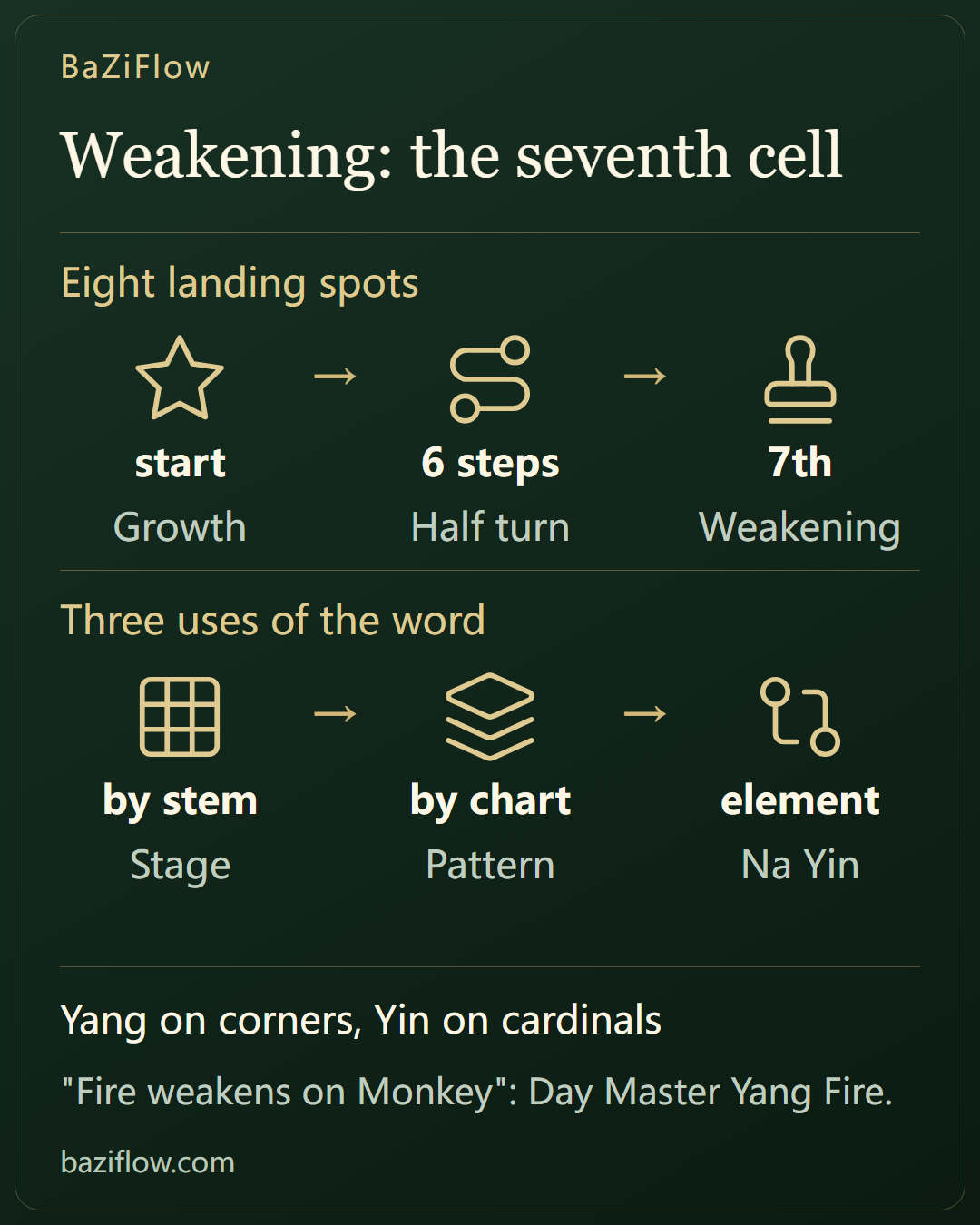
Weakening is the seventh cell of the twelve life stages, directly across from Growth. An eight-spot table, a lookup from the Yuanhai Ziping and a three-way comparison separate the stage, the pattern flaw and Na Yin.
The short version8 min read
Weakening is the seventh cell of the twelve life stages, half a circle after Growth: Yang stems land on Tiger, Snake, Monkey and Pig, Yin stems on Rat, Rabbit, Horse and Rooster, while two other uses of the same word in old books look up different tables.
- Count Growth as 1 and keep going in the stem's own direction to 7: that is Weakening, exactly half a circle, so it always sits across from Growth.
- The Yuanhai Ziping gives a worked case: Day Master Yang Fire over the branches Monkey, Rooster, Monkey, Monkey, with the author writing "Fire is at Weakening on Monkey, at Death on Rooster", which matches the site table exactly.
- The word has at least three tables behind it: the life stage, the flaw in a chart pattern and the Na Yin "self-weakening", looking up the Day Master, the whole chart and the Na Yin element respectively.
Read first
Twelve Life Stages and Void Branches: Two Tables, Two References ↗
Strong and weak Day Masters: references, relationship directions and evidence ↗
Weakening: the seventh cell, half a circle past Growth
Peak is the summit, Decline is the first step down, and one step further is Weakening (病). It is the seventh cell of the twelve life stages: count Growth (长生) as 1, Bath 2, Coming of Age 3, Establishment 4, Peak 5, Decline 6, Weakening 7.
The Sanming Tiyao (三命提要), as the Sanming Tonghui (三命通会) quotes it, gives this cell one of its two shortest entries (the other is Death):
Weakening: all things fall ill, as a person falls ill.
That is all the entry says: at this cell things have fallen ill, as a person does. The name is an image, and the position is fixed by the counting rule: Yang stems count forward through the branches and Yin stems count backward.
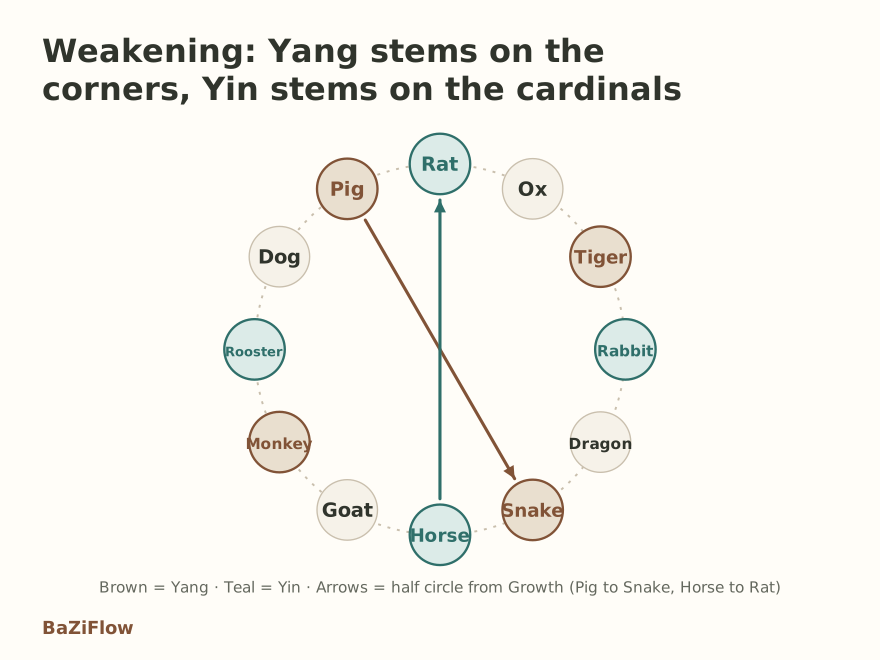
Position sketch: the positions come from the site engine's twelve-stage table; Yang Fire and Yang Earth share Monkey, Yin Fire and Yin Earth share Rabbit; the two arrows are examples of the half circle from Growth.
Eight landing spots: Yang stems on the corners, Yin stems on the cardinals
There are ten Day Masters but only eight landing spots for Weakening, because in the site engine's layout Earth follows Fire: Yang Earth lands with Yang Fire on Monkey, and Yin Earth with Yin Fire on Rabbit.
Enlarge diagram · scroll sideways to read
After Growth, each step moves to a new branch, and six steps later you arrive at Weakening. Half a circle keeps a corner branch (Tiger, Snake, Monkey, Pig) a corner branch and a cardinal branch (Rat, Rabbit, Horse, Rooster) a cardinal branch, only on the opposite side. So Yang stems, born on the corners, also weaken on the corners (Yang Wood runs from Pig to Snake, Yang Metal from Snake to Pig), and Yin stems, born on the cardinals, weaken on the cardinals (Yin Wood runs from Horse to Rat, Yin Metal from Rat to Horse).
One branch means different stages to different Day Masters. Monkey is Weakening for Yang Fire and Yang Earth, Growth for Yang Water and Severance for Yang Wood. A stage name belongs to the pair "Day Master and branch", not to the branch alone.
Fire on Monkey and Rooster: one lookup in the Yuanhai Ziping
In its section on Direct Wealth, the Yuanhai Ziping (渊海子平) analyzes a chart whose four pillars are Geng Shen (庚申), Yi You (乙酉), Bing Shen (丙申) and Bing Shen again, with Yang Fire as the Day Master. The author uses the stage names directly:
The reason is that the Day Master is weak: Fire is at Weakening on Monkey and at Death on Rooster, so it has no qi.
Yang Fire is Fire. In the site's table Yang Fire is at Weakening on Monkey and at Death on Rooster, which matches the sentence exactly. Of the four branches Monkey appears three times and Rooster once, and both the day branch and the hour branch are Monkey. The author takes this as one ground for calling the Day Master qi-less, and then moves on to an argument about heavy wealth and a weak self.
Enlarge diagram · scroll sideways to read
One word, three tables
The word for Weakening (病) turns up in the books more than once, and each time the thing being looked up is different. Besides this cell of the twelve stages there are two common uses. The first is the flaw of a chart pattern. Among the short maxims in its notes on the Hurting Officer, the Yuanhai Ziping has this one:
If the four pillars carry a flaw, the flaw must be removed; if it is not removed, the chart does not take off.
The usual later reading is that the "flaw" is a character in the chart that obstructs its pattern, and the character that takes it out is the "remedy". The commentary on balance in the Di Tian Sui (滴天髓) says that if the flaw is removed from the pattern, wealth and salary follow together, which is the same thread. It examines the whole chart and has nothing to do with the branch the Day Master stands on.
Enlarge diagram · scroll sideways to read
The second is in Na Yin and gets its own section next.
Self-weakening in Na Yin: Bing Shen and Jia Yin
When it explains the imagery of the Na Yin names, juan 1 of the Sanming Tonghui twice uses "self-weakening": the pillar Bing Shen is "self-weakening fire" and Jia Yin is "self-weakening water". The phrase says that the Na Yin element of the pillar stands on its own Weakening cell. The Na Yin of Bing Shen is Fire at the Mountain Foot and that of Jia Yin is Water of the Great Stream.
Enlarge diagram · scroll sideways to read
In the first row both look-ups agree, because Yang Fire is itself Fire. In the second row they split: Yang Wood is Wood, and Wood on Tiger is Establishment, but the Na Yin of this pillar is Water, and Water on Tiger is Weakening. When the book says "self-weakening water", it looks up the Na Yin element, not Yang Wood.
The book's imagery for the two pairs follows the weak qi as well. It says of the fire pair Bing Shen and Ding You that their qi is faint and only lives once wood helps it; of the water pair Jia Yin and Yi Mao, that although they stand on Death and Weakening positions, earth cannot overcome them, because both characters of each pillar are wood and wood can restrain earth. The full readings are in Fire at the Mountain Foot and Water of the Great Stream. The book calls the partners Ding You and Yi Mao "self-dying", which is left for the next article, Death.
Finally, count it out once with Yin Water. It is a Yin stem, born on Rabbit, and counts backward to the seventh cell:
The Weakening of Yin Water is Rooster, the same as the last row of the table.
Questions readers ask next
Why do Yang stems weaken only on Tiger, Snake, Monkey and Pig, and Yin stems only on Rat, Rabbit, Horse and Rooster?
Weakening is the seventh cell after Growth, which means a half circle. Half a circle turns a corner branch into the opposite corner branch and a cardinal into the opposite cardinal. Yang stems are born on the corners, so they weaken on the corners; Yin stems are born on the cardinals, so they weaken on the cardinals.
If a book says "Fire is at Weakening on Monkey", does it mean Yin Fire?
Not necessarily. For Yang Fire, Monkey is exactly Weakening. Yin Fire weakens on Rabbit, and Monkey is only Bath for it. Old texts often count by element alone (the "four growths"), so check which stem the sentence is about before quoting it.
The pillar Bing Shen is called "self-weakening fire". Is that the same as Yang Fire being at Weakening on Monkey?
For that pillar both look-ups happen to agree, because Yang Fire is itself Fire. Take Jia Yin instead: its Na Yin is Water, which is at Weakening on Tiger, while Yang Wood on Tiger is Establishment. The book's "self-weakening" looks up the Na Yin element.
Was this article helpful?
Sources & references
Continue reading
Decline (衰): The Step After Peak, and Why All Ten Stems Land in a Storehouse ↗
Death (死): Ten Day Masters, and the Picture the Classics Attach to Each Position ↗
What is Na Yin in BaZi? Why Jia-Zi Gold in the Sea does not replace Yang Wood ↗