

Align changed data with original positions
Content version · · Sources & references
Encode the source diagram as 9, 7, 9, 6, 7, 6, align its four moving positions, and separate changed branch assignments from the original movement record.
The short version6 min read
Xu encoded as 9, 7, 9, 6, 7, 6 reverses only positions one, three, four and six to form Song. Changed Horse Fire occurs twice, but it returns to different original branches at three and four. Retain indices and the primary palace alongside each assignment.
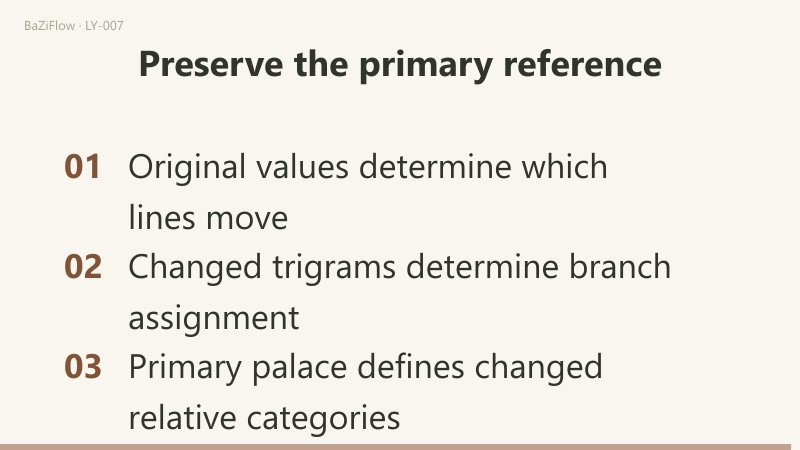
- Original movement selects the reversed positions; different labels in a complete changed chart do not make still positions two and five move.
- Changed trigrams supply the new branch assignments, while this record retains Xu’s Kun-Earth palace for the relative categories.
- Horse Fire generates original Dragon Earth at three but controls original Monkey Metal at four, so each returning relation needs its own endpoints.
Read first
A moving line and its changed counterpart are not the same entry
A moving line belongs to the original casting record. Its changed counterpart is the result assigned at that same position after the relevant trigram changes. The changed hexagram is the complete six-line structure produced by reversing all the specified moving lines. Keeping these three meanings separate prevents every row in a changed chart from being mistaken for a fresh moving line.
We use the Xu-to-Song diagram in Zengshan Buyi's Movement and Change chapter as an assembly exercise. It is not a personal reading. The numerical sequence below is a teaching encoding of that diagram, not a claim that the source recorded six modern coin throws.
Moving line
- Original position
Changed data
- Same-position counterpart
- Whole figure: hexagram
Encode the original states and reverse four positions
Count from the bottom and assign the values 9, 7, 9, 6, 7, 6. Here 9 represents moving yang, 6 moving yin, and 7 still yang. The lower three original lines are solid; the upper three are broken, solid, broken. That is lower Qian and upper Kan: Xu, Water over Heaven.
| Upward line | Assigned value | Original state | After change |
|---|---|---|---|
| 1 | 9 | Moving yang | Yin |
| 2 | 7 | Still yang | Yang |
| 3 | 9 | Moving yang | Yin |
| 4 | 6 | Moving yin | Yang |
| 5 | 7 | Still yang | Yang |
| 6 | 6 | Moving yin | Yang |
Only positions 1, 3, 4, and 6 reverse. The resulting lower trigram is Kan and the upper is Qian, giving Song, Heaven over Water. The corresponding Zhouyi chapters identify Xu as Qian below Kan and Song as Kan below Qian, providing a separate structural check.
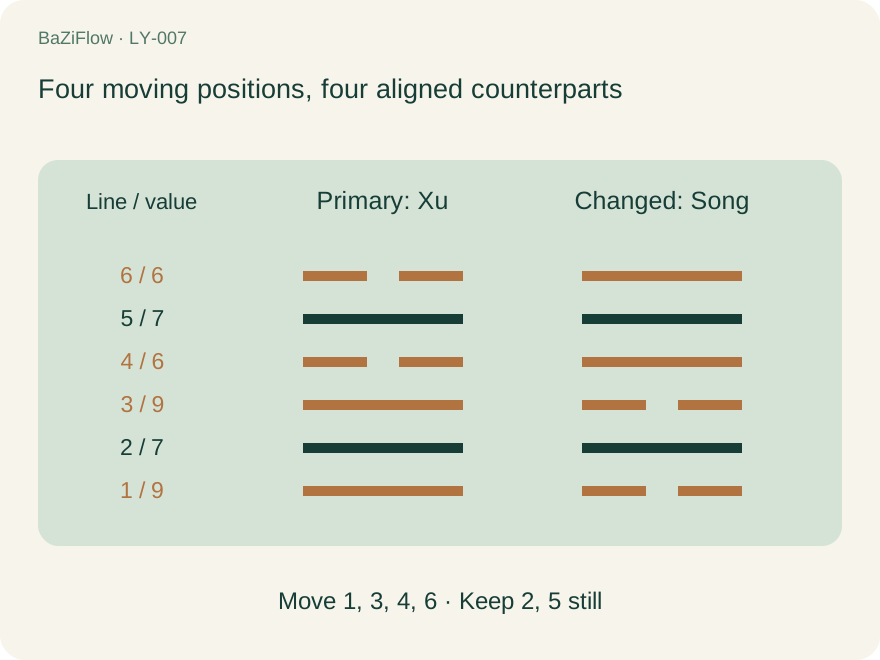
Original BaZiFlow line audit, using a teaching encoding of the source diagram rather than an invented personal casting record.
Both trigram names change, yet lines 2 and 5 stay yang. A whole trigram receiving a new name does not make all three of its original lines moving. For the underlying value convention, see recording six coin results.
Xu
Song
Xu 111010 changes only one, three, four and six into Song 010111; two and five stay yang.
Reassign branches without inventing extra movement
The primary Xu has Rat (子), Tiger (寅), Dragon (辰) in lower Qian and Monkey (申), Dog (戌), Rat in upper Kan. The complete Song structure has Tiger, Dragon, Horse (午) in lower Kan and Horse, Monkey, Dog in upper Qian. A full display of the changed structure can therefore show different branch labels even at a position whose original yin–yang state did not reverse.
For this casting pattern, the four moving-position pairs are line 1 Rat Water to Tiger Wood, line 3 Dragon Earth to Horse Fire, line 4 Monkey Metal to Horse Fire, and line 6 Rat Water to Dog Earth. Keep those pairs aligned by position. The other two rows of a complete changed chart do not acquire original movement merely because their branch labels differ.
This is also why changing only a solid or broken mark while leaving every branch annotation untouched is insufficient. Branch assignment follows the lower and upper trigrams after change. Movement, however, still comes from the original record. A table should identify whether its right column displays the entire changed structure or only counterparts at moving positions.
Original position 2
- Tiger Wood
- 7: still yang
Complete changed chart
- Dragon Earth
- Yang retained
Keep the primary palace as the relative-category reference
Xu belongs to the Kun Earth palace. The Movement and Change chapter specifies that relative categories for changed entries still follow the primary hexagram. In this Xu-to-Song record, changed Tiger Wood controls Earth and is Officials/Ghosts; changed Horse Fire generates Earth and is Parents; changed Dog Earth matches Earth and is Siblings.
If Song were assembled as an independent primary hexagram, it would belong to the Li Fire palace. That separate lookup is not permission to replace Earth with Fire halfway through this record. The hexagram's independent classification and the reference used for changed entries answer different questions.
The two changed Horse Fire entries at lines 3 and 4 also remain two distinct positions. Sharing a branch does not merge their provenance or their original counterparts. Review Najia and relative categories if the palace reference is unclear before proceeding to a relational judgment.
Xu transformation
- Primary Earth reference
Independent Song
- Fire reference
A returning relation must name its original counterpart
Under the rule stated in Zengshan Buyi's chapter on movement, change, generation, control, clash, and combination, a changed line acts on its own original moving position rather than freely acting on every other line. At position 4, changed Horse Fire controls original Monkey Metal: a returning-control relation. At position 3, changed Horse Fire generates original Dragon Earth: returning generation. The same changed branch therefore has a different relation to the two different original branches.
At position 6, changed Dog Earth controls original Rat Water, another returning-control relation. These checks identify relationships within the stated method. They do not make a single returning-generation label a guarantee of success or returning control proof of a harmful event.
That chapter separately discusses month and day effects on changed lines. The same-position restriction should not be misread as a claim that changed lines have no calendar conditions. If another tradition uses a different interaction scope, name it explicitly instead of silently changing rules during the example.
Hidden movement discussed through day effects is another layer. It does not authorize turning an originally still 7 into a recorded 9 and rebuilding the changed hexagram from altered data. See month and day conditions for the conditional distinction.
An audit of this example can stay concrete: four original moving positions, two unchanged yin–yang positions, lower Kan and upper Qian after reversal, four aligned changed-branch pairs, and the original Earth-palace reference for their relative categories. The diagram and the written pairs should agree on all of these. No question, date, or complete outcome analysis has been supplied, so the exercise ends at a verified transformation record.
Position 3
Position 4
Questions readers ask next
Can a different branch label in row two prove that it moved?
No. A complete changed chart reassigns branches from its resulting trigrams, so annotation text can differ even when a line remains yang. Original movement is a separate field tied to the recorded operation, not to string differences between columns.
Can the two changed Horse Fire entries be merged?
Their shared phase can be described together, but their position records cannot be collapsed. One returns to Dragon Earth and the other to Monkey Metal, producing different relations. Removing either provenance loses information needed for the comparison.
Why not copy the relatives from an independent Song chart?
Independent Song uses the Li-Fire palace. This transformation record instead describes changed entries relative to primary Xu’s Earth palace. Copying the independent column would switch the reference halfway through the record; identify the task before choosing the reference.
Was this article helpful?
Part of a learning path
Sources & references
Continue reading
Month and day effects: preserve the evidence behind strength ↗
Return generation and control: direction before interpretation ↗