

Separate textual location from Najia assignment
Content version · · Sources & references
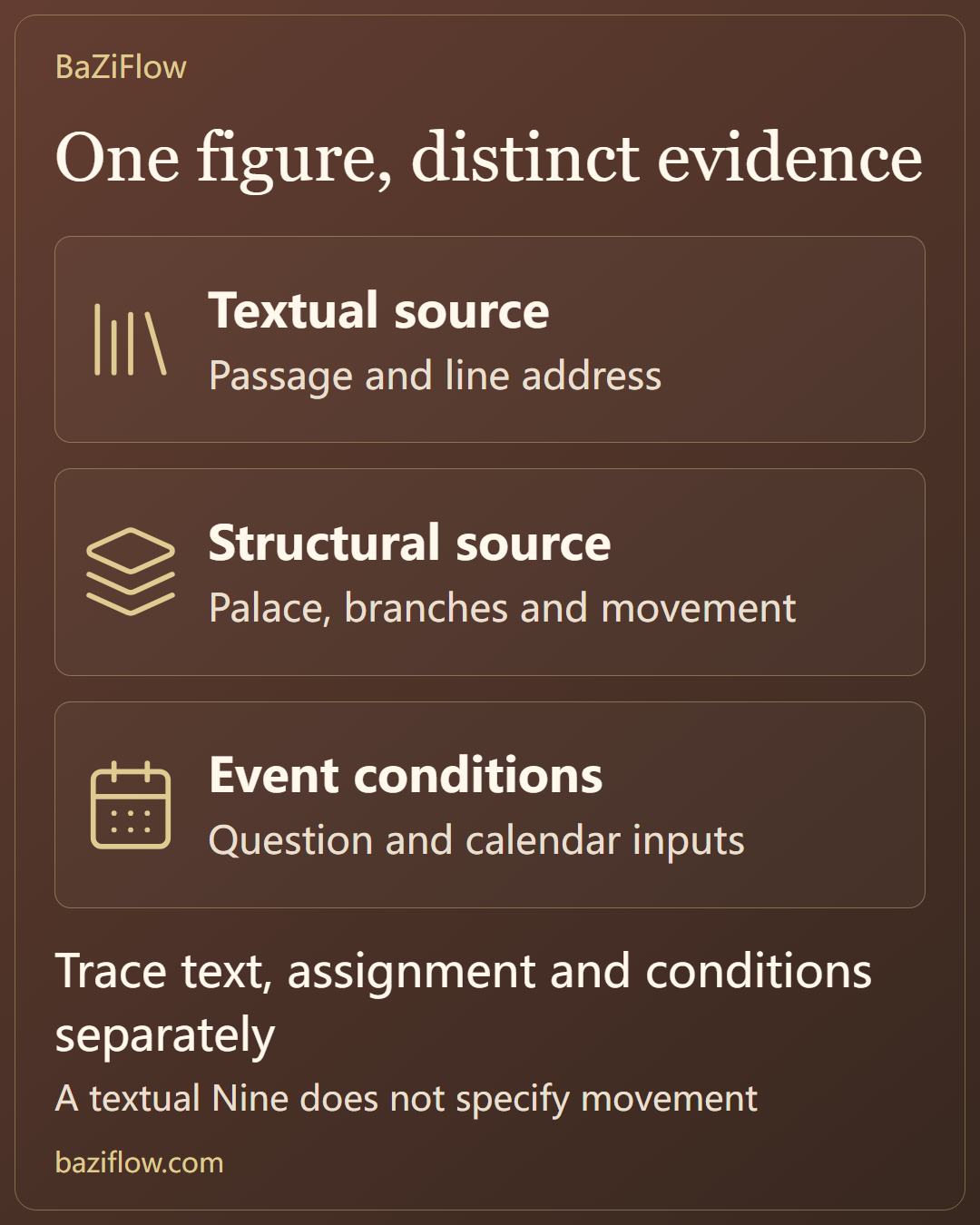
Distinguish canonical line names from casting values, then compare Jie’s First Nine passage with its Water-palace assignments and a local return-generation relation.
The short version6 min read
Jie’s First and Second Nine both describe not going out yet differ in judgment. Nine names a yang line, not an automatically moving input. With first-line movement separately supplied, Najia traces Snake Fire Wealth at Self to Tiger Wood Offspring and their generating relation.
- Identify the hexagram statement, line statement, commentaries and modern explanation separately instead of merging shared keywords.
- Textual Nine and Six names do not supply the actual casting values or movement positions.
- Snake Fire and Tiger Wood can be checked against original palace Water, while event and calendar conditions remain separate inputs.
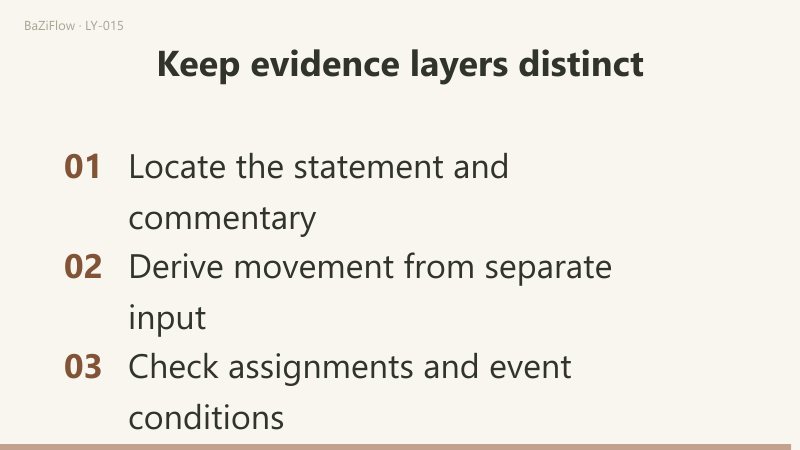
Read first
Najia, Six Relatives, and Six Spirits: three chart layers ↗
Moving lines and changed counterparts: auditing Xu to Song ↗
“First Nine” does not say that a coin throw produced nine
In the received Zhouyi, yang lines are named with nine and yin lines with six. Jie has a First Nine, a Second Nine, and a Fifth Nine. Those textual names do not establish that all three were moving yang lines in a particular casting. Actual movement requires casting information or an explicitly supplied teaching assumption.
This distinction opens a larger one: reading hexagram and line texts, and interpreting a chart through a named Najia Liuyao method, use related structures but different kinds of evidence. Neither can silently supply data missing from the other.
Textual names
- First / Second / Fifth Nine
Still record
- 7 7 8 8 7 8
- No movement
Two nearby passages resist a keyword reading
The first line of Jie associates staying within the inner courtyard with no blame. The second describes not going beyond the gate courtyard and gives an unfavorable judgment. Their shared image of not going out therefore cannot be reduced to a universal instruction to stay home.
The accompanying Image passages distinguish recognizing passage and obstruction from missing the appropriate time. A textual reading should keep the line position, the wording, and the commentary visible. It may discuss restraint and timely action, but that discussion is not proof that a particular person must remain indoors today.
Also distinguish the hexagram statement from individual line statements and from the Tuan and Xiang commentaries. Calling all of them “the hexagram text” in a loose sense may be convenient, but a precise citation should identify the actual layer. A modern interpretation is another layer again. This article demonstrates that distinction rather than claiming to settle every historical commentary dispute.
First Nine
- No blame
- Passage / obstruction
Second Nine
- Unfavorable
- Missed timing
Specify the structural example before comparing methods
For the following exercise, explicitly stipulate Jie with its first line moving. Jie is Water over Lake: Kan above Dui. Changing that first yang line to yin makes the lower trigram Kan, producing doubled Kan. The first line moves because the exercise supplies that condition, not because its canonical name contains the word Nine.
The companion article on recording cases reconstructs this change from a saved number sequence. Here the focus is the evidence used after the structure has been fixed. No calendar or real-world question has been supplied, so the comparison will not end with a prediction.
Announced procedure
Textual reading
- Question to settle
- Which passage and context?
- Record
- Chosen text before outcome
Najia reading
- Question to settle
- Which assignments and conditions?
- Record
- Chart and stated rule
Combination
- Question to settle
- What if they differ?
- Record
- Conflict rule chosen in advance
Najia supplies assignments, not a translation of the courtyard
In the Eight Palace diagrams of Zengshan Buyi, Jie belongs to the Water palace. Its first line is Snake (巳) Fire, classified as Wealth, and it occupies Self. At the corresponding position in the changed Kan structure is Tiger (寅) Wood. Keeping the original palace Water as the relation reference gives Offspring to Wood, because Water generates Wood; Snake Fire is Wealth because Water controls Fire.
| Layer | Evidence being inspected | Limit of the exercise |
|---|---|---|
| Textual reading | Jie’s first-line wording and its Image passage | Not a guarantee about a specific event |
| Najia structure | Self at Snake Fire Wealth, changing to Tiger Wood Offspring | Assignments and a local relation can be checked |
| Event judgment | Target, calendar, and relevant conditions | Not supplied here |
Wood generates Fire, so the changed Tiger Wood has the form of return generation toward the original Snake Fire at the same position. Zengshan Buyi's movement chapter treats the changed line's action on its own original position and also recognizes calendar influences. The local relation is therefore an item to examine, not a complete verdict that money must arrive.
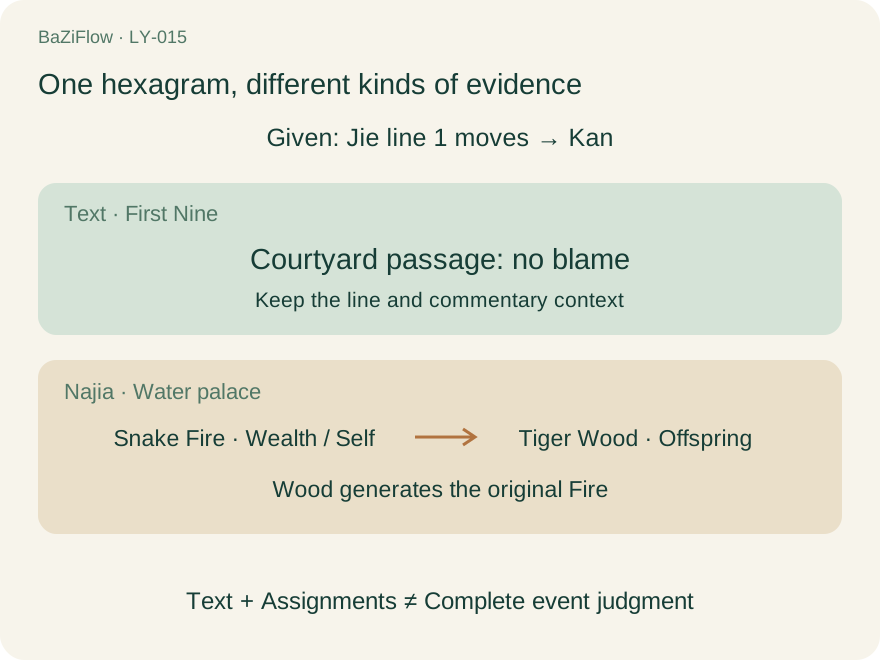
Original BaZiFlow comparison. The passage and the Najia assignments have separate sources; neither completes an event judgment here.
Wealth is not a translation of “courtyard,” and Tiger Wood was not extracted from a word in the passage. Branch assignment, relation class, and Self position each have their own derivation. Keeping them separate prevents an ordinary textual image from becoming fabricated chart data. See return generation and return control for the direction of the relation.
Same position; primary palace Water retained
Combining readings requires an announced procedure
This is not a claim that textual study and Najia are sealed traditions that never interact. An author may consult line wording, imagery, and phase relations together. The important question is how those materials are used, and which claims they are allowed to support.
If a concrete event is being judged through Najia, preserve the inputs that the chosen method requires. A resonant line statement cannot replace an absent month or day. Conversely, a reading intended to explore the canonical passage need not force every image into a literal family member or item of property.
When two layers seem to point in different directions, first ask whether they address the same event under the same conditions. A passage about restraint and a calculation showing generation do not automatically express opposing predictions. If a genuine conflict remains, report it and explain the priority convention used. Do not select whichever layer makes the desired answer easiest.
Let the reader trace each claim to its source
A clear explanation can state where the original wording is found, what interpretation is offered, how the chart was assigned, which relation was calculated, and which conditions remain unknown. These steps need not carry the same degree of certainty.
The nearby First and Second Nine passages warn against keyword extraction; the Snake-to-Tiger example warns against using a hexagram name as a complete chart judgment. A bounded event still needs to be specified, as discussed in question types and scope. Naming the method and preserving its evidence is more informative than blending every vocabulary into one confident sentence.
Questions readers ask next
Why does only one line move when Jie has three Nine names?
Those names identify yang positions in the received text. First-line movement is a separate input stipulated by the exercise. Inferring three movements from textual names would combine two kinds of information into a casting record that was never supplied.
Is Snake Fire Wealth a phase translation of courtyard?
No. Snake comes from the lower Dui branch assignment, Wealth from palace Water controlling Fire, and Self from the figure’s positional classification. Those derivations are distinct from translating an image in a line statement.
What if the two readings appear to disagree?
Check whether they address the same event, period and conditions. A passage about action and a local generating relation may not yet be comparable propositions. If a conflict remains, state the priority convention and preserve what is unresolved.
Was this article helpful?
Sources & references
Continue reading
Return generation and control: direction before interpretation ↗
Recording Liuyao cases: separate inputs, claims, and outcomes ↗