

Sui: thunder within the lake, following and tying
Content version · · Sources & references
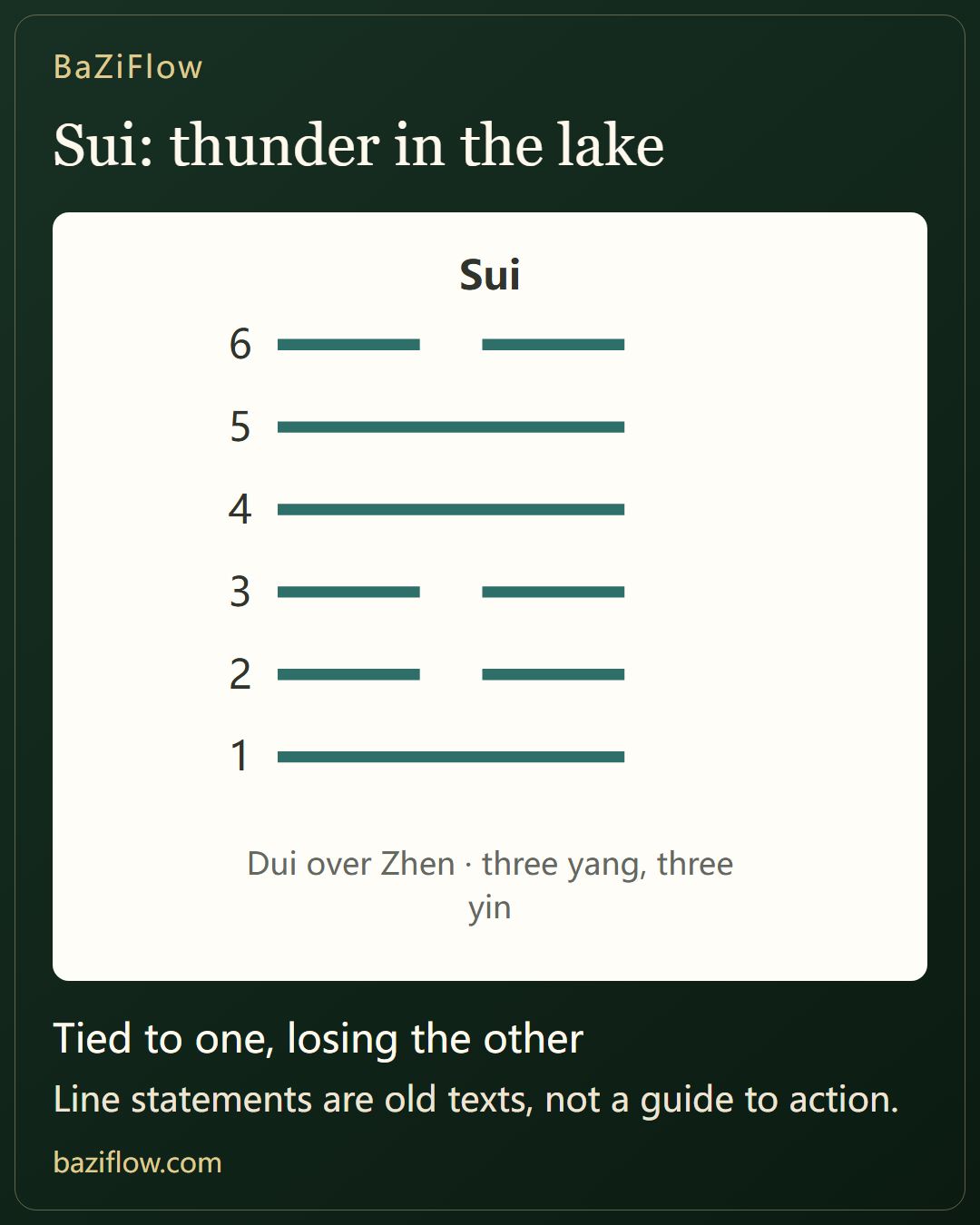
Sui is the 17th hexagram: thunder below a lake, three yang lines and three yin. Lines two and three mirror each other, the verbs grow heavier up to "held and bound", and the Great Image says only: at dusk, go in to rest.
The short version7 min read
Sui means following, but its statements turn it into a choice: lines two and three swap their words, and the verbs grow heavier from "go out" to "hold and bind".
- Sui (隨) is Dui (lake) over Zhen (thunder). The Shuo Gua calls Zhen "moving" and Dui "delighting", and the Commentary joins them as "moving and delighting". Its inverse and its reversed form are the same hexagram, Gu.
- The judgment "yuan heng; li zhen; no fault" is quoted in the Commentary as "great success through staying right, no fault", followed by a new clause: the world follows the time.
- Lines two and three mirror each other, with Small Image comments "cannot have both" and "his aim lets go of what is below". Line four holds both a bad sign and a question about fault.
Read first
The Sixty-Four Hexagrams: How Upper and Lower Trigrams Form One Figure ↗
Judgment and Line Statements: Whole Hexagram or Single Line? ↗
Thunder within the lake: Zhen below, Dui above
Sui (隨) is the 17th hexagram: Zhen (thunder) below, Dui (lake) above, and its Image is "within the lake there is thunder". Three of its lines are yang and three are yin, with the yang lines in places one, four and five. The name literally means to follow, to go along with.
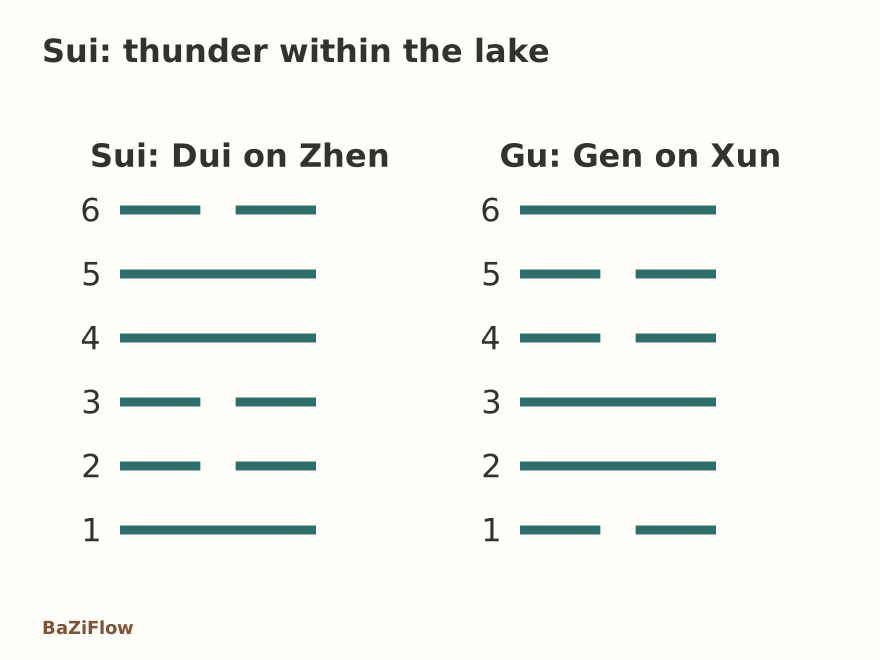
Sui and Gu: Gu is both the inverse and the reversed form of Sui.
Enlarge diagram · scroll sideways to read
Three terms to start with
- Zhen and Dui
- In the Shuo Gua, Zhen is "moving" and Dui is "delighting". The Commentary joins the two in one phrase: moving and delighting.
- Sui
- In the text it is not only following a person. The last clause of the Commentary says "the world follows the time", so what is followed can also be a moment.
- To tie
- A verb that keeps coming back in the statements: to bind, to fasten. Line two, line three and the top line all use it.
Moving below and delighting above: the push is at the bottom and the pleasant side is on top, and the Commentary on the Judgments (彖传) says the two together are Sui.
The judgment and the Commentary: the same words, said another way
The judgment of Sui is "yuan heng; li zhen; no fault". The first four words are the same as the judgment of Qian (乾), and "no fault" comes after them. The Commentary does not simply copy it.
Sui: the firm comes and goes beneath the soft; moving and delighting: this is Sui. Great success through staying right, no fault; and the world follows the time. The meaning of following the time is great indeed!
Enlarge diagram · scroll sideways to read
The most direct reading of "the firm comes and goes beneath the soft" is in the figure: the first line is a yang (firm) line sitting below the two yin (soft) lines, lines two and three. Now look at the quotation. The judgment's "yuan heng; li zhen" becomes "great success through staying right": the first word is replaced by "great", "li" does not appear, and success and rightness are joined. "No fault" is unchanged, and a new clause follows it: the world follows the time.
The Great Image: dusk comes, go in and rest
Next to many other hexagrams, the Great Image (大象) of Sui is a surprise: it says nothing of achievement or travel.
Within the lake there is thunder: Sui. The noble person, as dusk draws near, goes in to rest at ease.
Enlarge diagram · scroll sideways to read
The first phrase means drawing toward dusk, the second means to rest in comfort. The Great Image has the noble person go indoors to rest as the sky darkens, with no going out and no acting. Read together with the Commentary's last clause about following the time, one possible reading is that what is followed this time is time itself. That is one reading; the text supplies only the two halves.
The six statements: from "go out the gate" to "held and bound"
In the six statements, lines two and three are a pair of sentences that swap their words, and the verbs in the upper lines grow heavier.
Enlarge diagram · scroll sideways to read
Line 1: "The office has a change; staying right brings good fortune. Going out the gate to mix with others brings merit." The first word is usually read as an office or post and the sense of the clause is disputed. "Going out the gate to mix" is to step outside and mix with others, and the Small Image (小象) says "he does not lose it". Line 2: "Tied to the youngster, he loses the grown man." Line 3: "Tied to the grown man, he loses the youngster." The wording is identical apart from the swap, and line 3 adds "in following, what is sought is gained; abide in what is right". The Small Image gives one comment to each: "he cannot have both", and "his aim lets go of what is below".
Line 4: "Following brings a catch; staying on course is ill. Sincere on the way, through clear sight, what fault could there be?" Line 5: "Sincerity toward the excellent: good fortune", with "the place is correct and central". Line 6: "Held and bound; then followed and tied. The king makes an offering on the Western Mountain." The first word is to seize and fetter, the second is a rope. So from "go out the gate" to "tied" to "held and bound … tied", the verbs grow heavier. The Small Image has three words: "the top has run out".
Gu and Jian: the neighbors of Sui, and the Xu Gua
The relation between Sui and Gu is unusual. Change every line of Sui and you get Gu; turn Sui over and you also get Gu. So Gu is both the inverse and the reversed form of Sui.
Enlarge diagram · scroll sideways to read
The reason is that the pairs of lines taken from the two ends, first and sixth, second and fifth, third and fourth, have opposite polarity in each pair, so reversing and swapping arrive at the same figure. The nuclear hexagram is Jian (漸), Gen below and Xun above. The Xu Gua sets Sui after Yu and adds that those who follow in delight are sure to have affairs, so the next is Gu, which it defines as "affairs".
Where there is Yu there must be following; therefore Sui comes next.
Questions readers ask next
Does Sui simply tell you to follow others?
The statements are less simple than that. Lines two and three say that tying yourself to one side loses the other, line four says "following brings a catch; staying on course is ill", and the Commentary puts the weight on following the time, so what is followed can be a moment as well as a person.
Who are the "youngster" and the "grown man"?
The text does not say. The Small Image of line three says "his aim lets go of what is below", which suggests the grown man is above and the youngster below, but that is an inference and should be marked as one.
Why are Sui's inverse and reversed form the same hexagram?
Its lines pair off from the ends, first with sixth, second with fifth, third with fourth, and each pair has opposite polarity. So turning the figure over and swapping every line give the same result, Gu.
Was this article helpful?
Sources & references
Continue reading
Yu: thunder out of the earth, and "moving in accord" from hexagram to sage ↗
Gu: wind beneath the mountain, and how to count "three days before and after" ↗
The Sixty-Four Hexagrams: How Upper and Lower Trigrams Form One Figure ↗
Judgment and Line Statements: Whole Hexagram or Single Line? ↗