

The trine (120°): conditions and orbs
Content version · · Sources & references
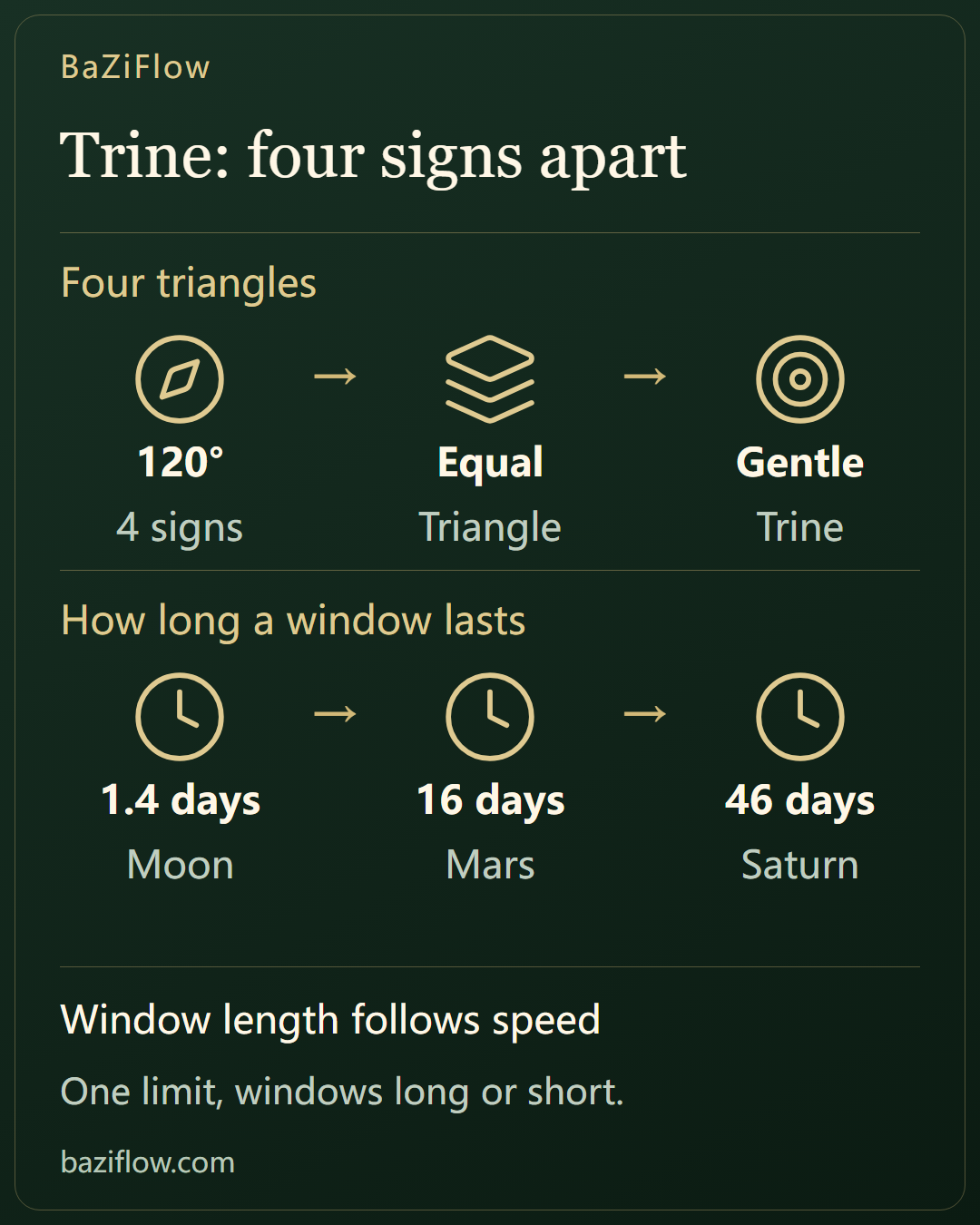
The trine is a longitude gap near 120°, four signs apart for Ptolemy. From his four triangles to cases where degrees disagree, and a window that lasts a day for the Moon but far longer for Jupiter.
The short version7 min read
The trine is two longitudes about 120° apart, four signs away, dividing the circle into four equilateral triangles. The orb is 8° with the Sun or Moon and 6° otherwise, but how long a window lasts depends on how fast the two bodies move relative to each other.
- Three signs four apart make an equilateral triangle, and Ptolemy sorts the twelve signs into four of them. The site's fire, earth, air and water are exactly those four sets.
- Signs of one triangle need not meet in degrees. On October 7, 2026 Jupiter in Leo and Saturn in Aries, both in one triangle, were 129.66° apart, no trine.
- One window lasts a day or so for the Moon and 46 days for Jupiter and Saturn in 2026, and their trine passed through three windows with three exact hits.
Read first
Aspects and orbs in astrology: how to calculate the angle between two planets ↗
Four signs apart make a triangle: Ptolemy splits the circle into four equilateral triangles
In plain words first: the trine is two thirds of a half-circle, 120°, four signs. In Ptolemy's drawing, cut the diameter in thirds and the position two parts along is the trine.
In his chapter on the triplicities (Book I chapter 18, XXI in Ashmand's numbering) he goes on: the three signs of one trine form an equilateral triangle, the whole zodiac is defined by the circle of the equinox and the two tropic circles, and the twelve signs are therefore shared among four equilateral triangles. The first is Aries, Leo and Sagittarius; the second Taurus, Virgo and Capricorn; the third Gemini, Libra and Aquarius; the fourth Cancer, Scorpio and Pisces.
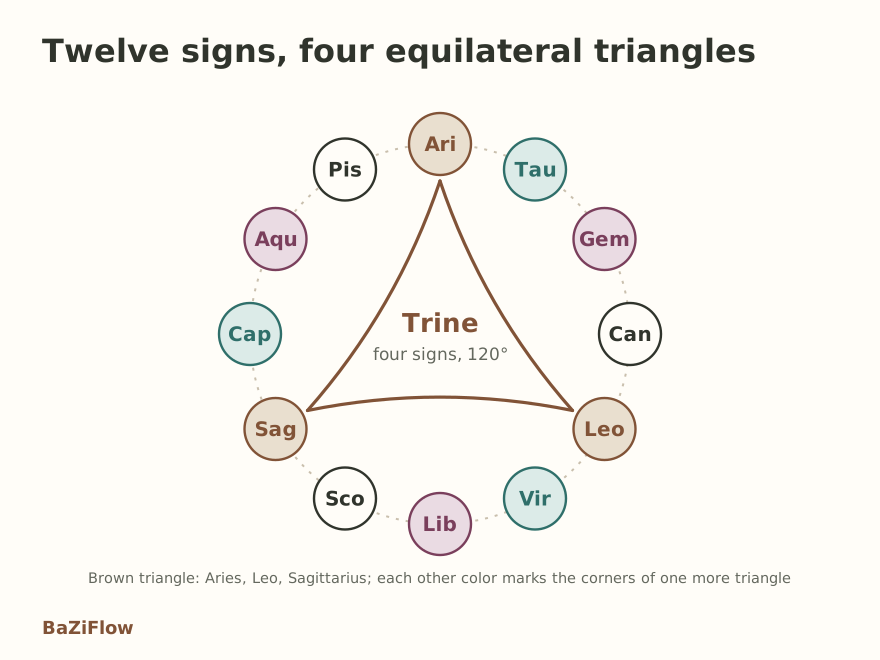
The triangle sets match the fire, earth, air and water of the site sign table; arcs join Aries, Leo and Sagittarius, and each other color marks one more triangle.
The site's sign table names the four sets fire, earth, air and water. Ptolemy in this chapter divides them by masculine and feminine and uses no element names, but the grouping is the same. From any sign, each jump of four lands on the next corner of the same triangle, and three jumps return to the start.
Two bodies in one triangle may not meet in degrees
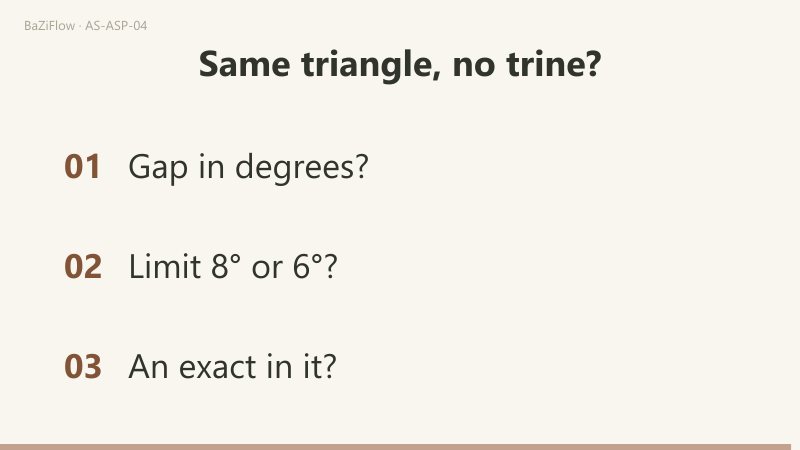
By counting signs, sharing a triangle is a trine. By measuring degrees the two rulers often disagree.
Enlarge diagram · scroll sideways to read
On October 7 Jupiter stood at 20°43′ Leo and Saturn at 11°03′ Aries, both in the fire triangle, a trine by count; the gap of 129.66° is 9.66° off 120°, past 6°. In the other direction, on September 22 the Sun stood at 29°30′ Virgo and Pluto at 3°11′ Aquarius, five signs apart, one earth and one air, yet 123.69° apart, only 3.69° off and inside the 8° that applies when the Sun is involved. The site calls that a trine, with a tightness of 0.54.
One 6° window: a day for the Moon, over a year for Saturn
The width of a window is fixed: the two ends of the limit add up to 16° for an 8° limit and 12° for a 6° limit. How long it lasts depends on how fast the two bodies close or open. Below are four 2026 examples, times in UTC sampled hourly or every six hours, with the axis in days from the exact trine.
Enlarge diagram · scroll sideways to read
The Moon covers a dozen degrees or more a day, so the Sun-Moon window ran from 15:53 UTC on October 20 to 01:12 on October 22, a day and a bit; Sun and Jupiter from February 26 to March 13 and Mars and Jupiter from March 14 to 30 each lasted about sixteen days. Jupiter and Saturn ran from August 8 to September 23, 46 days, with the exact trine at 22:05 UTC on August 31.
That is only one window of that pair, though. Taken together, Jupiter and Saturn have three trine windows:
Enlarge diagram · scroll sideways to read
Where "harmonious" comes from: three signs of one gender, one on each circle
In the chapter on the aspects of the signs (Book I chapter 13), Ptolemy says the trine and sextile are "harmonious" because they join signs of one kind, all masculine or all feminine, while the opposition and quartile join signs of a different kind (the chapter defines "same kind" as all feminine or all masculine). The three signs of a triangle share a gender, and the triangles chapter adds that the three lie near three different circles, the equinox, the summer tropic and the winter tropic, one each.
Enlarge diagram · scroll sideways to read
The site's aspect table keeps labels of this sort, but only as display classes: trine and sextile are tagged "harmonious", conjunction and semi-sextile "neutral", square, opposition and quincunx "tense". Whether a trine holds is a matter of degrees alone, and the engine never checks which triangle either planet's sign belongs to.
Work one through: Mars and Jupiter on March 22, 2026
One last reading runs the whole chain. At 12:00 UTC on March 22, 2026 Mars stood at 15°40′ Pisces and Jupiter at 15°17′ Cancer, both in the water triangle and at nearly the same degree.
Enlarge diagram · scroll sideways to read
A deviation of 0.38° against a limit of 6° gives a tightness of 1 − 0.38 ÷ 6, about 0.94. Mars passed the exact point in the early hours of that day and at 12:00 stood on the far side, 0.38° from it.
When several planets all trine one another and draw a "grand trine", the way to read it inside the whole chart is in how aspect patterns fit back into the whole chart. Take 30° off the trine and you reach the square (90°); add 60° and you reach the opposition (180°).
Questions readers ask next
Does a trine only happen between signs of one element?
By counting signs, yes. The site measures degrees, so a deviation inside the limit is enough, and trines across elements do occur: on September 22, 2026 the Sun at 29°30′ Virgo and Pluto at 3°11′ Aquarius were 123.69° apart.
Why can one Jupiter-Saturn trine become exact several times?
Both bodies turn retrograde, so the direction of their approach flips and the longitude gap crosses 120° more than once: at 22:05 UTC on August 31, 2026, and again on April 3 and July 11, 2027.
Once the window opens, is an exact trine certain?
No. From late September 2025 to early January 2026 Jupiter and Saturn came no nearer than 0.16° during the whole window and never reached exactly 120°.
Was this article helpful?
Sources & references
Continue reading
The Square (90°): Signs Three Apart Form a Cross, and the Quarter Moon Is One ↗
Opposition (180°): Why the Orb Has Only One Side, From a Full Moon to Sun-Saturn ↗
Conjunction, opposition and square aspects: measure the angle before judging good or bad ↗