

Laozi and Zhuangzi: not one voice
Content version · · Sources & references
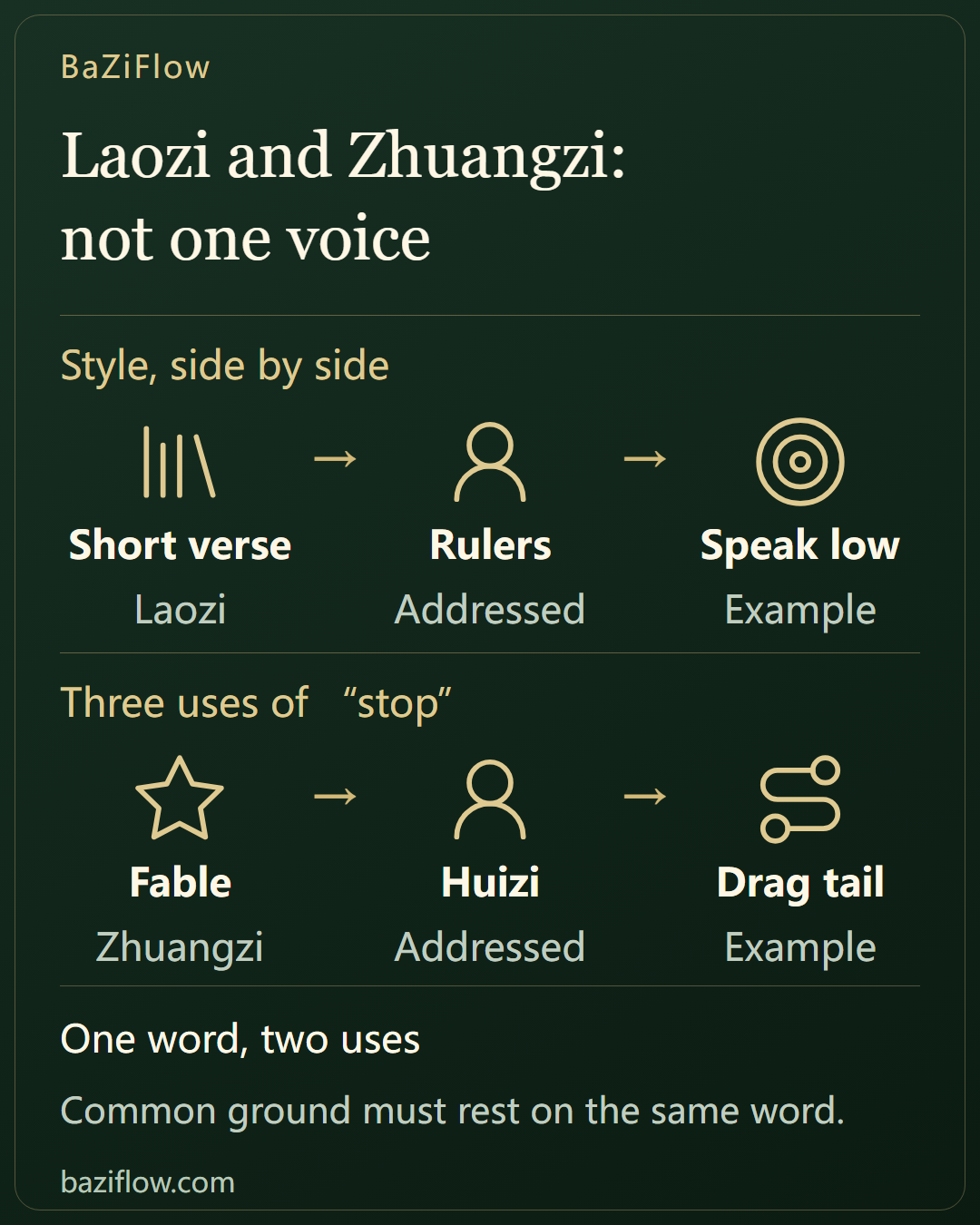
The Laozi and the Zhuangzi are both called Daoist yet write and use words differently. A style table, whom each addresses, three shared words and three uses of know-when-to-stop show how to read them together.
The short version7 min read
The Laozi and the Zhuangzi are often named together, yet they write and use words differently: one is short verse spoken to sages and rulers, the other fable and dialogue with Huizi and the River God in the room.
- The Laozi is eighty-one short chapters, mostly spoken to sages and rulers; the Zhuangzi is fable, dialogue and debate, with named figures such as Huizi and the River God present.
- Non-action occurs 12 times in ten chapters of the Laozi but only twice in the five Zhuangzi pieces read here; “of itself so” appears in five chapters of the Laozi and once in those pieces, with another sense.
- The same two words for knowing when to stop halt at the limits of name and desire in the Laozi, at what one does not know in “Equalizing Things”, and in the senses in “Nourishing Life”. Reading them together means resting on the same word and keeping each use.
Read first
Dao and De in the Laozi: Reading Chapters 1, 21, 25, 38 and 51 ↗
The Zhuangzi: Inner, Outer and Miscellaneous Chapters, Mapped ↗
Laozi Editions: Chapter Order and Wording in the Received Text, Silk and Bamboo ↗
First, what the two books look like
Set the Laozi and the Zhuangzi side by side and what you see first is not a doctrine but a manner of writing. The received Laozi has eighty-one chapters and about five thousand characters; each chapter is short, the phrasing even, and many chapters rhyme. The received Zhuangzi has thirty-three pieces of uneven length, with fable, dialogue and argument woven together.
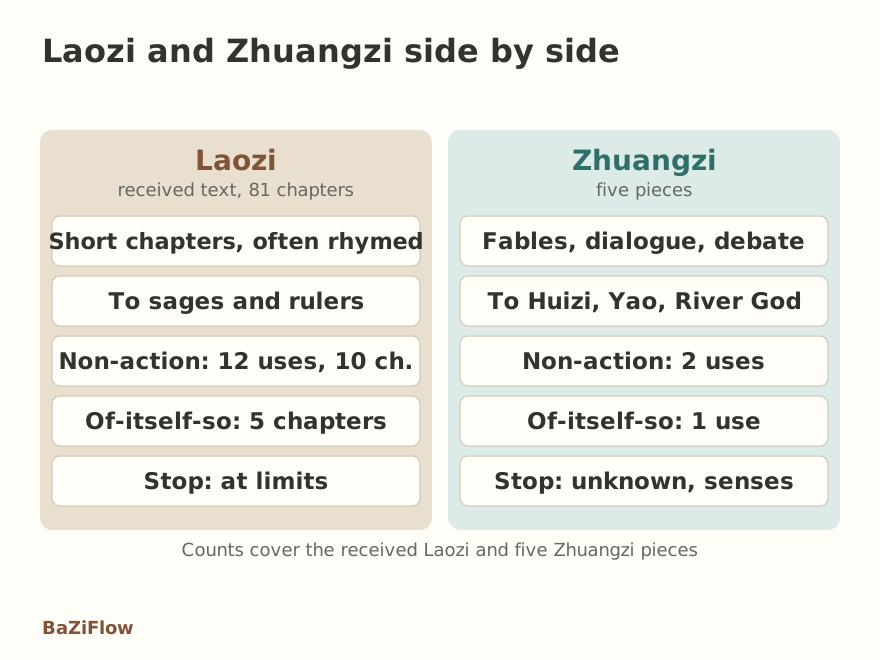
Sketch of the comparison. The counts come from the received Laozi and five Zhuangzi pieces and do not stand for the whole Zhuangzi.
The figure sets the two books side by side on five points: genre, whom each addresses, and the use of “non-action”, “of itself so” and “knowing where to stop”. The Zhuangzi counts cover only five pieces, “Free and Easy Wandering”, “Equalizing Things”, “Nourishing Life”, “Autumn Floods” and “All Under Heaven”, and the conclusions go no further.
Enlarge diagram · scroll sideways to read
Great completion seems lacking, and its use never wears out. Great fullness seems empty, and its use is never exhausted. Great straightness seems bent, and its use has no fixed place.
Zhuangzi said: “The minnows swim out at their ease; that is a fish’s joy.” Huizi said: “You are not a fish. How do you know a fish’s joy?” Zhuangzi said: “You are not me. How do you know I do not know a fish’s joy?”
The first passage is a run of even statements with no one speaking and no one answering. The second is two named people arguing, each question returned to the asker. The same word weighs differently in a statement and in an argument, and that is the first thing to keep in mind when reading the two books together.
Whom each book speaks to
In the received Laozi the word for sage appears in 26 chapters and “all under heaven” in 33; rulers (侯王) appear in chapters 32, 37 and 39, and the subject is often how to govern and how to live. In the five Zhuangzi pieces Huizi (惠子) appears nine times in three pieces, and Yao (尧) nine times in four; the subject is more often how to see and how to live.
Enlarge diagram · scroll sideways to read
Three scenes
Words for a ruler
“To put himself above the people, he must speak from below; to stand before them, he must keep behind.”
Yao offers the world; Xu You declines
Yao offers the world to Xu You (许由), who answers: “Go home, my lord. I have no use for the world.”
Dragging the tail in the mud
The king of Chu sends for Zhuangzi to take office. He answers with a sacred turtle and says: “I will drag my tail in the mud.” He would rather be alive.
Two kinds of listener bring two kinds of question. To a ruler the question is what to do; to Huizi it is often “how do you know?”
The same words, used differently
Dao, non-action and “of itself so” are words both books use, and they weigh differently in each.
Enlarge diagram · scroll sideways to read
Three words, two weights
- The Way (道)
- The Laozi treats the Way as the thing to be asked about, “born before heaven and earth” and able to be “mother of all under heaven”; see the Way and Virtue. In the five Zhuangzi pieces the word shows up more in the angle from which things are seen: “the Way joins them as one”, “looked at by the Way, things have no high or low”, and Cook Ding says that what he loves is the Way.
- Non-action (无为)
- It occurs 12 times in ten chapters of the Laozi, six of which also have a sage or a ruler, as in “I do not act, and the people transform themselves” (chapter 57); see wu wei. The five Zhuangzi pieces have it twice: Huizi’s great tree in “Free and Easy Wandering”, beside which one may stroll “doing nothing”, and “All Under Heaven”, describing Lao Dan as one who “does nothing and laughs at cleverness”.
- Of itself so (自然)
- Five chapters of the Laozi use it (17, 23, 25, 51 and 64); see of itself so. In the five Zhuangzi pieces it appears once, in “Autumn Floods”: “Yao and Jie each being so in their own view and condemning each other”. Tradition reads it as each thinking himself right, a use inside a judgement.
Know when to stop: one phrase, three stops
One phrase shows the difference clearly: “know when to stop” (知止). It occurs in two chapters of the Laozi and twice in the five Zhuangzi pieces. The characters are identical, and the place where things stop is not.
Enlarge diagram · scroll sideways to read
Chapter 44 of the Laozi asks about name, body and goods, then says that one who knows contentment escapes disgrace and one who knows when to stop escapes peril; what stops is the chase after name and goods. In “Equalizing Things” the stop is placed on knowing itself: the speaker no longer goes toward what is unknown. In “Nourishing Life”, “the senses stop” means perception halts and the spirit takes over, and that is how Cook Ding carves.
“Do you know what all things agree is right?” “How would I know?” “Do you know what you do not know?” “How would I know?” “Then do things know nothing?” “How would I know?”
The Laozi also speaks of the limits of knowing, in “those who know do not speak, those who speak do not know” and “to know that one does not know is best”, and it writes them as statements. The Zhuangzi lets the questions chain until “knowing” and “not knowing” are themselves questioned: “How do I know that what I call knowing is not ignorance?”
What to keep when reading them together
The two books can be read together once it is clear where each line comes from and how it is used there.
Three columns for reading side by side
Can be set side by side
- Both ask about “name”: “name or body, which is dearer?” (Laozi, chapter 44) and “name is the guest of reality” (“Free and Easy Wandering”)
- Both write of the sage, in different ways
- Both use the words for knowing when to stop, with different stops
To avoid
- Taking counts from five pieces as the whole Zhuangzi
- Reading every “of itself so” in the Zhuangzi through the Laozi
- Using a Zhuangzi fable as a note to a Laozi chapter
- Stitching sentences from the two books into one person’s speech
What to do
- Sort by source: book, chapter or piece, and line
- List each concept by its use in its own text
- Rest the common ground on one word or one line
- Keep later pairings apart: “All Under Heaven” writes Guan Yin and Lao Dan, and Zhuang Zhou, as two schools
“All Under Heaven” writes Guan Yin and Lao Dan, and Zhuang Zhou, as two schools; in the original the names enter separately, and the passage is read closely in an introduction to Daoist thought. For where each piece sits in the Zhuangzi as a whole, see the structure of the Zhuangzi.
Questions readers ask next
Are Laozi and Zhuangzi the same kind of thought?
Both books sit under the Daoist name, but each has its own manner and vocabulary. The Laozi is short verse addressed to sages and rulers; the Zhuangzi is fable and dialogue, often with a rival such as Huizi. The “All Under Heaven” chapter itself writes Guan Yin and Lao Dan, and Zhuang Zhou, as two schools. What can be set side by side is a comparison on one word or one line; sentences from the two books cannot be stitched into one person’s position.
Does “of itself so” mean the same thing in both?
The word is the same and the use is not. Five chapters of the Laozi use it, mostly as a general name for things being so of themselves. In the five Zhuangzi pieces read here it occurs once, in “Autumn Floods”, in “Yao and Jie each being so in their own view and condemning each other”, which tradition reads as each thinking himself right. The two should not be swapped.
How can I draw on both books without confusing them?
Keep a column for each book, and give the book, the chapter or piece and the line, then the reading belonging to each. To compare, rest on one word or one line, such as the words for knowing when to stop. Put later pairings and modern summaries in a separate column.
Was this article helpful?
Part of a learning path
Daoist thought: from Laozi concepts to Zhuangzi fables · Step 10 of 10 available
Sources & references
Continue reading
Dao and De in the Laozi: Reading Chapters 1, 21, 25, 38 and 51 ↗
The Zhuangzi: Inner, Outer and Miscellaneous Chapters, Mapped ↗
Laozi Editions: Chapter Order and Wording in the Received Text, Silk and Bamboo ↗