

Read the calendar count
Content version · · Sources & references
Reconstruct two date-table entries ending in Lou, distinguish day numbers from advances, and keep weekday, date system and personal fields separate.
The short version6 min read
A Sukuyō calendar can place dates, daily mansions, weekdays and personal comparisons beside one another without using one common cycle. In the specified NAOJ month-start table, day one occupies the start and day fifteen needs fourteen advances. Month eight day fifteen and month nine day thirteen both reach Lou: the label alone cannot recover a date.
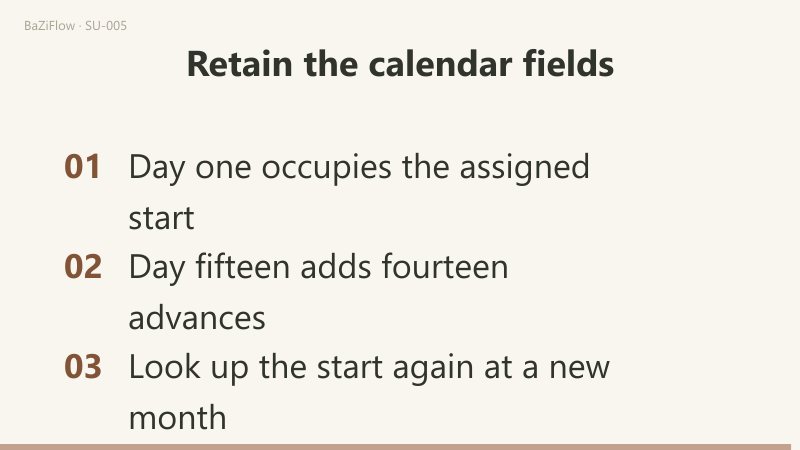
- For the specified 27-mansion table, first find the month start, then advance day number minus one; day fifteen needs fourteen moves.
- Month eight day fifteen and month nine day thirteen both reach Lou; even days one and twenty-eight of month eight share Jiao.
- Weekdays, daily mansions and personal positions have different inputs. A public date label does not include an unstated birth reference.
Read first
27 or 28 lunar mansions: what is the difference? ↗
Why Sukuyō Natal Mansion Methods Differ: Tell Lookup from Zoning, Then Check the Rule ↗
Turn a calendar entry into a reproducible note
Imagine copying a mansion name from a calendar and finding, months later, that you cannot reconstruct the lookup. The note says only “Lou”. It no longer identifies the date system, year, source table or whether a personal reference was involved. The label survived, but the calculation did not.
A better note preserves a small chain: the selected date as the calendar defines it, the table used, the month-start entry, the number of advances and the result. Keep any interpretation in a separate field. This approach makes a calendar readable without asking its traditional labels to stand in for missing date information.
Verify one lookup before interpreting the page
For this exercise, use the 27-mansion month-start table displayed by the National Astronomical Observatory of Japan. Its eighth month begins with Jiao and its ninth with Di. Follow the sequence without Niu and count the first day as the starting mansion, not as a move beyond it. No Gregorian year is being converted here.
| Date within the specified table | Start | Additional advances | Result |
|---|---|---|---|
| Month 8, day 15 | Jiao | 14 | Lou |
| Month 9, day 13 | Di | 12 | Lou |
The two rows end with the same label. That is not an error and does not make the dates interchangeable. It demonstrates why a mansion name alone cannot recover a unique date. It also does not imply matching weather, events or personal experiences on those two days.
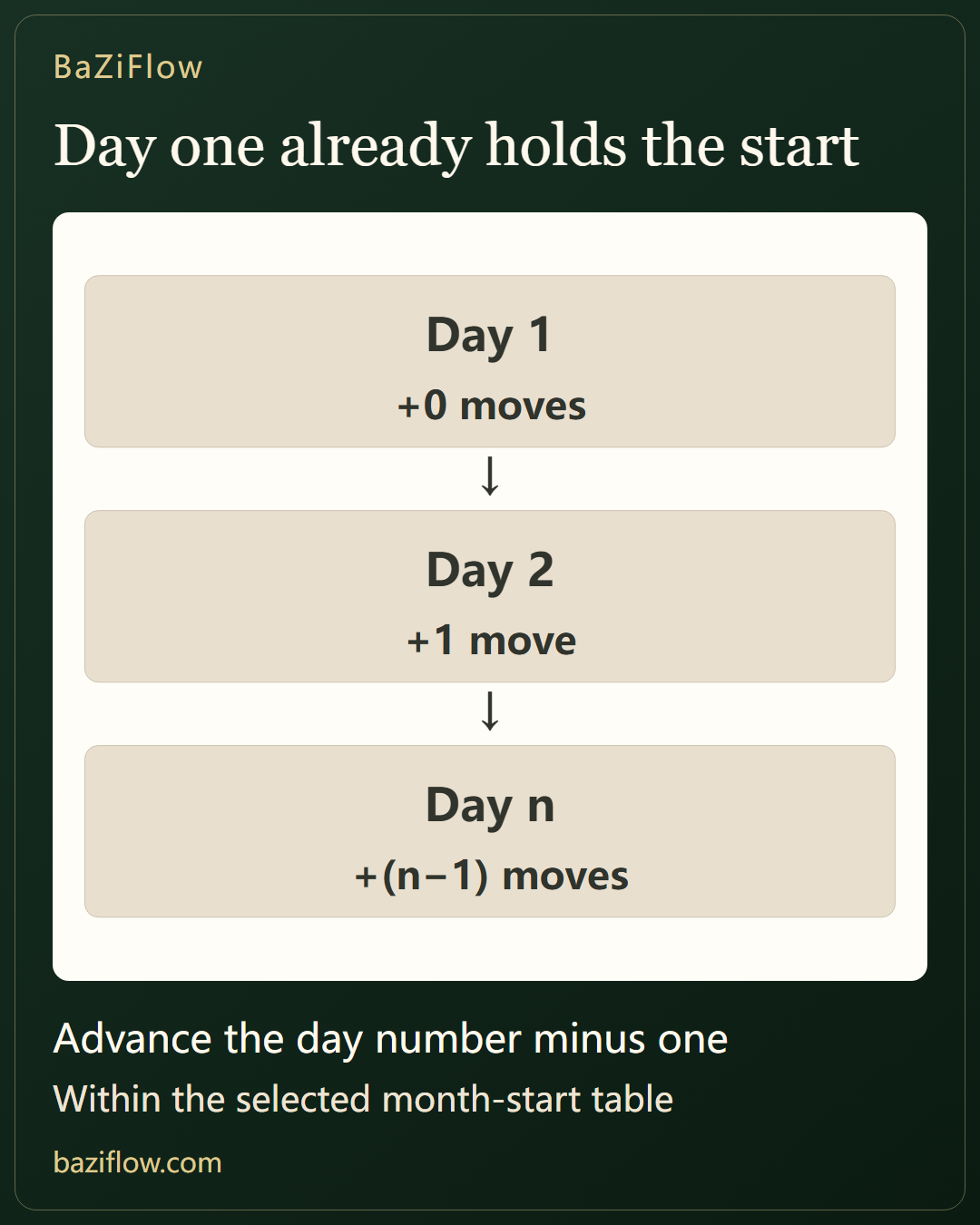
The count provides a useful implementation check. Day 1 already occupies the start, so day 15 requires fourteen further advances. Moving fifteen times would answer the next position instead. Once the table and convention are fixed, that extra step is a counting error rather than a difference of interpretive schools.
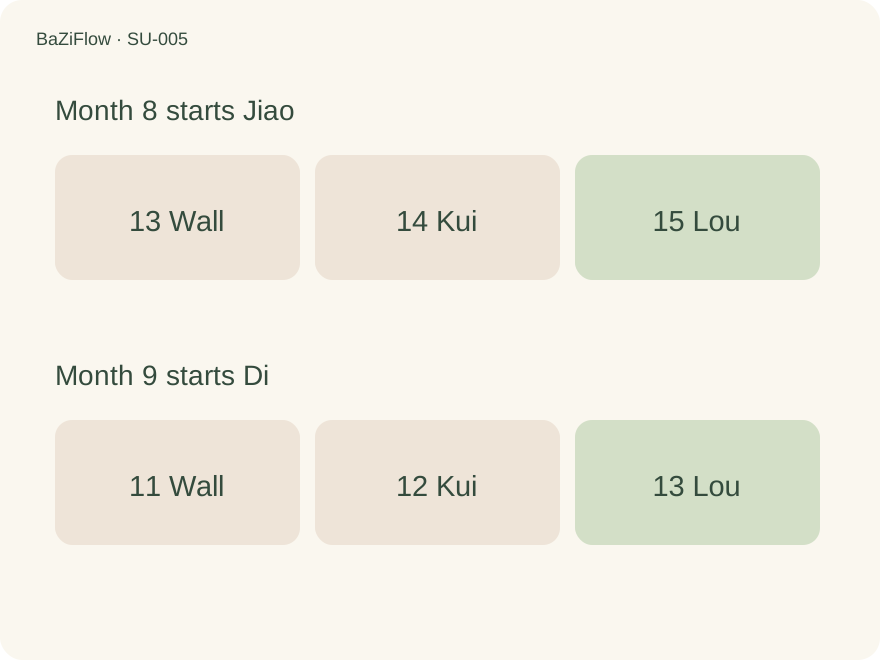
Original partial calendar strips using the specified table. Repeated labels do not identify the same date.
Only the final three entries of each run are shown: month 8 has Bi, Kui and Lou on days 13–15; month 9 has the same three labels on days 11–13. Here Bi (壁) names the Wall mansion, not the Net mansion Bi (畢). A transliteration without its source can introduce another ambiguity, so retain the original label when making your own records.
A second exercise stays within one month. Month eight starts at Jiao; day twenty-seven reaches Zhen, and day twenty-eight returns to Jiao. Twenty-seven day intervals complete the 27-name circuit. Day twenty-eight is not a newly added twenty-eighth mansion, and Niu has not re-entered the sequence.
Check the opening entries too: month eight day one Jiao, day two Kang, day three Di. If a transcription begins day one at Kang, it has advanced before assigning the start, and the following entries will also be shifted. At the next month’s first day, look up the ninth month’s Di assignment again; do not assume that the previous entry alone specifies the new month start.
Advances
- Day 1
- 0 moves
- Day 2
- 1 move
- Day 15
- 14 moves
A page can contain several clocks at once
The weekday, daily mansion, lunar phase and other calendar annotations need not share one counting system. Their placement in adjacent columns is a layout choice. A weekday belongs to a seven-day cycle; the example above uses a month-start table and day progression. One observed pairing between a weekday and a mansion does not establish a permanent correspondence.
The Sukuyō scripture itself distinguishes different arrangements. In the CBETA 2023.Q4 electronic T1299, the three-nine sequence begins at T21 p. 391a28, while the seven-luminary chapters (p. 391c06 and p. 398a27) describe a seven-day rotation. Consulting one book therefore still requires identifying which passage and which field you are using. A weekday name is not another spelling of a birth mansion.
A personalised relative-position field needs still more information: a person's birth reference and the date's target label. A printed calendar that never received anyone's birth data can supply its shared date labels, but it cannot silently personalise that comparison for each reader. For this distinction, see birth mansion and daily mansion.
Weekday
- Seven-day cycle
Daily mansion
- Month start + day
Personal position
- Birth + daily target
Do not translate month numbers into civil dates by instinct
“Month 8, day 15” in this example does not mean 15 August. Before applying an entry to an appointment or a birth record, identify the calendar and year and obtain the relevant conversion. If a page prints two date systems side by side, copy the column heading as well as the number. A bare “8/15” discards the distinction.
Leap-month handling also belongs in the source notes. The short month-start table used for our exercise does not alone document every policy a later calendar might apply. If a publication gives no rule for the input you need, record the gap. Do not silently select a policy and then attribute it to the publication.
Likewise, a cover saying “traditional” does not identify a particular edition or table. If two calendars disagree, compare their date conversions and declared month starts before diagnosing a printing error. Some disagreements involve different conventions; others can be simple transcription or counting mistakes. Calculation-method differences explains how to keep these possibilities separate.
Calendar A
- Its declared start table
Calendar B
- Its declared start table
Keep the completed task small and exact
The exercise can finish with this record: “Specified NAOJ table; month 8, day 15; Jiao at the start; fourteen advances; Lou. No conversion to a dated civil calendar and no personal comparison performed.” Every part can be checked against the stated inputs. It does not promise more than the lookup delivered.
Traditional auspiciousness notes can be studied alongside that record as cultural interpretations. They do not replace opening hours, booking confirmations or transport notices when organising an actual visit. Keeping practical information in its own field lets you read the calendar carefully without treating a symbolic label as a measurement of what will happen.
Questions readers ask next
Why does day fifteen require only fourteen advances?
Day one already occupies the assigned month start. The first advance reaches day two, so day fifteen is fourteen intervals away. With the table and order fixed, fifteen advances would select the next day’s position.
Can the mansion Lou identify the original date by itself?
No. Month eight day fifteen and month nine day thirteen both reach Lou in the specified table. Recovering a dated entry requires the calendar, year, month, day and table; a repeating result cannot uniquely identify them.
Why can day twenty-eight return to the first day’s mansion?
This example uses a 27-name sequence without Niu. Twenty-seven advances from day one reach day twenty-eight and complete one circuit. The dates remain different, and the next month still gets its own assigned start.
Was this article helpful?