

When readings conflict
Content version · · Sources & references
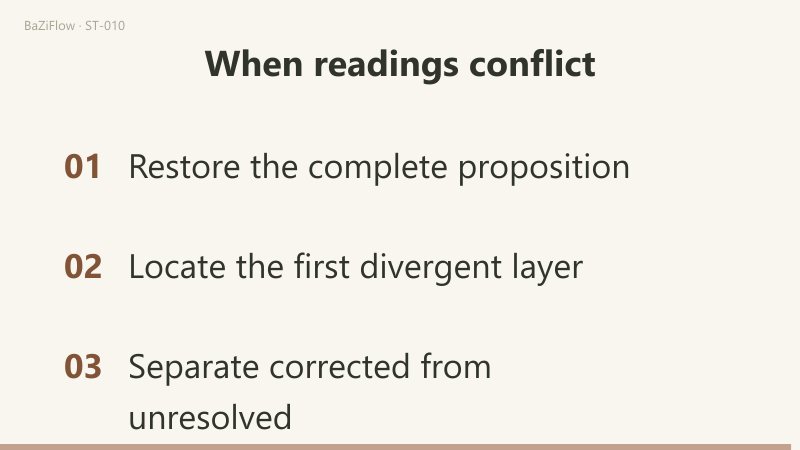
Treat a disagreement as a traceable comparison: align the subject and interval, then inspect inputs, rules, fields and interpretation before trying to reconcile the final sentence.
The short version6 min read
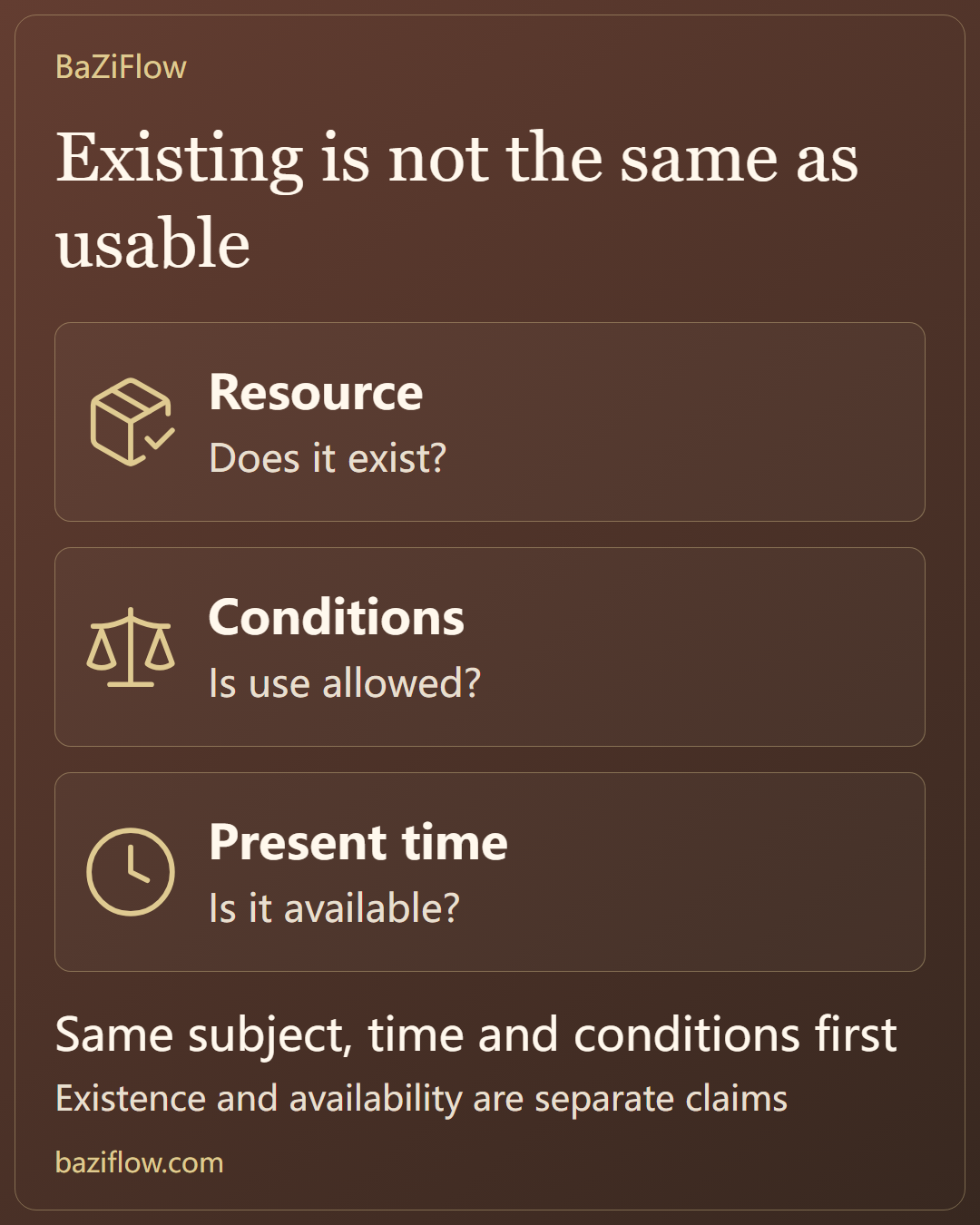
Resources may exist while being unavailable for use. A real conflict requires opposite answers about the same availability under the same conditions, not merely encouraging and discouraging words.
- A contradiction needs the same subject, interval, conditions and proposition.
- Inspect input, rule, field and interpretation in dependency order.
- A corrected field and an unresolved interpretation are different outcomes; preserve both labels.
Read first
Combination, clash and star in BaZi, Ziwei and astrology: different rules ↗
Freeze the comparison before changing anything
Keep both original outputs, their questions and their settings. If one reading is repeatedly regenerated while the other stays fixed, the comparison moves as you investigate it. You can lose the exact difference that prompted the question. A stable pair gives you something concrete to inspect and a record against which to judge a correction.
Next, write the alleged disagreement as a proposition. Identify whose situation it concerns, the time interval and the conditions. “Resources exist” and “resources cannot currently be used freely” are compatible statements. Only opposing claims about availability under the same conditions create the specific conflict that needs resolving.
This method of comparison is an editorial procedure used in this article, not a claim that every historical tradition employed the same diagnostic process. It also does not require deciding which tradition is generally superior before examining a particular discrepancy.
Resources exist
- Can be true
Free to use now
- Can still be false
Match the proposition before resolving it
- Apparent opposition
- Opposite words referring to different subjects, periods or claims.
- Actual disagreement
- Opposing answers to the same proposition under matched conditions.
Test one layer at a time
| Layer | Comparison to make | What a difference means |
|---|---|---|
| Input | Original records and question | The cases are not yet matched |
| Rule | Settings, version and position definitions | Different conventions may be operating |
| Field | Calculated values or recorded symbols | A bounded calculation or record check is needed |
| Interpretation | Reasons, scope and assumptions | The disagreement may be genuinely interpretive |
Follow that order because later claims depend on earlier choices. A date, location or subject mismatch is not repaired by a more sophisticated interpretation. Conversely, recalculating an unchanged field will not settle two authors' different judgments about it.
For a concrete technical example, the Swiss Ephemeris house interface takes a time, latitude, longitude and house-system parameter. If the house systems differ, the settings are not matched. If all relevant settings match but the values differ, inspect the calculation and data versions. The documentation establishes these dependencies; it does not establish that one interpretive use of a house system predicts personal outcomes better.
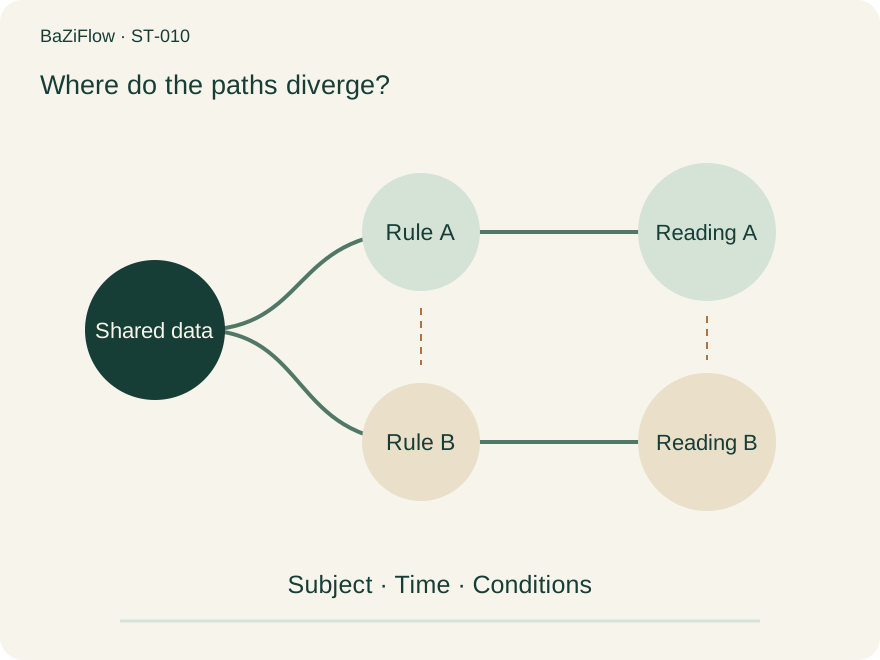
Original BaZiFlow comparison diagram; a branch marks a place to inspect, not a ranking of traditions.
The drawing keeps the paths separate after their common starting point. A divergence at the rule node requires a different response from one at the interpretation node. The subject, time and condition checks remain beside the paths because matching numbers is not enough if the resulting sentences concern different things.
Recover the context a summary may have removed
A one-word verdict can discard a conditional, a negation or the position that supplied its meaning. Compare the complete sentences rather than only their encouraging or discouraging tone. Also check whether a sentence describes the current subject, a partner, an earlier chart or a teaching example. A quotation about another case is not evidence about this one.
Part 3, section 7 of Waite's The Pictorial Key to the Tarot gives a useful historical illustration. In the position that crosses the querent’s card, Waite says that a favorable card means the opposing forces will not be serious, or else that something good in itself may not be productive of good in that particular connection. The point is contextual role, not a universal instruction to reverse every favorable card. Other spreads may define their positions differently, so preserve the version as well as the card name.
Timing context can produce a similar apparent conflict. A long phase and a short window need not answer the same proposition. Before labeling them opposites, compare their dates and objects. Luck Pillars, Ziwei decades and transits explains why those labels should not be treated as interchangeable clocks.
Conditional claim
- Context retained
- Only if permission is granted
- Lost in a verdict
- Can proceed
Other subject
- Context retained
- A comparison case
- Lost in a verdict
- Your situation
Decide whether the discrepancy is corrigible or unresolved
An input assigned to the wrong person, a mistaken offset or a lost negation is not merely a school difference. If the evidence establishes the error, correct the affected part and retain the reason for the change. Calling every mistake a difference of tradition prevents useful repairs.
After inputs, settings and fields are aligned, disagreement may remain. Ask each interpretation to identify its supporting rule, authorial judgment and unconfirmed real-world assumptions. Those are different kinds of support. Combining half of each account is not automatically an improvement; the combined account may retain both weaknesses while concealing their origins.
“There are opportunities and challenges” can be a perfectly ordinary sentence, but it does not resolve a conflict about whether a defined action is currently possible. If it replaces the disputed proposition without explaining it, the conflict has been hidden rather than answered. State which issue remains unsettled and what evidence, if any, could narrow it.
Confidence of tone is not a deciding test. Forceful wording can lack support, and cautious wording can be empty. The relevant question is whether the reasons actually connect to the present input under the stated conditions.
Established field error
- Keep the old value
- Correct dependent claims
Same field, different judgment
- List the reasons
- Retain unresolved issues
Preserve the result of the investigation
The final comparison can end in several honest states: different inputs, different conventions, a corrected field, or an unresolved interpretive disagreement. Do not give all of them the same label of passed or reconciled. A corrected number does not automatically validate every paragraph that surrounds it.
Keep the original version, the changed field and the explanations affected by that change. Unrelated material need not be rewritten. Remaining questions should remain visible. This makes it possible for a later reader to distinguish an established correction from a judgment that still needs support.
Locating the disagreement is more useful than asking an increasing number of readings to vote. Saving evidence and uncertainty provides the next step for keeping the comparison usable.
Restore the sentences
Write resources exist and resources cannot currently be used freely rather than good and bad.
Match the question
For a comparison of availability, retain the same resource, period and permission conditions.
Seek a discriminating fact
Check actual permission or restrictions. If evidence is missing, leave the issue open rather than averaging adjectives.
Questions readers ask next
Is existence incompatible with restricted use?
No. Existence and current availability are different propositions. Align the claim before judging a contradiction.
Will recalculation settle an unchanged-field dispute?
Repeating the same calculation adds no interpretive grounds. Compare rules, weighting and unresolved practical assumptions.
Does one corrected value validate the whole reading?
No. Preserve the old value and correction reason, update dependent portions, and retain unresolved judgments separately.
Was this article helpful?